1. Introduction
Ikat is a resist-dyeing technique applied to yarn. Bundles of warp or weft threads are bound tightly at measured intervals, dyed, untied and rebound for each further colour, and only then set on the loom, where the pattern appears as the cloth is woven. The slight shift of threads during weaving gives the motifs their feathered edge (Larsen, 1976). India has three well-known ikat traditions: the double-ikat silk patola of Gujarat (Bühler and Fischer, 1979), the cotton and silk ikats of the Telugu-speaking south, and the bandha of Odisha on the eastern seaboard (Mohanty and Krishna, 1974; Crill, 1998). This review concerns the last.
Handloom weaving is routinely described as a declining craft in need of rescue, and designers are routinely cast as the rescuers. Government schemes, non-governmental organisations, design schools and fashion labels have all sponsored projects in which a trained designer works with weavers on new products. The results are visible in boutiques and on runways. What they mean for the people at the loom is less often asked. This review considers how far the published literature supports the claim that collaboration between designers and artisans revives handloom ikat, and under what conditions.
2. Scope and Approach
The article is a narrative review of published books, journal articles, legislation and official reports. Three bodies of writing are brought together: textile scholarship on Indian ikat, historical and economic studies of the handloom sector, and anthropological and design writing on craft development. Scholarly work that deals specifically with collaboration in Odisha is thin, so findings from other Indian weaving regions are used where the conditions are comparable, and this is stated where it occurs. No formal search protocol was followed, and no fieldwork, interviews or case material were gathered for the review.
3. Ikat in Odisha: Technique, Places and People
The standard account of the Odisha tradition remains that of Mohanty and Krishna (1974), who documented tying, dyeing and weaving practice in detail. Two zones are usually distinguished. In the western districts around Sambalpur, Bargarh and Sonepur, weavers produce cotton and silk saris in weft and double ikat, including the chequered double-ikat field called pasapalli. In the coastal belt, the village of Nuapatna in Cuttack district is known for silk khandua, which includes cloths bearing verses of the Gita Govinda tied into the weft for use in the Jagannath temple at Puri. Odisha work is recognisable by its curvilinear drawing: because the yarn is tied in very small groups, weavers can render fish, conch shells, wheels, flowers and animals with soft, rounded outlines that set it apart from the geometric character of much other ikat (Desai, 1988; Crill, 1998; Gillow and Barnard, 2008).
The work is divided within the household and the community. Designing the layout, calculating the ties, binding, dyeing, warping and weaving are distinct tasks, and tying is often the most skilled and the slowest. The time embodied in a sari before the first pick is thrown is the central economic fact of the craft, since any change of design requires a new set of calculations and a fresh investment of unpaid preparation. Indian ikat also has a long commercial history. Patterned cloths from the subcontinent were traded across the Indian Ocean for centuries and shaped textile taste in Southeast Asia (Guy, 1998), a reminder that these weavers have always produced for distant buyers and have adapted to them.
4. The Decline Narrative and the Historical Record
The idea that Indian handloom was destroyed by mill cloth and survives only as a relic is deeply rooted. Economic historians have qualified it. Roy (1993) showed that handloom weaving in the twentieth century did not simply shrink: it reorganised, with some segments mechanising, others moving to finer or more distinctive cloth, and production concentrating in towns and in the hands of merchants and master weavers. His later work argued that traditional industries under colonial rule were commercialised and differentiated far more than they were extinguished (Roy, 1999). The official census of the sector continues to record a large workforce, most of it rural and a majority of it women (Ministry of Textiles, 2019).
The image of the craftsman as bearer of an unchanging national heritage has a history of its own. McGowan (2009) traced how colonial officials and nationalists alike constructed Indian crafts as tradition under threat, to be preserved by educated outsiders. After independence the state built institutions on that premise, among them handicraft and handloom boards, weavers' service centres and design schools. Venkatesan (2009) describes how development agencies still define who counts as a traditional artisan and what authentic work looks like. Against this, Mamidipudi and Bijker (2018) argue from weaving communities in southern India that handloom is better understood as a living technology in which weavers innovate constantly, and that the language of revival obscures that capacity (Mamidipudi et al., 2012). Their work concerns another region, but the argument applies with equal force to a technique as calculation-heavy as bandha.
Seen in this light, "revival" is a loaded word. It presumes that something has died and that the life must come from outside. The literature suggests a more modest description: ikat weaving in Odisha is a working industry under pressure from powerloom imitation and printed copies, from rising yarn prices, and from the reluctance of younger people to accept low and uncertain earnings (Liebl and Roy, 2003; Niranjana and Vinayan, 2001).
5. Forms of Collaboration
Designers reach weavers through several routes, and the route shapes the relationship. Table 1 summarises the main models described in the literature. The oldest is state sponsorship, in which a designer employed or commissioned by a government body develops samples with a cooperative society. Non-governmental organisations run longer programmes that combine design input with credit, yarn supply and marketing. Design schools send students for craft documentation and short projects. Independent labels commission cloth for their own collections, usually through a master weaver who distributes work and advances yarn. More recently, weavers and their children have themselves trained as designers and sell directly.
| Model | What the designer brings | Typical arrangement with weavers | Main risk noted |
|---|---|---|---|
| State-sponsored design input | Sample ranges for exhibitions and emporia | Through cooperative societies and service centres | Samples made, orders do not follow |
| NGO programme | Design, costing and market links over years | Groups or producer companies with shared services | Dependence on donor funding |
| Design school project | Documentation and student concepts | Short visits to a village | Knowledge leaves with the student |
| Fashion label commission | Layouts, colours and a brand | Piece-rate orders via a master weaver | Weaver anonymous; orders seasonal Murray, 2010 |
| Co-design partnership | Joint development with named weavers | Agreed prices, advances and credit | Slow; hard to scale Craft Revival Trust et al., 2005 |
| Weaver-led enterprise | Design training held within the community | Family or cluster firm selling direct | Needs capital and market access |
A practical guide issued jointly by the Craft Revival Trust, Artesanías de Colombia and UNESCO (Craft Revival Trust et al., 2005) set out principles for such encounters: begin from what the artisan already makes and knows, share information about prices and markets, and avoid interventions that leave no capability behind when the project ends. Murray (2010) examined collaborations across the global divide and observed that the language of partnership often conceals an outsourcing relationship in which the hand is hired and the idea is owned elsewhere. The contributors to Wilkinson-Weber and DeNicola (2016) make a related point about craft under global capitalism: value is created by stories of authenticity that are told by intermediaries.
6. What Collaboration Changes on the Loom
In ikat, design intervention is never only a matter of drawing. A designer who asks for a larger motif, an asymmetrical layout or a wider fabric for garment yardage is asking for new tie calculations, new frames and sometimes a different loom width. Typical changes described in the craft literature include moving from the bordered sari format to running yardage, stoles and furnishing widths, reducing the number of colours, enlarging and isolating traditional motifs, substituting finer or coarser yarn counts, and replacing synthetic dyes with natural ones. Each has a cost in preparation time. Simplified patterns can raise output and earnings, yet they may also lower the skill required, and with it the premium that separates hand-tied ikat from a printed imitation.
The weaver's own knowledge is easily underrated in these exchanges. Sennett (2008) describes craftsmanship as thinking carried out through material, in which problems are found as well as solved in the act of making. A tier of yarn who converts a sketch into a sequence of bindings is doing design work in exactly this sense. Studies of handloom entrepreneurship in southern India found that master weavers recognise market opportunities and mobilise resources through their social networks and experience (Bhagavatula et al., 2010), which suggests that the capacity to respond to new markets is already present in weaving communities and does not have to be imported.
7. Authorship, Protection and Returns
Who is named and who is paid are the questions on which the literature is most critical. Artisan labour in global markets is frequently precarious, paid by the piece and without security between orders (Scrase, 2003). A label that sells a garment under the designer's name, with the village reduced to a line on a swing tag, follows a pattern that critics have described across the crafts (Murray, 2010; Wilkinson-Weber and DeNicola, 2016).
Indian law offers collective protection. Certain articles are reserved for exclusive production on handlooms (Government of India, 1985), and the geographical indications statute allows producers of a regional product to register its name (Government of India, 1999). Odisha's ikat and several of its named saris have been registered under that statute. The value of registration should not be overstated. In his study of the Banarasi sari, Basole (2015) found that a geographical indication fixes a definition of the authentic product and can be captured by traders, while doing little by itself to raise weavers' earnings or to stop imitation in the market. A registered name tells the buyer where a cloth comes from. It does not determine how the price is divided.
Drawing these strands together, Figure 1 sets out the conditions that the literature associates with collaboration that lasts and that leaves weavers better placed. None is specific to ikat, but each presses harder on a craft in which so much labour is committed before weaving begins.
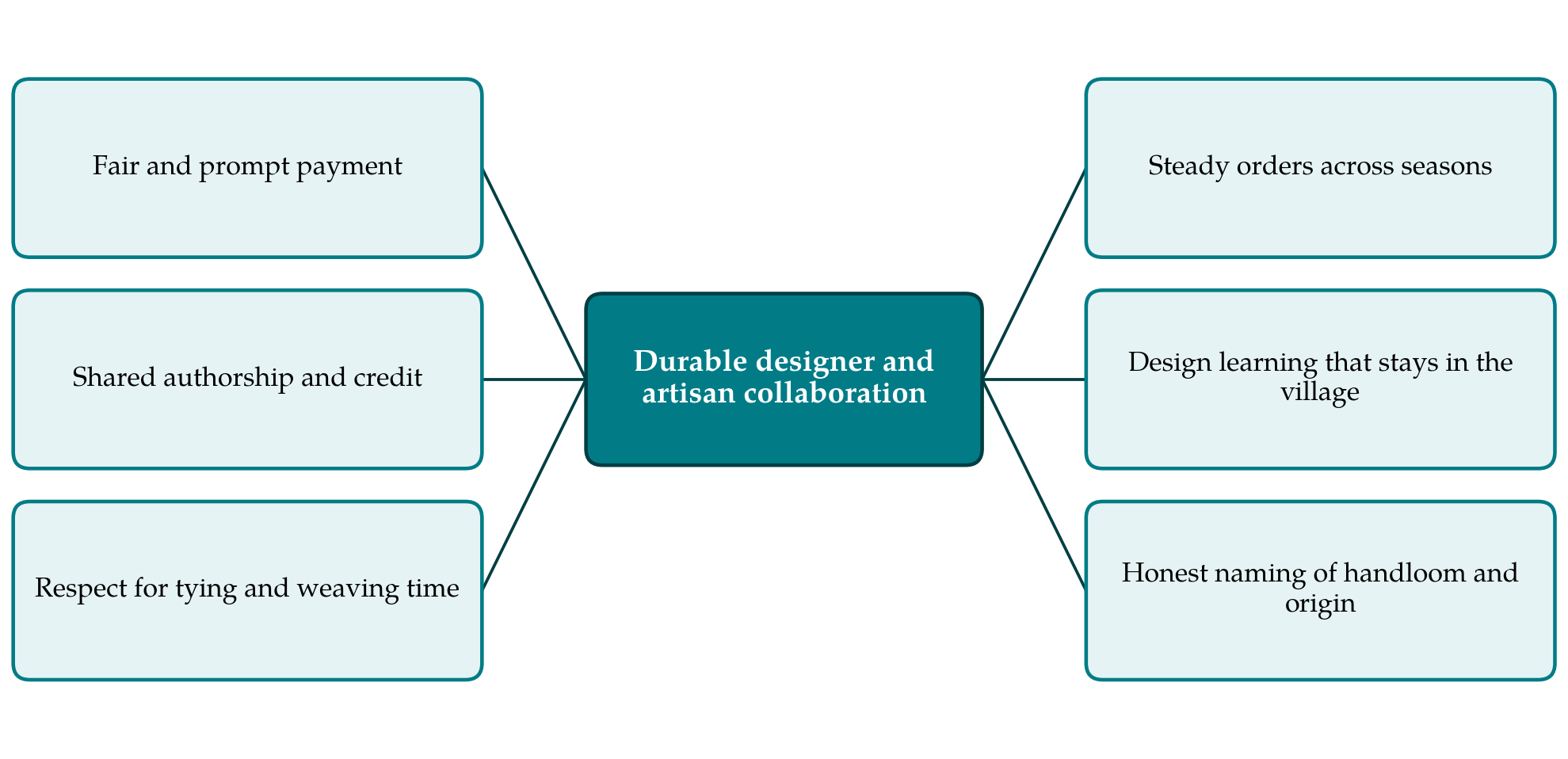
Payment terms come first. Advances for yarn and dye, and settlement on delivery instead of after retail sale, decide whether a household can afford to take a designer's order at all. Continuity matters almost as much, because a single seasonal commission can draw a weaver away from regular buyers and then vanish. Credit and shared authorship give weavers a reputation they can trade on. Finally, design learning needs to stay in the village, through training, shared costing and access to buyers, so that the next range can be developed without the designer.
8. Gaps and Future Work
The most obvious gap is regional. The detailed social research on handloom innovation and entrepreneurship comes mainly from southern India and from Varanasi, while writing on Odisha ikat is dominated by descriptions of technique and motif. Careful studies of weaving households in the Bargarh, Sonepur and Nuapatna clusters, following earnings, order books and the careers of younger weavers over several years, are needed before any general claim about revival can be made for the region. A second gap concerns comparison: the models in Table 1 have rarely been set side by side with attention to what weavers earn under each. A third concerns gender. Women do much of the preparatory work, and it is unclear whether collaboration changes their position or only their workload. Lastly, the effects of online selling and of weaver-led labels, which may make the outside designer less necessary, have yet to receive sustained scholarly attention.
9. Conclusion
The literature does not support a simple story in which designers revive a dying craft. Handloom ikat in Odisha is a skilled, adaptive industry with a long commercial past, and its weavers are designers in their own right. Collaboration with trained designers can widen markets and renew a visual language. It helps weavers when it is built on fair and timely payment, steady orders, acknowledged authorship and the transfer of design and market knowledge, and it harms them when it treats their skill as anonymous labour. Research that follows weaving households over time would show which of these outcomes is the more common.
Conflict of interest
To be declared by the author(s) before publication.
Funding
To be declared by the author(s) before publication.