1. Introduction
Granite and related plutonic rocks underlie large parts of the humid tropics, and under warm, wet conditions they decompose in place to depths of tens of metres. The product is a profile that passes from a clayey or silty sand at the surface, through material that looks like rock but crumbles in the hand, to jointed fresh granite at depth. Hong Kong, Singapore, Peninsular Malaysia, southern Brazil and parts of West Africa have extensive profiles of this kind, and much of what is known about them comes from the slope and foundation problems of those places (Lumb, 1965; Fookes, 1997).
Practitioners describe these profiles by weathering grade. The six-fold scale, from Grade I fresh rock to Grade VI residual soil, is embedded in national codes and in everyday logging, and it is natural to ask whether a grade carries with it a shear strength. The question matters because undisturbed sampling and testing of weathered granite is slow and costly, while grades are recorded on every borehole log.
This article reviews what the published literature says about that relationship. It is concerned with the soil-like part of the profile, Grades IV to VI, and with drained shear strength as used in slope and foundation design. It reports no new measurements. Its purpose is to set out which links between grade and strength are well founded, which are weak, and why.
2. Scope and Approach
The article is a narrative review of the published literature. It draws on the classic papers on decomposed granite, the working party reports of the Geological Society of London, the standard texts on residual soils and unsaturated soil mechanics, and published guidance from Hong Kong, where the subject has been studied most intensively. Sources were chosen for their influence on practice and for the clarity with which they treat the mechanisms involved. No formal search protocol was applied, and the review does not claim to be exhaustive.
3. Weathering Classifications and What They Record
The engineering grading of weathered granite began as a practical aid on a construction project. Moye (1955) devised a scale for the granites of the Snowy Mountains Scheme in Australia based on simple field tests: discolouration, whether a piece could be broken by hand, and whether it slaked in water. Ruxton and Berry (1957) then described the zoned weathering profile of Hong Kong granite, with its corestones set in decomposed matrix, and gave the geological basis for treating the profile as a sequence of zones. Little (1969) proposed the six-grade engineering scale for residual tropical soils that later schemes follow, and Deere and Patton (1971) offered a parallel zonal description aimed at slope stability.
British practice was shaped by the detailed study of weathered granite in south-west England by Dearman et al. (1978). The scale adopted in Hong Kong for material description is set out in Geoguide 3 (Geotechnical Control Office, 1988). Table 1 summarises the six grades as they are commonly applied to granite, and Figure 1 shows their idealised arrangement in a profile.
| Grade | Term | Field recognition | Bearing on shear strength |
|---|---|---|---|
| VI | Residual soil | Soil with no trace of the original rock texture | Behaves as a soil; density, grading and suction govern |
| V | Completely weathered | Soil that keeps the rock texture; slakes in water | Weak bonding and relict joints both matter |
| IV | Highly weathered | Large pieces break by hand; does not slake readily | Bonded, dilatant; hard to sample undisturbed |
| III | Moderately weathered | Discoloured throughout; not broken by hand | Rock material; joints control the mass |
| II | Slightly weathered | Staining near joints; strength close to fresh | Rock material; joints control the mass |
| I | Fresh | No visible sign of weathering | Rock material; joints control the mass |
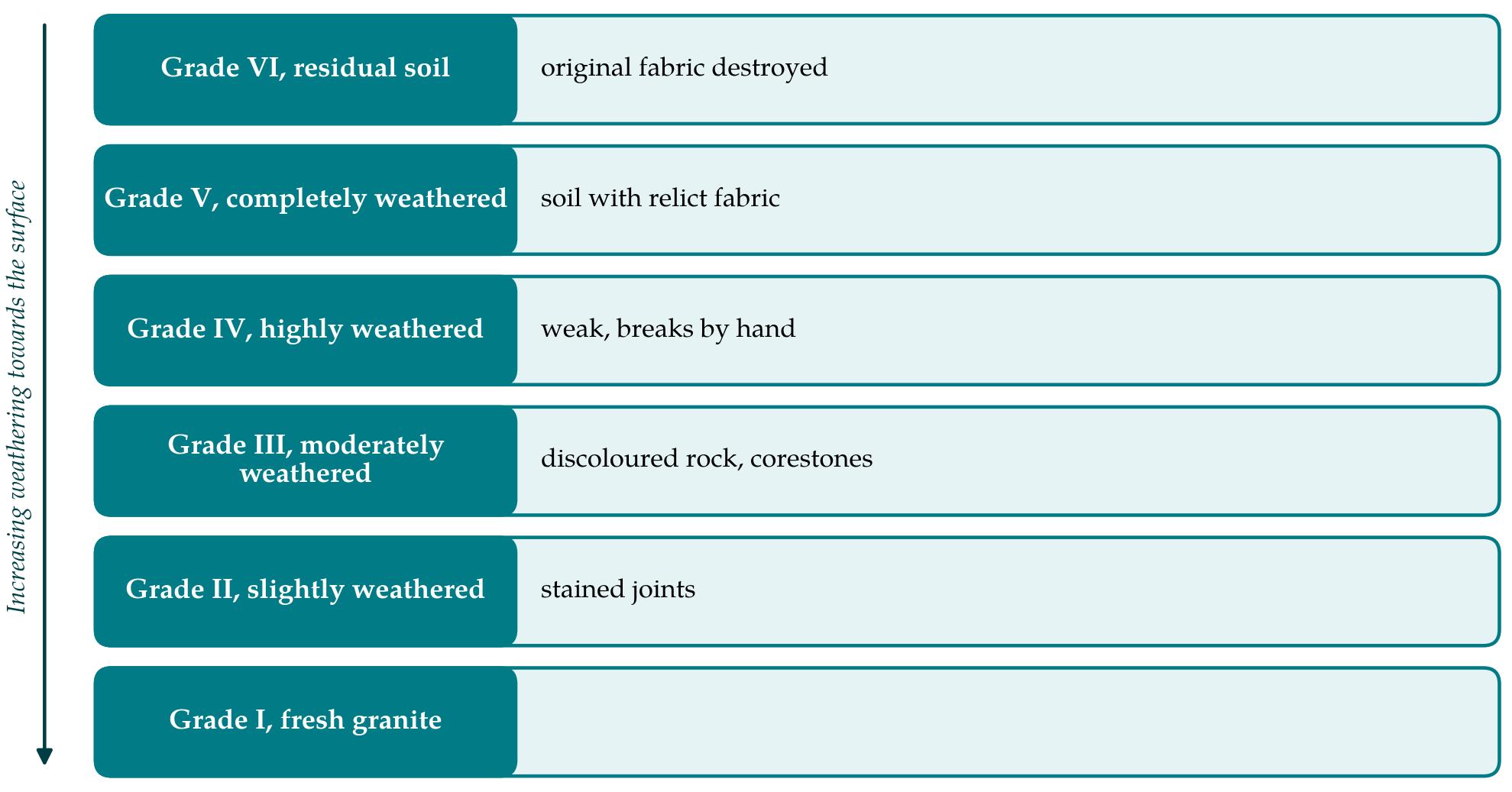
Two features of these schemes are easy to overlook. First, a grade describes a hand specimen. The Geological Society working party on weathered rocks drew a firm distinction between grading the material and zoning the mass, and recommended that different approaches be used for uniform materials, heterogeneous masses and rocks in which weathering produces a gradual change (Anon, 1995). Second, the grade boundaries are set by index tests chosen for convenience in the field, such as slaking and breakage by hand. They were not calibrated against shear strength, and nothing in their definition guarantees that strength changes in step with them.
Attempts have been made to replace the descriptive grades with measured indices. Lumb (1962) proposed a degree of decomposition based on the proportion of feldspar remaining relative to quartz, and Irfan and Dearman (1978) developed a micropetrographic index from thin sections that compares sound and unsound constituents. Irfan (1996) later related mineralogy and microfabric to the classification of Hong Kong granites. These indices track decomposition more finely than the six grades, but they need laboratory work and have not displaced the field scale.
4. How Granite Changes as It Weathers
Chemical weathering of granite under tropical conditions follows a well-described course. Plagioclase feldspar alters first, followed by potassium feldspar, to kaolinite and halloysite; biotite breaks down and releases iron that stains the mass; quartz survives largely unaltered as angular grains (Irfan, 1996). Leaching removes material in solution without a matching reduction in volume, so the void ratio rises while the original texture is retained. The result in Grades IV and V is a framework of quartz grains and partly decomposed feldspar held together by remnant mineral bonds and by clay bridges, with a porosity far higher than that of the parent rock.
Further weathering, together with movement of fines by percolating water and disturbance by roots and fauna, destroys this framework. In Grade VI the texture is lost and the material is a soil in the ordinary sense. Its grading reflects the parent rock: coarse-grained granites give gravelly silty sands, and fine-grained varieties give sandy silts and clays (Lumb, 1965). Rahardjo et al. (2004) documented comparable changes with depth in the residual soils of the Bukit Timah Granite in Singapore, where index properties, pore-size distribution and water retention all varied with the degree of weathering.
The significance for strength is that weathering changes several things at once and not always in the same direction. Bonding is lost, which reduces strength. Clay content rises, which reduces frictional resistance. Void ratio may rise through leaching or fall through collapse and reworking. A grade records the net visual effect of these changes and none of them individually.
5. Influences on Shear Strength Reported in the Literature
Four influences recur in the literature on the strength of decomposed granite. Each is considered below in relation to weathering grade.
5.1. Void ratio, grading and particle breakage
The earliest systematic work, by Lumb (1962) on Hong Kong decomposed granite, found that drained strength depended chiefly on void ratio and degree of saturation, and that the material behaved much like a sand with a variable fines content. Later work under controlled laboratory conditions supports the view that, once bonding is removed, completely decomposed granite can be described within a critical state framework. Lee and Coop (1995) showed that a reconstituted decomposed granite has a unique critical state line and that breakage of the weak, weathered grains during compression and shearing is a major feature of its behaviour. The friction angle at critical state reflects mineralogy and grain shape and changes little with grade, whereas peak strength depends on density and on bonding.
5.2. Bonding and structure
The second influence is the bonding inherited from the parent rock. Vaughan and Kwan (1984) argued that a residual soil forms by progressive weakening of a rock in place, so that its void ratio and in situ stress are products of weathering and bear no relation to a history of deposition and consolidation. Vaughan et al. (1988) went on to show that the engineering behaviour of such soils is governed by bond strength and void ratio, with a distinct yield at which bonds begin to fail, and they proposed indexing residual soils on that basis. Leroueil and Vaughan (1990) placed this within a general account of structure in natural soils and weak rocks.
Wesley (1990) reached a compatible conclusion from a different direction, stressing that composition and structure, and not stress history, explain the properties of residual soils, and that classification systems devised for sedimentary soils can mislead when applied to them. For the question at hand the implication is direct. Bonding declines from Grade IV to Grade VI, so a true cohesion intercept and a tendency to dilate are more likely in the lower grades. Bonding is also the property most easily destroyed by sampling, which is why the review of international practice edited by Brand and Phillipson (1985) gave so much attention to block sampling and triple-tube core barrels.
5.3. Matric suction
Residual granite soils above the water table are unsaturated for most of the year, and their strength in that state includes a component from matric suction. Lumb (1962) recognised that the apparent cohesion of partly saturated decomposed granite fell as the degree of saturation rose, and his later account of slope failures in Hong Kong attributed them to loss of this component during heavy rain (Lumb, 1975). The idea was given a formal basis by Fredlund et al. (1978), who extended the Mohr-Coulomb criterion with a term in which suction contributes to strength at a rate described by a second angle, φb. Later work showed that this rate is not constant and falls as the soil desaturates, and Vanapalli et al. (1996) linked the non-linearity to the soil-water characteristic curve. The framework is set out in full by Fredlund and Rahardjo (1993).
Suction interacts with weathering grade through pore-size distribution. Coarser, less weathered material drains at low suction and gains little strength from it. Finer, more weathered material holds water to higher suction and can sustain a larger apparent cohesion, which it then loses on wetting (Rahardjo et al., 2004). Strength measured on a sample at its natural water content therefore depends on the season and depth of sampling as much as on grade.
5.4. Relict discontinuities
The fourth influence operates at the scale of the mass. Joints, sheeting planes and dykes in the parent granite persist through Grades IV and V as relict discontinuities, often coated with clay or with iron and manganese oxides. Deere and Patton (1971) identified these as the usual control on slope failure in saprolite, since a smooth, coated relict joint can be far weaker than the material on either side of it. Laboratory tests on intact specimens do not capture this, and a material grade says nothing about joint orientation, persistence or coating. Texts on residual soil mechanics treat the mass strength of saprolite as a problem closer to rock mechanics than to soil mechanics for this reason (Blight and Leong, 2012).
6. What the Evidence Supports
The literature supports a limited set of statements. Across a complete profile, from Grade III to Grade VI, material strength falls markedly, and no author disputes this. Within the soil-like grades, bonding and dilatancy are more evident in Grade IV than in Grade VI, and fines content and water retention generally increase with weathering. The scatter about these trends is large, because void ratio, saturation and sample disturbance each alter measured strength by amounts comparable to the difference between adjacent grades.
The literature does not support the use of grade as a substitute for testing. The working party on tropical residual soils concluded that classification should rest on mineralogy and structure and should be supplemented by measured properties (Anon, 1990). Correlations between grade and strength parameters published for one granite have not been shown to hold for another, since parent grain size, climate and landscape position all differ. The safest reading is that grade is a means of dividing a site into units within which properties may then be measured.
7. Gaps and Directions for Further Work
Several gaps stand out. Published strength data for weathered granite seldom report void ratio, degree of saturation and sampling method alongside grade, which makes results from different studies hard to compare. A correlation that stated these, and that separated saturated from unsaturated strength, would be far more useful than one based on grade alone.
The treatment of relict joints remains largely qualitative. Systematic description of their orientation, persistence and coatings in saprolite, using the methods of rock mass characterisation, is uncommon in routine investigations. Finally, most of the classic work comes from a small number of regions. Whether its conclusions carry over to granites weathered under seasonally dry tropical climates, where cementation by iron oxides may be significant (Fookes, 1997), deserves direct study.
8. Conclusion
Weathering grade is a sound basis for describing tropical granite profiles and for dividing a site into zones of broadly similar material. The published literature shows that shear strength in the soil-like grades is governed by void ratio and grading, by the bonding that survives weathering, by matric suction, and in the mass by relict discontinuities. Grade is related to each of these only loosely. A design that takes strength from grade alone therefore rests on a correlation the literature does not support. Grade is best used to plan sampling and testing, with strength then measured on good-quality samples under the saturation conditions expected in service and with relict structure assessed separately.
Conflict of interest
To be declared by the author(s) before publication.
Funding
To be declared by the author(s) before publication.