1. Introduction
A clinical trial that has been done well and reported badly is, for the reader, indistinguishable from one that was done badly. This is the argument on which the modern reporting guideline movement was built, and it applies with particular force to homeopathy. The field is contested: its critics hold that ultra-diluted remedies cannot have specific effects, its proponents point to positive trials, and both sides appeal to the same published literature. If that literature omits how patients were allocated, who was blind, what was given and how many were lost, the dispute cannot be resolved by reading it.
Reporting standards for randomised trials have existed since the first CONSORT statement (Begg et al., 1996), and a supplement written specifically for homeopathy has been available since 2007 (Dean et al., 2007). Yet reviewers of homeopathic trials continue to report that large proportions cannot be assessed for bias because essential details are absent. This review sets out which standards apply, what is known about how well homeopathic trials meet them, and why the gap persists.
2. Approach
The article is a narrative review. It draws on the published reporting guidelines themselves, on systematic reviews and meta-analyses of homeopathic trials that assessed reporting or methodological quality, and on the general literature on guideline adherence and research waste. It does not present a new audit of trial reports, and it gives no counts or percentages of its own. Where a statement about the homeopathic literature is made, it rests on the cited reviews.
3. The Standards That Apply
No single document covers everything a homeopathic trial report should contain. The relevant standards form a set, summarised in Table 1, with a general core and several additions that address features common in this field.
| Standard | Applies to | What it secures for the reader |
|---|---|---|
| CONSORT 2010 (Schulz et al., 2010) | All randomised trials | Randomisation, concealment, blinding, flow, outcomes, harms |
| Non-pharmacological extension (Boutron et al., 2017) | Consultation-based care | Components, tailoring, provider expertise |
| Pragmatic extension (Zwarenstein et al., 2008) | Trials in routine practice | Setting, comparator, applicability |
| CONSORT PRO (Calvert et al., 2013) | Symptom and quality-of-life outcomes | Instrument validity, missing data, interpretation |
| SPIRIT 2013 (Chan et al., 2013) | Protocols | Pre-specified design, outcomes and analysis |
| TIDieR (Hoffmann et al., 2014) | Any intervention | Enough detail to replicate the treatment |
| RedHot (Dean et al., 2007) | Homeopathic treatment | Type of homeopathy, medicines, consultation, practitioners |
3.1. CONSORT and its extensions
The CONSORT 2010 statement provides a checklist of items and a flow diagram for parallel-group randomised trials, covering the generation of the random sequence, the mechanism of allocation concealment, who was blinded and how, the pre-specified outcomes, the numbers analysed and the harms observed (Schulz et al., 2010). An explanation and elaboration paper gives the rationale and examples for each item (Moher et al., 2010). Three extensions are regularly relevant. The extension for non-pharmacological treatments asks for details of the components of the intervention, how it was standardised or tailored, and the expertise of those who delivered it (Boutron et al., 2017). The extension for pragmatic trials addresses designs that compare whole packages of care in ordinary settings (Zwarenstein et al., 2008). The extension for patient-reported outcomes applies to nearly every homeopathic trial, since most rely on symptom scores or quality-of-life measures (Calvert et al., 2013).
3.2. Protocols, registration and intervention description
Reporting begins before the trial does. The SPIRIT 2013 statement lists the items a protocol should contain (Chan et al., 2013), and since 2005 the member journals of the International Committee of Medical Journal Editors have required prospective registration as a condition of publication (De Angelis et al., 2004). Registration and a published protocol allow readers to check whether the reported primary outcome is the one originally chosen. The TIDieR checklist addresses a different weakness: it asks authors to describe an intervention fully enough for it to be replicated, including materials, procedures, provider, mode, dose, tailoring and fidelity (Hoffmann et al., 2014).
3.3. The homeopathy-specific supplement
RedHot, short for Reporting Data on Homeopathic Treatments, was developed by consensus as a supplement to CONSORT (Dean et al., 2007). It asks authors to state the type of homeopathy tested, to identify the medicines by accepted nomenclature with their manufacture, potency and dosing, to describe the consultation and the background of the practitioners, to report co-interventions and the nature of the control, and to record adverse events, including the temporary worsening that practitioners call aggravation. It followed the model of earlier supplements for other complementary therapies: the STRICTA recommendations for acupuncture, later revised as a formal CONSORT extension (MacPherson et al., 2010), and the elaborated CONSORT statement for herbal interventions (Gagnier et al., 2006).
4. What Reviews of the Trial Literature Have Found
The earliest comprehensive meta-analysis of placebo-controlled homeopathy trials assessed methodological quality with standard scales and found that only a minority of trials scored well, in large part because procedures were not described (Linde et al., 1997). A follow-up analysis showed that trials with higher quality scores produced smaller effects, which means that incomplete reporting does not merely inconvenience reviewers; it is associated with the direction of the results (Linde et al., 1999). The comparative study of Shang et al. (2005) reached a similar conclusion for both homeopathic and conventional trials: smaller and lower-quality trials showed larger effects, and the apparent benefit of homeopathy shrank when the analysis was confined to larger trials of higher quality.
Later work used the Cochrane risk-of-bias approach, in which each domain is rated low, high or unclear, and an unclear rating usually reflects missing information and not a known flaw (Higgins et al., 2011). A characterisation of the journal literature of homeopathic randomised trials found it scattered across many journals and heterogeneous in design and quality (Mathie et al., 2013). When the same group reviewed placebo-controlled trials of individualised homeopathy, most were rated unclear in several domains and very few could be classed as reliable evidence, a judgement that directly limited what the meta-analysis could conclude (Mathie et al., 2014). The Australian National Health and Medical Research Council made the same observation at the level of whole reviews, noting that many studies were small, poorly designed or poorly reported (NHMRC, 2015).
A further problem is specific to the field. Reviewers need to know whether the intervention tested was homeopathy as practitioners would recognise it, a property that has been called model validity. A structured method for judging it asks whether the rationale for the remedy, the prescribing approach, the practitioner's role, the outcome measure and the length of follow-up were appropriate (Mathie et al., 2012). Each of those judgements depends on exactly the details that RedHot requests, and where they are missing the trial can be criticised from both directions: as too weak a test by proponents and as too vague a test by sceptics.
Harms are a further weak point. CONSORT asks for all important harms or unintended effects in each group, and RedHot adds that homeopathic aggravations should be recorded and distinguished from other adverse events. A systematic review of adverse effects in randomised trials of homeopathy observed that many trial reports gave no information on adverse events at all, or mentioned them without saying how they had been sought or classified (Stub et al., 2016). A statement that a treatment is safe carries little weight when the reports on which it rests did not describe how safety was monitored.
5. Why Adherence Remains Inconsistent
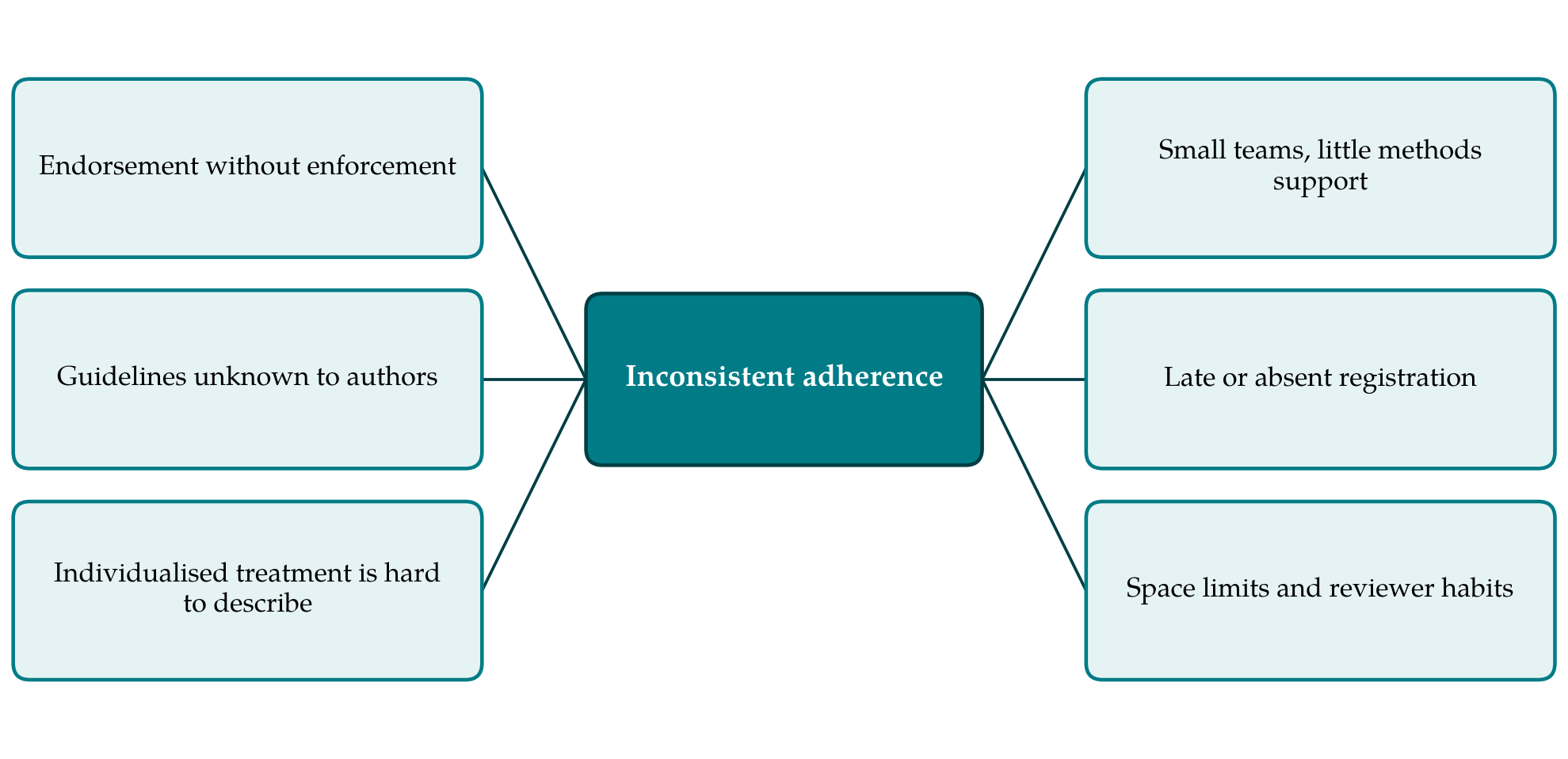
The persistence of incomplete reporting is not peculiar to homeopathy, and the general literature offers explanations that carry over. Figure 1 groups six of them. They are discussed here in three clusters: journals, investigators and the nature of the intervention.
5.1. Journals and peer review
A Cochrane review comparing trials published in journals that endorsed CONSORT with trials in journals that did not found that endorsement was associated with more complete reporting, but also that reporting remained far from adequate even in endorsing journals (Turner et al., 2012). Endorsement often amounts to a sentence in the instructions to authors. Unless a completed checklist is required at submission and checked against the manuscript, the guideline changes little. Many homeopathic trials appear in specialist complementary medicine journals or in general journals with limited editorial resources, where reviewers are chosen for clinical familiarity with the therapy and may not look for allocation concealment or outcome switching. Limits on article length, where they still apply, encourage authors to cut methods first.
5.2. Investigators and infrastructure
The number of reporting guidelines has grown to the point where a catalogue was needed to keep track of them (Simera et al., 2010), and an investigator trained as a clinician may be unaware that a supplement such as RedHot exists. Homeopathic trials are frequently run by small teams with modest funding and without a trials unit, a statistician or a data manager, which are the people who in larger studies ensure that randomisation procedures are documented and protocols registered. Registration that takes place late, or not at all, removes the external record against which a report can be checked.
5.3. The intervention itself
Individualised homeopathy is awkward to report. Each patient may receive a different remedy, potency and schedule, and these may change at every visit. A full account would require a table of prescriptions that few journals print, though supplementary files now make it feasible. The consultation is itself a component of the treatment and varies between practitioners. Authors who regard the prescribing process as an art may also resist reducing it to checklist items. None of this excuses omission, since the non-pharmacological extension and TIDieR were written for precisely such tailored, provider-dependent interventions.
6. Consequences and Remedies
Incomplete reports waste the effort of everyone involved, including the patients who took part. Chalmers and Glasziou (2009) estimated that a large share of research investment is lost through avoidable faults at the stages of question, design, publication and reporting, and a later series set out how unusable reports contribute to that loss (Glasziou et al., 2014). For homeopathy there is an additional cost. Because unclear reporting correlates with more favourable results, a literature full of unassessable trials sustains a misleading impression of efficacy and prolongs a debate that complete reporting could shorten.
Blinding deserves separate mention, because it is the feature on which the interpretation of a placebo-controlled homeopathy trial chiefly rests. Readers need to know who prepared the placebo, whether it was indistinguishable from the medicine in appearance, taste and packaging, whether the prescriber, the patient and the outcome assessor were all unaware of allocation, and how emergency unblinding was handled. Where the report says only that the trial was double-blind, none of these questions can be answered, and a risk-of-bias assessor has no option but to mark the domain unclear.
The remedies are well known and mostly lie with journals. Editors can require a completed CONSORT checklist with the relevant extensions and RedHot, verify registration dates against enrolment dates, ask for the protocol, and invite at least one reviewer with methodological training. Funders and ethics committees can make registration and a SPIRIT-compliant protocol conditions of approval. Investigators can place prescription-level data in supplementary files and involve a statistician from the outset. Whether such measures raise reporting quality in homeopathic journals specifically has not been evaluated, and a before-and-after audit in a journal that adopts them would be a useful contribution.
7. Conclusion
The standards needed to report a homeopathic trial properly exist and have existed for years. The published reviews agree that they are applied unevenly, and that the omissions fall on the items most needed to judge bias. The causes are ordinary ones: weak enforcement, limited awareness, thin infrastructure and an intervention that takes effort to describe. In a field where the plausibility of the treatment is disputed, a trial earns attention only through the transparency of its methods. Full reporting is therefore in the interest of those who believe the remedies work as much as those who do not, since it is the only route by which either could be shown to be right.
Conflict of interest
To be declared by the author(s) before publication.
Funding
To be declared by the author(s) before publication.