1. Introduction
A person refused a licence, a benefit or a visa ordinarily expects to be told why. The expectation is older than the computer and rests on a simple idea: power exercised over an individual should be capable of being understood and challenged by that individual. For most of the twentieth century the reasons came from an official who had read the file. A growing share of routine administrative decisions is now prepared, and sometimes taken, by software. Bovens and Zouridis (2002) described the shift early, observing that the street-level bureaucrat was giving way to the system designer whose choices are fixed in code before any individual case arises.
The legal literature that followed has been preoccupied with one consequence of that shift. If the operative reasoning sits inside a rule engine or a statistical model, the official who signs the letter may not be able to state the grounds of the decision, and the person who receives it may have nothing to argue against. Citron (2008) framed the problem as one of due process in automated benefit systems in the United States. A decade of scholarship in Europe and the Commonwealth has since restated it in the vocabulary of administrative law (Oswald, 2018; Cobbe, 2019).
This article reviews that body of work. It asks what the duty to give reasons requires when a public authority relies on an automated system, how legislators and courts have answered so far, and where the answers run out.
2. Scope and Approach
The review is narrative. It draws on monographs and journal articles in public law and in law and technology, on legislative texts, and on reported decisions that are widely discussed in the literature. No claim to exhaustive coverage is made, and the selection reflects the jurisdictions in which the debate has been most developed: the European Union and several of its member states, the United Kingdom, Canada, Australia and the United States.
3. The Duty to Give Reasons in Administrative Law
Reasons do several jobs at once. Schauer (1995) pointed out that to give a reason is to commit oneself to a generalisation that extends beyond the case, which is why reason-giving disciplines the decision-maker as well as informing the addressee. Mashaw (1983) placed reasons within a model of bureaucratic rationality in which accuracy and consistency across very large caseloads are the main virtues. In practice the most important function is instrumental. Without reasons, a right of appeal or review is difficult to use.
The sources of the duty differ by legal system. English common law has never recognised a general obligation, a position stated by the House of Lords in R v Secretary of State for the Home Department, ex parte Doody (1994), although fairness requires reasons in a widening range of situations and statute fills many of the gaps (Craig, 2021). In Canada the Supreme Court in Baker v Canada (1999) held that procedural fairness may demand written reasons, and in Canada v Vavilov (2019) it made justification, transparency and intelligibility the measure of a reasonable decision. European Union law treats the matter as a general principle: Article 296 of the Treaty on the Functioning of the European Union requires legal acts to state the reasons on which they are based, and Article 41 of the Charter of Fundamental Rights lists the obligation among the components of good administration. In the United States the Administrative Procedure Act requires a brief statement of the grounds when a written request is denied. Table 1 sets these general sources beside the instruments that address automation directly.
| Source | What it requires | Limits noted in the literature |
|---|---|---|
| General administrative law (common law fairness, Article 41 of the EU Charter) | Reasons adequate to permit understanding and challenge | Written for human decision-makers; content left to the courts Cobbe, 2019 |
| GDPR, Articles 13 to 15 and 22 | Meaningful information about the logic involved; safeguards for solely automated decisions | Scope and strength disputed Wachter et al., 2017 |
| French Code on relations between the public and the administration | Notice of algorithmic processing; rules and main characteristics on request | Depends on the individual asking; secrecy exceptions |
| German Administrative Procedure Act, section 35a | Full automation only where no discretion or margin of assessment exists | Regulates when to automate, not how to explain |
| Canadian Directive on Automated Decision-Making | Impact assessment; explanation scaled to impact level | Binds federal departments only; administrative policy, not statute |
| EU Artificial Intelligence Act, Article 86 | Explanation of the role of a high-risk system and main elements of the decision | Applies only where other Union law gives no equivalent right |
Two features of the general law matter for what follows. The standard of adequacy is flexible, and the duty attaches to the authority, not to its tools. An agency cannot answer a demand for reasons by saying that its software produced the result.
4. How Automation Strains the Duty
Burrell (2016) distinguished three sources of opacity, and the classification has been adopted across the legal literature. The first is deliberate secrecy, typically a supplier's claim that source code or model parameters are trade secrets. The second is technical illiteracy: the logic is available but can be read only by specialists. The third arises from the way machine learning models work, where a result emerges from the interaction of many weighted features and no short statement of grounds corresponds to what the model computed. Pasquale (2015) treated the first as the dominant problem. Writers on administrative law have been more troubled by the third, since it is the one that cannot be cured by an order for disclosure.
The older generation of systems raised a different difficulty. Rule-based engines of the kind used for benefit eligibility are transparent in principle, but the rules they apply are a programmer's translation of legislation and policy, and errors in translation are replicated in every case. Citron (2008) documented how such encoded rules could depart from the governing law without any notice-and-comment process, and Eubanks (2018) described their effects on welfare claimants. The Australian income-averaging scheme known as Robodebt, later examined by a Royal Commission, is the example most often cited in the Commonwealth literature: individuals were presented with a calculated debt and no account of the averaging inference on which it rested.
A further strain concerns the human who nominally decides. Many regimes treat a decision as automated only if no person is involved, which invites the insertion of a caseworker who confirms what the system proposes. Zalnieriute et al. (2019) and Oswald (2018) both observe that an official who cannot interrogate a recommendation is poorly placed to give independent reasons for following it, and that established doctrines against fettering discretion and acting under dictation are engaged when the output is treated as conclusive. Calo and Citron (2021) go further, arguing that agencies which hand judgement to systems they do not understand undermine the expertise that justifies delegation to them in the first place.
5. Legislative and Judicial Responses
Much of the European debate has been conducted through the General Data Protection Regulation (European Union, 2016). Article 22 restricts decisions based solely on automated processing that produce legal or similarly significant effects, and Articles 13 to 15 entitle the data subject to meaningful information about the logic involved. Wachter et al. (2017) argued that these provisions yield at most a right to be informed about system functionality in advance, not a right to an explanation of a particular decision. Selbst and Powles (2017) replied that the text, read purposively, does support an explanation that is meaningful to the individual, and Edwards and Veale (2017) doubted whether individual explanations were the right remedy at all. The Court of Justice has since taken a broad view of the provisions. In the SCHUFA scoring case (C-634/21) it held that producing a score on which a third party draws heavily is itself an automated decision, and in Dun and Bradstreet Austria (C-203/22) it read the access right as requiring an explanation of the procedure and principles actually applied to the person.
National legislatures have added rules aimed specifically at public bodies. French law requires an individual decision taken on the basis of algorithmic processing to say so, and entitles the person to be told on request the rules defining the processing and the main characteristics of its implementation. The Conseil constitutionnel, reviewing the legislation in 2018, added that an administration may not rely exclusively on an algorithm capable of revising its own rules without the controller's oversight, because the administration must be able to explain the processing in detail and in intelligible form. Germany took a structural route: section 35a of the Administrative Procedure Act permits a fully automated administrative act only where a legal provision allows it and neither discretion nor a margin of assessment is involved. Canada's federal Directive on Automated Decision-Making ties the depth of the required explanation to an assessed level of impact (Treasury Board of Canada Secretariat, 2019).
The Artificial Intelligence Act now adds a horizontal rule. Article 86 gives a person affected by a decision taken on the basis of the output of a listed high-risk system the right to obtain from the deployer clear and meaningful explanations of the role of the system in the decision-making procedure and the main elements of the decision (European Union, 2024). The provision is residual, and its relationship to national administrative procedure has yet to be worked out.
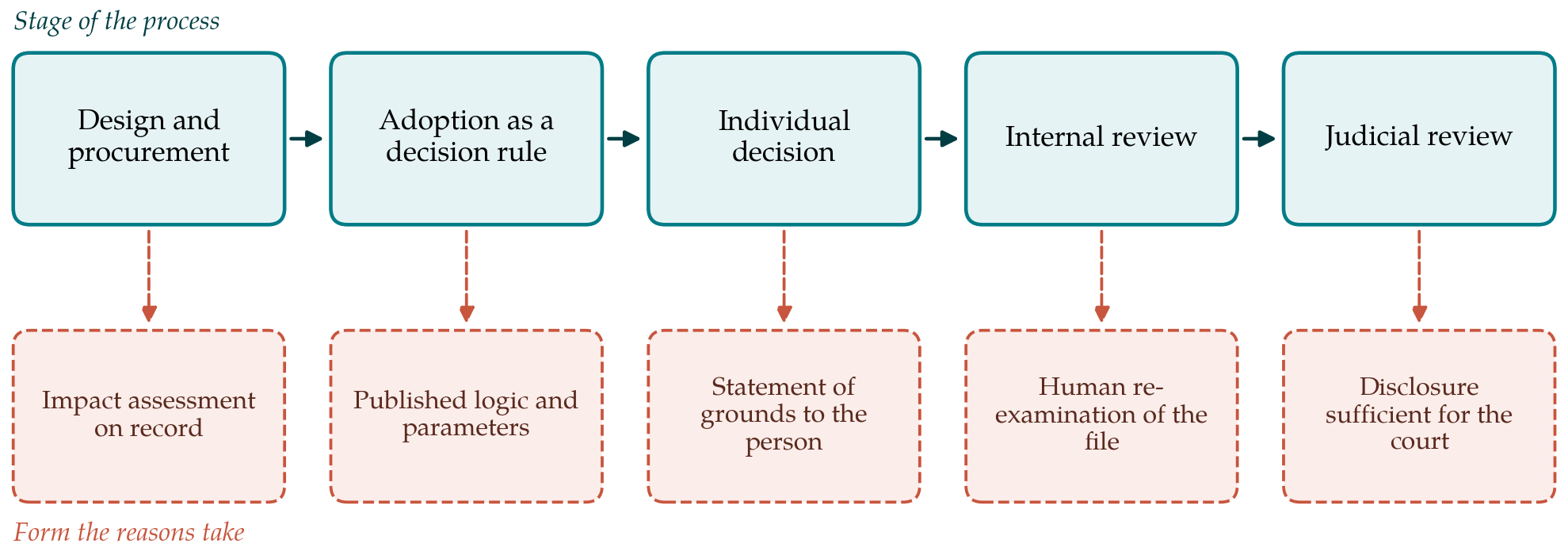
Case law remains thin but instructive. The District Court of The Hague in the SyRI judgment of 2020 struck down legislation authorising a welfare fraud risk-profiling system because its workings were insufficiently transparent and verifiable to satisfy Article 8 of the European Convention on Human Rights. The Italian Council of State, in decisions of 2019 on the algorithmic assignment of teachers, treated the algorithm as an administrative act that must be knowable in full and reviewable by the court. In the United States a federal district court allowed a due process claim to proceed in Houston Federation of Teachers v Houston Independent School District (2017), where teachers could not verify proprietary performance scores used against them. Figure 1 arranges these developments by the stage of the administrative process at which the explanatory obligation bites.
6. What Counts as an Adequate Reason
The literature has settled on a distinction between two objects of explanation. A system-level account describes the purpose of the tool, the data it uses, the rules or model type and how it was tested. A decision-level account says why this applicant received this outcome. Administrative law has always demanded the second. Much of the regulatory activity described above delivers the first, through registers, impact assessments and published source code. Kroll et al. (2017) argue that system-level assurance, in the form of verifiable evidence that the same announced procedure was applied to every case, may be worth more than disclosure of code that nobody can interpret.
On decision-level reasons, positions divide. Coglianese and Lehr (2017) maintain that existing American administrative law can accommodate machine learning, since agencies have never been required to recount the mental processes of officials and need only show that the system is rationally connected to a lawful objective; their later work argues that the degree of transparency the law requires is attainable (Coglianese and Lehr, 2019). Wachter et al. (2018) propose counterfactual statements, which tell the person what would have had to differ for the outcome to change, as a form of explanation that needs no access to the model's internals. Critics answer that a counterfactual chosen by the authority is not the same thing as the ground of the decision, and that it may leave unlawful considerations undisclosed.
A more radical view holds that the duty should shape the choice of technology. Rudin (2019) argues from within computer science that for high-stakes decisions inherently interpretable models should be used in place of post hoc explanations of opaque ones, since the latter are approximations that can be wrong about what the model did. Cobbe (2019) reaches a compatible legal conclusion: an authority that adopts a system incapable of yielding reasons has disabled itself from complying with its obligations, and the decision to adopt is itself reviewable. Hildebrandt (2018) and Yeung (2018) place the point in a wider frame, reading contestability as a rule-of-law requirement on any system of algorithmic regulation.
7. Gaps and Future Work
Two questions are left open by the material reviewed. The first is doctrinal: courts have said little about how the adequacy standard applies to a mixed decision, in which a model supplies a score and an official supplies the conclusion. Whether the reasons must disclose the score, its main drivers and the weight the official gave it has been answered by statute in France and by policy in Canada, but not yet by general principle elsewhere.
A second gap is institutional. Individual reasons reach only those who are told a decision was automated and who have the means to challenge it. Scholars who doubt the individual model have proposed collective mechanisms such as public registers, audit by an independent body and standing for representative organisations (Edwards and Veale, 2017), yet comparative study of how these operate alongside ordinary judicial review is scarce.
8. Conclusion
The duty to give reasons has proved more durable than early commentary feared. Legislators in several systems have restated it for automated decisions, and the courts that have addressed the question have refused to let confidentiality or complexity displace it. What the literature has not resolved is whether the duty can be met by explanations generated after the fact for models that are not themselves intelligible, or whether it operates as a constraint on the systems a public authority may lawfully use. The weight of legal opinion leans towards the second reading: the reason owed is one the person can contest, and a tool that cannot supply it is unsuited to the task.
Conflict of interest
To be declared by the author(s) before publication.
Funding
To be declared by the author(s) before publication.