1. Introduction
A sense of belonging at school, the feeling of being accepted, respected and included by others there, has been tied to motivation and persistence since Goodenow (1993) developed a scale to measure it, and a large body of research summarised by Osterman (2000) treats it as a condition for learning. The underlying claim is older and broader: that people have a basic need for lasting, positive relationships (Baumeister and Leary, 1995).
For students who arrive in a school system from another country during adolescence, belonging is unsettled on several fronts at once. They are learning a language, a curriculum and a set of unwritten rules while friendships formed elsewhere are stretched by distance. Longitudinal research with newly arrived students in the United States has shown how much their engagement depends on relationships with peers and adults at school (Suárez-Orozco et al., 2008). The standard instruments for studying belonging serve these students poorly. A rating scale requires reading fluency, and its items carry assumptions about what belonging consists of.
This article sets out a procedure for studying belonging with such students through photovoice. It is written for researchers and for teachers who work with them. The procedure is proposed on the basis of published guidance and has not been applied or evaluated in this article.
2. Background
The procedure rests on three sets of ideas: the method itself, the concept under study, and the standing of young people in research about them.
2.1. Photovoice
Photovoice was developed by Wang and Burris in work with village women in rural China, at first under the name photo novella (Wang and Burris, 1994). Its stated goals are to enable people to record their community's strengths and concerns, to promote critical dialogue through group discussion of photographs, and to reach policymakers (Wang and Burris, 1997). The method draws on the problem-posing education of Freire (1970), on feminist theory and on documentary photography. It shares with photo elicitation the insight that talking about a picture produces a different kind of account from answering a question (Harper, 2002), and differs in placing the camera in participants' hands. A review of photovoice projects in health found wide variation in how fully participants were involved at each stage (Catalani and Minkler, 2010), which is a reminder that the label does not guarantee participation.
2.2. Belonging
Belonging is more than a feeling. Yuval-Davis (2006) separated belonging, as emotional attachment and feeling at home, from the politics of belonging, the boundary work by which some are counted as members and others are not. Antonsich (2010) drew a similar line between a personal sense of being at home in a place and the discourses that grant or refuse inclusion. A method for studying belonging among migrant students should be able to register both: the bench where a friend waits, and the form that asks for a nationality.
2.3. Participation and voice
Article 12 of the Convention on the Rights of the Child gives children the right to express views on matters affecting them and to have those views given due weight (United Nations, 1989). Hart (1992) warned that much of what is called children's participation is decoration or tokenism. Lundy (2007) argued that voice alone does not satisfy Article 12, and that children also need a safe space in which to form views, an audience that listens, and influence over what follows. These four elements, space, voice, audience and influence, are used below as a test of each stage.
3. The Proposed Procedure
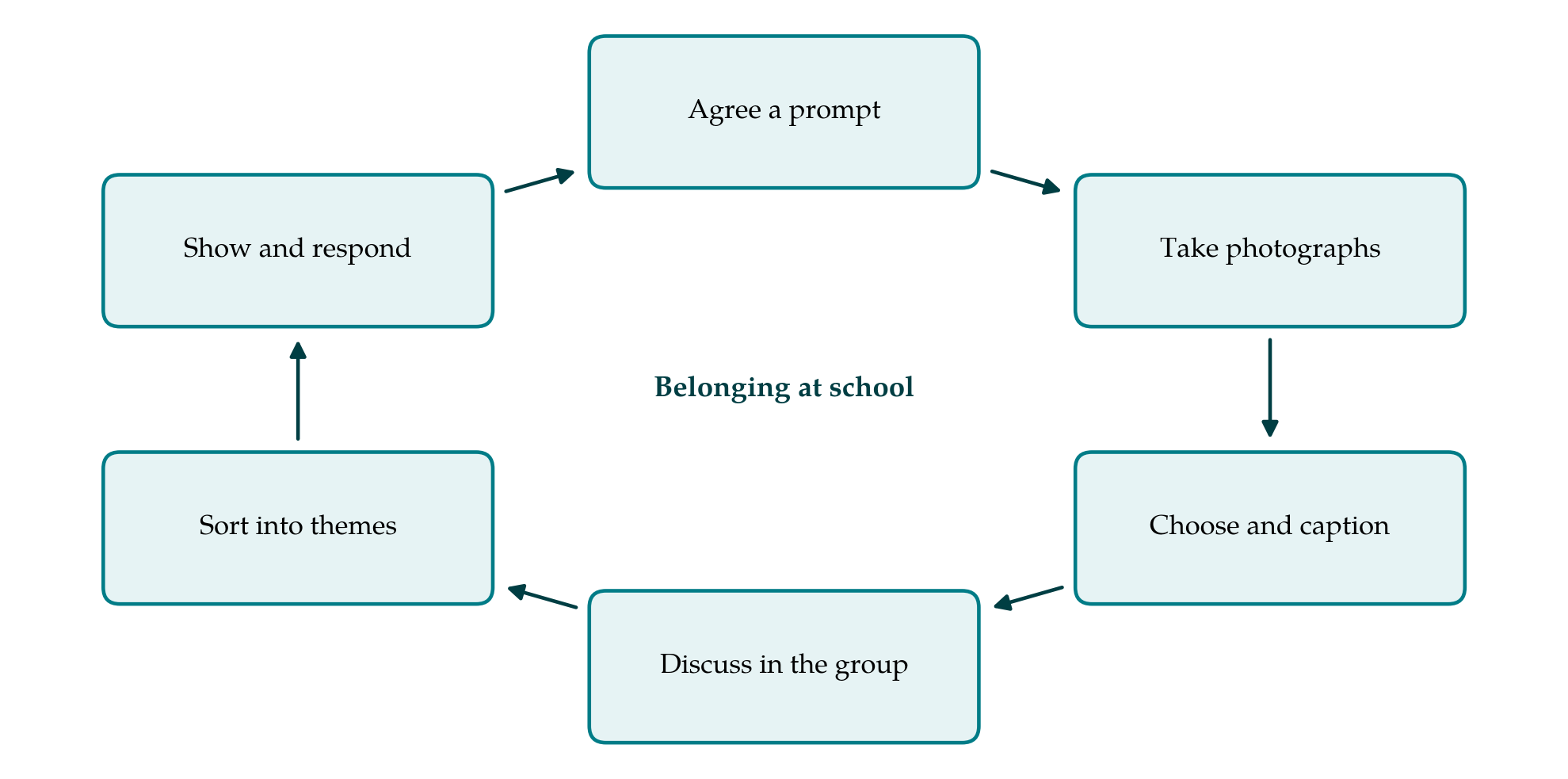
The procedure has seven stages spread over roughly one school term. Stages 4 to 6 repeat with each new prompt, and Figure 1 shows that repeating core. A group of six to ten students is suggested, small enough for every photograph to be discussed.
3.1. Stage 1: Build the partnership and the ethical ground
Work begins with the school's leadership, the staff who teach newly arrived students, and where possible a community organisation trusted by migrant families. Three matters are settled in writing before any student is approached: that taking part or declining will have no bearing on grades or standing; that teachers will not be present in discussion sessions; and that the school commits in advance to receive and answer what the students present. Review by a research ethics committee is sought on a protocol that covers the image-specific issues set out below.
3.2. Stage 2: Invite, inform and obtain consent and assent
Invitations go to all eligible students in the chosen year groups, not to those picked by staff, so that confident speakers are not the only ones heard. Information is given orally and in writing in the languages of the families concerned, with an interpreter present. Consent from a parent or guardian and the young person's own assent are both required, and assent is treated as continuing: it is confirmed at the start of each session. Following Wang and Redwood-Jones (2001), separate permissions cover taking part, being photographed by others, and the release of each image for display.
3.3. Stage 3: Orientation and camera workshop
The first two sessions introduce the idea of the project, basic composition, and the ethics of taking pictures: asking before photographing a person, what to do if someone refuses, and how to convey an idea without showing a face, for instance through objects, places, hands or shadows. Phone cameras are adequate, and devices are lent to anyone without one. The group also agrees its own rules for discussion, including which languages will be used and how translation among members will work.
3.4. Stage 4: Photo assignments
Each cycle starts from a prompt agreed with the group. Prompts are concrete and open, such as places in school where the student feels at ease, places avoided, and something that would be changed. The word belonging itself may have no close equivalent in a student's first language, and the facilitator works with the group to find phrasings that carry across. Students take photographs over a week and bring a few of their choice to the next session.
3.5. Stage 5: Group dialogue
Each student presents chosen images and the group discusses them. The questions known by the mnemonic SHOWeD give a structure: what is seen here, what is really happening, how it relates to our lives, why the situation exists, and what can be done about it (Wang, 1999). They move discussion from description towards causes and action, in keeping with the method's origins in Freire (1970). Students write or dictate a caption for each image in the language they prefer. Sessions are audio recorded with permission and facilitated by a researcher who is not a member of the school's staff, working with an interpreter or a bilingual co-facilitator.
3.6. Stage 6: Shared analysis
In photovoice, participants take part in interpreting the material, through selecting images, placing them in context and grouping them into themes (Wang and Burris, 1997). In practice the group lays out printed photographs with captions, sorts them into piles, names each pile and discusses what is missing. The researcher then carries out a fuller thematic analysis of transcripts and captions using an established approach (Braun and Clarke, 2006) and brings the result back to the group for correction.
3.7. Stage 7: Exhibition and response
The group decides whether, where and to whom its work is shown. Options range from a closed presentation to school leaders to a display open to families. Each image is cleared again by its maker before use. The school's response, given at a later meeting, completes the cycle. In the terms of Lundy (2007), this stage supplies audience and influence, without which the earlier stages amount to an exercise.
4. Adapting the Method to Risk, Language and Power
Four features of the setting call for specific safeguards, summarised in Table 1. The first is exposure. Some students or their relatives may have uncertain legal status or reasons to avoid being identified, and a photograph of a home, a street or a face can disclose more than its maker intended. The second concerns people who appear in images without having agreed to take part in research. Wang and Redwood-Jones (2001) identified intrusion into private space, disclosure of embarrassing facts and placing people in a false light as the main dangers of the method, and all three are sharper in a school.
| Risk | How it arises | Proposed safeguard |
|---|---|---|
| Identification of the student or family | Faces, homes or documents visible in images | Teach non-identifying photography; maker reviews every image before release |
| Images of other pupils | Classmates photographed without agreement | Ask-first rule; no identifiable third parties shown without consent |
| Distress | Prompts recall loss, separation or hostile treatment | Open prompts; freedom to pass; named counsellor available |
| Teacher influence | Students say what staff are thought to want | External facilitator; no staff in sessions; no link to grades |
| Loss of meaning in translation | Captions and talk cross several languages | Captions in preferred language; bilingual co-facilitator; meanings checked with the student |
| Raised hopes | School hears the students and changes nothing | Prior written commitment to respond; follow-up meeting |
The third feature is language. Photographs lower the threshold for taking part, but interpretation still happens in words, and the method would defeat its purpose if only students fluent in the school's language shaped the themes. Allowing captions and discussion in first languages, with translation checked against the student's own sense of what was meant, addresses this at some cost in time. The fourth is power. A school is a place where adults assess young people, and students new to a country may be especially unwilling to criticise it. Holding sessions without staff and using a facilitator from outside reduces the pressure and does not remove it.
5. Limitations and What Remains to Be Shown
The procedure is proposed and untested. It would need to be tried in schools before anything could be said about whether the safeguards are sufficient, whether students find the sessions worthwhile, or whether schools act on what they are shown. Several known weaknesses of photovoice apply. Some experiences of exclusion cannot be photographed, because they happened in the past or because showing them would be unsafe, so an absence of images is not an absence of concern. Small groups of volunteers do not represent all migrant students in a school, and those most isolated may be the least likely to join.
There is also a question of fit between method and concept. Photographs favour places and objects, and so may bring out the personal, place-bound side of belonging more readily than the institutional side that Yuval-Davis (2006) calls its politics. The discussion questions are meant to correct for this, and whether they do is an empirical matter. Researchers who adapt the procedure should report their adaptations and difficulties as fully as their themes.
6. Conclusion
Photovoice suits the study of belonging among adolescent migrants because it starts from what they choose to show, makes fewer demands on a new language than a questionnaire, and builds in an audience. It also carries risks that are specific to images, to schools and to families whose position may be insecure. The seven-stage procedure proposed here pairs each stage with those risks and with the requirements of space, voice, audience and influence. It is offered as a starting point for careful trial, and the judgement of whether it works belongs to the students who take part in such trials as much as to researchers.
Conflict of interest
To be declared by the author(s) before publication.
Funding
To be declared by the author(s) before publication.