1. Introduction
The two-wheel tractor is a simple machine: an engine of a few kilowatts on a single axle, a gearbox, and two long handles by which the operator steers, balances and controls it. In wetland rice it does the heaviest work of the year. The flooded field is churned with a rotary tiller or a puddler until the soil loses its structure and forms the soft, nearly watertight layer into which seedlings are transplanted. Puddling is done against the calendar, since water and seedlings are both waiting, and operators who work for hire may spend most of every day at the handles for several weeks.
Vibration transmitted to the hands and arms over years of work causes a recognised group of vascular, neurological and musculoskeletal disorders, of which episodic blanching of the fingers is the best known (Griffin, 1990). The risk rises with the magnitude of the vibration and the duration of exposure (Bovenzi, 1998). This note asks what can be said, from published knowledge, about the exposure of two-wheel tractor operators during puddling in particular.
2. What Is Known About These Machines
The principal source is the engine. A single-cylinder four-stroke diesel cannot be fully balanced, and it shakes its mounting at the frequency of rotation and delivers a torque pulse at half that frequency, with harmonics of both. The handles are long, lightly built cantilevers attached to the same chassis, and where one of their natural frequencies lies near an engine order the motion at the grips is amplified. Early measurements on a power tiller described the vibration at the handle and at other points of the machine under several operating conditions (Salokhe et al., 1995).
Later studies measured the vibration at the grips according to the international standard and compared it with exposure criteria. Measurements on walking and riding power tillers in India found handle vibration high in both forms (Sam and Kathirvel, 2006). A study of a single-axle tractor in Europe concluded from the standard's dose-response relationship that regular use carried a real risk of vibration-induced disorder (Goglia et al., 2006). Field work with hand tractors has also linked their operation to marked operator fatigue (Tewari et al., 2004). Only one of the studies cited here treated puddling as a distinct mode, comparing it with transport and dry rotary tilling on the same hand tractor (Dewangan and Tewari, 2009). The comparison established that the mode of operation matters, and it remains a thin base for so common a task.
3. How Puddling Differs
Several features set puddling apart from the operations on which most measurements were made, and they do not all act in the same direction. Figure 1 gathers the factors that determine an operator's daily exposure. The engine works under a heavy and fairly steady load, at a speed the operator sets and then leaves, so the excitation is sustained instead of intermittent. Pneumatic tyres, which give some isolation from the ground, are exchanged for steel cage wheels whose lugs enter the mud in succession, and the rotary tiller adds the impacts of its blades. These inputs lie at lower frequencies than the engine orders, in the range where the weighting used for hand-transmitted vibration counts most heavily.
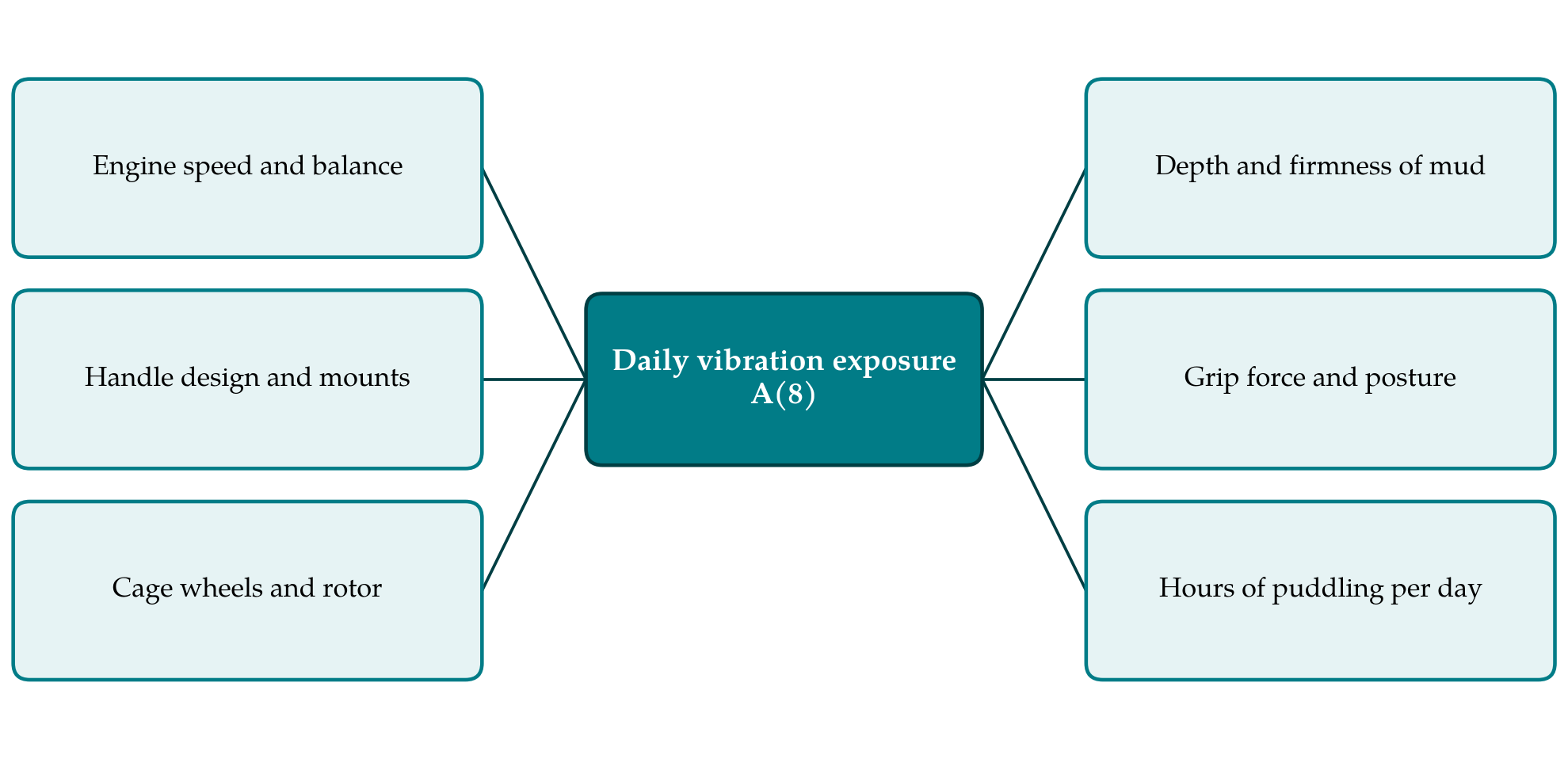
Against this, water and soft mud are a yielding, dissipative support. The shocks from stones and clods that mark dry tillage are largely absent, and a machine partly afloat in slurry may transmit less ground-borne vibration than one on a hard headland. Which effect prevails will depend on the depth of the hard pan, the amount of standing water and the stage of puddling, since the first pass over a ploughed field is very different from the last pass over a finished bed. The operator's own contribution also changes. An operator wading through mud leans on the handles for support and pulls hard to turn at each bund. Grip and push forces couple the hand more tightly to the handle and are widely thought to increase the vibration energy passed into the arm (Griffin, 1990), yet they are seldom recorded. Where a seat is fitted behind the puddler, the exposure of the whole body through the seat becomes a second question with its own standard (ISO, 1997).
4. Assessing Exposure in the Paddy
The method of assessment is settled. Acceleration is measured on each handle, close to the hand, in three perpendicular directions, weighted by frequency, and combined into a single vibration total value. The daily exposure, written A(8), scales that value by the square root of the ratio of actual exposure time to a reference day of eight hours (ISO, 2001a). The companion standard gives practical guidance for the workplace, including the need to sample the real task for long enough and to establish exposure time separately from machine hours (ISO, 2001b). European law offers a benchmark even where it does not apply: it sets a daily exposure action value of 2.5 m/s² and a limit value of 5 m/s² for hand-arm vibration (European Parliament and Council, 2002).
Puddling makes each of these steps harder. Accelerometers and cables must be sealed against water and mud, and mounted so that the operator can still grip normally. Records should cover straight runs and turns, early and late passes, and both handles, and should be accompanied by engine speed, water depth and a description of the soil. Exposure time is best taken from observation across whole working days, since stops for refuelling, clearing weeds and moving between plots are frequent. Because the square-root rule makes long days count, and because the puddling season compresses many such days together, the hours matter as much as the magnitudes. Table 1 lists the sources of vibration in puddling with the control measures that correspond to each.
| Source or factor | How it acts in puddling | Control measure |
|---|---|---|
| Grip and push forces | Tight coupling while wading and turning | Steering clutches in good order; resilient grips; training |
| Long working days | Daily exposure grows with hours | Rotation of operators; planned breaks |
| Poor maintenance | Loose mounts and worn parts raise vibration | Routine checks before the season |
| Source or factor | How it acts in puddling | Control measure |
|---|---|---|
| Engine unbalance and firing | Sustained under heavy, steady load | Resilient engine mounts; correct idle and working speed |
| Handle resonance | Amplifies engine orders at the grips | Isolators at the handle root (Sam and Kathirvel, 2009); stiffer or damped handles |
| Cage wheels and tiller blades | Low-frequency impacts as lugs and blades enter the mud | Lug number and spacing; blade arrangement; sound bearings |
5. Reducing Exposure
The measures in Table 1 fall into three groups. The first belongs to the manufacturer: isolating the engine from the chassis and the handles from the chassis, and moving handle resonances away from the working speed. Isolators developed for walking and riding power tillers have been reported to lower the vibration reaching the hand substantially (Sam and Kathirvel, 2009), and such parts are cheap in relation to the machine. The second group belongs to the owner: mounts, bearings, blades and clutches kept in order, and an engine run at the speed for which the isolation was designed. The third is organisational. Sharing a machine between two operators through the day halves each one's hours, although under the square-root rule it reduces each daily exposure by less than half. Gloves sold as anti-vibration offer little protection at the low frequencies that dominate here and should not be relied on (Griffin, 1990).
6. Conclusion
Operators of two-wheel tractors are exposed to hand-transmitted vibration at magnitudes that published studies consistently describe as high, and puddling adds long hours, sustained engine load and hard gripping to that exposure while removing some of the shocks of dry ground. The balance of these effects has scarcely been measured. What is needed is a set of field assessments made to the international standard in flooded fields, with soil condition, water depth, machine state and true exposure time recorded, so that the control measures already known can be directed at the conditions in which operators spend most of their season.
Conflict of interest
To be declared by the author(s) before publication.
Funding
To be declared by the author(s) before publication.