1. Introduction
For most of the history of organic chemistry a reaction has meant a flask: reagents combined in a vessel, stirred and heated, then worked up and purified. Continuous-flow chemistry replaces the flask with a stream. Reagents are pumped through narrow tubing, etched chips or packed columns, mix as they meet, react during a controlled time of passage, and emerge at the other end. The approach is not new in principle, since the chemical industry has run continuous processes for a century, but its adoption at laboratory scale for synthesis grew rapidly once suitable pumps, reactors and back-pressure regulators became available, as the reviews of Hartman et al. (2011) and Plutschack et al. (2017) describe.
With flow now common in research and increasingly in manufacturing, where regulators have encouraged continuous production of medicines (Lee et al., 2015; Porta et al., 2016), teaching laboratories have started to introduce it. Small and inexpensive reactors have made this feasible, and a number of undergraduate experiments using flow have appeared in the educational literature (Leibfarth et al., 2018; Penny and Rourke, 2019). This perspective considers what that development means for the training of synthetic chemists. The argument is made from the published literature on flow chemistry and its teaching; the article presents no study of its own.
2. What Flow Teaches Well
The central claim of this perspective is that flow chemistry makes certain ideas concrete in a way the flask does not. The first is steady state. In a batch reaction concentrations change continuously as reagents are consumed, and a student reasons about a moving target. In a flow reactor run to steady state the composition at any fixed point along the tube is constant in time, and the progress of the reaction is laid out in space along the reactor. A student who sets a flow rate and watches the output stabilise is handling the steady-state picture directly rather than as an abstraction, a pedagogical value emphasised by Britton and Jamison (2017). Table 1 collects the main contrasts between the two modes as they bear on teaching.
| Aspect | In a batch flask | In a flow reactor |
|---|---|---|
| Time variable | Reaction time; composition changes as it runs | Residence time set by volume and flow rate |
| Steady state | Rarely seen; a moving target | The normal operating condition, seen directly |
| Mixing and heat | Slow and uneven in a large vessel | Fast in small channels, part of the design |
| Hazardous species | Prepared and stored in quantity | Made and consumed in place in small amount |
| Purification | Done by hand after the reaction | Often a separate step on the collected stream |
The second idea is control. Residence time, the counterpart of reaction time in a flask, is set cleanly by the reactor volume and the flow rate, and stoichiometry is set by the relative pump rates, so the link between a chosen parameter and the outcome is unusually direct. Mixing and heat transfer, which in a large flask are slow and uneven, are fast in the small channels of a flow reactor, so a student sees that the engineering of contact between reagents is part of chemistry and not a detail to be assumed away. These transport advantages are set out by Jensen (2017).
The third, and perhaps the most valuable, is safety. Because only a small quantity of material is within the reactor at any instant, hazardous or unstable intermediates can be generated and consumed in place without ever accumulating, a strategy reviewed by Movsisyan et al. (2016) and illustrated for diazo and azide chemistry and for other reactive species. A student who learns to handle a dangerous reagent by making it in a stream and using it at once, rather than preparing and storing a flaskful, has absorbed a principle of process safety and of reagent minimisation that transfers directly to responsible practice.
3. What Might Be Lost
A perspective that only listed benefits would be incomplete. The concern is not that flow chemistry is harmful but that, if it displaces rather than supplements batch teaching, skills accumulated over a long tradition of flask work may get less practice. Figure 1 sets the skills that flow work reinforces beside those that need deliberate attention if a course leans heavily on flow. Manual purification is the clearest case: crystallisation, distillation, extraction and column chromatography are learned by doing them by hand, and a course in which products emerge from a reactor as a stream to be collected and analysed offers fewer occasions to practise them.
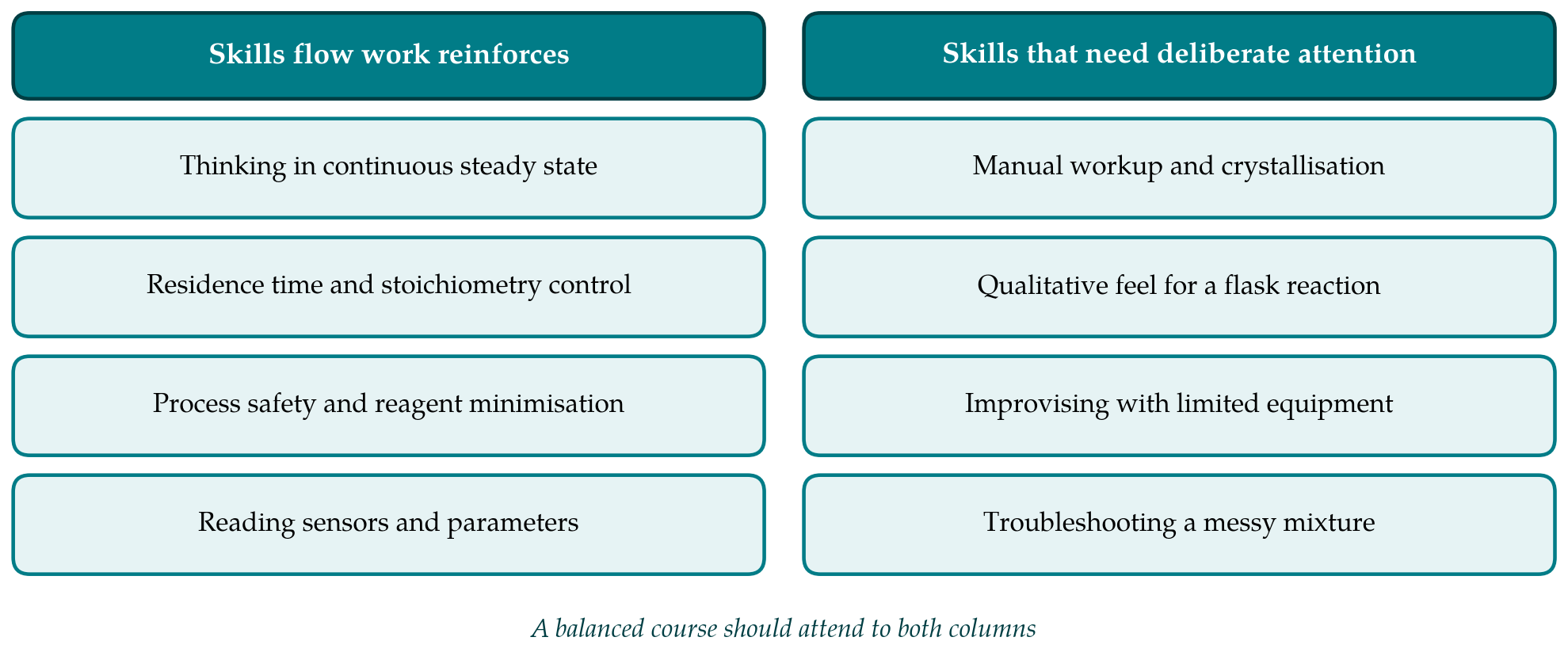
Less tangible but no less real is the qualitative feel for a reaction that comes from watching a flask: the colour that signals an endpoint, the exotherm felt through the glass, the precipitate that marks a change. Much of a chemist's intuition is built from such observation. A sealed reactor hides these cues, and a student who meets reactions mainly through sensor readings may be slower to develop the tacit judgement that experienced chemists rely on. There is also the matter of improvisation. Generations of chemists learned resourcefulness by making do with limited glassware, and a well-equipped flow bench, paradoxically, can remove the productive difficulty from which that resourcefulness grew.
4. Counter-Arguments
Several objections deserve a hearing. The first is cost. Pumps, reactors and back-pressure regulators are an expense beyond glassware, and a department equipping many student stations faces a real barrier, although home-built and low-cost reactors have narrowed the gap and several published teaching experiments were designed with affordability in mind (Penny and Rourke, 2019). The second is the demand on instructors, who must themselves be fluent in a technique many were not trained in, and who must support equipment that fails in unfamiliar ways, with blockages and pump faults replacing the broken flask. The third, and the most serious, is the black-box risk: a flow reactor can be operated by following a procedure without understanding what happens inside, so that a student obtains a product while learning less chemistry than a flask would have taught. Each objection is real, and none is decisive. Cost is falling, instructor fluency grows as the technique spreads, and the black-box risk is a reason to design flow teaching around understanding rather than a reason to avoid it.
There is a deeper counter-argument worth stating plainly. It could be held that the purpose of an undergraduate laboratory is to teach fundamentals that do not date, and that flow chemistry, however useful, is a technique rather than a fundamental and might be left to later specialised training. The reply is that the ideas flow makes concrete, steady state, residence time, mixing and heat transfer, mass and energy balance, are themselves fundamentals, long taught in reaction engineering and until now largely absent from the synthetic chemist's education. On that view flow in the teaching laboratory is not a passing fashion but a route to concepts the batch curriculum has underserved, a case argued in the context of continuous manufacturing by Baumann and Baxendale (2015).
5. Implications for the Curriculum
If both the gains and the risks are real, the implication is not to choose between flask and flow but to combine them deliberately. A reasonable sequence introduces batch work first, so that students acquire manual technique and the observational feel for a reaction, and brings in flow once those foundations are laid, using it where it teaches best: a reaction whose selectivity depends on residence time, a hazardous intermediate best generated in place, a comparison of the same transformation run both ways. Running a transformation in batch and then in flow, and asking students to account for the differences, turns the two modes into instruments for teaching each other.
Assessment and framing matter as much as the experiment. To counter the black-box risk, students can be asked to predict how the output will change when a flow rate or a temperature is altered and then to test the prediction, so that the reactor becomes an object of reasoning rather than a dispenser of product. Linking the laboratory to the wider move toward continuous and greener manufacturing gives the work a context that students recognise as current (Gutmann et al., 2015; Newman and Jensen, 2013). None of this requires abandoning what the flask teaches; it requires deciding, experiment by experiment, which tool serves the lesson.
6. Conclusion
Flow chemistry has earned a place in the teaching laboratory. It makes steady state, residence time, mixing and heat transfer tangible, and it teaches process safety and reagent economy through the direct experience of handling little material at a time. These are real additions to the training of a synthetic chemist. The accompanying risk is that the manual craft and the observational intuition of flask work, and the resourcefulness that limited equipment fosters, receive less practice if flow is allowed to crowd them out. The sensible response is to treat flow as a complement rather than a replacement, to introduce it once manual foundations are secure, and to frame it so that students reason about the reactor instead of merely operating it. Handled this way, the arrival of flow stands to produce chemists who are more complete than either tradition alone would make them.
Conflict of interest
To be declared by the author(s) before publication.
Funding
To be declared by the author(s) before publication.