1. Introduction
Within a generation the working conditions of historians have been transformed. Newspapers, parliamentary papers, court proceedings, parish registers and colonial correspondence that once required travel and weeks of page-turning can now be queried in seconds. For those who study people who left few records of their own, the change has seemed especially promising. A name typed into a database of digitised newspapers may return a labourer's court appearance, a runaway notice or a letter to an editor that no finding aid would have led to.
The promise deserves a careful second look. Historians have long recognised that archives are made by the powerful and that the poor, the colonised and the enslaved appear in them largely as objects of administration (Trouillot, 1995). Digitisation does not undo that history. It reproduces a portion of the archive in a new medium, and the choice of portion, the manner of reproduction and the tools of retrieval each have consequences for who can be seen.
This Perspective contends that digitised archives have made the visibility of marginal voices more uneven, raising some sharply and lowering others in relative terms. It then weighs the main objections to that view and suggests what researchers and institutions might do in response.
2. An Archive Already Filtered
Trouillot (1995) distinguished four moments at which silences enter the making of history: when sources are created, when they are assembled into archives, when narratives are drawn from them, and when significance is assigned in retrospect. Archivists have made a parallel case from within their own profession, insisting that archives are instruments of power that shape what a society can remember, and are far from neutral storehouses (Schwartz and Cook, 2002). Scholars of slavery and empire have shown what this means on the page. Spivak (1985) found an Indian queen present in East India Company records only where she served the Company's purposes, and Fuentes (2016) reconstructed the lives of enslaved women in Barbados from documents that register them through violence and sale.
These writers responded with methods of reading: along the grain of official reasoning to learn its habits (Stoler, 2009), against it to catch what it let slip, and in some cases beyond it, by openly imaginative reconstruction where the record gives out (Hartman, 2008). All of them assume a reader who knows what kind of archive is in hand. That assumption is the first thing that mass digitisation weakens.
3. What Digitisation Adds
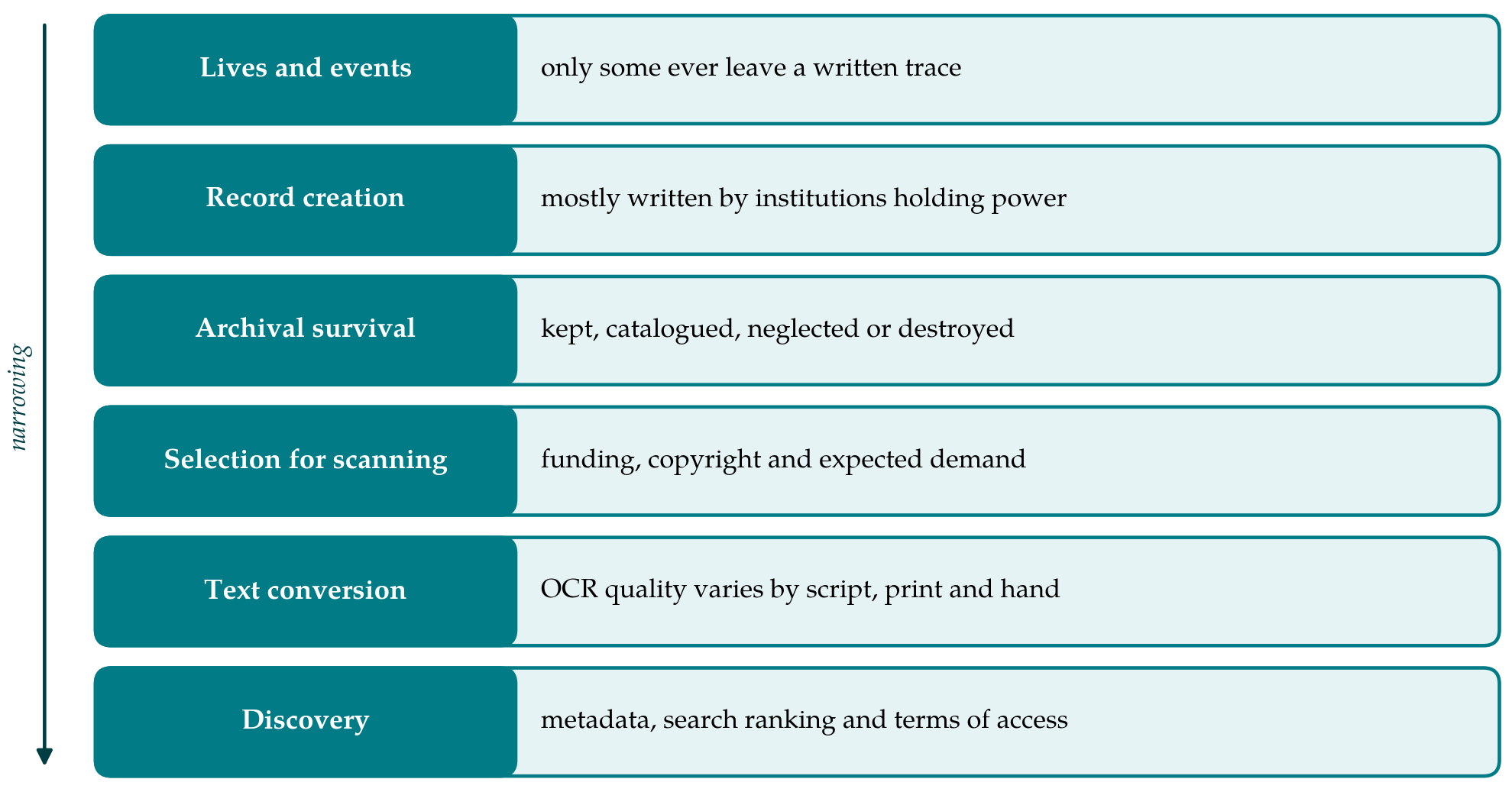
Digitisation places further layers between a past life and a present researcher. Figure 1 sets them out in order, from the creation of a record to its discovery on a screen, and the subsections below take up the three that are new.
3.1. Selection
Only a small fraction of archival holdings has been scanned, and the fraction is not a sample. Projects are funded where demand is proven, where rights are clear and where material is uniform enough to process cheaply. National newspapers, printed government papers and records useful to family historians come first. Material in the languages and scripts of colonised peoples, manuscript collections in small repositories and records still in private or community hands come later or not at all. The politics of these choices, including the tendency of former imperial powers to digitise colonial records held in the metropole on their own terms, has become a subject of study in its own right (Zaagsma, 2023).
3.2. Conversion
A scanned image becomes searchable only when its text is extracted, usually by optical character recognition. Recognition works best on clean modern print in major languages and degrades on worn type, crowded columns, older letterforms and non-Latin scripts; handwriting requires separate and costlier methods. Cordell (2017) has argued that the error-strewn text behind a newspaper database is best understood as a new edition with its own bibliographic character. The practical consequence is that a failed search does not show absence. It may show only that the cheap paper and small type of a radical or minority-language weekly defeated the software.
3.3. Discovery
What can be found also depends on description and ranking. Catalogue records often carry the vocabulary of the period that produced them, so that people are retrievable under the terms their rulers used and seldom under the names they gave themselves. Full-text search bypasses the catalogue but brings its own distortions. Underwood (2014) pointed out that a search engine is a tool whose workings scholars rarely examine and which tends to confirm the hypothesis that framed the query. Putnam (2016) showed how text-searchable sources allow historians to follow people and topics across borders without the contextual knowledge that long immersion in one place used to supply, and warned that those who lived beyond the reach of print are pushed further into shadow as a result.
4. Uneven Visibility in Practice
The effect on research habits is documented. Milligan (2013) traced citations in Canadian history dissertations and found that references to the major dailies rose markedly once those titles could be searched online. Hitchcock (2013) observed that historians routinely consult the digital copy and cite the paper original, which conceals the role of search in shaping what they found. Attention is finite, and when it moves to what is online it moves away from what is not.
For marginal groups the outcome is split. People who came into contact with institutions that printed, and whose records were in a favoured language, have become dramatically easier to trace: defendants in a metropolitan court, passengers on a manifest, subjects of a newspaper report. Even then they are met through the eyes of the court, the shipping clerk and the reporter, and Johnson (2018) has cautioned that databases of the enslaved can repeat the logic of the ledger by turning persons into rows. People whose traces lie in oral tradition, in manuscript, in vernacular print or in under-funded archives in the global South gain nothing comparable. Table 1 summarises how each stage skews visibility and what a researcher can do about it.
| Stage | How visibility is skewed | What a researcher can do |
|---|---|---|
| Selection | Official, printed and metropolitan material is scanned first | Ask what was left out; consult collection-level documentation |
| Conversion | Poor OCR hides worn print, minority scripts and handwriting | Browse page images; test searches on known items |
| Description | Catalogues retain the terms of the record creators | Search under period terms and self-given names alike |
| Search | Queries return what was expected and rank the well converted | Record queries; vary spellings; read around each hit |
| Access | Subscription databases exclude poorer institutions | Prefer and cite open collections where they exist |
| Citation | Digital use is hidden behind references to originals | Cite the database and date of consultation |
5. Counter-Arguments
Two objections carry weight. The first is that digitisation has plainly recovered hidden lives. Full-text search finds individuals whom no index recorded, and work on servants, sailors, convicts and the enslaved has been enriched by it. This is true and is not in dispute here. The claim is about distribution: recovery has been concentrated where sources were printed and scanned, so that the gap between the findable and the unfindable among the marginal has widened even as the total of findable lives has grown.
The second objection is that communities now build their own digital archives. Independent community archives have a substantial history (Flinn et al., 2009), and Caswell (2014) has described how seeing one's own group represented in a collection counters the symbolic annihilation produced by its absence from mainstream ones. Such projects matter a great deal. They are also small, dependent on volunteers and short grants, and exposed to the fragility of digital materials, which need continual maintenance to survive at all (Rosenzweig, 2003). They complement large-scale digitisation without yet balancing it.
A further consideration cuts the other way. More visibility is not always what a community wants. Christen (2012) has shown that Indigenous knowledge systems commonly restrict who may see certain materials by kinship, gender or ritual status, and that an ethic of universal open access overrides those rules. The CARE principles for Indigenous data governance, which set collective benefit, authority to control, responsibility and ethics beside technical openness, give that position a formal statement (Carroll et al., 2020). Unevenness, then, is not cured simply by scanning more.
6. Implications
For researchers the first implication is that source criticism must extend to the interface. A historian should know why a collection was digitised, what it omits, how its text was produced and how its search works, just as one would ask who compiled a printed calendar of documents. Queries should be recorded and reported, and the digital resource cited as what was consulted. Searching should be paired with browsing, reading whole issues and files so that a hit is understood in its setting. And the physical archive retains its value, both for what has not been scanned and for the knowledge of a collection's shape that handling it gives.
For institutions and funders the implication concerns priorities. Selection criteria that weigh under-representation alongside demand, investment in text recognition for neglected scripts and for handwriting, catalogue revision that adds self-given names to inherited headings, and long-term support for community-held collections on terms those communities set would each reduce the skew. Teaching matters as well. Students who meet the past first through a search box need to be shown what the box cannot reach.
7. Conclusion
Digitised archives have widened access to the past and have brought many obscure lives into view. They have done so selectively, along lines laid down by old archival hierarchies and by new technical and commercial ones. Recognising this is no argument against digitisation. It is a reason to treat every database as a made thing with a history, to keep asking who is missing from it, and to direct effort towards the records and communities that the first wave passed over.
Conflict of interest
To be declared by the author(s) before publication.
Funding
To be declared by the author(s) before publication.