1. Introduction
The case for handwashing with soap rests on a large body of community trials. An early systematic review concluded that washing hands with soap could substantially reduce the risk of diarrhoeal disease (Curtis and Cairncross, 2003), and a randomised trial in the squatter settlements of Karachi showed lower rates of both diarrhoea and pneumonia in children from households given soap and encouragement to use it (Luby et al., 2005). Later syntheses have confirmed a protective effect against gastrointestinal and respiratory infection while drawing attention to the weakness of unblinded trials with self-reported outcomes (Ejemot-Nwadiaro et al., 2015).
Schools are an obvious place to act on this evidence. Children spend much of the day there, share latrines and food, and can be reached in large numbers through one institution. Coverage is nonetheless poor. The first global baseline for water, sanitation and hygiene in schools defined a basic hygiene service as a handwashing facility with water and soap available at the time of the survey, and found that a large share of the world's schools did not meet that modest standard (UNICEF and WHO, 2018). Observation studies add that where facilities exist, only a minority of children wash with soap after using the toilet (Freeman et al., 2014).
Peri-urban primary schools present the problem in a concentrated form. They sit at the edge of growing towns, often outside the piped network or at the end of it, and they absorb rapid enrolment on plots that were laid out for far fewer pupils. This review examines what is known about one question in that setting: whether the design of the handwashing station itself, as distinct from hygiene education, influences how long children keep washing their hands.
2. Scope and Approach
This is a narrative review of the published literature. It draws on trials and observational studies of school handwashing interventions in low- and middle-income countries, on formative design research, on systematic reviews of school water and sanitation programmes, and on the psychological literature on habit. No formal search protocol was followed and no pooled estimate is offered. Studies were chosen because they report on physical features of handwashing facilities, on the supply of soap and water, or on how behaviour changed over time after an intervention. Few of them were carried out in schools described as peri-urban, so the review also uses work from urban informal settlements and from rural schools, and states where the transfer of a finding is uncertain.
3. Why Design Might Matter: Habit, Cues and Setting
Handwashing is not a decision children deliberate over. A review of formative research in eleven countries found that hygiene behaviour was driven mainly by habit and by motives such as disgust, nurture and social affiliation, with knowledge of germs playing a small part (Curtis et al., 2009). Habit, in the psychological sense, is a learned link between a stable context and an action, so that the context comes to trigger the action without much conscious intent (Wood and Neal, 2007). Forming such a link takes repetition in the same circumstances over weeks or months, and the time required varies widely between people and behaviours (Lally et al., 2010).
If this account is correct, the physical setting is not a backdrop to behaviour change but one of its instruments. A station that stands in the same place, on the path a child already walks, offers the stable cue that habit needs. Behaviour Centred Design makes the point explicit by treating the setting, with its objects, infrastructure and routines, as the place where behaviour is shaped (Aunger and Curtis, 2016). The Integrated Behavioural Model for Water, Sanitation and Hygiene likewise gives technology its own dimension alongside context and psychosocial factors, and asks of any device whether it is convenient, attractive and easy to keep in working order (Dreibelbis et al., 2013). The idea of the nudge, a change in the choice environment that steers behaviour without instruction or incentive, comes from behavioural economics and has been taken up directly in school handwashing research.
4. What the Evidence Shows
The studies fall into four groups according to what was changed: the location and appearance of the station, the supply of consumables, the daily routine, and the hardware. Table 1 summarises the design features discussed and the sources that bear on each.
| Design feature | Proposed mechanism | What the literature suggests | Representative sources |
|---|---|---|---|
| Placement on the latrine exit route | Stable cue at the moment of need | Associated with more washing after toilet use | Dreibelbis et al., 2016; Adams et al., 2009 |
| Visual cues such as painted paths | Draws attention without instruction | Raised washing in a small pilot; trial results similar to education | Dreibelbis et al., 2016; Grover et al., 2018 |
| Reliable soap at the tap | Removes the commonest missing element | More washing with soap when supply is regular | Saboori et al., 2013 |
| Waterless sanitiser where water is scarce | Removes dependence on water supply | Higher hand cleaning than soap alone in Nairobi schools | Pickering et al., 2013 |
| Multi-user group washing troughs | Makes washing a supervised daily routine | Feasible at scale within school health programmes | Monse et al., 2013 |
| Child-height, robust, repairable hardware | Lowers effort and downtime | Valued by users in formative design research | Hulland et al., 2013 |
4.1. Placement and visual cues
The clearest test of design as a behavioural tool is the nudge study by Dreibelbis et al. (2016) in two primary schools in rural Bangladesh. Handwashing stations were built close to the latrines, a paved path was laid between the two and painted in a bright colour, and footprints on the path and handprints on the station pointed the way. No hygiene education was given. Observed handwashing with soap after toilet use rose sharply from a very low starting level and remained high when the schools were revisited some weeks later. The study had no control schools and a short follow-up, and its authors presented it as a proof of concept.
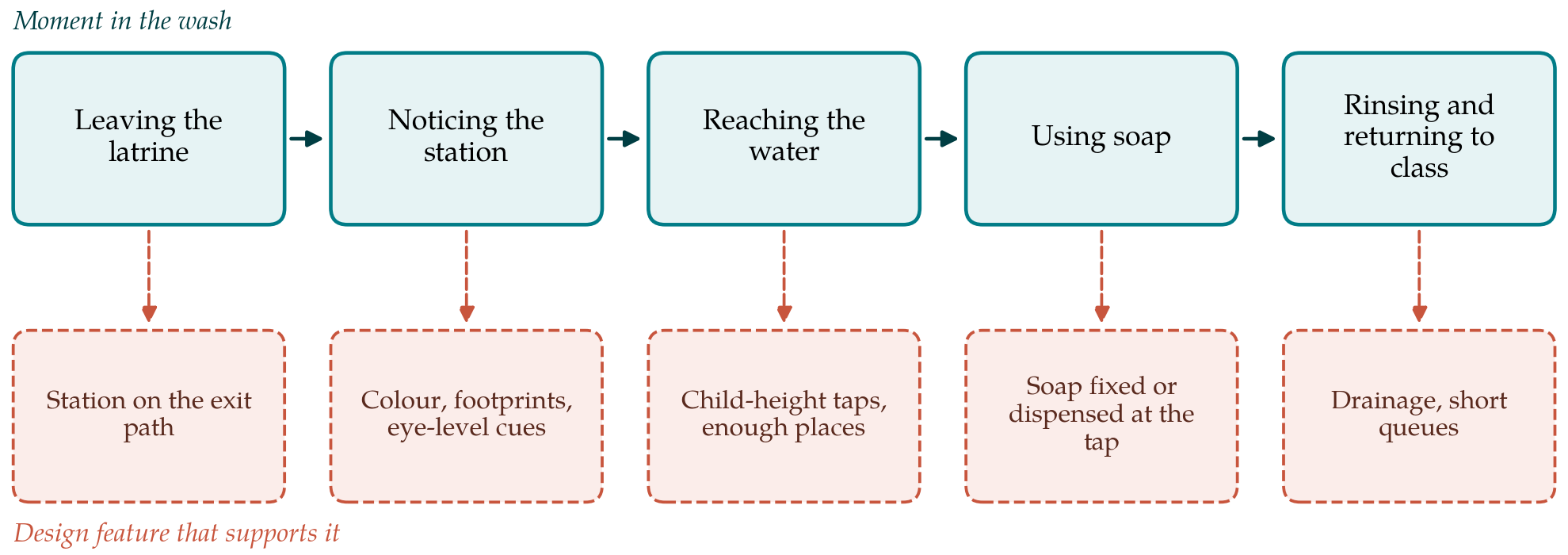
A subsequent cluster-randomised trial compared the same kind of nudges with an intensive programme of hygiene education. Both raised handwashing, and the low-cost nudges did about as well as the more demanding education package (Grover et al., 2018). Taken with the pilot, this suggests that an environmental cue can substitute for a good deal of teaching effort. It does not show that the effect lasts for years, and neither study was set in a crowded peri-urban school where the path between latrine and classroom may be a few metres of shared yard. Figure 1 sets out the moments in a single wash and the design feature that the literature links to each.
4.2. Soap and water at the point of use
Stations without soap are the common failure. In a cluster-randomised trial in Nyanza Province, Kenya, schools that received a regular supply of soap showed more handwashing with soap among pupils than control schools, although the effect on hand contamination was less consistent (Saboori et al., 2013). The larger trial from which that work grew found that a school package of water treatment, hygiene promotion and sanitation did not reduce absence overall but did so among girls (Freeman et al., 2012). The health gains of a working station are therefore plausible but not guaranteed by the hardware.
Where water itself is unreliable, as it often is on the urban fringe, the choice of cleansing agent becomes a design question. In primary schools serving an informal settlement in Nairobi, pupils with access to waterless hand sanitiser cleaned their hands after toilet use more often than those given soap and water (Pickering et al., 2013). Sanitiser does not remove visible dirt and has its own costs and supply chain, so the finding argues for matching the station to local constraints and not for a single preferred product.
4.3. Group handwashing as a daily routine
A different approach builds the habit through timetabled, supervised washing by a whole class. The Fit for School programme in the Philippines combines daily group handwashing with soap, daily toothbrushing with fluoride toothpaste and periodic deworming, using long troughs with many outlets so that a class can wash together in a few minutes (Monse et al., 2013). Promotion trials in Chinese and Egyptian schools, which coupled teaching with soap and scheduled washing, reported less absence from illness (Bowen et al., 2007; Talaat et al., 2011). The design implication is that capacity matters: a single tap serving several hundred pupils cannot support a routine, however well placed it is.
4.4. Hardware, height and durability
Formative research in Bangladesh used the Integrated Behavioural Model to develop a household handwashing station through repeated prototypes and user feedback (Hulland et al., 2013). Users valued a station that kept soap and water together in one place, could be refilled easily, and was sturdy. School guidance from the World Health Organization makes similar practical demands: handwashing points close to toilets and eating areas, at a height children can reach, with drainage that does not leave standing water (Adams et al., 2009). A process evaluation in English primary schools, a very different setting, found the same obstacles under other names: too few sinks, too little time between lessons, and facilities that were unpleasant to use (Chittleborough et al., 2012).
5. Sustaining Use After the Programme Ends
Systematic reviews of school water, sanitation and hygiene programmes agree that reported benefits are real but uneven, and that most evaluations stop within a school year (Jasper et al., 2012; McMichael, 2019). What happens afterwards depends less on the original design than on who refills the soap, who repairs the tap and whether the school has money for either. The Kenyan soap trial was designed around exactly this problem, since schools that had been given handwashing containers frequently had no soap to put beside them (Saboori et al., 2013). Design can ease that burden by using parts that are sold locally, by protecting soap from theft and by making faults visible, but it cannot remove it.
Evidence from outside schools shows that sustained change is possible. The SuperAmma campaign in rural India, built on emotional motives instead of health messages, raised handwashing with soap in intervention villages, and the difference was still present a year later (Biran et al., 2014). Behaviour change models used in the sector treat the ability to maintain a behaviour and to recover from lapses as something to be planned for in its own right. For a school, the equivalent is a routine that survives a change of head teacher or a week without water.
6. Implications for Peri-Urban Schools
Three features of peri-urban schools alter how the findings should be read. Intermittent supply means that stations depending on mains pressure will be dry for part of most days, which favours designs with storage, low-flow outlets or a non-water alternative. High pupil numbers on small plots mean that queues form quickly at break, which favours multiple outlets and scheduled group washing over a single showpiece unit. Shared or contested compounds raise the risk of theft and vandalism, which favours fixed soap, enclosed tanks and involvement of the surrounding community.
None of these inferences has been tested directly in a controlled study in peri-urban primary schools. They follow from the mechanisms the literature describes, and they are consistent with the Nairobi findings on sanitiser, but they remain reasoned extrapolation. School authorities choosing a design should therefore treat it as provisional and watch what children do at the station over several terms.
7. Gaps and Future Work
The largest gap is duration. Almost no study has followed handwashing at school stations for more than a year, so claims about sustained use rest on theory and short trials. A second gap is measurement. Structured observation is the accepted standard but is costly and alters behaviour, while self-report overstates washing; practical guidance recommends proxies such as the presence of soap and water at the station, with their limits acknowledged (Ram, 2013). A third gap is comparison. Station designs have rarely been tested against one another, so it is not known which feature carries most of the effect when several are introduced together. Trials that vary one design element at a time, run for at least two school years and include schools on the urban fringe would address all three.
8. Conclusion
The literature gives reasonable grounds for treating the handwashing station as a behavioural device and not only as plumbing. Placement on the route from the latrine, conspicuous cues, soap that is always at the tap and enough outlets for a class to wash together are each supported by at least one field study and by a coherent account of how habits form. The same literature is candid about its limits: follow-up is short, peri-urban schools are scarcely represented, and the upkeep of consumables is repeatedly the point at which programmes fail. Design can make sustained handwashing easier. Whether it can secure it without a maintained supply of soap, water and attention is a question the evidence does not yet answer.
Conflict of interest
To be declared by the author(s) before publication.
Funding
To be declared by the author(s) before publication.