1. Introduction
Diseases such as Chagas disease, leishmaniasis and human African trypanosomiasis affect populations with little commercial purchasing power, and the drugs available for them are old, toxic or awkward to administer. The road map published by the World Health Organization (2021) sets targets for control that the current pharmacopoeia is not adequate to meet. Repurposing an approved medicine shortens development because human pharmacokinetics and safety are already documented, an argument reviewed with its practical obstacles by Pushpakom et al. (2019).
Antifungal agents are a natural set to examine. The azoles act on sterol 14-demethylase, a cytochrome P450 enzyme that catalyses an essential step in sterol biosynthesis and that is present across fungi, plants, animals and trypanosomatid protozoa (Lepesheva and Waterman, 2007). The mechanisms of the main antifungal classes are well characterised (Odds et al., 2003), and interest in azole inhibition of the trypanosomatid enzyme has a long history (Buckner and Urbina, 2012). The set of approved antifungals is small enough that every member can be docked, inspected by eye and discussed.
What is missing is not computing power but discipline. Docking a few dozen known drugs into a homology model and reporting the best scores is quick, publishable and of little consequence. This article proposes a workflow that makes such a screen worth doing: it fixes the decisions in advance, requires a validation step before any prediction is believed, and ends in a committed list for experimental testing. The workflow is a proposal. It has not been applied to a target here, and no docking results are reported.
2. Background
Two bodies of work inform the design. The first concerns the reliability of docking. Comparative assessments have repeatedly found that docking programs reproduce crystallographic poses reasonably often while ranking compounds by affinity poorly (Warren et al., 2006), and Chen (2015) catalogued the ways in which docking results are routinely over-interpreted. The practical guidance assembled by Bender et al. (2021) treats retrospective validation against known ligands and decoys as a precondition rather than an optional extra, and large prospective campaigns such as the one reported by Lyu et al. (2019) succeed partly because they test many predictions experimentally.
The second concerns repurposing itself. A compound optimised against one organism carries the properties it was optimised for, including a distribution profile suited to its original indication. Potency against a purified enzyme is therefore a weak predictor of clinical usefulness, and the history of azoles in Chagas disease illustrates the point: encouraging activity against the parasite enzyme did not carry through, and a randomised trial of posaconazole in chronic infection reported inferior parasitological efficacy compared with benznidazole (Molina et al., 2014). A workflow that ends at a docking score ignores exactly the step where the difficulty lies, a concern raised in the wider discussion of lead discovery for tropical diseases by Nwaka and Hudson (2006).
3. The Proposed Workflow
The workflow has five stages, shown in Figure 1. The loop in the figure is deliberate: a stage that fails its stop condition returns to the preceding one rather than passing forward a weak result. Table 1 states the condition for each stage and the record it leaves.
| Stage | Condition to be met before proceeding | Record kept |
|---|---|---|
| 1. Target choice | Published evidence of essentiality and of an approved drug against the orthologue | Target rationale with citations |
| 2. Receptor preparation | Co-crystallised ligand re-docked near its observed pose; site residues well resolved | Structure source, preparation settings |
| 2b. Protocol validation | Known actives ranked above property-matched decoys (Mysinger et al., 2012) | Enrichment plot and decoy set used |
| 3. Docking | Two programs run with declared settings and fixed seeds | Parameter files, versions, full score table |
| 4. Pose inspection | Expected interaction present and pose consistent between programs | Annotated figures of retained poses |
| 5. Commitment | Number of compounds and assay fixed before the final ranking is read | Signed and dated test list |
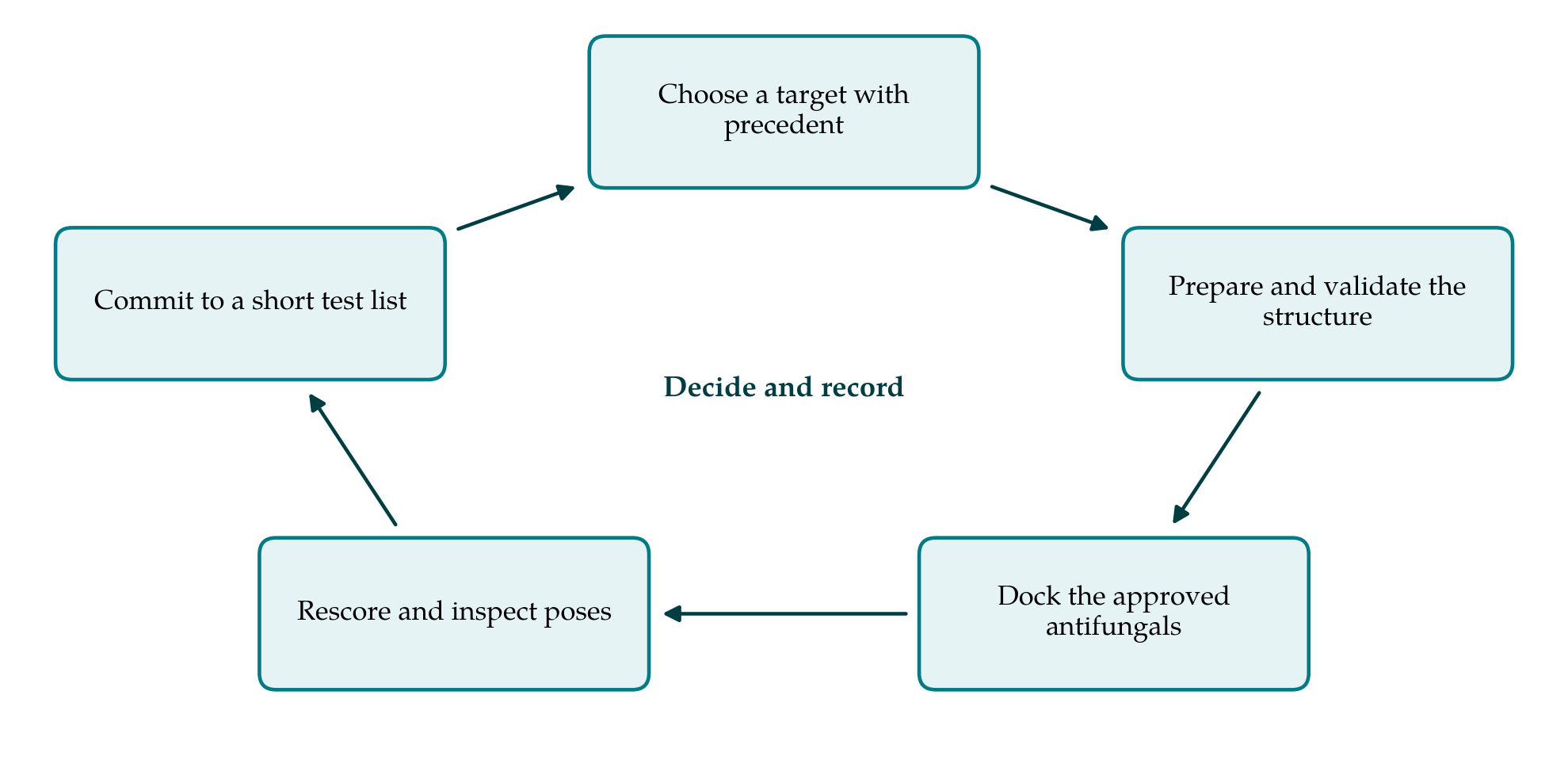
3.1. Stage 1: Choose a target with cross-kingdom precedent
The target is chosen before any compound is docked, and the case for it is written down. Three conditions are reasonable: the enzyme or receptor is essential to the pathogen under the conditions of infection, an orthologue is the established target of at least one approved antifungal, and the binding site is similar enough that the same chemistry is plausible. Sterol 14-demethylase satisfies all three for several trypanosomatids (Lepesheva and Waterman, 2007), which is why it recurs in this literature, but the same reasoning can identify others. Essentiality claims should rest on published genetic or chemical evidence and be cited as such.
3.2. Stage 2: Prepare and validate the receptor
An experimental structure of the pathogen enzyme is preferred, obtained from the Protein Data Bank (Berman et al., 2000). Where none exists, a predicted model from the database of Varadi et al. (2022), built with the method of Jumper et al. (2021), can be used, with the confidence scores for the binding site residues reported rather than the global score. Preparation involves adding hydrogens, assigning protonation states at the relevant pH, deciding the fate of the haem cofactor and of ordered water molecules, and defining the search box. Every one of those choices alters the outcome and belongs in the record.
Validation comes before prediction. The protocol is required to re-dock a co-crystallised ligand close to its observed pose where such a structure exists, and to rank known actives above property-matched decoys of the kind assembled by Mysinger et al. (2012). A protocol that cannot separate known azole inhibitors from decoys for the orthologous enzyme is not fit to make predictions about the pathogen enzyme, and the correct response is to revise the preparation rather than to proceed.
3.3. Stage 3: Dock the approved antifungal set
The compound set is defined by an explicit rule, for example every systemically administered antifungal with a current marketing authorisation in a stated jurisdiction, drawn from a referenced source such as the database described by Wishart et al. (2018). Structures are standardised, protonated at the chosen pH and expanded into the relevant tautomers and stereoisomers. Docking itself is routine: an open program such as the one described by Trott and Olson (2010) in its current implementation (Eberhardt et al., 2021) is adequate, and a second program with an independently derived scoring function provides a useful cross-check. Exhaustiveness settings, box dimensions, random seeds and software versions are recorded.
3.4. Stage 4: Rescore and inspect the poses
Scores are treated as a filter and not as affinities. The top-ranked poses are inspected by a chemist, who asks whether the coordinating interaction expected for the compound class is present, whether the pose is strained, whether it buries polar groups without compensation, and whether it is consistent across the two programs. Rescoring with a different function, or short molecular dynamics relaxation of the complex where resources allow, tests the stability of the pose. Compounds whose ranking depends entirely on one scoring function are set aside. This stage is where most of the value is added and it cannot be automated away.
3.5. Stage 5: Commit to a short list
Before the ranked list is examined for a second time, the group fixes how many compounds will go to the wet laboratory and what assay will be used: an enzyme inhibition assay, a whole-cell assay against the relevant parasite stage, and a counter-screen against the human orthologue to gauge selectivity. Fixing the number first prevents the list from expanding to include whatever looks interesting. Negative results from the committed list are reported with the positive ones, since a screen whose failures are invisible teaches nothing about the method.
4. Stop Conditions and the Record
Table 1 collects the stop conditions. They are deliberately strict, because the cost of proceeding with an inadequate receptor or an unvalidated protocol is borne later, by the collaborator who spends laboratory time on a prediction that was never sound.
5. Fitting the Workflow to a Small Group
The computational demands are slight. A set of a few dozen approved drugs docked into one site runs on a laptop in hours, and the open tools required are freely available. The costs lie elsewhere: in the time of a chemist who can judge a pose, in access to a laboratory able to run the parasite assay, and in the discipline of writing the rationale before the results. Groups in endemic countries often have the second of those and lack the first, which argues for collaboration rather than for more compute.
Reporting deserves the same care. A screen reported with its validation step, its full score table and its committed test list is useful to the next group even when nothing active is found. A screen reported only as a ranked list of hopeful compounds adds to a literature that is already crowded with them.
6. Limitations and What Remains to Be Shown
Three limitations are intrinsic. Docking scores correlate weakly with measured affinity (Warren et al., 2006), so the workflow should be understood as a way of ordering a small set for testing and not as a prediction of potency. Predicted receptor structures may be accurate in the fold and wrong in the side chain conformations that determine the fit, which matters most for a buried site. And activity against an isolated enzyme does not establish activity in the parasite, let alone in a patient, as the azole experience in Chagas disease shows (Molina et al., 2014).
What remains to be shown is whether the workflow improves on current practice. Two tests suggest themselves. One is retrospective: applying it to targets for which the outcome of an antifungal repurposing attempt is already published, and asking whether the stop conditions would have prevented the attempts that failed for computational reasons. The other is prospective and collaborative: several groups applying the same workflow to different targets, reporting the committed lists and the assay results whatever they are. Neither has been done here, and until one of them is, the workflow should be read as a proposal.
7. Conclusion
Screening approved antifungals against a conserved target in a neglected pathogen is cheap, and cheapness is what makes a disciplined procedure worth having. The five-stage workflow proposed here places the target rationale and the protocol validation before any prediction, keeps two scoring functions in play, insists on human inspection of poses, and fixes the experimental test list in advance. It is assembled from published docking practice and repurposing guidance rather than from new results, and its value is an empirical question. Groups working on these diseases, who carry the cost of unproductive predictions, are the ones best placed to settle it.
Conflict of interest
To be declared by the author(s) before publication.
Funding
To be declared by the author(s) before publication.