1. Introduction
An operator who controls a remote manipulator by vision alone works slowly and presses too hard. Returning the forces and vibrations of contact restores much of the dexterity lost to distance, and the control theory of doing so has been studied for decades (Hokayem and Spong, 2006). The central difficulty has not changed since the earliest work: the communication channel delays the signals, and a force-reflecting loop closed across a delay can become unstable.
One response is to ask the network to remove the delay. The Tactile Internet programme set a target of roughly one millisecond of end-to-end latency so that remote touch would feel immediate (Fettweis, 2014). The physics is unforgiving, since light in optical fibre covers only about 200 km in a millisecond, and the target presupposes infrastructure that is absent from disaster sites, offshore platforms, rural clinics and orbit. On the links actually available there, delay fluctuates and packets go missing. This communication considers what can be done at the two ends of such a link, and argues that tactile feedback in particular leaves more room for engineering than the one-millisecond figure suggests.
2. Two Kinds of Feedback, Two Kinds of Sensitivity
Haptic feedback is not one signal. Kinesthetic feedback applies forces to the operator's hand through a motorised device, and the hand's resulting motion is sent back as a command. Energy flows both ways, so the operator, the two robots and the channel form a closed loop. Anderson and Spong (1989) showed that a delayed channel in such a loop behaves as an active element and proposed a scattering transformation that keeps it passive for any constant delay. Niemeyer and Slotine (1991) recast the idea as wave variables. Passivity buys stability at the cost of fidelity, a trade-off that Lawrence (1993) made explicit: the stiffer and more transparent the rendering, the narrower the stability margin. Time-domain passivity control later allowed the damping to be applied only when an energy observer detects that the loop is generating energy (Hannaford and Ryu, 2002), which suits delays that vary.
Cutaneous tactile feedback is different in kind. A vibration motor, a skin-stretch element or a pressure pad on the fingertip conveys information without pushing the operator's arm, so it does not close a mechanical loop through the channel, and a late tactile cue cannot destabilise the system. Its sensitivity to delay is perceptual. Manipulation relies on discrete mechanical events (making contact, the start of slip, release), which tactile afferents signal with brief bursts and to which grip responses are tightly timed (Johansson and Flanagan, 2009). A cue that arrives after the event has been seen is no longer fused with it. What matters, therefore, is that the timing of contact events is preserved, and that is a weaker requirement than a uniformly fast channel.
3. Keeping the Critical Loop Short
Three strategies from the literature reduce dependence on the link. They act at different points and can be combined; Table 1 sets them beside the two passivity methods described above.
| Strategy | What crosses the network | Behaviour under delay and loss | Main risk |
|---|---|---|---|
| Wave-variable control (Niemeyer and Slotine, 1991) | Wave signals in place of force and velocity | Passive for constant delay; contact feels softer as delay grows | Loss and varying delay need extra measures |
| Time-domain passivity control (Hannaford and Ryu, 2002) | Force and velocity, with energy monitored at each end | Damping injected only when the loop generates energy | Abrupt damping can be felt |
| Perceptual deadband coding (Hinterseer et al., 2008) | Samples only when the change exceeds a perceptual threshold | Fewer packets, so less congestion; a lost update persists until the next | Stale values held after loss |
| Model-mediated teleoperation (Mitra and Niemeyer, 2008) | Parameters of a local model of the remote environment | Forces rendered locally with no delay | Model wrong or outdated |
| Event-based transient rendering (Kuchenbecker et al., 2006) | Notice of a contact event and its intensity | High-frequency cue generated locally at the event | Cue is synthetic, not measured |
Perceptual coding exploits the limits of the sense of touch. Haptic devices are conventionally served at about one kilohertz, and sending every sample as a packet loads the network heavily. Under the deadband scheme of Hinterseer et al. (2008) a sample is sent only when it differs from the last transmitted value by more than a fraction of that value, following Weber's law of just noticeable differences. Lowering the packet rate eases congestion, which is itself a source of delay and loss. The drawback under loss is that each surviving packet carries more weight, and a missing update leaves an old value in force until the next arrives, so the scheme is normally paired with a passivity safeguard (Steinbach et al., 2012).
Model-mediated teleoperation removes the measured force from the loop altogether. The remote robot estimates a simple model of what it touches, for instance the position and stiffness of a surface, and sends the model's parameters. The operator's device renders forces from the local copy at full rate (Mitra and Niemeyer, 2008). Delay then affects how quickly the model is corrected, not how quickly the operator feels a wall. Event-based rendering applies similar thinking to the high-frequency part of touch. Kuchenbecker et al. (2006) showed that the realism of contact with a hard surface depends on a brief acceleration transient at the moment of impact, and that such a transient can be triggered open-loop from a stored or scaled waveform. Over a network this means that a contact event needs to be announced once, and the cue can be produced locally. The approach has an older root in the observation that vibration felt through a tool tells the operator a great deal about the contact it is making, and it fits lossy links well: an event notice is a few bytes long and can be sent several times over to make sure that one copy arrives. Its limit is equally plain. The waveform the operator feels is chosen in advance, so differences between materials are conveyed only as far as the event message describes them.
4. A Layered View of the Design Problem
These strategies are easier to combine when the system is seen in layers, as in Figure 1. At the bottom, the transport layer offers whatever delay, jitter and loss the link has; redundancy and prioritisation of haptic packets belong here, and surveys of haptic communication over mobile networks treat them at length (Antonakoglou et al., 2018). The coding layer decides what is worth sending. The control layer keeps the kinesthetic loop passive whatever arrives. The local rendering layer generates the time-critical cues at the operator side from events and models. At the top sits the operator's perception, which sets the tolerances for every layer beneath it.
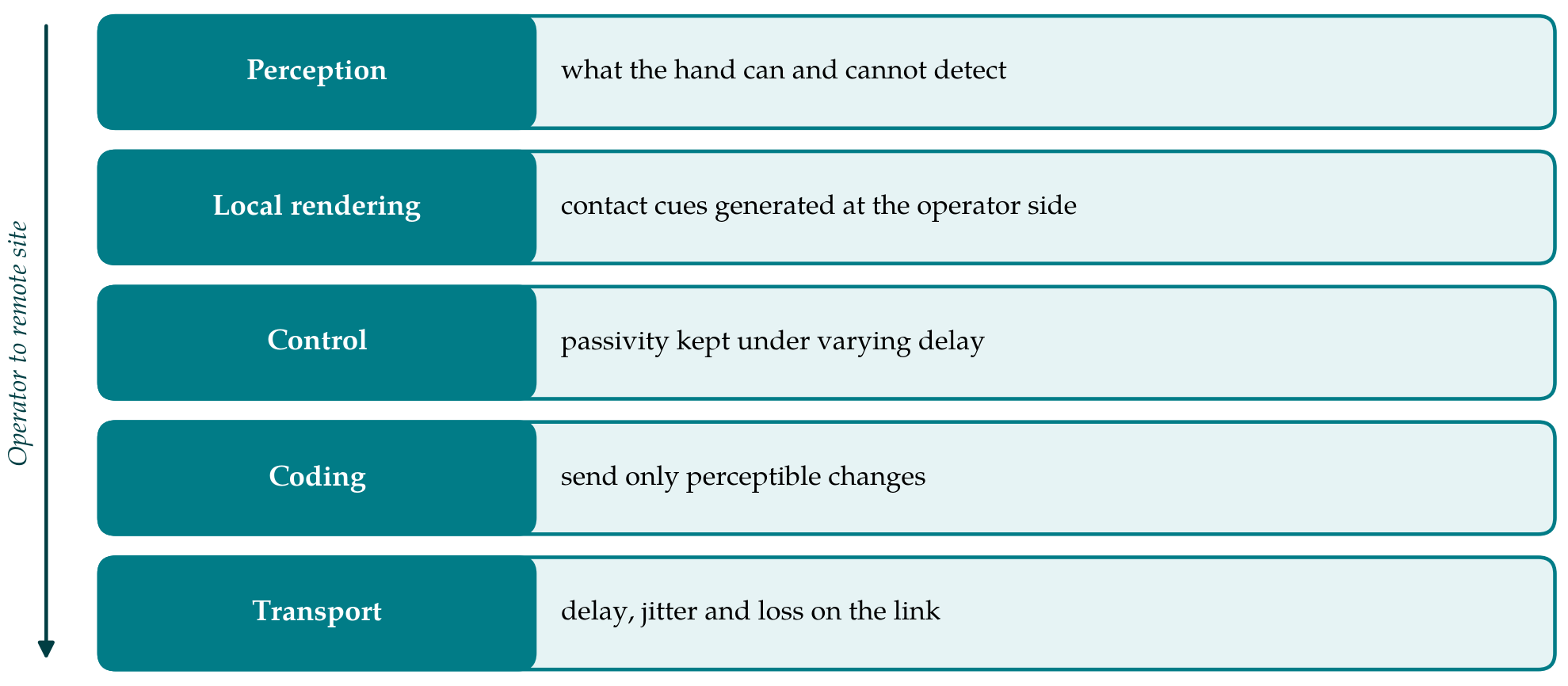
Reading the stack from the top changes the design question. Instead of asking how fast the link must be, the designer asks which signals the hand needs promptly, which of those can be produced locally, and what the remainder demands of the network. For many manipulation tasks the prompt signals are few: contact, slip and release. Sustained force can be shown more slowly, or on a different channel such as a visual gauge, with little loss of task performance, while the stability-critical kinesthetic path is kept conservative.
5. Open Questions
Several matters are unresolved. Evaluation is the first. Stability analyses assume bounded or constant delay, and perceptual thresholds are measured under laboratory conditions. Real wireless links lose packets in bursts, and neither literature says much about how bursts are felt. Test methods that replay recorded network traces against standard manipulation tasks would make results comparable.
The second concerns honesty of the display. A locally generated cue is a prediction. If the model is wrong, the operator feels a contact that did not happen or misses one that did. How uncertainty should be conveyed through touch without overloading the operator is largely unexplored. The third is the division of authority: as more of the feedback is synthesised locally, teleoperation shades into supervised autonomy, and the point at which the operator should be told so deserves explicit design.
6. Conclusion
Low-latency tactile feedback need not wait for a low-latency network. Kinesthetic feedback closes a loop and must be kept passive, which established methods achieve at some cost in fidelity. Cutaneous tactile feedback does not close that loop, and its timing requirements attach to a small number of contact events that can be coded sparsely and rendered at the operator side. A design that starts from what the hand must feel promptly, and assigns each signal to the layer that can best supply it, makes useful touch feedback possible on the imperfect links where remote manipulation is most often needed.
Conflict of interest
To be declared by the author(s) before publication.
Funding
To be declared by the author(s) before publication.