1. Introduction
Operating on the larynx of an awake patient is an old practice. Before general anaesthesia became safe and routine, laryngologists removed lesions under mirror guidance with cocaine as the only anaesthetic, and the indirect approach never entirely disappeared (Bastian and Delsupehe, 1996). Its return to the mainstream came with technology. Flexible endoscopes with a camera chip at the tip and a working channel gave a stable, magnified view that could be shared on a screen. Lasers that could be passed through that channel on a thin fibre, first the pulsed dye laser and then the potassium titanyl phosphate laser, allowed papilloma and dysplasia to be treated without suspension laryngoscopy (Zeitels et al., 2004; Zeitels et al., 2006). Injectable materials for vocal fold augmentation completed the set.
A substantial review a decade and a half ago already described office-based diagnosis and treatment as an established part of laryngology (Rosen et al., 2009), and later reviews have catalogued the procedures and their results (Shah and Johns, 2013; Wellenstein et al., 2018). What these sources assume is an experienced unit. A department starting from nothing has to make many decisions that the technical papers pass over: which procedures to offer first, in what room, with which staff, on which patients, and with what arrangements for the occasion when something goes wrong. This article proposes an ordered way of making those decisions. It describes a framework and reports no experience of applying it.
2. The Case for the Office
Three arguments are usually made. The first is avoidance of general anaesthesia, which matters most for the frail patients who make up a good share of those with vocal fold paralysis or recurrent papilloma. The second is functional: an awake patient can phonate, so the surgeon injecting a paralysed vocal fold hears the voice change and can judge the amount to place (Sulica et al., 2010). The third is cost and convenience. Comparisons of office and theatre pathways for injection laryngoplasty and for laser treatment of papilloma have found the office route considerably cheaper (Bové et al., 2007; Rees et al., 2007), and patients asked about unsedated laser procedures have mostly said they would choose the same again (Rees et al., 2006). Table 1 lists the procedures commonly moved to the office and the route by which each is done.
| Procedure | Usual route | Principal hazard | Source |
|---|---|---|---|
| Injection augmentation | Transoral, or through the neck under endoscopic view | Misplaced or excessive injectate | Sulica et al., 2010 |
| Botulinum toxin injection | Through the neck, often with electromyography | Breathy voice, aspiration of liquids | Blitzer et al., 1998 |
| Biopsy | Forceps through the endoscope channel | Bleeding, inadequate sample | Rosen et al., 2009 |
| Laser treatment of papilloma or dysplasia | Fibre through the endoscope channel | Thermal injury, eye exposure | Koufman et al., 2007 |
| Steroid or other medication injection | Transoral or through the channel | Coughing, incomplete delivery | Wellenstein et al., 2018 |
3. What the Office Does Less Well
The case has limits that a new service should recognise from the outset. The view through a flexible endoscope is two-dimensional and the instruments passed down its channel are small, so the precision of microlaryngoscopy, with binocular magnification and two-handed dissection, is not reproduced. Biopsies taken through the channel are small and may under-represent a lesion. An equivocal or negative result from a lesion that looks suspicious should therefore lead to direct laryngoscopy and not to reassurance. Office laser treatment of papilloma controls the disease but generally has to be repeated at intervals. These are reasons to regard the office and the theatre as complementary, with a clear route from one to the other.
4. Hazards the Service Must Control
The reported complication rate of office laryngeal procedures is low, including in a large series of laser cases using three wavelengths (Koufman et al., 2007). Low is not zero, and the hazards differ from those of the operating theatre. The patient is conscious, unmonitored unless monitoring is arranged, and without a secured airway. Yung and Courey (2010) measured heart rate and blood pressure during office-based flexible endoscopic surgery and found rises large enough, in a notable share of patients, to qualify as severe hypertension or tachycardia, with no symptoms to alert the operator. Awake instrumentation of the pharynx can also provoke the opposite response, a vasovagal faint.
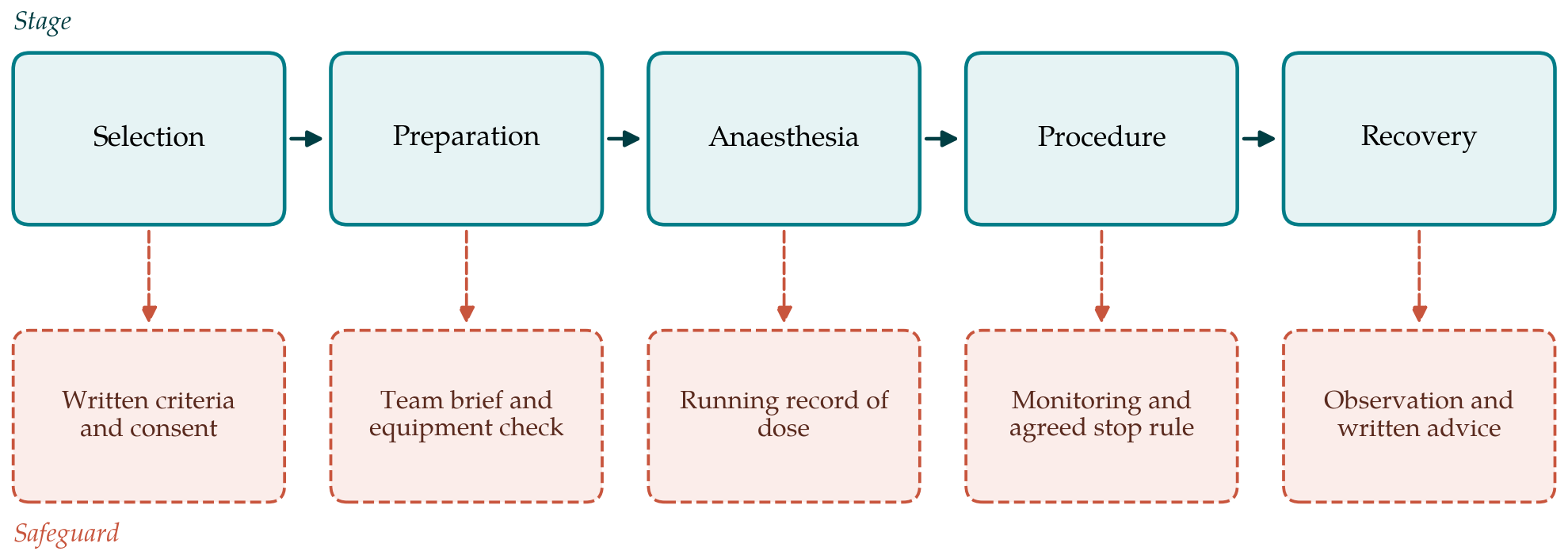
The airway itself may be compromised by laryngospasm, by bleeding, or by swelling after injection into an already narrow glottis. Topical anaesthesia removes the protective sensation of the larynx for a time, so that food and drink taken too soon may be aspirated. Local anaesthetic is applied to mucosa from which it is absorbed quickly, and several applications by different routes can add up to a large total. Lasers bring risks to the eyes of everyone in the room and are governed by formal standards (American National Standards Institute, 2018). A safe service is one in which each of these hazards has a named control, and Figure 1 pairs the stages of a procedure with the safeguard proposed for each.
5. Components of the Service
The framework has eight components. They are described in the order in which a department would normally address them.
5.1. Governance and scope
The service should begin with a written statement of which procedures it will perform, approved through the hospital's process for introducing new procedures. A sensible starting scope is narrow: injection augmentation and channel biopsy, for example, with laser work added once the team is practised. The statement names the clinicians credentialed for each procedure and what training that requires. It also records who was consulted. Anaesthetic and resuscitation colleagues should see the plan in advance, since they are the people who will be called if a patient collapses.
5.2. Room, equipment and staff
The room needs space for a reclining chair that can be laid flat, the endoscopy stack, and free access to the patient from both sides. Oxygen, suction separate from that on the endoscope, a bag-valve-mask, basic airway adjuncts, a pulse oximeter and a blood pressure monitor are kept in the room and checked before each list. The location of the nearest resuscitation trolley and the means of summoning the emergency team are known to everyone present. A card listing the immediate actions for collapse, laryngospasm and suspected local anaesthetic toxicity is displayed on the wall, and the drugs it names are held with the emergency equipment. Where a laser is used, the room meets the requirements of the applicable laser safety standard, including wavelength-specific eyewear, door signage and a designated laser safety officer (American National Standards Institute, 2018). The minimum team is the operator, an assistant who handles instruments or the endoscope, and a nurse whose only task is to watch and support the patient. Endoscopes are reprocessed according to the hospital's decontamination policy, which may limit the number of cases per session.
5.3. Patient selection and consent
Written criteria decide who is offered an office procedure. Anatomy and temperament both count: a strong gag reflex, severe anxiety, inability to sit still or a nasal airway too narrow for the endoscope make success unlikely. So does the lesion: bulky or obstructing disease, and lesions needing precise microsurgical excision, belong in theatre. Cardiovascular disease is not a bar but should prompt monitoring throughout, given the haemodynamic findings described above (Yung and Courey, 2010). Published practice on anticoagulant and antiplatelet drugs varies, and the service should agree a policy with its haematology advisers and not leave the matter to each operator. Consent covers the specific risks of the procedure, the chance that it cannot be completed awake, and the alternative of general anaesthesia.
5.4. A standard anaesthetic routine
Variation in anaesthetic technique is a source of both failure and risk, and a single default routine is preferable to individual habit. The usual elements are a topical decongestant and anaesthetic to the nose, anaesthetic to the pharynx, and anaesthetic to the larynx itself, dripped onto the vocal folds through the endoscope channel or a curved cannula while the patient phonates, so that it is spread by the resulting cough. Nebulised anaesthetic and injection through the cricothyroid membrane are alternatives. For percutaneous injections the skin and the track are infiltrated, for example across the thyrohyoid membrane (Amin, 2006). The essential safeguard is arithmetic. The maximum dose for the patient's weight is calculated from the product information before starting, and the nurse keeps a running total of every application. Time must then be allowed for the anaesthetic to work, since haste at this stage is the commonest reason for an abandoned procedure.
5.5. Conduct of the procedure and stop rules
Immediately before starting, the team pauses to confirm the patient, the procedure, the side, the allergies and the equipment, in the manner of the surgical safety checklist whose use reduced complications in a multinational study (Haynes et al., 2009). A version shortened for the clinic is adequate. Baseline pulse, blood pressure and oxygen saturation are recorded, and oximetry continues throughout. Stop rules are agreed in advance and stated aloud: the procedure ends if the patient asks, if bleeding obscures the view, if saturation falls or the pulse or pressure passes limits the service has set, or if a fixed time has elapsed without progress. An operator absorbed in a difficult injection is poorly placed to make that judgement alone, and the nurse must have explicit authority to call a halt.
5.6. Recovery and discharge
After the procedure the patient is observed until the voice, breathing and observations are stable. Nothing is taken by mouth until sensation in the throat has returned, and the first drink is water, taken under supervision. Written advice states what to expect, including transient hoarseness or discomfort, and which symptoms, above all noisy or laboured breathing, require immediate return. A telephone number that will be answered is given. Patients who have had augmentation of a narrow glottis or a substantial laser treatment may warrant longer observation. If a planned procedure has been abandoned, the patient leaves with a definite plan, either a further attempt with a modified technique or a date for theatre, so that failure in the office does not turn into delay in treatment.
5.7. Documentation
Each procedure is recorded in a standard form: indication, consent, anaesthetic agents and total dose, the endoscope and instruments used, laser settings and energy delivered where relevant, the material and volume injected, observations before and after, any adverse event, and the advice given on leaving. Still images or a short video clip taken before and after are stored with it. A template completed at the time takes little longer than a free-text note and allows later audit without a search through case notes.
5.8. Audit and training
From the first case the service records a small set of measures: whether the procedure was completed as planned, conversions to general anaesthesia, adverse events of any severity, the dose of anaesthetic used, and the patient's own rating of tolerability. Reviewed at intervals, these show whether selection criteria are too loose or too strict. New operators and nurses should rehearse the routine, including the response to a faint and to laryngospasm, before working with patients. Reviews of injection technique give a useful account of the choices of route and material that training must cover (Mallur and Rosen, 2010).
6. Limitations and What Remains to Be Shown
The framework is a proposal. Its elements are taken from published descriptions of office practice and from general patient safety measures, and each is reasonable on its face, but the package has not been introduced and evaluated in a department, and no claim is made that it lowers complication rates. Serious events in this setting are rare enough that demonstrating a reduction would require pooled data from many units. Several of its particulars are matters on which practice differs and evidence is thin: the place of routine blood pressure monitoring in patients without cardiovascular disease, the handling of anticoagulants, the length of observation, and how many supervised cases constitute adequate training.
Local conditions will also force changes. Regulations on lasers, on who may administer local anaesthetic and on the classification of procedure rooms differ between countries, and reimbursement rules can make an office service financially unattractive even where it is clinically sound. A unit adopting the framework should treat its first year as a pilot and publish what it finds.
7. Conclusion
Office laryngeal procedures under local anaesthesia offer patients a quicker and often safer alternative to the operating theatre, and the techniques are well described. Safety in this setting comes less from individual skill than from organisation: a defined scope, a prepared room, a team with distinct roles, selection criteria, a counted anaesthetic dose, monitoring, stop rules and audit. The framework proposed here gathers those elements into a form a department can adapt before it treats its first patient.
Conflict of interest
To be declared by the author(s) before publication.
Funding
To be declared by the author(s) before publication.