1. Introduction
Tailings are what is left when ore has been ground and the valuable mineral removed: a slurry of sand, silt and clay-sized particles in process water. For most of the last century the standard way to store them has been to pump the slurry to an impoundment, let the solids settle and reclaim the water that clears on top. The retaining dam is often built in stages from the tailings themselves, and the facility ends its working life as a large body of saturated, loose, fine-grained material that must remain stable indefinitely (Vick, 1990; Blight, 2010).
The failures at Mount Polley in Canada in 2014 and at Fundão and Feijão in Brazil in 2015 and 2019 brought the weaknesses of that arrangement to wide public attention. The expert panels that investigated them traced each to conditions specific to the dam, but they also drew a general lesson. The Mount Polley panel recommended moving to best available technology, by which it meant eliminating surface water from the impoundment, promoting unsaturated conditions and achieving dense or dilatant material through compaction, and it named filtered tailings as a technology that satisfies all three (Morgenstern et al., 2015). The Global Industry Standard on Tailings Management now requires operators to consider alternative technologies when selecting a design (ICMM et al., 2020).
Filtered tailings are dewatered in pressure or vacuum filters until they behave as a moist soil, then carried by truck or conveyor and placed in a compacted stack. The term "dry stack" is established but loose, since the material is damp and not dry. This article reviews how such stacks compare with conventional dams on water use, stability and closure cost, the three headings under which the case for and against them is usually made.
2. Scope and Approach
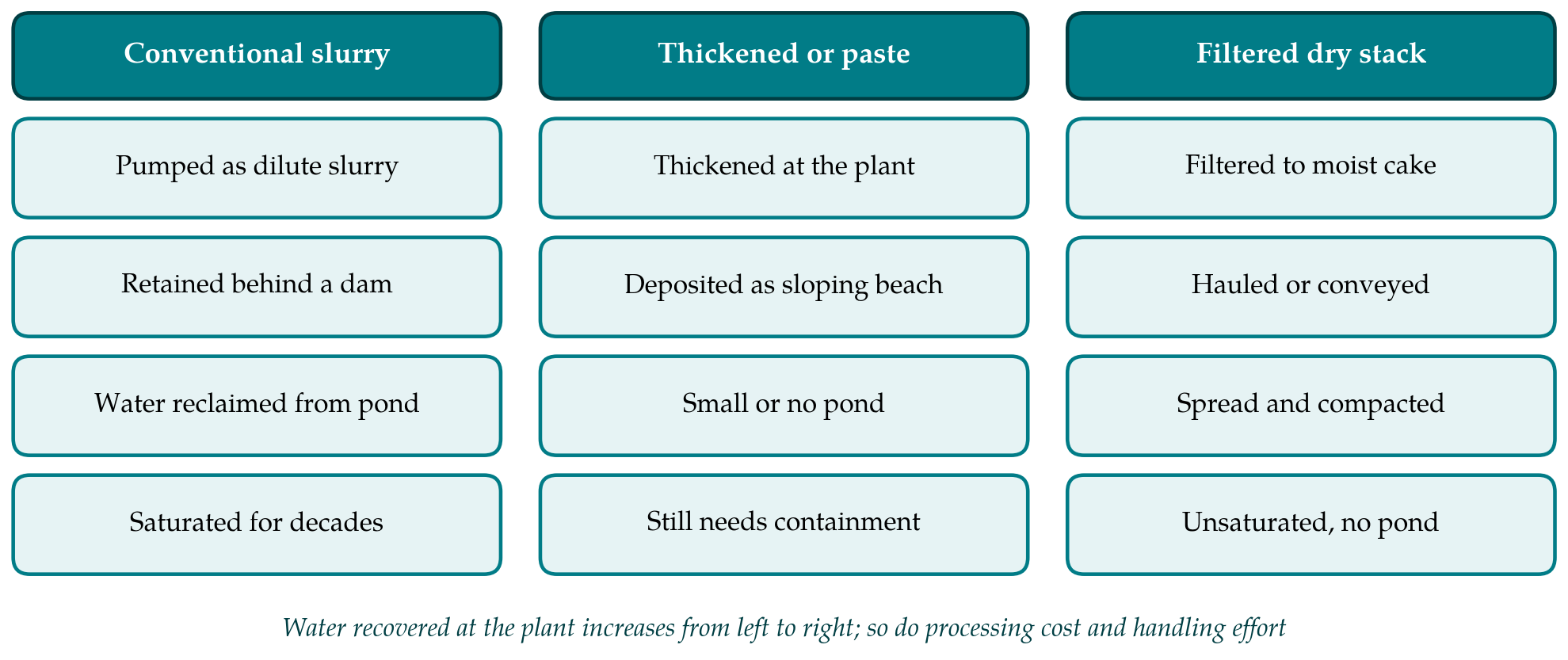
The review is narrative. It draws on standard texts in tailings engineering, the reports of the independent failure panels, guidance from the International Commission on Large Dams and national bodies, peer-reviewed reviews and the proceedings of the Tailings and Mine Waste and Paste conference series, where much of the practical experience with filtration is recorded. No systematic search was undertaken and no new data are presented. Thickened and paste tailings are treated only as intermediate points on the dewatering continuum that Figure 1 sets out; fuller treatment is available elsewhere (Jewell and Fourie, 2015).
A caution applies throughout. Conference papers on dry stacking are largely written by designers and operators of the facilities described, and unsuccessful projects are less likely to be written up. Claims in that literature are treated here as informed professional experience and not as controlled evidence.
3. The Record of Conventional Dams
Any comparison starts from the performance of what is being replaced. Compilations of incidents show that tailings dams have failed at a rate well above that of water-retaining dams, and that the leading causes are overtopping, slope instability, seismic and static liquefaction, foundation failure and seepage or internal erosion (ICOLD, 2001; Rico et al., 2008; Azam and Li, 2010). Dams raised by the upstream method, where each lift is founded on previously deposited tailings, are over-represented. Davies (2002) argued that these failures were not the result of unknown mechanisms but of known principles not being applied.
The common thread is water. A pond can overtop; a high phreatic surface reduces effective stress in the embankment; and loose, saturated, contractive tailings can lose strength suddenly and flow. Santamarina et al. (2019) set out how these conditions combine, and the Fundão and Feijão panels both identified static liquefaction of saturated tailings as the failure mechanism (Morgenstern et al., 2016; Robertson et al., 2019). The damage done downstream is a function of the volume of fluid material that can be released (Kossoff et al., 2014). Removing water at source addresses the cause directly, and this is the core of the argument for filtration.
4. Water Use
In a conventional circuit, water leaves the system in four ways: it stays locked in the pores of the settled tailings, it evaporates from the pond and the wet beach, it seeps into the foundation, and some is discharged. Models of impoundment water balance show that entrainment in the pores is normally the largest of these, with evaporation next in dry climates (Wels and Robertson, 2003). Filtration attacks all of them. Water is recovered inside the plant before the tailings leave it, there is no pond to evaporate, and the placed material has little free water to seep.
Gunson et al. (2012) compared water-saving options for a model copper concentrator and found filtered tailings among the most effective single measures for reducing withdrawal, alongside thickening and the reduction of evaporation. The saving is not total. The filter cake retains moisture, and that water goes to the stack with the solids. Fine, clay-rich tailings hold more water and filter slowly, so the benefit depends on mineralogy and grind as well as climate.
Whether the saving matters depends on the site. Where water is scarce, costly to pump or contested with other users, as in the Atacama, a reduction in make-up demand has direct value, and it is no accident that early filtered operations such as La Coipa in Chile were in deserts (Davies and Rice, 2001). In wet climates the issue is reversed: the difficulty is surplus water, and the advantage of a stack is that it sheds rain instead of accumulating it in a pond that must later be treated and released. Reviews of sustainable tailings practice treat the reduction of both water demand and contact water as central benefits of dewatering (Franks et al., 2011; Edraki et al., 2014).
5. Physical Stability
Table 1 sets the two systems side by side. The geotechnical case for the filtered stack rests on three features. It has no pond, so overtopping is not a credible mode. It is placed unsaturated, so pore pressures are low or negative and strength is correspondingly higher. And it is compacted, so that the outer structural zone at least is dense enough to dilate when sheared. Flow liquefaction requires material that is both saturated and contractive (Jefferies and Been, 2016); a stack built to specification has neither property in its structural shell.
| Aspect | Conventional dam | Filtered dry stack | Representative sources |
|---|---|---|---|
| Water recovery | From pond after settling; losses to pores, evaporation, seepage | At the plant; losses limited to cake moisture | Gunson et al., 2012; Wels and Robertson, 2003 |
| Stored water | Pond on the facility for its whole life | None; runoff diverted and collected | Morgenstern et al., 2015 |
| State of solids | Saturated, often loose and contractive | Unsaturated, compacted in lifts | Davies, 2011 |
| Main failure modes | Overtopping, liquefaction, seepage, foundation | Wetting of base, poor compaction, erosion | ICOLD, 2001; Lupo and Hall, 2010 |
| Consequence of failure | Flow of fluid tailings over long distances | Local slumping; limited runout expected | Kossoff et al., 2014 |
| Geochemistry | Saturation limits sulphide oxidation | Oxygen enters; acid generation possible | MEND, 2017 |
| Cost profile | Low operating cost; long closure and liability tail | High operating cost; simpler closure | Carneiro and Fourie, 2019 |
The qualifications are as well documented as the advantages. Filters do not always meet their moisture target, particularly when ore mineralogy changes or the plant is pushed, and wet cake cannot be compacted. Operations therefore divide the stack into a compacted structural zone and an interior zone that receives off-specification material, and the design depends on that discipline being kept through bad weather and production pressure (Lupo and Hall, 2010; Davies, 2011). In wet or cold climates placement and compaction may be possible only for part of the year.
A second concern grows with height. Tailings placed unsaturated can approach saturation at the base of a tall stack as they compress under the weight above and the pore space shrinks, and infiltration can add to the effect. If the basal material is also loose, the conditions for undrained strength loss are partly restored. The empirical relations for liquefied strength developed from flow failures (Olson and Stark, 2002) are then relevant to stacks as well as to dams. Drainage at the base, limits on the rate of rise and monitoring of pore pressure are the usual responses. Seismic design follows the same principles as for any compacted fill.
Stacks are also exposed surfaces. Without a pond or wet beach, fine tailings are open to wind and rain, and dust and erosion gullies are the day-to-day problems reported by operators. Surface water must be kept off the stack by diversion and the runoff from it collected. None of these issues carries the catastrophic potential of a dam breach, and that difference in consequence, more than any difference in the probability of something going wrong, is what the stability argument comes down to.
6. Geochemical Stability
Physical and chemical stability can pull in opposite directions. Keeping sulphide-bearing tailings under water is an accepted way of limiting oxidation and acid generation, because oxygen diffuses slowly through saturated pores. An unsaturated stack admits oxygen. For tailings with acid-generating potential the choice of filtration can therefore exchange a dam safety risk for a water quality risk, and the Canadian review of tailings technologies treats this as one of the main reasons the best option is site specific (MEND, 2017). Compaction lowers permeability to air and water, and covers, liners and collection of seepage are available, but they are added costs and they need to work for a very long time (Blight, 2010).
7. Closure and Cost
On operating cost the comparison goes against filtration. Pressure filters are capital-intensive, use power and consumables, and need maintenance; the cake must then be moved and compacted by equipment and people, where slurry simply flows down a pipe. For this reason filtered stacks were long confined to operations of modest throughput in places where water or terrain left little choice, among them Greens Creek and Pogo in Alaska and Raglan in northern Quebec (Davies, 2011). Larger filters and conveying systems have since raised the practical scale, but the published record for very high tonnages is still short.
Closure reverses the ranking. A conventional impoundment reaches closure as a saturated deposit with a pond, a dam that remains a dam, and a requirement for surveillance without a foreseeable end. A stack can be shaped to its final landform and covered progressively while the mine is operating, occupies a smaller footprint for the same tonnage because of its higher density, and carries no water-retaining structure into the post-closure period. Current guidance on tailings management stresses that closure objectives should shape the design from the beginning, a principle that favours options with simpler end states (ICMM et al., 2020).
The difficulty is that these costs fall at different times and partly on different parties. Discounted cash flow analysis shrinks closure costs that lie decades ahead, and the cost of a failure is borne largely by people downstream and by the public. Bowker and Chambers (2015) argued that this structure leads to systematic under-weighting of failure liabilities. Carneiro and Fourie (2019) proposed comparing tailings options on an integrated basis that includes closure, post-closure care and risk, and argued that the apparent advantage of conventional storage can narrow considerably once those items are counted. Such comparisons depend heavily on the discount rate and on how failure risk is priced, and neither has an agreed treatment.
8. Gaps in the Evidence
Several questions remain open. Long-term field data on the moisture and pore pressure regime inside tall stacks are scarce in the open literature, so the concern about basal saturation rests more on soil mechanics principle than on measurement. Performance at high throughput and in high-rainfall climates is documented for only a few operations. Published cost comparisons are mostly study-level estimates and not audited outcomes. And there is little independent reporting of problems at filtered facilities, which makes it hard to say how often the qualifications discussed above arise in practice. Hybrid schemes, such as co-disposal of filtered tailings with waste rock, are promising but have even less of a record (Edraki et al., 2014).
9. Conclusion
The literature supports a clear but conditional judgement. Filtered dry stacking recovers more water, removes the pond and the saturated loose state from which the most damaging failures arise, and leaves a facility that is simpler and cheaper to close. It costs more to operate, demands sustained control of filtration and placement, introduces oxidation risk for reactive tailings, and has a shorter record at large scale. Where water is scarce, where people or sensitive environments lie downstream, or where closure liabilities are honestly counted, the balance tends to favour the stack. The choice still has to be made site by site, with the full life of the facility in the comparison.
Conflict of interest
To be declared by the author(s) before publication.
Funding
To be declared by the author(s) before publication.