1. Introduction
Leather is a by-product of meat and dairy production turned into a durable material by tanning, most often with chromium salts. Its mechanical qualities come from the hide's dense, interwoven network of collagen fibres, which tanning stabilises against heat and microbial attack (Covington, 2009). The same process generates effluent and solid waste that are difficult to treat, and the hazards of poorly regulated tanneries are well documented (Dixit et al., 2015; Kanagaraj et al., 2015). Material flow analysis shows how little of the raw hide ends up in the finished article (Joseph and Nithya, 2009). Concern for animal welfare and for the climate burden of cattle has added to the pressure on brands to find something else.
For decades the alternative was coated fabric: a textile backing carrying a layer of polyvinyl chloride or polyurethane. It is cheap and uniform, but it is made from fossil feedstock and does not biodegrade. The newer proposal is a material that is neither animal nor petrochemical. Some candidates use agricultural residues such as pineapple leaf fibre, apple pomace, grape marc or cactus. Others are grown, either as fungal mycelium or as bacterial cellulose, an approach that designers have explored as a way of working with living matter (Karana et al., 2018).
Press coverage of these materials has run ahead of the technical record. Announcements of collaborations with luxury houses are frequent; peer-reviewed measurements are not. This review asks what the published literature supports regarding performance, and what stands between a promising sample and a material that a factory can order by the roll.
2. Scope and Approach
This is a narrative review of the published literature. It draws on peer-reviewed studies in materials science, fungal biotechnology and cleaner production, on standard test methods for leather, and on reference works in leather chemistry. It does not claim to be exhaustive, and no formal screening of records was carried out. Trade names appear only where a published study has examined the product concerned. Commercial claims that could not be traced to a published source have been left out. The term "leather" is used here for tanned animal hide alone, in line with the trade definition (CEN, 2022), and the substitutes are called leather alternatives.
3. Material Families
The alternatives fall into three families that differ in how the sheet gets its structure. Table 1 summarises them alongside the two incumbent materials.
| Material family | How the sheet is formed | Reported strengths | Reported limits |
|---|---|---|---|
| Bovine leather | Collagen fibre network stabilised by tanning Covington, 2009 | High tensile, tear and flex performance; breathable | Tanning effluent; livestock burden |
| PU or PVC coated fabric | Polymer layer on a textile backing | Uniform, cheap, available at scale | Fossil feedstock; not biodegradable |
| Plant-residue composites | Plant fibre or powder in or under a polymer coating | Leather-like handle; ready supply | Often partly synthetic Meyer et al., 2021 |
| Pure mycelium sheet | Fungal hyphae grown as a mat, then treated and pressed Jones et al., 2021 | Wholly biological base; low-cost feedstock | Lower strength; variable; needs finishing |
| Reinforced mycelium | Mycelium grown through or laminated to a textile | Improved tear strength | Mixed material; harder to recover |
| Bacterial cellulose | Nanofibre pellicle from fermentation García and Prieto, 2019 | Fine, strong fibre network when dry | Moisture sensitive; small scale |
3.1. Plant-residue composites
Materials in this family take a fibrous or powdered residue and give it cohesion with a polymer. One route forms a nonwoven from leaf fibre and finishes it with a pigmented resin. Another blends dried fruit or plant powder into a polyurethane paste that is spread on a woven or knitted backing in the same way as a conventional coated fabric. The bio-based share therefore varies widely from product to product. When Meyer et al. (2021) examined a set of marketed alternatives in the laboratory, they found that several contained substantial synthetic polymer, and that the textile backing, where present, carried most of the load. Such materials are better understood as coated fabrics with a bio-based filler than as a new class of material.
3.2. Mycelium materials
Mycelium is the vegetative body of a fungus, a branching network of hyphae whose walls are built mainly of chitin and glucans. Grown on a solid substrate such as sawdust, or on the surface of a liquid medium, species such as Ganoderma lucidum, Pleurotus ostreatus and Schizophyllum commune form a continuous mat that can be harvested, treated and pressed into a sheet (Haneef et al., 2017; Jones et al., 2021). The substrate, the species and the growth conditions all shape the density and stiffness of the result (Appels et al., 2019). Rigid mycelium composites for packaging and construction are a separate and more mature field (Jones et al., 2020). Flexible, leather-like sheets need further steps: plasticising, commonly with glycerol, crosslinking, sometimes with vegetable tannins, then drying, pressing, embossing and coating (Gandia et al., 2021; Vandelook et al., 2021).
Recent work has widened the range of organisms and feedstocks. Raman et al. (2022) reported leather-like sheets from brown-rot fungi, and Wijayarathna et al. (2022) grew fungal biomass on waste bread and tanned it into a flexible film. Bustillos et al. (2020) characterised a mushroom-derived leather-like material and described its thermal and mechanical behaviour. Reviews written for the fashion sector have gathered this work and present mycelium as the most credible wholly biological candidate (Amobonye et al., 2023).
3.3. Bacterial cellulose
Certain acetic acid bacteria secrete cellulose as a gel-like pellicle at the surface of a sugar medium. Dried, the pellicle becomes a thin sheet of very fine, highly crystalline fibres. García and Prieto (2019) discuss its potential as a substitute in footwear. Its weaknesses are that it takes up water readily, stiffens as it dries, and is produced in small trays, so most garments made from it remain studio pieces.
4. Material Performance
Leather is specified by physical tests that have been standardised for decades. Tensile strength and elongation are measured on dumb-bell specimens (ISO, 2020), and resistance to repeated folding is measured on a flexometer that creases the specimen many thousands of times (ISO, 2017). Footwear and upholstery buyers add tear strength, abrasion, colour fastness to rubbing, water vapour permeability and finish adhesion. Any alternative offered for the same uses is, fairly or not, judged against these methods.
4.1. Strength, tear and flex endurance
The most direct comparison in the literature is that of Meyer et al. (2021), who put leather, a synthetic leather and a group of alternatives through the same battery of tests. None of the alternatives matched leather across the whole profile. Those with a textile backing reached useful tensile and tear values because of that backing, while the materials without reinforcement, including a fungal sheet, were markedly weaker and performed poorly in flexing. Studies of laboratory-grown mycelium sheets point the same way: untreated mats are soft and tear easily, and their properties improve with hot pressing, crosslinking and plasticiser content, though usually not to the level of full-grain bovine leather (Haneef et al., 2017; Appels et al., 2019; Jones et al., 2021). The explanation is structural. Collagen fibres in hide are long, bundled and woven in three dimensions; hyphae are short, fine and entangled mostly in the plane of the mat.
4.2. Water, ageing and finish
Fungal cell walls and cellulose both absorb water, and a wetted mycelium sheet loses strength and can swell. Plasticisers such as glycerol are themselves water soluble and may migrate, which raises questions about how handle changes over years of wear. Coatings solve several of these problems at once, giving water resistance, abrasion resistance and a consistent grain, and this is why most commercial samples carry one (Gandia et al., 2021). The coating is frequently polyurethane. A material may thus be fungal in its body and synthetic at its surface, which bears on every later claim about biodegradability. Long-term data on ageing, hydrolysis of finishes and behaviour under light are almost absent from the published record.
4.3. Consistency and scale
A biological process varies. Thickness, density and strength differ across a single sheet and between batches, and contamination can spoil a growth run. Tanneries grade hides for the same reason, but they work with an established sorting system and a large supply. Vandelook et al. (2021) identify reproducibility and sheet size as central obstacles for pure mycelium materials, and note that much process knowledge sits in patents and company practice and not in the open literature.
5. Environmental Claims and the Evidence Behind Them
The case for these materials is environmental, so the quality of the environmental evidence matters. Fungal biotechnology is widely promoted as a route to a circular economy in which low-value residues become useful products (Meyer et al., 2020), and the textile sector has been urged to adopt lower-impact fibres and materials (UNEP, 2020). Product-level assessments are fewer. Hildebrandt et al. (2021) compared production routes for several bio-based leather substitutes and showed that results depend heavily on the energy used in processing and on the share and type of polymer added. Williams et al. (2022) published a life cycle assessment of one commercial mycelium material and reported a lower carbon footprint than the leather benchmarks they used, while also noting the influence of the electricity supply. That study was produced with the manufacturer, which does not invalidate it but underlines how few independent assessments exist.
Two comparisons deserve caution. The burden attributed to leather depends on how much of the animal's impact is allocated to the hide, a methodological choice on which studies differ. And a footprint per square metre says nothing about service life. A bag that lasts a fraction as long as its leather equivalent must be replaced, and the comparison then changes.
6. Barriers to Commercial Adoption
Few of these materials have moved from capsule collections into regular supply. The reviewed literature points to barriers of three kinds, grouped in Figure 1.
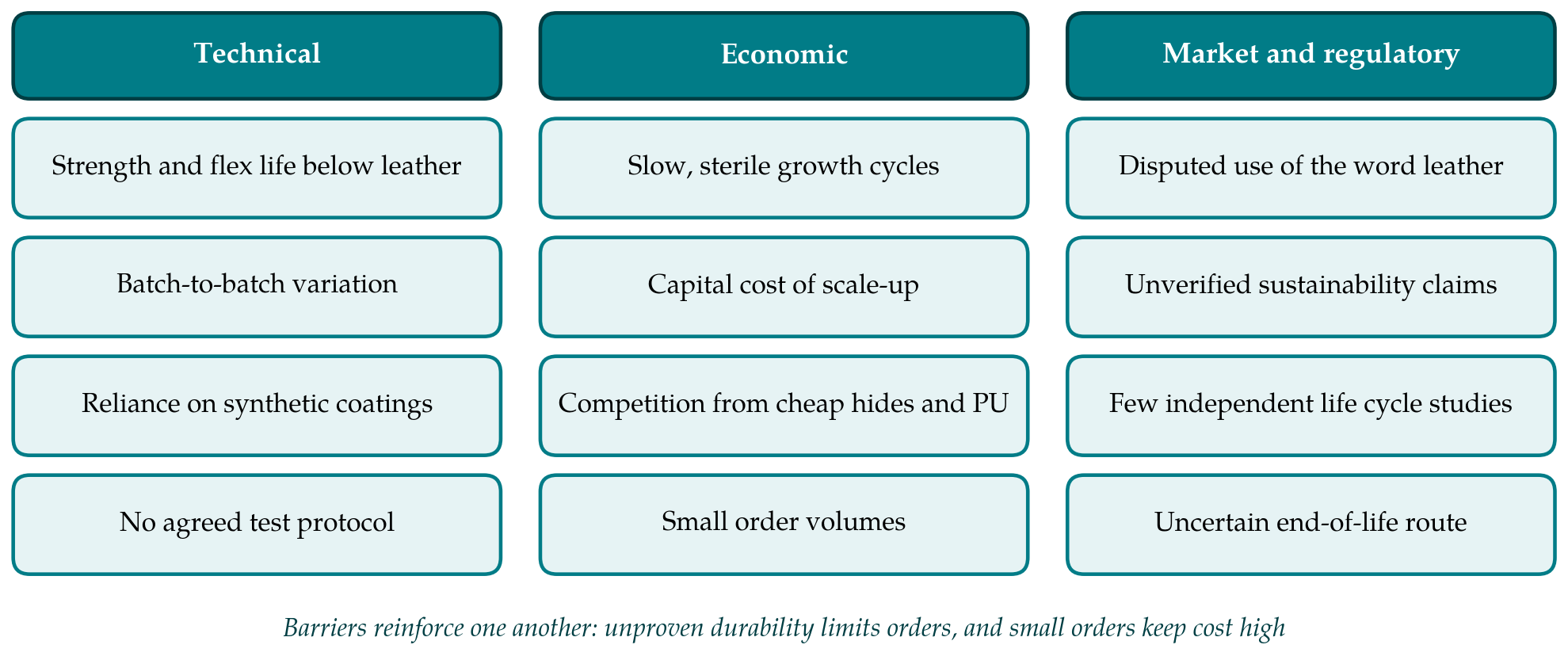
The technical barriers have been described above: performance below the incumbent, variability, and dependence on synthetic finishes. They are compounded by the absence of test methods written for these materials. Leather standards assume a collagen structure, and coated-fabric standards assume a textile carrier, so results are hard to compare between laboratories and suppliers.
The economic barriers follow from the biology. Growth takes days to weeks in controlled, clean conditions, and capacity is added tray by tray or vessel by vessel. Hides, by contrast, are an abundant by-product, and polyurethane sheet is made on continuous coating lines. A new material must compete with both on price while still paying for its pilot plant. Brands place small trial orders, which keeps unit cost high and prevents the learning that volume brings. Rogers (2003) described how the spread of an innovation depends on its relative advantage, compatibility with existing practice, complexity, trialability and observability. On compatibility in particular the alternatives are at a disadvantage, since cutting, skiving, stitching and edge finishing in footwear and leather goods factories are tuned to leather.
Market and regulatory barriers complete the picture. Several jurisdictions restrict the word "leather" to animal hide, and the trade terminology standard reflects that position (CEN, 2022). Terms such as "vegan leather" also cover ordinary polyurethane, which blurs the distinction that bio-based producers wish to draw. Sustainability claims that rest on unpublished data invite scepticism from buyers and regulators alike. End-of-life routes are unsettled: a coated, reinforced sheet is a composite that is neither readily compostable nor easily recycled.
7. Gaps and Future Work
Four gaps stand out. The first is independent, standardised testing of current commercial grades, repeated as products change, since published comparisons date quickly. The second is durability in use: wear trials of footwear, bags and garments over realistic periods, with attention to flex cracking, delamination and changes in handle. The third is finishing chemistry. Bio-based coatings and crosslinkers that give water and abrasion resistance without a fossil polymer layer would remove the main inconsistency in the present offer. The fourth is transparent life cycle assessment by parties without a commercial interest, with explicit treatment of service life and disposal.
For designers there is a further question, which is whether imitation of leather is the right goal. Karana et al. (2018) argue that grown materials have qualities of their own, and products designed around those qualities, in applications that do not demand the flex life of a shoe upper, may offer a more realistic first market than direct substitution.
8. Conclusion
The published evidence supports a measured view. Plant-residue composites are available and usable, but many owe their performance to synthetic polymer. Mycelium sheets are the most promising wholly biological option and have improved quickly, yet they do not at present equal bovine leather in strength and flex endurance without reinforcement or coating. Their environmental advantage is plausible and only thinly documented. Adoption is held back less by any single weakness than by the way technical uncertainty, cost and unclear claims feed one another. Open testing and independent assessment would do more for these materials than further announcements.
Conflict of interest
To be declared by the author(s) before publication.
Funding
To be declared by the author(s) before publication.