1. Introduction
An abandoned citrus orchard is easy to recognise. The canopies have closed across the rows, the lower and inner branches are dead from shade, the fruit is small and borne out of reach at the top of the tree, and weeds or scrub occupy the floor. Yet the trees are often alive and structurally sound. Citrus is a long-lived evergreen with a large reserve of dormant buds beneath the bark of old wood, and it responds to hard cutting with vigorous new growth (Spiegel-Roy and Goldschmidt, 1996). An owner who inherits or buys such an orchard has to choose between clearing it and trying to bring it back.
Replanting gives a uniform stand on a chosen rootstock but takes several years to yield and requires capital for land preparation, trees and irrigation. Rehabilitation keeps the established root systems and can restore a bearing canopy sooner, but it inherits whatever is wrong with the old trees. The choice is frequently made on impression. This article proposes a more orderly way of making it and of carrying out the rehabilitation where it is justified.
The protocol combines two interventions that are usually described separately: rejuvenation pruning of the tree and organic amendment of the soil. It is set out as a sequence of steps with the reasoning for each. The article does not report the rehabilitation of any particular orchard. It describes a proposed procedure, drawn from published principles, that has yet to be evaluated in the field.
2. Background
Neglect affects the tree and the soil in different ways, and the remedies rest on different bodies of knowledge. Both are summarised briefly here.
2.1. What neglect does to the tree
Citrus bears most of its crop on the outer shell of the canopy, where light is adequate. As unpruned trees grow into one another the productive shell shrinks to the tops, and shaded wood inside the canopy loses its leaves and dies back (Davies and Albrigo, 1994). Flowering and fruit set in citrus depend on carbohydrate status and on the balance between vegetative and reproductive growth (Iglesias et al., 2007), and neglected trees commonly fall into a pronounced alternation of heavy and light crops of the kind reviewed by Monselise and Goldschmidt (1982). Shoots from the rootstock, if not removed, can overtop and eventually replace the scion.
Disease status is the decisive unknown. Foot rot and gummosis caused by Phytophthora species attack the bark at the base of the trunk, particularly where soil or debris has built up around it, and a tree girdled in this way will not repay pruning (Timmer et al., 2000). Systemic diseases are more serious still. Huanglongbing, associated with phloem-limited bacteria and spread by psyllid vectors, has no cure, and infected trees act as a source of inoculum for the district (Bové, 2006). The rootstock matters as well: trees on sour orange are susceptible to decline caused by citrus tristeza virus, and rootstocks differ in their tolerance of Phytophthora, salinity and lime (Castle, 1987).
2.2. What neglect does to the soil
The effect on soil is less predictable. Where a dense ground cover has developed and leaf litter has accumulated, organic matter near the surface may have risen during abandonment. Where the floor was kept bare by herbicide or cultivation before the orchard was left, or where irrigation with poor water continued for a time, the soil may be compacted, low in organic matter or saline. Organic matter binds mineral particles into water-stable aggregates and so governs infiltration and aeration (Tisdall and Oades, 1982), and repeated additions of organic amendments have been shown in long-term work to raise soil organic carbon, biological activity and nutrient supply (Diacono and Montemurro, 2010). For citrus specifically, the place of organic sources in soil fertility management was reviewed by Srivastava et al. (2002).
3. The Proposed Protocol
The protocol runs over about three growing seasons. Figure 1 shows the order of operations. The steps are described below in the same order, beginning with work that should be completed before a single branch is cut.
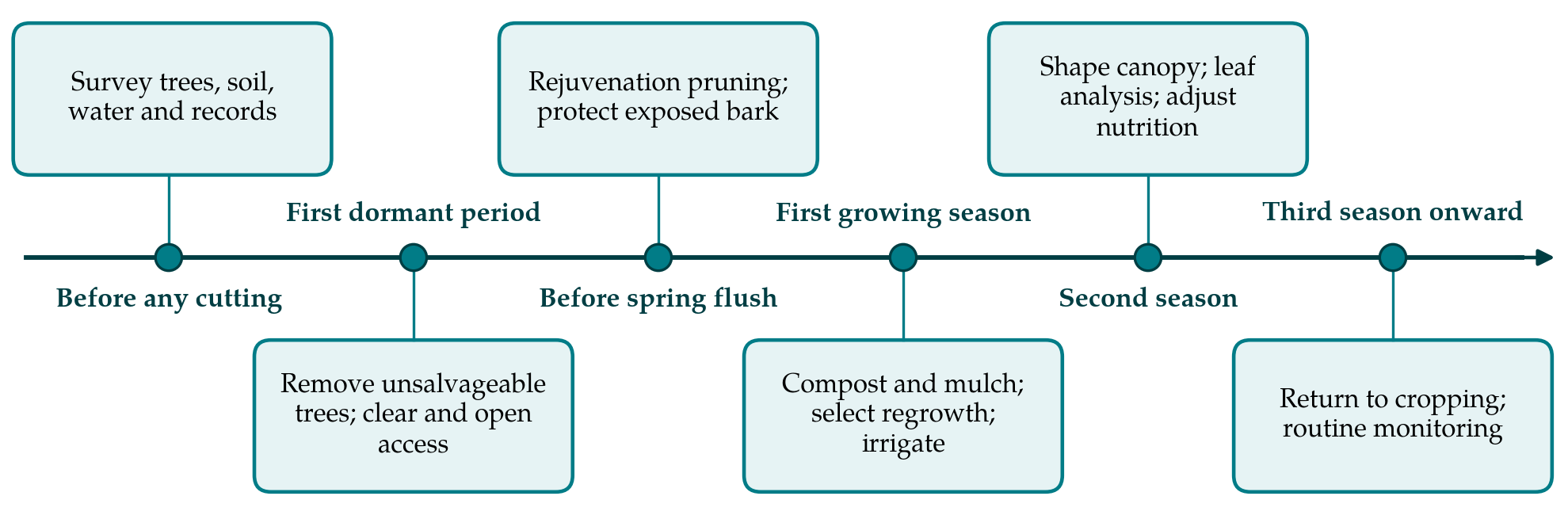
3.1. Step 1: Baseline survey
The survey has three parts. The first is a census. Every tree position is mapped and recorded as occupied, dead or missing, and for each living tree the surveyor notes the state of the trunk and graft union, the presence of gumming or bark lesions at the base, the extent of dieback, any rootstock shoots, and leaf symptoms that suggest systemic disease. Where huanglongbing or tristeza is known in the region, suspect trees should be sampled for laboratory diagnosis, since visual symptoms are easily confused with nutrient deficiency.
The second part is a soil survey. Pits or auger holes at representative points show rooting depth, compaction and drainage, and can be described using a standard guide. Composite samples from the root zone are analysed for pH, electrical conductivity, texture, organic carbon and available nutrients. Organic carbon has long been determined by the wet oxidation method of Walkley and Black (1934), and whichever method the laboratory uses should be kept the same for later sampling. The third part concerns the conditions for production: the quantity and quality of irrigation water, the cultivar and rootstock and their market, and the reason the orchard was abandoned. If that reason still holds, rehabilitation will not succeed however good the horticulture.
3.2. Step 2: Tree triage and the decision to proceed
Each living tree is assigned to one of the classes in Table 1. The classes are intended to be applied quickly in the field by two people working together. Once the census is classified, the share of positions that can be expected to carry a productive tree after rehabilitation is known. Where a large proportion of trees must be removed, or where systemic disease is confirmed and widespread, clearing and replanting is the sounder course, and the protocol stops here.
| Class | Field signs | Action |
|---|---|---|
| A. Sound | Healthy trunk and union; foliage dense to mid-canopy; little dieback | Remove dead wood; light thinning and skirting only |
| B. Overgrown | Sound trunk; foliage confined to canopy top; interior bare | Rejuvenation pruning to main scaffold limbs |
| C. Weak but sound | Sparse, small leaves; twig dieback; no trunk lesions | Moderate heading back; priority for soil amendment |
| D. Rootstock takeover | Scion dead or minor; canopy formed by rootstock shoots | Remove, or top-work if rootstock is healthy |
| E. Trunk or root disease | Gumming, bark lesions or girdling at the base | Remove; correct drainage before replanting |
| F. Systemic disease | Confirmed huanglongbing or virus-induced decline | Remove promptly, following local regulations |
3.3. Step 3: Rejuvenation pruning
Trees in class B are cut back to a framework of three to five main scaffold limbs, removing the whole of the leafy canopy, an operation known to citrus growers as skeletonising or buckhorning (Davies and Albrigo, 1994). Cuts are made cleanly, at a slight angle so that water does not stand on them, and just above a point from which new shoots can be expected. The work is timed for the end of the cool season, after the risk of frost has passed where frost occurs and before the spring flush, so that the tree's reserves go into regrowth.
Bark that has been shaded for years is easily killed by direct sun. All exposed limbs and the trunk are therefore coated immediately with whitewash or a diluted white water-based paint. Rootstock shoots are removed at their origin. Prunings carrying pests or disease are taken out of the orchard or burned where that is permitted; sound wood can be chipped and returned to the floor as mulch. Where the owner cannot afford to lose the whole crop at once, alternate rows may be cut in successive years, with the disadvantage that uncut trees shade the regrowth of their neighbours.
3.4. Step 4: Soil organic amendment
Amendment begins as soon as machinery can pass. The material should be a mature, stabilised compost. Immature compost can immobilise nitrogen and release phytotoxic compounds, and criteria for judging maturity, such as the carbon to nitrogen ratio, the ammonium to nitrate ratio and germination tests, are reviewed by Bernal et al. (2009). Compost is spread in a band beneath the former canopy drip line, where feeder roots are concentrated, and is left on the surface or incorporated very shallowly, since citrus roots near the surface are damaged by cultivation.
A coarse mulch of chipped prunings or other plant residue is laid over the compost to reduce evaporation and suppress weeds. Mulch and compost are kept well clear of the trunk, because moist organic material against the bark favours foot rot (Timmer et al., 2000). The rate of application is set from the analysis of the compost and the soil test, with attention to the nitrogen, salt and heavy metal content of the material and to any regulatory limit on nutrient loading. The protocol deliberately prescribes no single rate, because composts differ too widely for one figure to be safe.
3.5. Step 5: Managing regrowth, water and nutrition
A skeletonised tree produces a dense crop of upright shoots within weeks. During the first season these are thinned to leave well-spaced shoots that will form the new canopy, and the strongest are tipped to encourage branching. The tender growth is attractive to leaf miners, aphids and psyllids and needs regular inspection. Because the tree has no leaf area at first, its water use is low; irrigation is light and frequent initially and is increased as the canopy returns. Over-watering a leafless tree on a heavy soil invites root disease.
Fertiliser nitrogen is withheld or kept low immediately after pruning, when root reserves and the mineralising compost supply the limited demand. From the second season, nutrition is guided by leaf analysis. The standard sample is of spring-flush leaves several months old taken from non-fruiting terminals, interpreted against published sufficiency ranges (Embleton et al., 1973; Obreza and Morgan, 2008). Micronutrient deficiencies, which are common on neglected calcareous or acid soils, are corrected by foliar sprays once there is foliage to receive them.
3.6. Step 6: Monitoring
Progress is judged against the baseline. For the trees, the indicators are survival, canopy volume, the proportion of positions carrying a bearing tree, and yield and fruit size once cropping resumes. For the soil, a minimum data set of the kind proposed by Doran and Parkin (1994) is adequate: organic carbon, pH, electrical conductivity, bulk density, infiltration and a simple biological measure such as soil respiration. Bünemann et al. (2018) review the choice of indicators and caution that they must be interpreted for the soil type and the purpose in hand. Soil is sampled at the same points, depth and time of year as in the survey. Organic carbon responds slowly, and sampling every second or third year is sufficient.
4. Fitting the Protocol to Local Conditions
The protocol will need adjustment for climate, species and resources. Mandarins and lemons differ from sweet oranges in growth habit and in their response to hard pruning, and local experience should decide how severe the cut is. In regions with huanglongbing, the flush of new growth that follows pruning is highly attractive to the psyllid vector, and rehabilitation without area-wide vector control may do more harm than good (Bové, 2006). Where compost is scarce, well-rotted farmyard manure or a sown cover crop mown onto the tree row can serve the same purpose more slowly. Gaps left by removed trees should be replanted on a rootstock suited to the soil problems revealed by the survey (Castle, 1987).
5. Limitations and What a Trial Should Record
This protocol is a proposal and has not been tested here. Each of its elements is supported by established horticultural knowledge, but their combined effect on an abandoned orchard, and above all the economic comparison with replanting, can only be established by trial. A sound evaluation would compare pruning with and without organic amendment, and both against replanted plots, on the same site; would record costs and labour alongside yield and fruit quality for long enough to pass through at least one full bearing cycle; and would follow soil indicators at fixed points.
Two further limits should be stated. The triage classes are qualitative, and different surveyors may classify marginal trees differently until the criteria are calibrated against outcomes. And the protocol assumes that the cause of abandonment has been removed. No programme of pruning and compost will rescue an orchard that lacks water, a market or secure tenure.
6. Conclusion
Citrus trees left untended for years can often be brought back, because the species regenerates readily from old wood and because its root system outlasts its canopy. The protocol proposed here puts diagnosis first: a survey of trees and soil, a triage that removes diseased trees and identifies those worth cutting back, and an explicit decision on whether to proceed. Rejuvenation pruning and organic amendment then address the canopy and the soil together, followed by two or three seasons of regrowth management and monitoring. The approach remains to be validated, and the article has indicated what evidence such validation would require.
Conflict of interest
To be declared by the author(s) before publication.
Funding
To be declared by the author(s) before publication.