1. Introduction
A person whose depression has not lifted after two courses of antidepressant medication is, by the most widely used convention, treatment resistant. The label opens doors: to augmentation strategies, to newer licensed treatments, to neuromodulation, to specialist clinics. It also carries a judgement about the illness that the person may live with for years. It matters, then, what the label is built on.
It is built on symptom scores. Response is conventionally a halving of the baseline score on a scale such as the Hamilton Rating Scale for Depression (Hamilton, 1960), and remission is a score below a low cut-off sustained for a short period, following consensus definitions proposed three decades ago (Frank et al., 1991). Resistance is the repeated failure to reach those marks. Functioning, meaning the capacity to work, study, care for others and take part in social life, is recorded in trials as a secondary outcome if it is recorded at all.
This Perspective considers whether that ordering should be reversed. The question in the title is answered here with a qualified no: functional recovery should enter the definition, but as a partner to symptom criteria and not as their replacement.
2. How Resistance Came to Be Defined by Symptoms
The concept grew out of pharmacology. Staging systems ranked patients by the number and class of antidepressants that had failed, with electroconvulsive therapy at the top of the ladder (Thase and Rush, 1997). Later schemes refined the count by taking account of dose optimisation, duration and augmentation (Fava, 2003), and the Maudsley Staging Method added the severity and duration of the episode to the tally of failed treatments (Fekadu et al., 2009). Regulators adopted a simpler rule. The European Medicines Agency guideline describes treatment-resistant depression as a lack of clinically meaningful improvement after at least two antidepressants given at adequate dose for adequate duration with confirmed adherence (European Medicines Agency, 2013).
Table 1 compares the main approaches. What the first four share is more telling than how they differ. All count pharmacological trials, none requires an adequate course of psychotherapy to have been tried, and all judge failure by a symptom threshold. A review of definitions used in research found no consensus on the number of failed trials, on what counts as adequate, or on the scale and cut-off to be used, although two failures was the most common criterion (Gaynes et al., 2020).
| Approach | Basis of the definition | Place of functioning | Source |
|---|---|---|---|
| Thase and Rush staging | Number and class of failed antidepressants, then ECT | None | Thase and Rush, 1997 |
| Massachusetts General Hospital method | Failed trials weighted for optimisation and augmentation | None | Fava, 2003 |
| Maudsley Staging Method | Failed treatments plus episode severity and duration | Indirect, through severity | Fekadu et al., 2009 |
| European regulatory definition | Two adequate antidepressant trials without meaningful improvement | None | European Medicines Agency, 2013 |
| Difficult-to-treat depression | Continuing burden despite usual treatment efforts | Central: function and quality of life | McAllister-Williams et al., 2020 |
The empirical background is the Sequenced Treatment Alternatives to Relieve Depression study, in which outpatients moved through up to four treatment steps. Remission became less likely at each step, and those who needed more steps relapsed more often during follow-up (Rush et al., 2006). The finding gave the count of failed trials a prognostic meaning that it retains. It did not show that a symptom cut-off is the right measure of whether treatment has worked.
3. The Case for Functional Recovery
The first argument is about what symptom scales measure. The Hamilton scale was designed in the 1950s for inpatients, weights sleep and somatic anxiety heavily, and has been criticised on psychometric grounds for decades (Bagby et al., 2004). More fundamentally, adding unlike symptoms into one number assumes that they are interchangeable indicators of a single quantity. Two people with the same total may share few symptoms, and individual symptoms differ in their causes and in how much impairment they bring (Fried and Nesse, 2015). A definition of resistance that rests on crossing a line on such a scale inherits these weaknesses.
The second argument is about what patients want. When depressed outpatients were asked what remission meant to them, they gave most weight to features of positive mental health such as optimism and self-confidence, to feeling like their usual self and to a return to their usual level of functioning; the absence of symptoms came lower (Zimmerman et al., 2006). A treatment that removes symptoms and leaves a person unable to resume their life has not delivered what was asked of it.
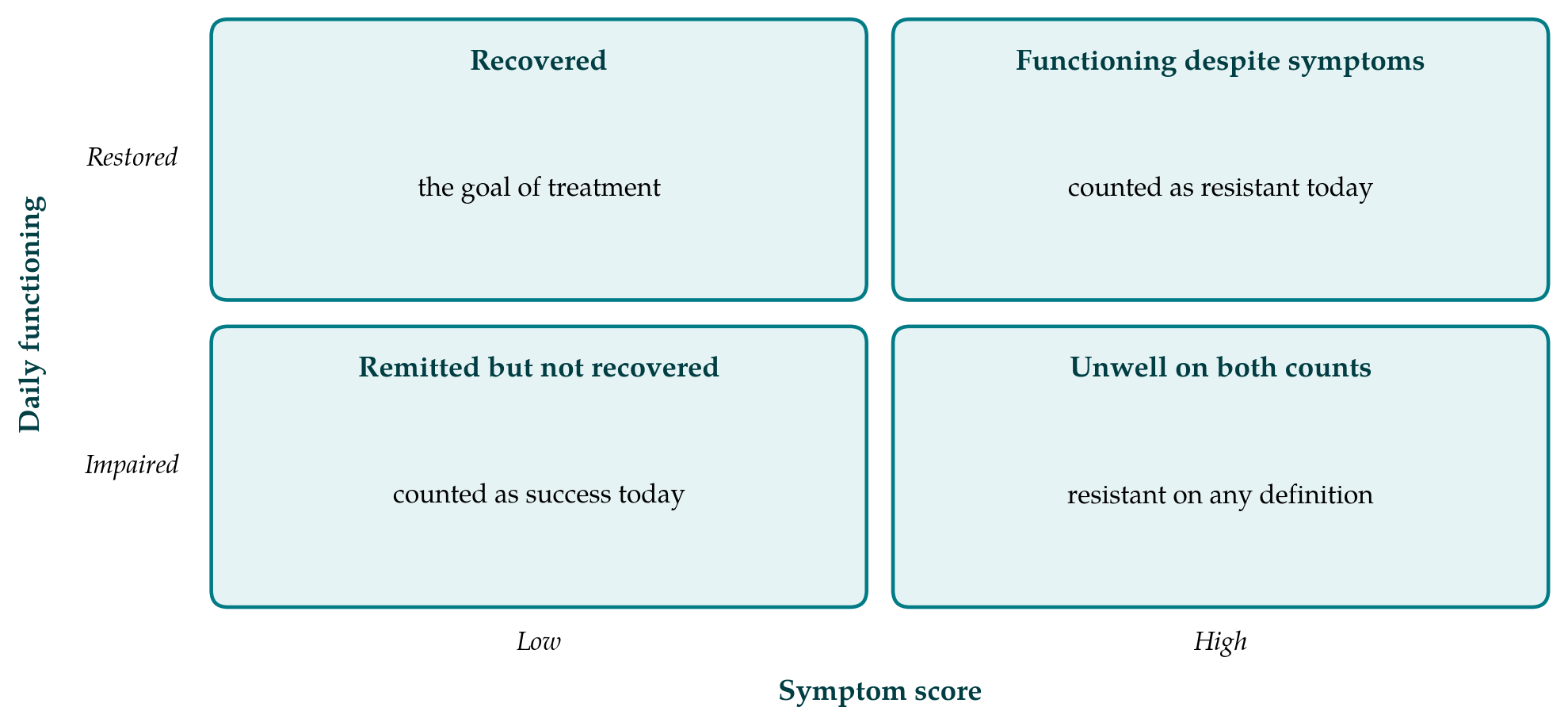
The third argument is that the two outcomes come apart. Figure 1 crosses symptom status with functional status. Two of the four cells are uncontroversial: people who are well on both counts and people who are unwell on both. The other two are where the present definition misleads. A person may fall below the remission cut-off and still be out of work and withdrawn, and is counted as a treatment success. Another may carry residual symptoms above the cut-off and yet be working and engaged, and is counted as resistant. Clinicians recognise both groups, and neither is well served by the label it receives.
The fourth argument comes from within the field. The proposal to replace treatment-resistant with difficult-to-treat depression was motivated by exactly these concerns. Its authors argued that the older term implies a binary state defined by drug failure, encourages an endless search for the next agent, and neglects the management of persisting illness, and they proposed that when remission proves elusive the aim should shift toward optimal symptom control together with better functioning and quality of life (Rush et al., 2019). An international consensus statement adopted the term and placed psychosocial functioning among the core domains to be assessed (McAllister-Williams et al., 2020).
4. The Case Against Replacing Symptom Criteria
These arguments are strong, but they establish less than a full redefinition would require. The first difficulty is that functioning has many determinants. Whether someone returns to work depends on the labour market, on an employer's willingness to adjust, on physical health, caring duties and the security of housing and income. A definition of resistance based on function would classify a person as resistant to treatment because of circumstances that no treatment for depression could alter.
The second difficulty is that function and symptoms are not independent. Long-term follow-up of people with unipolar depression showed that psychosocial disability rises and falls with symptom severity month by month, and that even subthreshold symptoms carry measurable disability (Judd et al., 2000). For most patients, then, treating symptoms to full remission is the most reliable route to functional recovery. A definition that demoted symptoms could weaken the pressure to reach remission, when the consistent finding is that residual symptoms predict relapse.
The third difficulty is measurement. Instruments exist, including the brief Sheehan Disability Scale (Sheehan et al., 1996) and the World Health Organization Disability Assessment Schedule 2.0, which was developed for use across cultures and health conditions (Üstün et al., 2010). There is, however, no agreed threshold on any of them that defines functional recovery from depression, they rely on self-report that low mood can bias, and functioning changes more slowly than symptoms, which would lengthen the period needed to judge a treatment. Clinical trials of a few weeks cannot wait for a return to employment.
A last consideration is practical. Regulatory definitions, licensing decisions and access criteria for several treatments are tied to the count of failed antidepressant trials. A change of definition that made existing evidence hard to interpret, or that could be used to deny treatment to someone who is functioning at great personal cost, would do harm.
5. A Two-Part Definition
The more defensible course is to keep both dimensions and to require that both be reported. Under such a definition, non-response would continue to be judged by symptoms after adequate treatment, because that criterion is fast, comparable across studies and prognostically meaningful. Alongside it, a functional assessment would be made with a named instrument at baseline and at follow-up. Recovery would be declared only when both symptom remission and restored functioning are present. A person in symptomatic remission without functional recovery would be identified as needing further care, of a kind that is likely to be psychological, occupational and social more than pharmacological.
Three consequences would follow. Clinical records and trials would describe patients in the terms of Figure 1 instead of a single binary. Adequate treatment history would have to include evidence-based psychotherapy and attention to comorbidity, since a functional goal cannot be pursued with medication changes alone. And services would be judged in part by whether patients resume valued roles. The contextual objection is not removed by this arrangement, but it becomes visible: a functional shortfall that persists after symptoms have cleared is a prompt to ask what stands in the way, which may be the illness or may be the person's circumstances.
Work would be needed before such a definition could be used formally. Agreement is required on which functional instrument to use and on what change counts as meaningful, and patients should take part in setting those thresholds.
6. Conclusion
The present definition of treatment-resistant depression measures a narrow thing well enough for regulatory purposes and leaves out the outcome that matters most to those who have the illness. Redefining resistance wholly around functional recovery would exchange one partial view for another, since functioning depends on much besides treatment and is harder to measure. The better answer is to stop treating the two as rivals. Symptom non-response should remain the trigger for stepping up treatment, and functional recovery should become a required part of how outcome is defined and reported.
Conflict of interest
To be declared by the author(s) before publication.
Funding
To be declared by the author(s) before publication.