1. Introduction
Poly(ethylene terephthalate), or PET, is made into bottles, films and fibres, and the fibre market is by far the largest of the three. Most plastic ever produced has been discarded, burned or left in use, and only a small fraction has been recycled even once (Geyer et al., 2017). Textiles fare worse than packaging. Mechanical recycling shortens the polymer chains and cannot remove colour, so the recycled polyester found in clothing today comes mostly from bottles and not from old clothes. Reviews of textile reuse and recycling agree that fibre-to-fibre routes are the least developed part of the system (Sandin and Peters, 2018).
Chemical recycling offers a way round the quality problem by taking the polymer back to its monomers, terephthalic acid (TPA) and ethylene glycol (EG), which can be purified and polymerised again. Glycolysis, methanolysis and alkaline hydrolysis all do this, at high temperature or with aggressive reagents. Enzymatic hydrolysis does it in water, near neutral pH and below 100 °C, and it is selective for the ester bond, which matters when the feedstock is a mixture of fibres (Ellis et al., 2021).
The discovery of a bacterium that grows on PET (Yoshida et al., 2016) and the report of an engineered enzyme that depolymerised bottle waste almost completely within hours (Tournier et al., 2020) drew wide attention to the field. Both studies, and most that followed, worked with amorphous film or pretreated bottle flake. This review considers what the same body of work implies for polyester textile waste, a substrate that is more crystalline, more contaminated and more variable.
2. Scope and Approach
This is a narrative review of the published literature on PET-hydrolysing enzymes and their use on fibres and fabrics. It draws on the primary reports of the principal enzymes and their engineered variants, on studies of how substrate properties govern the reaction, and on process analyses. Earlier reviews provide fuller catalogues of enzymes than space allows here (Wei and Zimmermann, 2017; Kawai et al., 2019; Tournier et al., 2023). No new experiments are reported, and figures quoted are those given by the cited authors.
3. The Enzymes
The enzymes that hydrolyse PET are serine hydrolases of the α/β-hydrolase fold, and most are related to cutinases, which in nature break down the polyester cuticle of plants. They share a shallow, exposed active site that can accept a polymer chain, which sets them apart from lipases and esterases with buried or lidded sites. Table 1 lists the enzymes that recur most often in the literature and how each was obtained.
| Enzyme | Origin and engineering | Working range | Representative source |
|---|---|---|---|
| TfH and TfCut2 | Hydrolases of Thermobifida fusca; stabilised by engineered metal-binding sites | Moderately thermophilic | Müller et al., 2005; Then et al., 2015 |
| HiC | Wild-type cutinase of the fungus Humicola insolens | Thermophilic, near the glass transition | Ronkvist et al., 2009 |
| LCC | Cutinase recovered from a leaf-branch compost metagenome | Thermophilic | Sulaiman et al., 2012 |
| LCC-ICCG | Four-point variant of LCC with an added disulfide bridge | Thermophilic, used at 72 °C | Tournier et al., 2020 |
| IsPETase | Wild-type enzyme of Ideonella sakaiensis | Mesophilic | Yoshida et al., 2016 |
| ThermoPETase and DuraPETase | Rational and computational redesign of IsPETase | Mesophilic to moderate | Son et al., 2019; Cui et al., 2021 |
| FAST-PETase | Machine-learning-guided variant of IsPETase | Moderate temperatures | Lu et al., 2022 |
| HotPETase | Directed evolution of a stabilised IsPETase | Thermophilic | Bell et al., 2022 |
3.1. Thermophilic cutinases
The first clear demonstration that an enzyme could erode PET at a useful rate came from a hydrolase of the actinomycete Thermobifida fusca, which degraded low-crystallinity film at 55 °C (Müller et al., 2005). A comparison of three cutinases soon showed that the enzyme from the thermophilic fungus Humicola insolens, which tolerates 70 °C, far outperformed its less stable relatives, and that its activity fell steeply as the crystallinity of the film rose (Ronkvist et al., 2009). Those two observations, that heat helps and crystals hinder, have shaped the field since.
The leaf-branch compost cutinase, LCC, was isolated by screening a metagenomic library and proved both more active and more thermostable than the T. fusca enzymes (Sulaiman et al., 2012). Tournier et al. (2020) reshaped its substrate-binding groove by saturation mutagenesis and replaced a divalent-metal binding site with a disulfide bridge. The resulting variant, usually called LCC-ICCG, reached at least 90% depolymerisation of pretreated bottle waste in under ten hours at 72 °C, and the recovered TPA was polymerised and blown into new bottles. Stabilisation of T. fusca cutinases through their calcium and magnesium binding sites follows the same logic on a different scaffold (Then et al., 2015).
3.2. Ideonella sakaiensis PETase and its descendants
IsPETase evolved, or was recruited, in a bacterium living on PET debris, and at 30 °C it is more active on the polymer than the cutinases are (Yoshida et al., 2016). Its crystal structure revealed a wider active-site cleft than that of homologous cutinases, and narrowing the cleft by mutation, unexpectedly, improved activity (Austin et al., 2018). The wild-type enzyme unfolds at modest temperatures, so much of the subsequent work has been an effort to make it robust.
Rational design produced a triple mutant with a markedly higher melting temperature (Son et al., 2019). A computational strategy that clusters and combines stabilising substitutions gave DuraPETase (Cui et al., 2021), and a structure-based machine-learning model was used to pick the mutations of FAST-PETase, which works between 30 and 50 °C (Lu et al., 2022). Directed evolution with a high-throughput screen for thermostability then yielded HotPETase, which remains folded above 80 °C (Bell et al., 2022). In a side-by-side assessment of four engineered enzymes at the high solids loading an industrial reactor would use, LCC-ICCG gave the best overall result (Arnal et al., 2023), a reminder that rankings obtained on dilute film do not always carry over to process conditions.
4. Why Fibre Is a Harder Substrate Than Flake
A polyester filament is melt-spun, drawn and heat-set. Drawing aligns the chains along the fibre axis and heat-setting lets them crystallise, which is what gives the fibre its strength and dimensional stability. The same order makes it resistant to enzymes. Hydrolases attack the mobile amorphous regions and barely touch the crystalline ones, and the rate falls off sharply over a narrow range of crystallinity (Thomsen et al., 2022). Untreated fabric incubated with even the best enzymes typically loses only a surface layer.
Temperature is the second constraint. Chain mobility rises abruptly at the glass transition, which for PET lies near 70 °C and somewhat lower when the polymer has taken up water. Running the reaction at or just above that point speeds hydrolysis, which is the reason thermostable enzymes are sought. Yet mobility also allows the amorphous polymer to crystallise during the reaction, so that the substrate becomes steadily less digestible while it is being digested. The choice of 72 °C for LCC-ICCG was a compromise between these two effects (Tournier et al., 2020). For fibres, which begin with substantial crystallinity, a thermostable enzyme is necessary but cannot be sufficient.
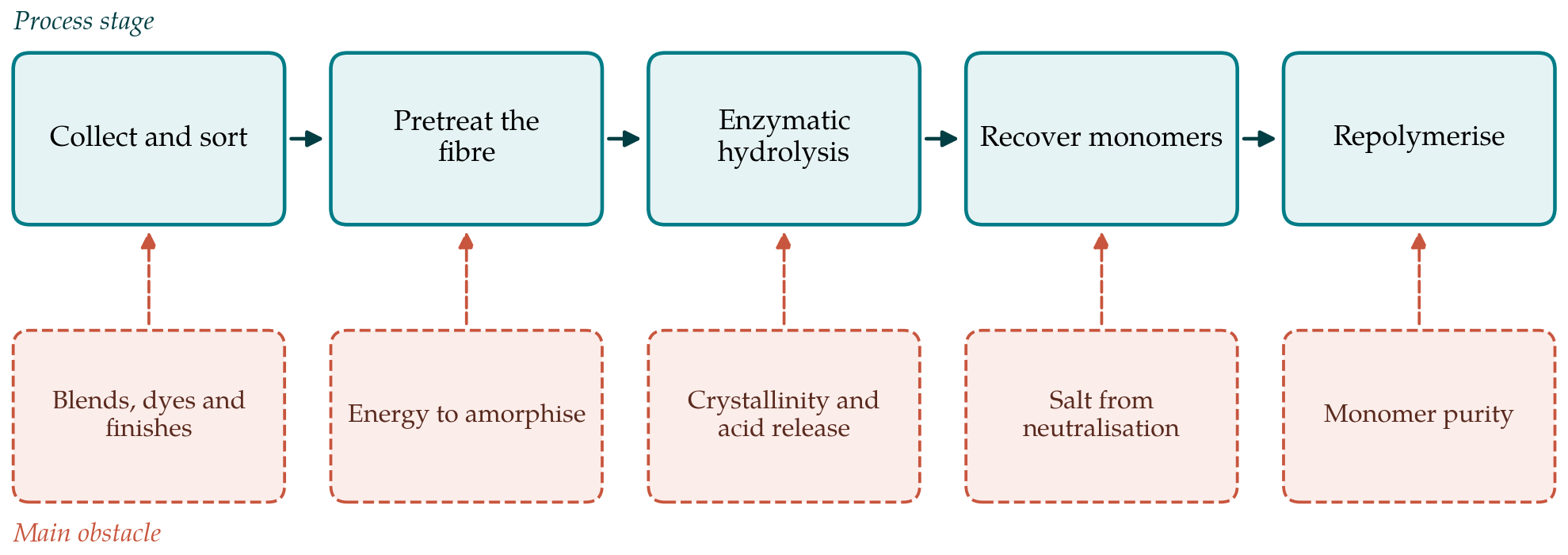
Garments add a third layer of difficulty that bottles lack. Polyester is blended with cotton, wool or elastane, dyed with disperse dyes that sit inside the fibre, and finished with softeners, water repellents and flame retardants. Buttons, zips and sewing thread of other polymers travel with the fabric. Figure 1 sets the stages of a fibre-to-fibre enzymatic process against the obstacle most characteristic of each.
5. Process Options for Textile Feedstocks
The pretreatment used for bottle waste is to melt the polymer in an extruder, quench it quickly so that it solidifies in the amorphous state, and mill it to a fine powder. The same sequence can be applied to shredded polyester fabric, and it removes the crystallinity that the fibre process put in. It also consumes heat and electricity, and micronisation of a tough polymer is slow. Any pretreatment has to be judged against the simpler option of feeding the melt directly to a chemical depolymerisation that does not care about crystallinity.
An alternative is to share the work between chemistry and enzyme. Quartinello et al. (2017) treated polyester textile waste with water under pressure at high temperature, which broke the fibre down to TPA and soluble oligomers, and then used the H. insolens cutinase to hydrolyse the oligomers, obtaining TPA of high purity. The enzyme here acts as a polishing step on a substrate that no longer has a crystalline morphology to defend it. The approach gives up some of the mildness that is the main argument for enzymes, but it is tolerant of feedstock quality.
Blends invite a selective strategy. Because a PET hydrolase leaves cellulose untouched and a cellulase leaves polyester untouched, a polycotton fabric can in principle be separated either by dissolving the cotton to glucose and keeping the polyester, or by removing the polyester and keeping the cotton as pulp. Which order is better depends on the blend ratio and on the value assigned to each product. Elastane is not hydrolysed by either class of enzyme and has to be removed by other means, and dyes released into the hydrolysate must be separated from the monomers before repolymerisation.
5.1. Product inhibition and pH control
Hydrolysis releases TPA together with the intermediates mono(2-hydroxyethyl) terephthalate and bis(2-hydroxyethyl) terephthalate. Both intermediates inhibit the T. fusca hydrolase (Barth et al., 2015), and their accumulation slows the reaction at the high conversions a process needs. Each ester bond cleaved also liberates an acid group, so the pH falls unless base is added continuously. Titration with sodium hydroxide keeps the enzyme active and leaves the product as a soluble terephthalate salt, from which TPA is precipitated with mineral acid. The price is a stoichiometric stream of sodium salt that has to be disposed of or sold.
6. What Process Analyses Show
A detailed techno-economic and life-cycle assessment of enzymatic PET recycling found that the modelled process could yield TPA at a cost in the range of the virgin material, with feedstock price, solids loading and the extent of depolymerisation among the strongest influences on the result (Singh et al., 2021). The same study located much of the environmental burden outside the enzyme reactor, in the energy used for pretreatment and in the sodium hydroxide and acid consumed for pH control and product recovery. These conclusions were drawn for bottle-type feedstock. For textiles the feedstock may be cheaper, since post-consumer clothing has few buyers, but sorting, removal of non-polyester material and decolourisation add steps that the model did not include.
7. Gaps and Directions for Research
Several questions follow from the evidence. The first is whether the amorphisation step can be made cheaper or avoided. Enzymes that act well below the glass transition do not solve the problem, because the crystalline fraction is unavailable at any temperature; what is needed is either a cheaper way to disorder the fibre or an enzyme system with real activity on ordered PET, and no published enzyme yet shows that. The second is reporting. Many studies use commercial amorphous film, enzyme loadings far above what a process could afford, and low substrate concentrations, so their results cannot be compared with one another or scaled. Agreement on a few reference substrates that include a drawn fibre would help.
A third gap concerns real waste. Very little has been published on how disperse dyes, finishes and residual detergents affect PET hydrolases, or on what happens to those substances downstream. A fourth is the salt problem: processes that hold pH by other means, or that tolerate acidic conditions, would remove a large reagent cost. Finally, enzymatic recycling should be compared honestly with glycolysis and methanolysis on the same textile feedstock, since the claim that the enzymatic route is preferable rests on selectivity and mild conditions and not yet on demonstrated cost.
8. Conclusion
Protein engineering has delivered PET hydrolases that are stable at the temperatures where the polymer is most accessible, and one of them has been shown to depolymerise pretreated bottle waste nearly to completion. The literature gives less reason for confidence about textiles. Fibre crystallinity, recrystallisation during reaction, blended and dyed feedstock, and the reagents consumed in pH control and recovery are all documented obstacles, and the best-supported textile routes rely on thermal or chemical pretreatment to do part of the work. Progress now depends as much on polymer processing and separation chemistry as on finding a better enzyme.
Conflict of interest
To be declared by the author(s) before publication.
Funding
To be declared by the author(s) before publication.