1. Introduction
Guava (Psidium guajava L.) is valued for its aroma and its high content of ascorbic acid, but the whole fruit is awkward to eat out of hand and bruises easily, which makes it a natural candidate for sale as ready-to-eat slices. The difficulty is that guava is a climacteric fruit with a high respiration rate, and cutting makes matters worse. Wounding ruptures cells, brings phenolic substrates into contact with polyphenol oxidase, releases the enzymes that degrade cell walls and stimulates respiration and ethylene production. The biochemistry of these changes in fresh-cut produce has been reviewed in detail by Toivonen and Brummell (2008).
Edible coatings, thin layers of food-grade material applied to the cut surface, are among the established tools for slowing this deterioration (Baldwin et al., 1995; Olivas and Barbosa-Cánovas, 2005). A separate line of research has examined the residues of fruit processing as sources of functional compounds (Schieber et al., 2001). This note brings the two together for one product and asks how far the combination is justified by what is already known.
2. What a Coating Can Do for Cut Guava
A coating acts as a partial barrier. It modifies the atmosphere inside the tissue by restricting the exchange of oxygen and carbon dioxide, it slows the loss of water vapour, and it can carry additives to the surface where they are needed. Coatings fall into three families: polysaccharides such as pectin, alginate, starch, chitosan and cellulose derivatives; proteins; and lipids. Polysaccharide and protein films are good barriers to gases but poor barriers to moisture because they are hydrophilic, whereas lipids resist moisture but form brittle or greasy films, so composite formulations are common (Dhall, 2013; Falguera et al., 2011).
For fresh-cut fruit the coating is also a vehicle. Antioxidants such as ascorbic acid, calcium salts that firm the tissue by cross-linking pectin, and antimicrobial compounds can be incorporated into the film and held at the cut surface (Rojas-Graü et al., 2009). Antimicrobial coatings in particular have been widely studied for minimally processed produce (Valencia-Chamorro et al., 2011). The limits should be kept in view. A coating slows deterioration and does not stop it; a barrier that is too effective causes anaerobic respiration and off-flavours; and no coating compensates for poor hygiene, immature or over-ripe fruit, or a broken cold chain.
3. Processing Waste as a Source of Coating Materials
The commercial pectin industry is itself an example of waste valorisation, since citrus peel and apple pomace left after juice extraction are its principal raw materials (Thakur et al., 1997). Other residues are less used. Mango processing leaves peel and kernel, and mango peel is rich in polyphenols, carotenoids and dietary fibre (Ajila et al., 2007); the kernel contains starch and fat. Guava processing itself discards peel and seed. Schieber et al. (2001) surveyed the functional compounds available in such by-products, and Galanakis (2012) set out the sequence of operations, from pre-treatment through extraction to purification, by which they can be recovered. Figure 1 relates the main waste streams to the fractions obtained from them and to the part each could play in a coating.
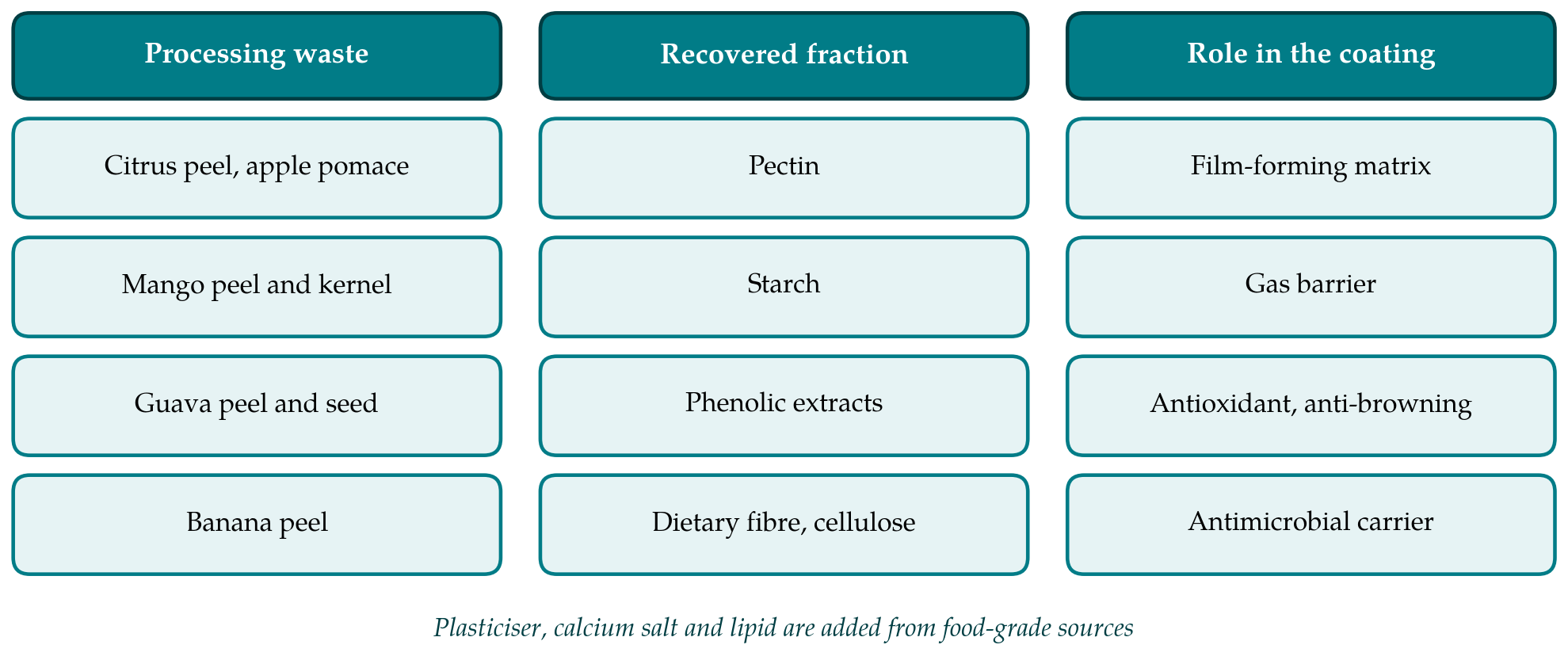
Two kinds of ingredient are in question. The first is the structural polymer: pectin or starch recovered from peel, pomace or kernel replaces a purchased hydrocolloid as the film-forming matrix. The second is the active fraction: phenolic extracts from peel or seed are added for their antioxidant and antimicrobial properties in place of synthetic additives. Table 1 sets out the principal options with the constraint attached to each. A plasticiser such as glycerol, and usually a calcium salt or a small proportion of lipid, would still come from conventional food-grade sources.
| Waste stream | Fraction of interest | Possible role | Main constraint |
|---|---|---|---|
| Citrus peel | Pectin | Film-forming matrix | Already a commercial raw material; competing demand |
| Apple pomace | Pectin, fibre | Matrix, texture | Colour and flavour carry-over |
| Mango peel | Pectin, phenolics | Matrix; antioxidant | Sap residues; pesticide residues on skin |
| Mango kernel | Starch | Gas-barrier matrix | Tannins must be removed; moisture sensitivity |
| Guava peel and seed | Phenolic extract, fibre | Antioxidant; anti-browning | Seasonal supply; little published characterisation |
| Banana peel | Starch, phenolics | Matrix; antioxidant | Rapid browning of the raw material |
4. Obstacles Between the Idea and a Product
The first obstacle is variability. The composition of peel or pomace changes with cultivar, ripeness, season and the process that generated it, and wet residues ferment within hours unless they are dried or stabilised. A coating ingredient has to meet a specification for viscosity, degree of esterification or phenolic content from one batch to the next, and achieving that from a variable feedstock is the main technical cost (Galanakis, 2012).
The second is safety. Fruit peel is the part of the fruit most exposed to pesticides and to microbial contamination, and extraction can concentrate residues along with the desired compounds. Extraction solvents must be acceptable for food use. An ingredient recovered from waste is subject to the same food additive and labelling rules as any other, and its regulatory status differs between jurisdictions; an extract of peel is not automatically covered by the approval given to purified pectin.
The third is the eating experience. Phenolic extracts are often coloured, bitter or astringent, and a coating that is visible or tasted on a pale, delicately flavoured guava slice will not be accepted. Sensory evaluation is therefore as necessary as measurements of browning, firmness and microbial counts. Finally there is cost and scale. The approach makes most sense where a fresh-cut operation sits beside a pulp or juice line and can use its residues without transport or long storage.
5. What Future Studies Should Show
Published coating studies on fresh-cut fruit share some weaknesses that work on guava could avoid. A coating made from a waste-derived ingredient should be compared with the same formulation made from the commercial ingredient and with an uncoated control, so that the effect of the source can be separated from the effect of coating as such. The recovered fraction should be characterised well enough for another laboratory to reproduce it. Storage trials should be run at realistic retail temperatures and continued until the product fails, and should report sensory quality and microbial safety together with physical and chemical measurements. An account of yield, energy and solvent use in recovering the ingredient would allow the environmental claim implied by the word waste to be examined and not assumed.
6. Conclusion
The reasoning behind coatings from processing waste for fresh-cut guava is sound. Cut guava fails through browning, softening, water loss and microbial growth; coatings are known to slow each of these; and fruit residues contain the polymers and phenolics from which coatings are formulated. The proposition is an extension of practices already established for pectin. What is lacking is evidence specific to guava, gathered with adequate controls, and a demonstration that recovered ingredients can be produced to a consistent and safe specification at acceptable cost. Until that is available, the approach should be described as promising and not as proven.
Conflict of interest
To be declared by the author(s) before publication.
Funding
To be declared by the author(s) before publication.