1. Introduction
Wheat is a cool-season cereal grown across a wider span of latitude than any other crop, and in much of that range the end of its season is already hot. Analyses of historical records indicate that warming since 1980 has held wheat yields below what they would otherwise have been (Lobell et al., 2011), and an ensemble of crop models projected a fall in global production of about six per cent for each further degree Celsius of warming (Asseng et al., 2015). The irrigated plains of South Asia and the spring wheat regions of the subtropics are the most exposed (Ortiz et al., 2008). Breeders have responded by selecting within elite material, and they have made progress, but the variation available inside the cultivated gene pool is finite.
The reason lies in the crop's history. Hexaploid bread wheat arose from hybridisation between cultivated tetraploid wheat and the wild diploid goatgrass Aegilops tauschii, an event that involved few plants and captured only a sliver of the diversity of the wild parent; domestication and modern breeding narrowed the base further (Dubcovsky and Dvorak, 2007). The species that were left out are still growing, many of them in habitats hotter and drier than any wheat field. Tanksley and McCouch (1997) argued that such material holds useful alleles even where the wild plant itself looks unpromising, and the use of wild relatives in breeding has grown steadily since (Hajjar and Hodgkin, 2007).
This review considers how far that argument has been borne out for heat tolerance in wheat. It asks which relatives have been shown to carry tolerance, by what means that tolerance has been transferred, and what stands between the present evidence and routine use in breeding.
2. Approach of the Review
The article is a narrative review of the published literature and does not report a systematic search. It draws on reviews and primary studies of heat stress physiology in wheat, on the cytogenetic literature on alien introgression, and on evaluations of wild accessions and derived lines under high temperature. The term crop wild relative is used in the sense of Maxted et al. (2006), as a wild taxon whose relatively close genetic relationship to a crop gives it an indirect use. Cultivated emmer and landraces are mentioned where they form part of the same pre-breeding effort. Sources were selected for their standing in the field and their relevance to the question, and the account is illustrative, not exhaustive.
3. Heat Stress in Wheat and the Traits Used to Measure Tolerance
High temperature harms wheat at every stage, but two periods are especially sensitive. Around meiosis and anthesis, heat reduces pollen viability and grain set, so that fewer grains are formed. During grain filling, it hastens senescence, shortens the filling period and disturbs starch deposition, so that the grains formed are lighter (Farooq et al., 2011). At the cellular level the damage involves loss of membrane integrity, inhibition of photosynthesis and oxidative stress, and plants respond with heat shock proteins and other protective mechanisms. A distinction is usually drawn between chronic exposure to moderately high temperature through the season and short episodes of extreme heat, which need not involve the same genes.
Because yield under heat is costly to measure on thousands of entries, breeders rely on proxy traits. Cossani and Reynolds (2012) grouped them under light interception, radiation use efficiency and partitioning to grain. Canopy temperature, which reflects the capacity to keep transpiring and so stay cool, is the most widely used, followed by delayed senescence or stay-green, membrane thermostability measured by electrolyte leakage, chlorophyll fluorescence and grain weight under late sowing. Wild species complicate the use of these proxies. Many have brittle ears, small grains and a strong vernalisation or day-length requirement, so that their own performance in a field plot says little about the alleles they could contribute to an adapted background.
4. The Gene Pools of Wheat
Harlan and de Wet (1971) classified the relatives of a crop into primary, secondary and tertiary gene pools according to how readily they exchange genes with it. For bread wheat, whose three genomes are denoted A, B and D, the primary pool comprises species with fully homologous genomes: landraces, the tetraploid wheats including wild emmer, the A-genome diploid Triticum urartu and the D-genome donor Ae. tauschii. The secondary pool holds polyploid species that share at least one genome with wheat, together with close relatives of the B-genome donor, and the tertiary pool holds species whose chromosomes do not normally pair with those of wheat at all. Figure 1 places the principal taxa discussed in this review within that scheme.
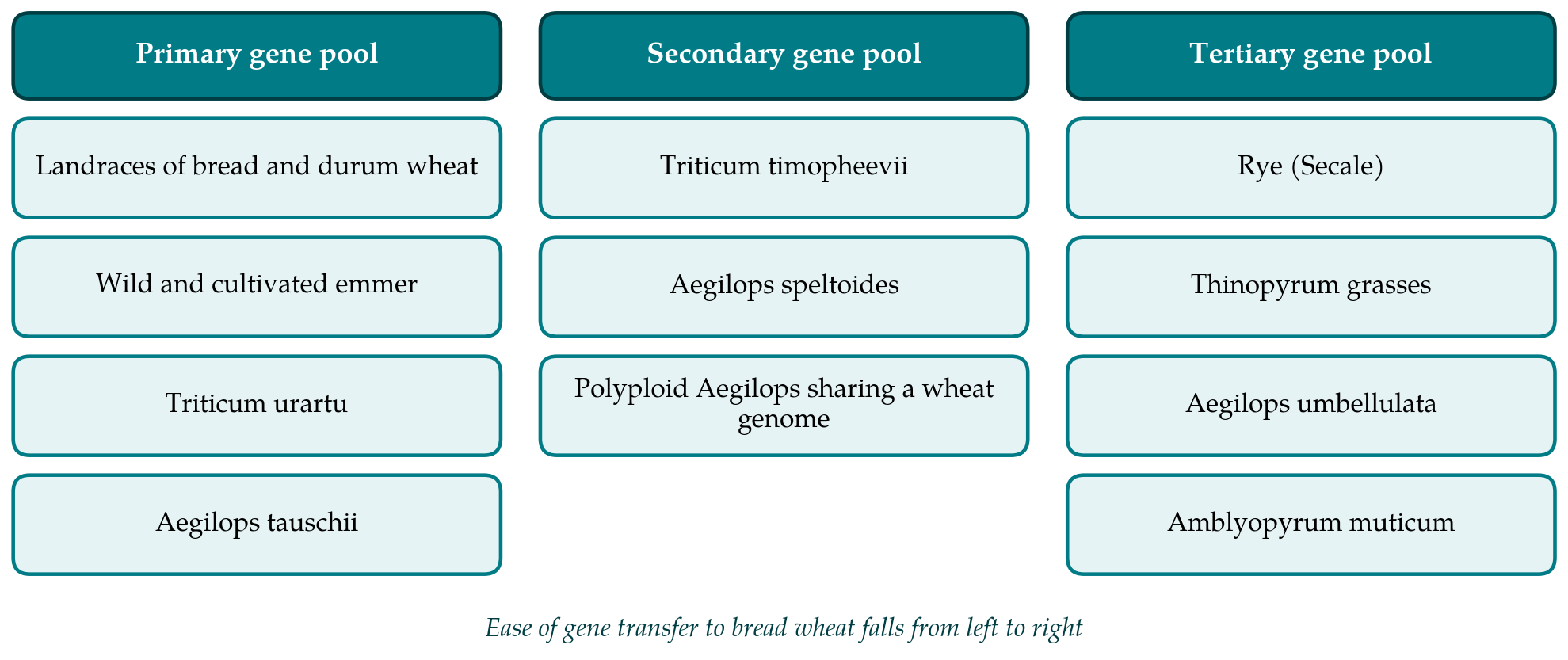
The classification is practical as much as taxonomic. Genes from the primary pool can be recovered by ordinary crossing and recombination. Those from the tertiary pool cannot, because pairing between wheat chromosomes and their counterparts from distant species is suppressed by the Ph1 locus on chromosome 5B (Riley and Chapman, 1958). Transfer then depends on cytogenetic intervention, a route opened when Sears (1956) used irradiation to move a segment carrying leaf rust resistance from Aegilops umbellulata into wheat. For half a century almost all such work aimed at disease and pest resistance, where a single gene gives a visible effect (Friebe et al., 1996; Hajjar and Hodgkin, 2007). Abiotic stress tolerance, which is polygenic and hard to score, came later.
5. Sources of Heat Resilience
Evidence that wild relatives tolerate heat comes from three kinds of study: screening of wild accessions themselves, evaluation of amphiploids or synthetic wheats, and testing of derived lines in an adapted background. Only the third speaks directly to breeding value. Table 1 summarises the main groups of relatives, the genomes they carry and the kind of evidence available for each.
| Relative | Genome and gene pool | Evidence relating to heat | Sources |
|---|---|---|---|
| Aegilops tauschii | D; primary | Synthetic hexaploids and derived lines tested in hot, dry sites | Trethowan and Mujeeb-Kazi, 2008 |
| Wild emmer | AB; primary | Adaptation to hot, dry habitats; drought tolerance documented | Nevo and Chen, 2010 |
| Cultivated emmer | AB; primary | Emmer-derived bread wheat lines evaluated under heat | Ullah et al., 2018 |
| Aegilops speltoides and allies | S; secondary | Tolerant accessions identified in controlled screens | Waines, 1994; Pradhan et al., 2012 |
| Other Aegilops species | Various; secondary or tertiary | Accession screening; few derived lines | Pradhan et al., 2012 |
| Amblyopyrum muticum | T; tertiary | Genome-wide introgressions available for testing | King et al., 2017 |
5.1. Aegilops tauschii and synthetic hexaploid wheat
The most productive route so far has been to repeat the origin of bread wheat. Crossing durum wheat with Ae. tauschii and doubling the chromosomes of the hybrid gives a synthetic hexaploid that crosses freely with bread wheat and brings with it the D genome of whichever goatgrass accession was used. A large collection of such synthetics was produced at CIMMYT for exactly this purpose (Mujeeb-Kazi et al., 1996). Lines derived from them have been tested widely in water-limited and hot environments, and reviews of that work credit the synthetic parents with contributions to yield stability, root traits and grain weight under stress (Reynolds et al., 2007; Trethowan and Mujeeb-Kazi, 2008). Several synthetic-derived varieties have been released by national programmes. The approach works because recombination is normal and because the breeder evaluates wild alleles in a plant that already resembles wheat.
5.2. Wild and cultivated emmer
The tetraploid ancestors offer variation for the A and B genomes. Wild emmer, Triticum dicoccoides, grows across the Fertile Crescent in sites that range from cool uplands to hot, arid margins, and populations from the drier sites have been characterised extensively for drought and salt tolerance (Nevo and Chen, 2010). Direct evidence on heat is thinner than the ecological argument would suggest. Cultivated emmer has been used more often in practice because it lacks the brittle rachis of the wild form. Ullah et al. (2018) evaluated bread wheat lines derived from crosses with emmer under heat in the field and concluded that the emmer parents had contributed to the heat tolerance of the better lines.
5.3. More distant relatives
Beyond the primary pool the evidence consists largely of screens of wild accessions. Waines (1994) compared wild wheats with spring wheat cultivars under high temperature and drew attention to variation among the wild species. Pradhan et al. (2012) exposed accessions of several Aegilops species to heat at anthesis and identified tolerant accessions, notably in Ae. speltoides and Ae. geniculata, on the basis of grain yield and physiological measurements. Such results show that the variation exists. They do not show that it can be expressed in wheat, since tolerance in a small-grained wild grass may rest on features, such as early flowering or few florets, that a breeder would not want.
6. From Wild Accession to Breeding Line
Moving a useful segment into an elite line takes several steps, and each loses material. The wide cross may need embryo rescue. An amphiploid or a set of addition lines is produced, pairing with wheat chromosomes is induced by removing or suppressing Ph1, and recombinants are sought among large progenies. What comes through is usually a long block of wild chromatin that carries undesirable genes alongside the target, the problem known as linkage drag. The rye chromosome arm 1RS, present in many widely grown wheats, shows both sides of the matter: it brought disease resistance and good adaptation together with a known penalty in bread-making quality.
Genomic tools have shortened the process. Zamir (2001) proposed that wild genomes be captured as libraries of overlapping introgression lines, each carrying a defined segment in a cultivated background, so that quantitative traits can be assessed segment by segment. Dense marker arrays now make this feasible in wheat. King et al. (2017) produced and tracked a large set of introgressions from Amblyopyrum muticum, and the annotated reference genome of bread wheat provides the coordinates against which such segments are placed (IWGSC, 2018). Small recombinant segments can be identified early with markers and the drag reduced before field testing begins. Organised pre-breeding, in which genebank accessions are crossed to elite lines and the progeny screened under stress, is the bridge between these resources and breeding programmes (Dempewolf et al., 2017).
7. Gaps and Future Work
The first gap concerns the material itself. A global assessment of crop wild relatives found that a large share of taxa are poorly represented in genebanks, and that many populations are unprotected in the wild (Castañeda-Álvarez et al., 2016). For heat tolerance the populations of greatest interest are those at the hot margins of each species' range, which are also among the most exposed to habitat loss. Collecting guided by climate data at the site of origin would raise the chance of finding adaptive alleles.
The second concerns evidence. Studies differ in how heat is imposed, whether by late sowing, field tunnels or growth chambers, and in the stage targeted, so results for different relatives cannot be ranked against one another. Screens of wild accessions are rarely followed by tests of derived lines, and very few heat tolerance alleles of wild origin have been characterised at the level of the gene. Agreed protocols, and reporting of temperature actually experienced by the crop, would help. Third, heat in farmers' fields usually comes with water deficit, and tolerance to the combination deserves direct study in introgression material. Finally, yield in favourable seasons must be checked, since a segment that helps in a hot year and costs yield in a mild one will not be adopted.
8. Conclusion
Wild relatives of wheat do hold variation for tolerance to high temperature, and the literature contains enough examples from accessions, synthetics and derived lines to put that beyond reasonable doubt. What it does not yet contain is a catalogue of characterised alleles comparable to the one that exists for disease resistance. Synthetic hexaploids built on Aegilops tauschii have delivered most of the practical benefit to date, because they sit in the primary gene pool. The more distant species are better regarded as a longer-term reserve whose value will depend on introgression libraries, consistent phenotyping under realistic heat and continued conservation of the populations themselves.
Conflict of interest
To be declared by the author(s) before publication.
Funding
To be declared by the author(s) before publication.