1. Introduction
The distance between the number of people who have a common mental disorder and the number who receive care for it is usually called the treatment gap, and it is widest in low- and middle-income countries and in rural districts within them (Kohn et al., 2004). Psychological treatments with good evidence exist, but they were developed for delivery by psychologists and psychiatrists, who are few and concentrated in cities. The response that has gained most ground is task sharing, in which people without specialist training deliver defined elements of care under supervision (Patel et al., 2018).
Community health workers are an obvious workforce for this purpose. They live in the communities they serve, they already visit homes for maternal and child health or infectious disease programmes, and they are trusted. They are also busy, often modestly schooled and seldom trained in mental health. A treatment has to be reshaped before they can deliver it, and the reshaping is a technical task with its own methods.
This article sets out a procedure for that task. It is written for programme managers, trainers and researchers who have chosen, or been asked, to introduce a brief psychological intervention through community health workers in a rural area. The procedure draws on published adaptation frameworks and on the methods reported by trial teams. It is a proposal and has not been applied or evaluated in this article.
2. Background
Evidence that non-specialists can deliver effective psychological care has accumulated over two decades. In rural Uganda, group interpersonal psychotherapy led by trained local facilitators reduced depression (Bolton et al., 2003). In rural Pakistan, the Thinking Healthy Programme, a cognitive behavioural approach woven into the routine home visits of community health workers, improved recovery from perinatal depression (Rahman et al., 2008). In Goa, lay health counsellors working within a collaborative stepped-care model improved outcomes for common mental disorders in public primary care (Patel et al., 2010), and a later trial found that a brief behavioural activation treatment delivered by lay counsellors was effective for severe depression (Patel et al., 2017). In Zimbabwe, problem-solving therapy given by lay health workers on the Friendship Bench reduced symptoms of common mental disorders (Chibanda et al., 2016). A Cochrane review concluded that non-specialist health workers can improve outcomes for depression and anxiety, while judging much of the evidence to be of low or moderate certainty (van Ginneken et al., 2013).
These programmes have features in common. A review of psychological treatments tested in low- and middle-income countries found that most were short, relied on a small set of elements such as behavioural activation, problem solving and interpersonal skills, and were delivered with structured supervision (Singla et al., 2017). The World Health Organization built its Problem Management Plus programme on the same reasoning, combining stress management, problem solving, behavioural activation and strengthening of social support in a format for lay helpers (Dawson et al., 2015). On cultural adaptation, a systematic review found that most adaptations concerned language, context and the person delivering the treatment, and that the core content of the parent therapies was generally retained (Chowdhary et al., 2014).
3. The Proposed Procedure
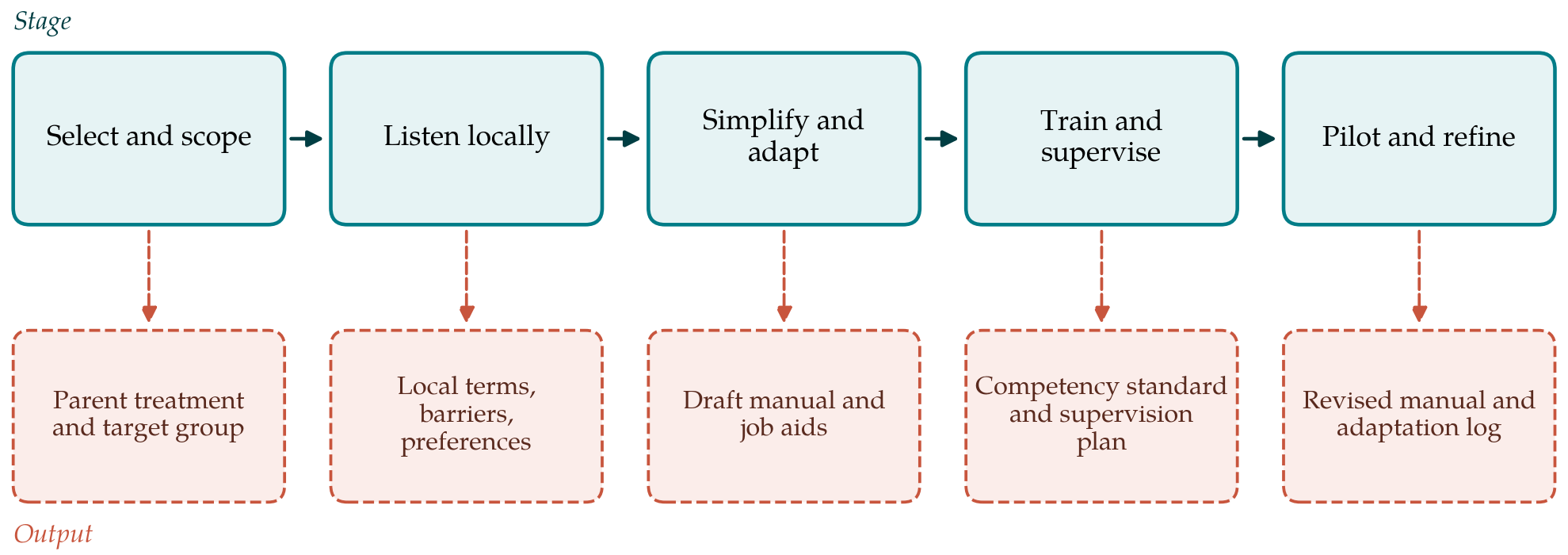
The procedure has five stages, shown with their outputs in Figure 1. It follows the general logic of guidance on complex interventions, which advises that development, piloting and evaluation be treated as distinct phases and that the reasoning behind an intervention be made explicit (Craig et al., 2008).
3.1. Stage 1: Select and scope
The first decisions are which problem to address, in whom, and with which parent treatment. The choice should rest on local need and on the strength of evidence for the treatment in comparable settings. Treatments built from few elements are easier to transfer; behavioural activation and problem solving have the advantage that their rationale can be explained in everyday terms. The team should state at the outset who will not be treated by the community health worker, such as people with psychosis, suicidal intent or severe functional decline, and where they will be referred. The mhGAP Intervention Guide provides assessment and referral guidance for non-specialist settings that can anchor these rules (World Health Organization, 2016). The output is a short scope document.
3.2. Stage 2: Listen locally
Formative inquiry comes next. Its purpose is to learn how distress is described and explained in the community, what people already do about it, what would make an intervention acceptable and what would stop people from taking part. Interviews and group discussions with people who have lived with depression or anxiety, family members, community health workers, their supervisors and local leaders are the usual methods. Local expressions for distress matter greatly, because a programme framed as treatment for mental illness may be avoided where one framed around tension, overthinking or problems of the heart is welcomed. The inquiry should also record the practical conditions of work: caseloads, distances, transport, literacy, and the times of year when farming leaves no one at home.
3.3. Stage 3: Simplify and adapt
The third stage produces the draft manual. Two operations are involved and are best kept separate. Simplification reduces the parent treatment to the elements judged essential and expresses each as a small number of concrete steps that can be taught and checked. Adaptation then fits those steps to the people who will receive them. The ecological validity framework of Bernal et al. (1995) names eight dimensions on which a treatment can be adapted, and Table 1 turns them into questions with illustrations for community health worker delivery in a rural area. The illustrations are examples of the kind of change to consider, not recommendations for any particular place.
| Dimension | Question for the team | Illustration |
|---|---|---|
| Language | Which words do people use for distress and recovery? | Local idioms replace clinical terms in all materials |
| Persons | Who is acceptable as a helper, and for whom? | Matching by gender where custom requires it |
| Metaphors | Which images and sayings carry the ideas? | Farming or household examples to explain activity scheduling |
| Content | Which values and customs should the sessions reflect? | Family duties and religious practice included as valued activities |
| Concepts | Does the explanation of the problem make sense locally? | Link between inactivity and low mood explained without diagnostic labels |
| Goals | Do the aims match what clients and families want? | Return to household and farm tasks as an agreed goal |
| Methods | How will sessions be delivered and recorded? | Pictorial flip chart; spoken instead of written homework |
| Context | Which conditions of local life affect delivery? | Home visits timed around planting, harvest and market days |
Materials should suit workers and clients with limited literacy: a flip chart with pictures, a one-page session guide, and tasks between sessions that can be agreed and remembered without writing. The number and length of sessions should be set by what a worker can fit into existing rounds. A heuristic from the adaptation literature is useful here: change the surface freely and the core mechanism reluctantly, and record every change with the reason for it.
3.4. Stage 4: Train and supervise
A manual does nothing without people able to use it. Training for community health workers should be short, practical and built on role play, with theory kept to what the worker needs in order to explain the treatment to a client. The apprenticeship model describes a sequence that has been used in several low-resource settings: classroom training, practice under close supervision with initial clients, and continuing group supervision led by local supervisors who are themselves supported by a specialist at a distance (Murray et al., 2011). Supervision is the component most often cut when budgets tighten and the one on which safety depends.
Competence should be assessed and not assumed. The ENACT rating scale was developed in Nepal to rate the common therapeutic skills of non-specialists, such as empathy, collaboration and the assessment of risk, through observed role plays (Kohrt et al., 2015). A programme can use such a tool to set the standard a worker must reach before seeing clients alone and to guide feedback afterwards. The output of this stage is a training curriculum, a competency standard and a supervision schedule with named supervisors.
3.5. Stage 5: Pilot and refine
The draft package is then tried with a small number of workers and clients, with the stated aim of finding what does not work. Session attendance, the time sessions take, the parts of the manual that workers skip or change, client and family reactions and any adverse events are recorded. Workers' improvised changes deserve attention, as they often point to a poor fit that the designers missed. The manual is revised, and the changes are entered in an adaptation log that states what was altered, why, and on whose advice. The pilot is a test of feasibility and acceptability. It cannot show that the treatment is effective.
4. Fitting the Procedure to Rural Conditions
Several features of rural work cut across the stages. Home visiting brings care to people who could not travel, but homes are seldom private, and a session held within earshot of in-laws or neighbours is a different thing from one held in a clinic room. Teams should decide where sessions can take place and how the worker will explain the visits to others in the household. In a small community the worker is likely to know the client socially, which builds trust and also raises the stakes for confidentiality. Training has to address this directly, with clear rules on what may be shared and with whom.
Workload is a second concern. Community health workers are asked to carry many programmes, and adding a psychological intervention without removing other duties or adjusting incentives invites superficial delivery and burnout. The scope agreed in stage 1 should be negotiated with the health authority that employs the workers. Finally, referral routes are thin. A protocol for responding to suicide risk or severe illness is only as good as the service at the other end of it, and the team should confirm, before training begins, who will receive referrals, how the person will get there and what the worker should do in the meantime.
5. Limitations and What Remains to Be Shown
The procedure has been put together from frameworks and from accounts of programmes that worked; it has not itself been tested, and accounts of success are a selective source. It is not known whether following these stages produces better interventions than a quicker, less formal adaptation, nor which stages contribute most. The balance between fidelity to a parent treatment and fit to local conditions remains a matter of judgement, and the procedure offers a way to document that judgement without resolving it.
Evaluation should proceed in steps. Early studies would examine implementation outcomes such as acceptability, feasibility, fidelity and reach, which are distinct from clinical outcomes and need their own measures (Proctor et al., 2011). A controlled trial would then be required to establish effectiveness, using outcome measures validated in the local language. Comparative work across sites, with adaptation logs published alongside results, would show over time which adaptations are needed everywhere and which are specific to a place.
6. Conclusion
Brief psychological treatments can be delivered by community health workers, and the trials that show this also show that careful preparation lies behind each success. The five-stage procedure described here orders that preparation: choose and scope the treatment, learn from the community, simplify and adapt the content, build training and supervision, and pilot with honest documentation. It is offered as a working method for teams in rural settings and as a proposal to be tested, revised and improved by those who use it.
Conflict of interest
To be declared by the author(s) before publication.
Funding
To be declared by the author(s) before publication.