1. Introduction
Adults with severe growth hormone deficiency have more fat and less lean tissue than their peers, an adverse lipid profile and reduced wellbeing, and hypopituitary adults receiving conventional replacement without growth hormone were found to have excess cardiovascular mortality (Rosén and Bengtsson, 1990). The first placebo-controlled trials of recombinant growth hormone, published in 1989, showed that treatment increased lean mass, reduced fat mass and improved metabolic measures (Salomon et al., 1989; Jørgensen et al., 1989). Replacement has been licensed for adults in many countries since the 1990s.
Those trials borrowed their dosing from children. A child's dose is scaled to body size because the aim is growth and the child is growing. An adult is not, and the argument of this article is that scaling the adult dose to weight has neither a physiological rationale nor a good safety record. Most specialists already titrate doses individually, and guidelines endorse it. The position is restated here because weight-based thinking persists in product labeling, in reimbursement rules and in the design of some trials, and because new long-acting preparations have reopened the question of how doses are chosen.
2. What Went Wrong With Weight
The side effects of growth hormone in adults are mostly those of sodium and water retention: peripheral edema, arthralgia, myalgia, paresthesia and carpal tunnel syndrome. They are dose related. In the early experience they were frequent enough to lead many participants to reduce or stop treatment, and analysis of who was affected showed that older and heavier patients, and those whose deficiency began in adult life, were the most susceptible (Holmes and Shalet, 1995). The plain reading of that experience is that the doses were too high for many of the people who received them, and that the excess was not spread evenly: it fell on exactly those patients for whom a weight-based calculation produced the largest number.
The pattern is what physiology predicts. Spontaneous growth hormone secretion declines steadily through adult life, and it is suppressed in obesity; age and relative adiposity are independent negative determinants of secretory burst frequency and amplitude (Iranmanesh et al., 1991). A rule that multiplies a fixed quantity by body weight therefore runs opposite to nature. It assigns the largest dose to an obese man of seventy, who if healthy would secrete very little, and the smallest to a lean woman of twenty-five, who would secrete a good deal.
3. The Case for Individualized Dosing
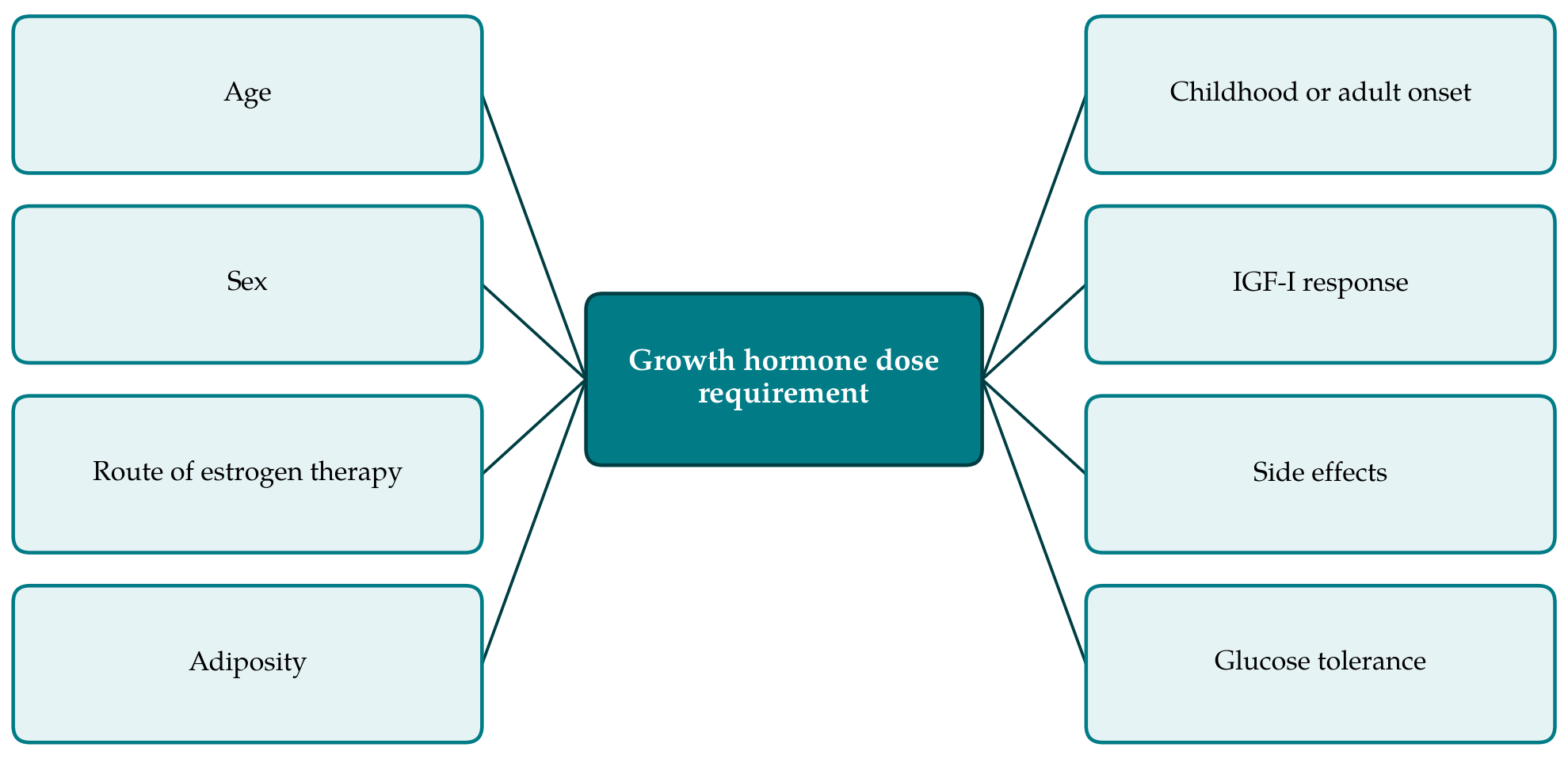
The argument rests on three observations. Requirements vary widely between patients, the variation is partly predictable from characteristics other than weight, and a titrated regimen has been shown to work. Figure 1 gathers the factors that bear on the dose an individual needs, and Table 1 states the direction in which each acts.
| Factor | Effect on dose needed | Representative source |
|---|---|---|
| Older age | Lower; greater susceptibility to fluid retention | Holmes and Shalet, 1995 |
| Female sex | Higher than in men for the same IGF-I | Burman et al., 1997 |
| Oral estrogen | Higher; hepatic response to growth hormone blunted | Wolthers et al., 2001 |
| Transdermal estrogen | Little effect; requirement close to that of men | Cook et al., 1999 |
| Obesity | Lower starting dose advised; side effects more likely | Molitch et al., 2011 |
| Diabetes or glucose intolerance | Lower starting dose and cautious titration advised | Yuen et al., 2019 |
3.1. Sex and estrogen
Women need more growth hormone than men to reach the same serum insulin-like growth factor I (IGF-I). Burman et al. (1997) showed that men with deficiency responded to a given dose with larger changes in IGF-I and body composition than women did. The difference is largely attributable to estrogen acting on the liver. Taken by mouth, estrogen reaches the liver in high concentration and impairs growth hormone signaling there, lowering IGF-I production and blunting metabolic effects (Wolthers et al., 2001; Leung et al., 2004). Women taking oral estrogen needed substantially higher doses than women using transdermal estrogen, whose requirements resembled those of men (Cook et al., 1999). No weight-based formula captures this, yet it is among the largest known influences on dose.
3.2. Titration against IGF-I
Two studies in the late 1990s established the alternative. Johannsson et al. (1997) compared individualized titration, starting low and adjusting to clinical response and IGF-I, with a conventional weight-based regimen, and found similar improvements in body composition at a lower dose with fewer side effects. Drake et al. (1998) titrated doses to bring IGF-I into the upper part of the age-related reference range and reported that maintenance doses were lower than those used in earlier trials, markedly so in men, with good tolerability. A large multinational comparison of two dosing algorithms likewise found fewer adverse events when the dose was built up individually (Kehely et al., 2002). What these studies share is the order of events. The dose is not fixed at the outset and then defended; it is found, by small steps, for each patient, and the final figure differs several-fold between individuals of similar weight.
3.3. What guidelines now say
Consensus has followed the evidence. The Growth Hormone Research Society workshop recommended that dosing regimens be individualized and not weight-based, starting low and increasing gradually according to clinical response, side effects and IGF-I (Ho, 2007). The Endocrine Society gives the same advice and adds that age, sex and estrogen status should be taken into account (Molitch et al., 2011). The American Association of Clinical Endocrinologists recommends lower starting doses in older patients and in those with diabetes or obesity (Yuen et al., 2019). Readers should take specific doses from those documents.
4. Objections Considered
A view held this widely should still be tested against the arguments on the other side. Three deserve an answer.
4.1. Simplicity and comparability
A weight-based dose is easy to calculate, easy to write into a protocol and easy to compare across trials. Titration takes repeated visits and blood tests, and the maintenance dose is not known for months. This is a fair description of the cost. It is not a sufficient reason to accept more adverse effects, and titration schedules can themselves be standardized: a fixed low starting dose with stepwise increments at defined intervals is as reproducible as a formula. Trials that titrate to a target also answer a more relevant question, namely what happens when the drug is used as it should be.
4.2. The imperfection of IGF-I
The stronger objection is that IGF-I is a flawed guide. Assays differ, and results from one laboratory cannot be read against another's reference range, a problem serious enough to prompt an international consensus statement on standardization (Clemmons, 2011). Reference intervals depend heavily on age and must be derived from large populations with the same assay (Bidlingmaier et al., 2014). A proportion of adults with proven deficiency have a normal IGF-I before treatment, so the marker says little about severity. And IGF-I reflects the hepatic response to growth hormone, which oral estrogen suppresses, more than its direct actions on fat and muscle. The target itself, usually the upper half of the reference range, rests on expert consensus and not on outcome trials.
All of this is true, and none of it favors weight. IGF-I is used in titration mainly as a ceiling, to avoid overtreatment, alongside symptoms, body composition and tolerability. An imperfect biological signal that responds to the drug is still more informative than a scale reading that does not. The right response to the limitations is better assays, shared reference data and trials comparing targets.
4.3. Long-acting preparations
Weekly growth hormone preparations are now available for adults, and their registration trials used titration to IGF-I (Johannsson et al., 2020). They do complicate matters. IGF-I rises and falls across the dosing week, so the value depends on the day of sampling, and the relation between a weekly profile and the daily pulses of normal physiology is not well understood. These are problems of how to individualize, and they would be worse, not better, under a fixed weight-based rule.
5. Implications
For clinicians the practical message is already familiar: start low, increase slowly, and let age, sex, estrogen route, adiposity and glucose tolerance shape expectations of where the dose will settle. A change in estrogen therapy, including a switch between oral and transdermal routes, is a reason to recheck IGF-I, as are substantial weight change and the passage of years, since a dose that suited a patient at forty may be excessive at sixty-five. For those who write formularies and reimbursement criteria, dose limits expressed per kilogram should be replaced by limits framed around titration. For trialists, weight-based arms should no longer be used as comparators in adults.
The research agenda is the larger matter. Individualized dosing in its present form means titration to a biochemical target that has never been tested against hard outcomes. Whether aiming for the middle or the upper part of the IGF-I range yields better results for body composition, quality of life, fracture or cardiovascular events is unknown. So is the best approach in older adults, in whom benefit is least certain and side effects most frequent. Individualization should be understood as a direction of travel, with the targets still to be validated.
6. Conclusion
Dosing adult growth hormone replacement by body weight was a historical accident with predictable consequences. Secretion and sensitivity depend on age, sex, estrogen exposure and adiposity in ways that weight does not track and partly inverts. Titration from a low starting dose, guided by clinical response and IGF-I, gives comparable benefit with fewer adverse effects and is recommended by every major guideline. Its tools are imperfect and its targets rest on consensus. The remedy is to improve them, and the evidence offers no reason to go back.
Conflict of interest
To be declared by the author(s) before publication.
Funding
To be declared by the author(s) before publication.