1. Introduction
Ascariasis, trichuriasis and hookworm infection together affect a substantial fraction of the world population and remain concentrated where sanitation is poor (Bethony et al., 2006). Control rests on periodic mass administration of benzimidazoles to school-age children and other at-risk groups, a strategy set out in the expert committee report that still frames national programmes (WHO, 2002). Monitoring is done by counting eggs in stool, almost always with the Kato-Katz thick smear, which fixes a known mass of faeces under cellophane soaked in glycerol and malachite green and allows eggs to be counted under low power (Katz et al., 1972).
The method is well matched to its original purpose, which was to measure intensity in heavily infected populations. It is poorly matched to the situation that successful programmes create. As intensity falls, a single thick smear misses a growing proportion of infections, and the loss is worst for hookworm, whose eggs clear rapidly from the preparation. A meta-analysis that estimated test sensitivity in the absence of a reference standard quantified the extent of the problem across the three parasite groups (Nikolay et al., 2014). Alternatives based on flotation improve recovery and allow larger volumes to be examined (Cringoli et al., 2010), but they remain microscopy, with its dependence on technician skill and on prompt examination.
Molecular detection answers that limitation and introduces others. Quantitative PCR for soil-transmitted helminths is well established in reference laboratories (Verweij and Stensvold, 2014), yet its interpretation in programme settings is debated, because the relationship between a cycle threshold and the egg burden that drives transmission is not straightforward (Papaiakovou et al., 2019). Loop-mediated isothermal amplification sits between these options. It requires only a heat block, and the chemistry tolerates crude templates. This article proposes a workflow for using it on stool in the field. The workflow is a proposal: it has not been applied to field specimens in preparing this article, and no performance results are reported here.
2. Why the Chemistry Suits Field Use
The reaction uses a strand-displacing polymerase and four primers recognising six regions of the target, which generates concatemeric products with stem-loop structures at a single temperature (Notomi et al., 2000). Two additional loop primers shorten the reaction considerably (Nagamine et al., 2002). The practical consequences are that no thermal cycler is needed, that the six-region recognition gives high specificity, and that the very large mass of DNA produced permits readout without electrophoresis. Products can be seen as magnesium pyrophosphate turbidity (Mori et al., 2001), or with metal-indicator dyes such as hydroxynaphthol blue (Goto et al., 2009), or through the pH shift caused by proton release during synthesis, which drives a colour change in a weakly buffered mixture (Tanner et al., 2015). A general protocol for setting up and reading these reactions is given by Tomita et al. (2008).
The same properties create the principal hazard. A reaction that yields very large amounts of product and is read by opening the tube is an efficient source of amplicon contamination, and a laboratory that has once contaminated its workspace will see positives everywhere. Physical separation of preparation and readout areas, unidirectional workflow, and readout formats that keep tubes closed are therefore not refinements but requirements. Table 1 compares the proposed workflow with the methods a programme already uses.
| Method | Equipment needed | Main strength | Main limitation |
|---|---|---|---|
| Kato-Katz thick smear | Microscope, template, cellophane | Cheap, quantitative, long record | Weak at low intensity |
| Flotation methods | Microscope, flotation apparatus | Larger volume examined | More handling per specimen |
| Real-time PCR | Thermal cycler, cold chain | Sensitive and species-specific | Needs a reference laboratory |
| Proposed LAMP workflow | Heat block, pipettes, dye | No thermal cycler required | Contamination risk, not validated |
3. The Proposed Workflow
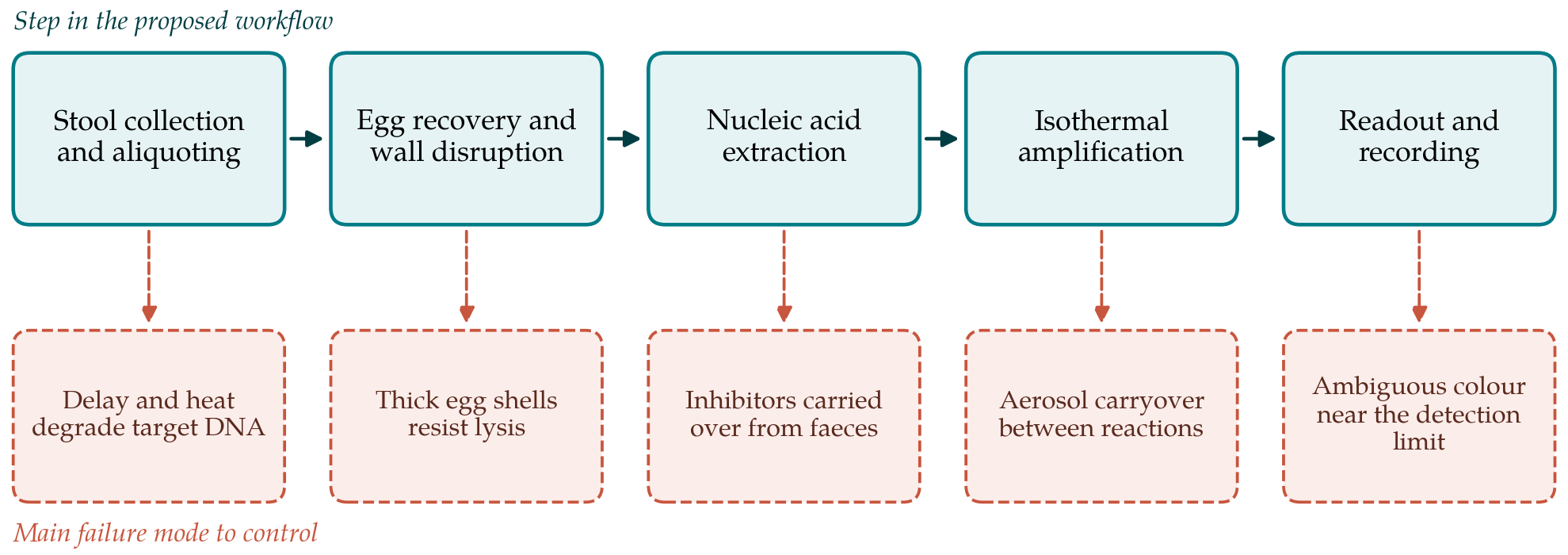
The workflow has five stages. Figure 1 pairs each with the failure mode it must control, which is the organising idea of the design: the amplification itself is robust, and almost all the loss of performance occurs before the tube is closed.
3.1. Stage 1: Collection and aliquoting
Stool is collected into a labelled container and processed the same day where possible. Where it cannot be, an aliquot is placed in a preservative that stabilises nucleic acid at ambient temperature, and the choice of preservative is recorded, because some fixatives used for microscopy crosslink DNA and are unsuitable for molecular work. Two aliquots are taken from different parts of the specimen and combined, since eggs are not distributed evenly through a stool. If the same specimen is also to be examined by Kato-Katz, that preparation is made first, from fresh material, as the smear cannot be made after preservation.
3.2. Stage 2: Egg recovery and disruption
This is the step that most often limits sensitivity, and it is where published protocols diverge most. Helminth eggs, and particularly those of Ascaris lumbricoides, have multilayered shells including a lipid layer that resists both chemical lysis and brief heating. Concentration by sedimentation or flotation before disruption raises the number of eggs entering the reaction and removes a large part of the faecal matrix. Disruption then combines mechanical and thermal treatment: bead beating with zirconia or glass beads, followed by a freeze-thaw cycle or sustained heating in lysis buffer. The duration and intensity of bead beating should be fixed and recorded, since excessive treatment shears the released DNA while insufficient treatment leaves intact eggs that contribute nothing.
3.3. Stage 3: Extraction
Faeces contain polysaccharides, bile salts and haem compounds that inhibit polymerases. The isothermal reaction tolerates them better than PCR does, but tolerance is not immunity, and an extraction step remains advisable for diagnostic use. Silica-based capture in the presence of a chaotropic salt, the approach described by Boom et al. (1990), is well suited because the reagents are stable and the procedure needs no centrifuge if a spin column is replaced by a magnetic bead format. Each extraction batch should include a negative control taken through from the beginning and an extraction control consisting of material spiked with a non-target organism, so that failure of extraction can be distinguished from absence of the parasite.
3.4. Stage 4: Amplification
Primer sets are designed against multi-copy targets, usually the internal transcribed spacer regions of the ribosomal DNA or species-specific repeat sequences, since copy number per genome directly affects the limit of detection. Reactions are run in a heat block at a temperature in the range used for this chemistry, typically between sixty and sixty-five degrees Celsius, for a fixed time, with a no-template control and a positive control in every run. Lyophilised reagent formats remove the need for a cold chain in transport and reduce pipetting at the point of use, which also reduces the opportunity for contamination.
3.5. Stage 5: Readout and recording
Closed-tube readout is strongly preferred. A colorimetric indicator incorporated before amplification allows the result to be judged without opening the tube (Tanner et al., 2015), and a portable fluorescence or turbidity reader gives an objective record where one is available. Visual readings are subject to observer variation, especially near the detection limit, so two readers should score independently where the result will inform a programme decision, and the agreement between them should be reported using a standard measure of categorical agreement (Landis and Koch, 1977). The run log records the operator, the reagent lot, the control results and the time at which each tube was read.
4. Fitting the Workflow to a Programme
Three practical constraints shaped these choices. The first is staffing: the whole workflow is intended for a technician already competent with pipetting and microscopy, trained over a few days, rather than for a molecular biologist. The second is power and cold chain, which is why lyophilised reagents, battery-capable heat blocks and ambient-temperature preservatives appear throughout. The third is the purpose to which the result will be put. For mapping and for deciding whether to continue mass administration, a qualitative result at the level of the community may be sufficient, and pooling specimens before extraction becomes attractive; for individual diagnosis, pooling is not acceptable. That distinction should be settled before the first specimen is collected, because it determines the sampling design.
5. Limitations and What Remains to Be Shown
The workflow has not been validated. An evaluation would need to establish four things. The first is analytical sensitivity, expressed as eggs per gram of stool, determined on spiked negative stool across the three parasite groups. The second is diagnostic accuracy against a composite reference standard combining repeated Kato-Katz examinations and quantitative PCR, reported in the manner that the STARD statement sets out (Bossuyt et al., 2015), with reagent lots and operating conditions documented as fully as the MIQE guidelines require of quantitative PCR studies (Bustin et al., 2009). The third is reproducibility between operators and sites, since a visual readout is the weakest link. The fourth is programmatic utility: whether a more sensitive test changes the decisions a programme actually takes, which is a separate question from whether it detects more infections.
Two cautions remain. A positive result indicates target DNA, not a viable infection capable of contributing to transmission, and DNA from ingested or recently cleared material can give a signal of no epidemiological consequence. And the published work applying this chemistry to helminths is still limited; studies such as the hookworm assay described by Mugambi et al. (2015) show feasibility rather than readiness for programme use. The proposal here should be read as a design to be tested, not as a method to be adopted.
6. Conclusion
Isothermal amplification is a reasonable candidate for field detection of soil-transmitted helminth eggs because it removes the thermal cycler and tolerates imperfect templates. The obstacles lie in egg disruption, inhibitor removal and contamination control rather than in the amplification itself, and the workflow proposed here is organised around those three problems. Whether it performs well enough to supplement or replace the thick smear in programme monitoring is an empirical question, and the evaluation outlined above is the work that would answer it.
Conflict of interest
To be declared by the author(s) before publication.
Funding
To be declared by the author(s) before publication.