1. Introduction
Consumer sales law was written for things that can be handed over and inspected. Digital content fits poorly. It is usually licensed and not sold, it may be supplied once or streamed continuously, and it changes after supply because the trader retains the ability to modify it remotely. Perzanowski and Schultz (2016) describe the resulting erosion of the buyer's position as the end of ownership. An early comparative study found that national laws classified the same transaction variously as sale, service or licence (Helberger et al., 2013).
This note sets four systems side by side and asks what a consumer can demand when digital content is defective, with particular attention to updates. It is a selective commentary on legislation and published scholarship.
2. Four Regulatory Models
Table 1 summarises the four models. The European Union has the most detailed regime. Directive 2019/770 governs contracts for the supply of digital content and digital services (European Union, 2019a), and Directive 2019/771 brings goods with digital elements within the law of sale (European Union, 2019b). Both are full harmonisation measures, so that member states may not depart from the conformity rules in either direction. The Digital Content Directive also applies where the consumer provides personal data instead of paying a price, a step whose contractual implications Metzger (2017) had examined while the proposal was under negotiation.
| System | Legal basis | Conformity standard | Duty to supply updates |
|---|---|---|---|
| European Union | Directives 2019/770 and 2019/771 | Subjective and objective conformity requirements | Express; includes security updates |
| United Kingdom | Consumer Rights Act 2015, Part 1, Chapter 3 | Satisfactory quality, fitness for purpose, as described | None express; modified content must conform |
| Australia | Australian Consumer Law; software is goods | Acceptable quality, including durability | None express |
| United States | Uniform Commercial Code Article 2 by analogy | Implied merchantability, subject to disclaimer | None; governed by licence terms |
| Soft law (US) | ALI Principles of the Law of Software Contracts | Warranty against known material hidden defects | Not addressed |
The United Kingdom legislated earlier and separately. Chapter 3 of Part 1 of the Consumer Rights Act 2015 creates statutory terms that digital content must be of satisfactory quality, fit for a particular purpose and as described (United Kingdom, 2015). Australia chose not to create a separate category. The Australian Consumer Law defines goods to include computer software, so that the consumer guarantees, including the guarantee of acceptable quality, apply directly (Commonwealth of Australia, 2010). The Federal Court confirmed in Australian Competition and Consumer Commission v Valve Corporation (2016) that games supplied by download from an overseas platform were covered.
The United States has no federal or uniform regime for consumer digital content. Courts have often applied Article 2 of the Uniform Commercial Code to software by analogy, with its implied warranty of merchantability, but the Code permits conspicuous disclaimers and the limitation of remedies to repair or replacement. The American Law Institute's Principles of the Law of Software Contracts propose, among other things, a non-disclaimable warranty that the software contains no material hidden defects of which the transferor was aware (American Law Institute, 2010), but the Principles are not binding law.
3. The Hierarchy of Remedies
Under the Digital Content Directive the consumer's first entitlement is to have the content brought into conformity, free of charge and within a reasonable time. If that is impossible or disproportionate, or the trader fails to do it, the consumer may claim a proportionate price reduction or terminate the contract. Termination is excluded where content was supplied for a price and the lack of conformity is only minor. The directive leaves damages to national law. Figure 1 sets out this structure, which the commentary describes as a two-stage hierarchy adapted from sales law (Sein and Spindler, 2019; Carvalho, 2019).
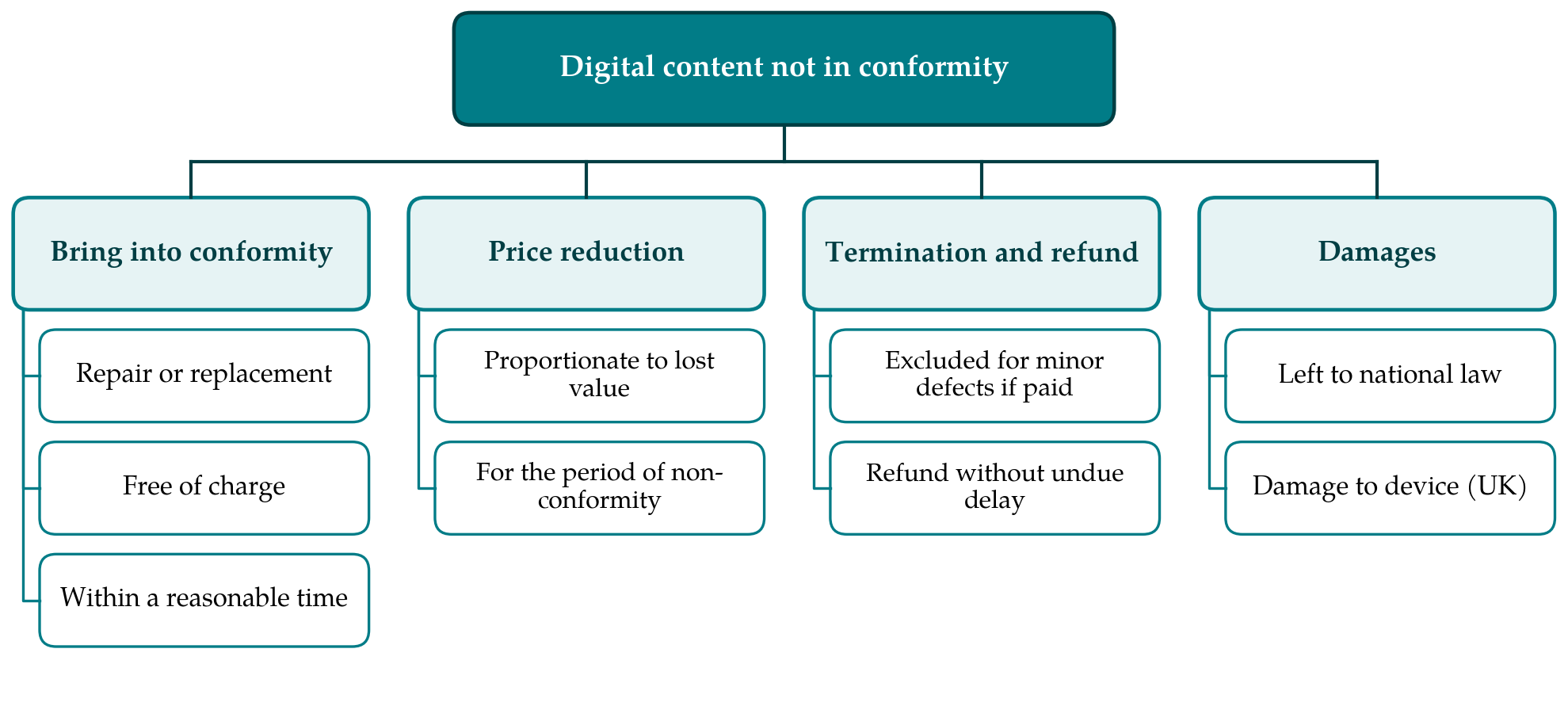
The British scheme is similar in outline. The consumer has a right to repair or replacement and, failing that, to a price reduction which may extend to the full price. There is no short-term right to reject of the kind available for goods, a point considered in the research report that preceded the Act (Bradgate, 2010). The Act adds a remedy with no direct counterpart in the directive: where digital content damages the consumer's device or other digital content and reasonable care would have prevented it, the trader must repair the damage or pay compensation.
Australian law arranges remedies by the gravity of the failure. For a major failure the consumer may choose a refund or a replacement; otherwise the supplier may choose to remedy the failure within a reasonable time. In the United States the outcome depends largely on the licence terms.
4. Updates as Part of Conformity
The most distinctive European rule concerns updates. The trader must ensure that the consumer is informed of and supplied with updates, including security updates, that are necessary to keep the content in conformity. Where supply is continuous the duty lasts for the contract period. Where there is a single act of supply it lasts for the period the consumer may reasonably expect, given the type and purpose of the content and the circumstances of the contract. If the consumer fails to install an update within a reasonable time, the trader is not liable for a defect resulting solely from that failure, provided the consumer was told of the update and of the consequences of not installing it and the installation instructions were adequate. Staudenmayer (2020) presents the update obligation as a central innovation of the two directives, since it extends conformity beyond the moment of supply.
The same directive regulates the opposite problem, the update that makes things worse. A trader supplying content over a period may modify it beyond what conformity requires only if the contract allows it and gives a valid reason, the consumer bears no extra cost and is clearly informed. If the modification has more than a minor negative effect on access or use, the consumer may terminate. The Consumer Rights Act addresses modification more briefly, requiring that content as modified still meets the statutory terms.
5. Points That Remain Unsettled
Three questions stand out. The first is how long a trader must keep supplying updates for content bought outright. The reasonable expectation standard is flexible, and it will fall to national courts and eventually the Court of Justice to give it content. The second is the allocation of responsibility in the supply chain: the seller of a connected device owes the update duty to the consumer, yet only the manufacturer or software developer can usually perform it. The third concerns content supplied in exchange for personal data. Price reduction has no obvious meaning where no price was paid, and the directive accordingly allows termination even for minor defects in such cases.
6. Conclusion
The four systems agree that digital content must meet a standard of quality and disagree on almost everything else. For software that is expected to change throughout its life, a conformity standard fixed at the moment of supply protects the consumer only briefly. The European approach of treating updates as part of what the trader promises is the more coherent answer, and its unresolved details are worth close study by systems considering reform.
Conflict of interest
To be declared by the author(s) before publication.
Funding
To be declared by the author(s) before publication.