1. Introduction
A first-year composition student can now type a description of a piece, wait less than a minute, and play back a recording that many listeners would take for the work of a competent professional. The student has written no notes, hired no players and made no decisions about harmony or orchestration. Whatever one thinks of the result, the event alters the ground on which composition is taught, because the thing a conservatory has traditionally certified, the ability to produce idiomatic and well-made music, has become cheap to imitate.
This article takes the view that the right response is neither prohibition nor enthusiasm. Bans cannot be enforced outside the practice room, and the claim that the tools simply make everyone a composer mistakes output for understanding. The more useful question is the one the technology forces: what composition teaching is meant to give a student that a generated file does not contain. Answering it requires conservatories to say aloud what has long been assumed.
2. What the Models Do
The line of development is short. WaveNet showed that a neural network could generate raw audio sample by sample (van den Oord et al., 2016). Jukebox applied related ideas to music with singing, conditioned on artist, genre and lyrics (Dhariwal et al., 2020). MusicLM and MusicGen then produced music from free text descriptions, with the second released openly for others to build on (Agostinelli et al., 2023; Copet et al., 2023). Commercial services built on similar principles now return whole songs with vocals to anyone who asks.
Two features distinguish these systems from earlier music software. They work in sound, not in symbols, so their output arrives performed, mixed and complete. And they are trained on very large collections of existing recordings, which means that what they return is a statistical rendering of how music of a requested kind has usually gone. They are at their most convincing where a style is well represented and conventions are strong, which is also where pastiche exercises and much commercial writing sit.
3. What Composition Teaching Has Assumed
Conservatory composition teaching combines two inheritances. One is craft passed on through graded exercises: species counterpoint after Fux, chorale harmonisation, fugue, orchestration from models (Fux, 1965). The other is the individual lesson, in which a student brings work in progress and a teacher responds. Kingsbury's ethnography of an American conservatory describes how such institutions treat talent as a property of persons that the teacher discerns and the institution ratifies (Kingsbury, 1988). Behind both stands what Goehr calls the work-concept, the idea that music exists as discrete, authored, finished works (Goehr, 1992).
Assessment follows from this. A student is judged on a portfolio of scores and recordings, and the portfolio is read as evidence of the skills that produced it. The inference from product to skill was always imperfect, since teachers edit, performers rescue and notation software flatters. It held well enough while making a polished piece demanded most of the abilities being certified. Table 1 sets out the main aims that composition teaching has pursued, what generative audio does to each, and the adjustment argued for in the remainder of this article.
| Aim of teaching | What generative audio changes | Proposed reorientation |
|---|---|---|
| Stylistic fluency | Plausible pastiche is available on request | Teach pastiche as ear training, not as output |
| A portfolio of works | A finished recording no longer shows who decided what | Assess reasons, drafts and spoken defence |
| Technical craft | Surface polish is separated from understanding | Keep exercises; justify them as training of judgement |
| An individual voice | Models return the average of a style | Ask what a piece does that the average would not |
| Writing for performers | Largely untouched: models emit audio, not parts | Move collaboration with players to the centre |
| Professional readiness | Routine commissions face automated competition | Add data, rights and tool literacy to the course |
4. The Argument: From Product to Judgement
If a stylistically competent product can be had without the skills, then the product can no longer be the main thing taught or the main thing marked. What remains scarce is judgement: hearing what a passage is doing, knowing why one continuation is better than another for this piece and these players, and being able to change it on purpose. Boden's account of creativity is helpful here. She separates exploring an established conceptual space from transforming it, and observes that recognising the value of a new idea is as much part of creativity as generating it (Boden, 2004). A model can generate without end. Selection and evaluation fall to whoever is listening.
Seen this way, the old exercises look different without ceasing to matter. Nobody needs a student's fourth-species counterpoint as music. Its use is that writing it slowly, by hand, against rules, builds an inner hearing of voice leading that later lets a composer notice what is wrong with a bar. Sennett describes craft in general as a dialogue between hand and head in which problems are found as well as solved (Sennett, 2008), and Schön describes professional knowledge as reflection carried on in the midst of action (Schön, 1983). Both accounts locate the value of practice in what it does to the practitioner. Conservatories should defend counterpoint and orchestration on exactly those grounds and stop implying that the exercises are valuable as artefacts.
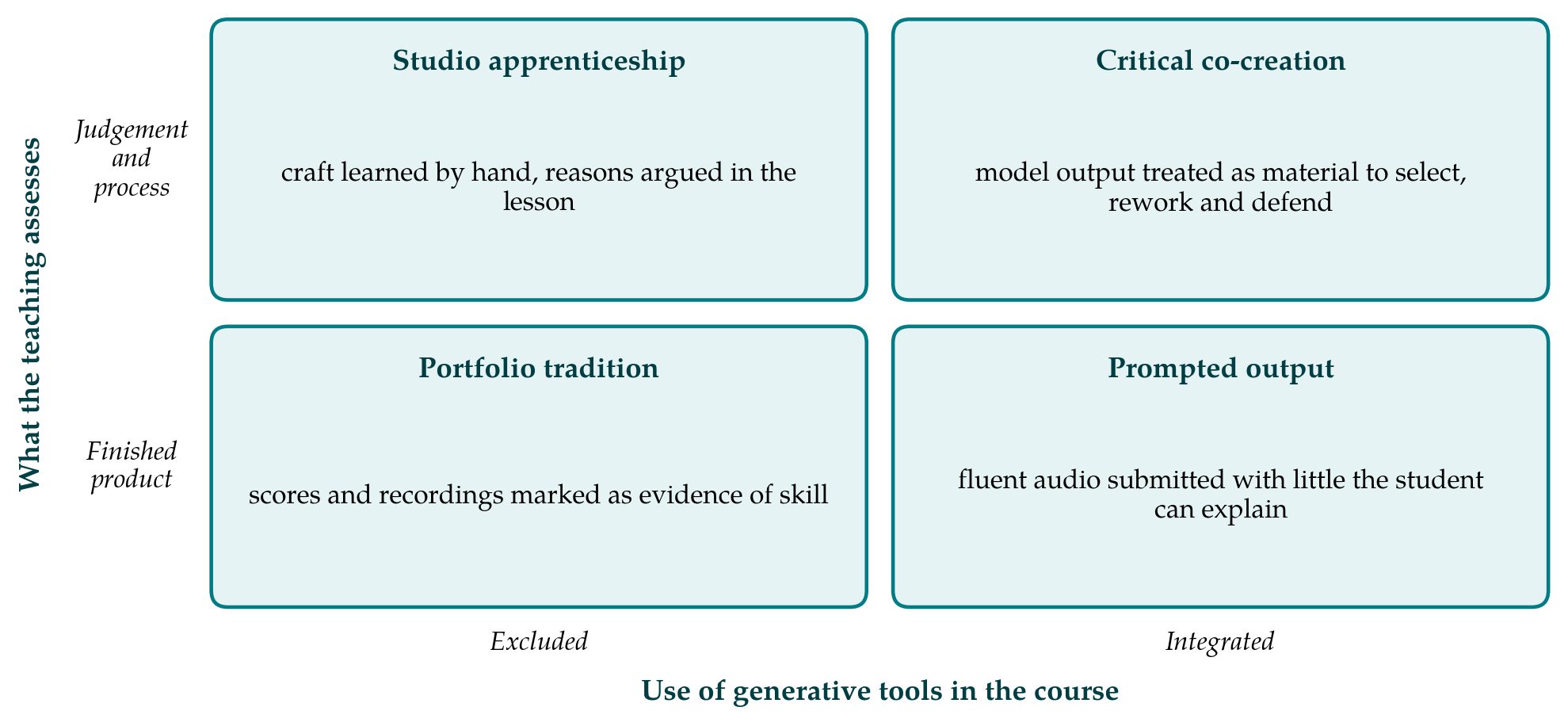
Figure 1 maps the choice facing a department along two lines: whether generative tools are kept out of the course or brought into it, and whether assessment attends to the finished product or to the student's judgement and process. The lower right-hand corner, where tools are permitted and only the product is marked, is the position an institution reaches by default if it changes nothing. The upper row is defensible with or without the tools. The argument of this article is that the vertical move matters more than the horizontal one.
There is a second part to the argument. Small insisted that music is something people do together, and that its meanings lie in the relationships a performance sets up (Small, 1998). A composer who writes for a string quartet enters such relationships: with four players, their instruments, a rehearsal, a room. Generated audio bypasses all of them. The part of composition that consists in imagining what particular people can do, and then learning from what they do in fact, is the part the models leave alone, and it deserves more of the timetable than it usually receives.
5. Three Objections
The first objection is that none of this is new. Hiller and Isaacson programmed a computer to compose a string quartet in the 1950s (Hiller and Isaacson, 1959), and Cope's software wrote pastiche Bach and Chopin that unsettled audiences decades ago (Cope, 2001). Recording, the synthesiser and the sequencer each prompted predictions that musicianship would wither, and Katz has shown how musicians absorbed and redirected such technologies (Katz, 2010). The precedent is real, but the earlier systems needed expert operators and produced notation or simple synthesis. The difference now is access and finish: any student can obtain complete audio, in any common style, without knowing anything.
The second objection is that the models are irrelevant to what conservatories teach. They do not write parts that a bassoonist can play, and their grasp of long-range form is weak. That is fair as a description of the present, and it is the reason this article treats writing for performers as the secure centre of the subject. It would be unwise to rest a curriculum on a technical limitation, however. Many graduates will also earn part of their living from media, library and commercial music, where delivered audio is the product and where the pressure will be felt first.
The third objection comes from the other side: that making room for the tools abandons craft and lets students skip the slow work on which judgement depends. The risk is genuine. Participants in a songwriting contest that required the use of machine learning reported that steering the models and sifting their output was laborious and that musical decisions still had to be made by people (Huang et al., 2020), which suggests that the tools reward those who already know what they want. The answer is sequencing. Students should meet generative systems after, and alongside, training that gives them something to judge with.
6. Implications for Curriculum and Assessment
Several practical changes follow. Assessment should include what a file cannot fake: sketches and drafts, an oral defence in which the student explains choices and responds to alternatives, and workshop sessions where a piece is revised in front of players. These practices already exist in many departments and need to carry more of the mark. Calls to reform music degrees around creativity and integration of skills predate the present technology and point the same way (Sarath et al., 2017).
Students also need to understand the tools as made things. That includes, at a non-specialist level, how a model is trained and why it returns the typical; whose recordings were used and on what terms, a matter on which copyright law remains unsettled (Sturm et al., 2019); and what the alternatives look like. Lewis's Voyager, an improvising program conceived as a partner with its own behaviour and not as a generator of products, shows that a musical machine can embody an aesthetic and a politics chosen by its maker (Lewis, 2000). A composer who can read systems in that way is better placed to use, refuse or redesign them.
Finally, institutions should say plainly why they teach composition. Three answers survive the arrival of generative audio: to train musical judgement, to prepare people to make music with and for others, and to sustain traditions of thought about sound that are worth having whether or not a market pays for them. Certifying the ability to turn out competent music in a given style is no longer among them.
7. Conclusion
Generative audio does not make composers redundant, and it does not leave composition teaching where it was. It removes the scarcity of the plausible product, on which a good deal of teaching and most assessment have quietly depended. What it cannot supply is a reason for one musical choice over another, or the experience of working something out with other musicians in a room. A conservatory that organises its teaching around those two things will have an answer when students ask why they should spend years learning what a machine appears to do in seconds. The answer is that they are learning to hear, to judge and to collaborate, and that the writing was always a means to that.
Conflict of interest
To be declared by the author(s) before publication.
Funding
To be declared by the author(s) before publication.