1. Introduction
Offsetting has an attractive logic. The atmosphere is indifferent to where a tonne of carbon dioxide is emitted or absorbed, so a party that finds its own emissions expensive to cut can pay another to cut or absorb the same amount more cheaply. On this reasoning, markets in offset credits lower the cost of a given climate outcome, and governments have been invited to recognise them in emissions trading systems, in national pledges and in rules on corporate claims. The cooperative approaches provided for in the Paris Agreement give the idea an international footing (UNFCCC, 2015).
The logic depends on the two tonnes being equivalent in their effect on the climate. Debate about offset quality has concentrated on whether the credited reduction was additional and whether its baseline was honest. Those questions matter and are returned to below. This Perspective puts a different one first. Even a credit that is additional and correctly counted fails as an offset if the carbon it represents returns to the atmosphere while the emission it was sold against is still warming the planet. The position argued here is that verifiable permanence should be a precondition for policy support, and that most credits now traded do not meet it.
2. The Equivalence That Offsetting Assumes
Carbon dioxide from fossil fuels is not removed from the atmosphere on any timescale relevant to policy. Uptake by the ocean and the land draws down part of an emission over decades to centuries, but a substantial fraction persists for many thousands of years (Archer et al., 2009). Peak warming is consequently governed by the cumulative total of carbon dioxide emitted and not by the rate of emission in any given year (Allen et al., 2009). A tonne of fossil carbon burnt today is, for practical purposes, a permanent addition to that total.
To cancel it, an offset must make a permanent subtraction. Storage that lasts forty years and is then lost postpones the warming from that tonne and does not prevent it, a point made formally by Kirschbaum (2006). The asymmetry was recognised early. The Intergovernmental Panel on Climate Change's special report on land use identified the potential reversibility of carbon held in vegetation and soils as a distinctive problem for accounting (IPCC, 2000). Carbon in a forest remains part of the active cycle, exposed to fire, drought, pests and the decisions of whoever owns the land. Carbon left in a coal seam is not. Treating a tonne of one as equal to a tonne of the other is the assumption on which the whole edifice stands.
3. How Markets Manage Reversal Risk
Offset programmes have not ignored the problem. They have devised instruments to manage it, and it is worth setting these out fairly. The most common is the buffer pool: every project contributes a share of its credits to a common reserve, and credits are cancelled from the reserve when a project suffers a reversal. A second is the fixed-term commitment. California's compliance protocol for forest projects requires carbon to be maintained for one hundred years after credits are issued, and voluntary standards commonly accept shorter terms. A third is the temporary credit, used for afforestation and reforestation under the Clean Development Mechanism, which expired after a set period and had to be replaced by the buyer.
Two accounting ideas run alongside these. Tonne-year methods assign a fraction of a permanent credit for each year a tonne is held, using an equivalence factor derived from the decay of carbon dioxide in the atmosphere over a chosen horizon (Fearnside et al., 2000). The rental approach treats sequestered carbon as leased, not sold, with the liability returning to the emitter when the lease ends (Marland et al., 2001). Each of these devices converts a physical risk into an accounting convention. Whether the conversion is sound depends on whether the convention matches what happens to the carbon.
4. Why the Safeguards Fall Short
The evidence that has accumulated suggests it often does not. An analysis of the buffer pool in California's forest offset programme concluded that wildfires in the programme's first decade had already consumed nearly all of the credits set aside to cover fire risk for a full century, and that the pool was unlikely to cover losses from disease as well (Badgley et al., 2022a). The contributions had been set from historical loss rates in a period when the risks are rising. Anderegg et al. (2020) reviewed the threats that climate change itself poses to forest carbon, including fire, drought and insect outbreaks, and concluded that they are growing and are poorly represented in the design of forest-based mitigation.
Fixed terms have a different weakness. A century is long for an institution and short for the climate. A promise to monitor and replace carbon for one hundred years must be honoured by landowners, registries and regulators that do not yet exist, and it still falls well short of the lifetime of the emission it covers. Tonne-year accounting makes the shortfall disappear by choosing a time horizon beyond which warming is not counted, which is a value judgement presented as arithmetic.
Permanence also interacts with the better known defects. Studies have found that credited volumes can exceed real reductions because of how baselines are set, in California's forest protocol (Badgley et al., 2022b), in projects to reduce tropical deforestation (West et al., 2023) and across the Clean Development Mechanism (Cames et al., 2016). Haya et al. (2020) show how standardised rules, adopted to reduce transaction costs, leave such uncertainties unmanaged. A credit of doubtful quantity backed by storage of doubtful duration compounds two errors, and assurance on one does nothing for the other.
5. A Standard of Verifiable Permanence
Four conditions would be enough to meet the standard proposed here. The stored carbon must be observable, so that its continued presence can be checked and not presumed. The risk of reversal must be estimated from current evidence and revised as conditions change. A named party must carry the liability to make good any reversal for the full period over which the offset is claimed. And the durability of the storage must be comparable to the lifetime of the emission against which it is retired. Table 1 sets the main forms of storage against these conditions.
| Form of storage | Durability | Main reversal risks | Means of verification |
|---|---|---|---|
| Forest biomass | Decades to centuries, while protection lasts | Fire, drought, pests, harvest, change of owner | Remote sensing and field inventory |
| Soil organic carbon | Years to decades; depends on management | Return to former tillage or land use; warming | Repeated soil sampling, costly at scale |
| Long-lived wood products | Decades | Disposal, burning and decay | Product tracking, seldom carried out |
| Geological storage of CO 2 | Thousands of years at well-chosen sites (IPCC, 2005) | Leakage through wells or faults | Injection metering and subsurface monitoring |
| Avoided emissions | Not storage: no stock is held | Overstated baseline | Counterfactual cannot be observed |
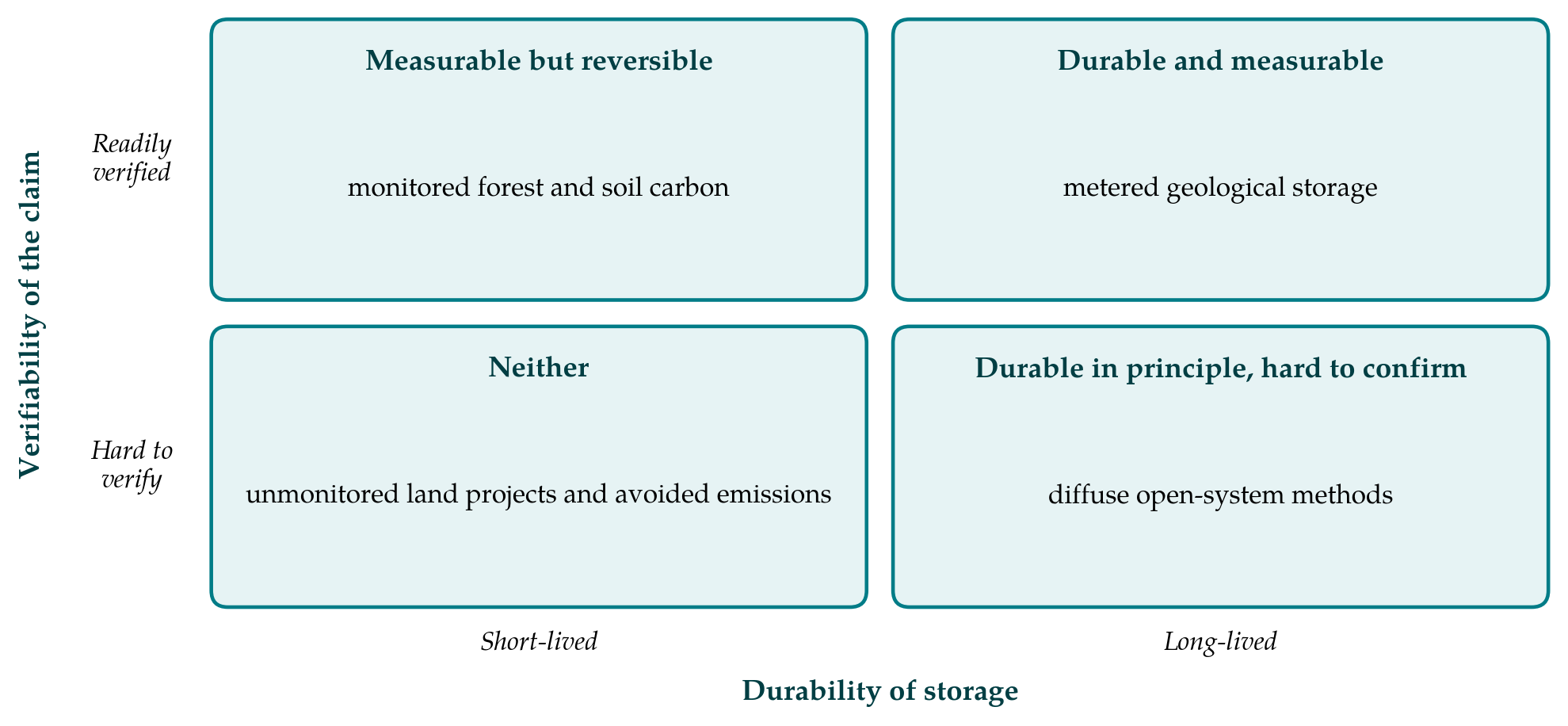
The comparison shows that durability and verifiability are separate properties. Geological storage in a well-characterised formation scores highly on both: the quantity injected is metered, the site can be monitored, and the Intergovernmental Panel on Climate Change judged that appropriately selected and managed reservoirs are likely to retain almost all of their carbon dioxide for a thousand years or longer (IPCC, 2005). Forest carbon can be measured well with modern remote sensing but is exposed to reversal. Avoided emissions leave nothing to monitor. Figure 1 arranges the options on these two axes. Only credits in the upper right quadrant can support a claim of equivalence with a fossil emission.
6. Counter-Arguments
The strongest objection is that temporary storage is not worthless. Matthews et al. (2022) showed that carbon held in ecosystems for some decades can lower the peak of warming, provided that fossil emissions are falling steeply over the same period. This is correct and important. It is an argument for protecting and restoring ecosystems. It is not an argument for selling that protection as a licence to emit an equal quantity of fossil carbon, because in that case the condition on which the benefit depends, falling emissions, is the very thing the offset relaxes.
A second objection is that offset revenue pays for forest conservation that would otherwise go unfunded. The premise may be true while the conclusion does not follow. Finance can flow to forests as a contribution to mitigation, reported as such, without the payer subtracting the tonnes from its own account. What would be lost is the claim of neutrality, and that claim is the element that lacks physical support.
A third objection is practical: durable storage is scarce and expensive, and a rule that admits only durable storage would leave almost nothing to buy. That scarcity is information. It indicates what neutralising a tonne of fossil carbon really costs, and a policy that hides the cost behind cheaper, weaker credits delays the abatement it was meant to encourage. Nor is the proposed standard all or nothing. Short-lived storage could be matched to short-lived claims, with the liability reverting to the emitter when storage ends, as the rental approach envisaged (Marland et al., 2001).
7. Implications for Policy
Several strands of recent thinking converge on the same direction. The Oxford Principles for net zero aligned offsetting recommend that buyers shift over time from avoided emissions to removals and from short-lived to long-lived storage (Allen et al., 2020). Fankhauser et al. (2022) hold that net zero has meaning only if residual emissions are balanced by removals of matching permanence. McLaren et al. (2019) propose separate targets for emission reductions and for removals, so that one cannot be substituted for the other without scrutiny.
For governments the practical consequences are fourfold. Compliance markets should admit offsets only where storage is monitored and a solvent party is liable for reversal throughout the claimed period. National targets should report land-based storage separately from fossil emissions and should not net one against the other. Rules on public procurement and on corporate environmental claims should require that any statement of neutrality identify the durability of the storage behind it. And registries should publish reversals and buffer balances in a form that outsiders can audit. None of this prevents public or private money from supporting forests, soils and wetlands for the many benefits they provide.
8. Conclusion
An offset is a promise about the future state of a carbon stock, made on behalf of a buyer whose emission is already irreversible. Markets have treated that promise as a matter of contract design. The physics of the carbon cycle, and the record of the safeguards tried so far, indicate that it is a matter of evidence: either the storage can be shown to last as long as the harm, with someone accountable if it does not, or the tonnes are not equivalent. Policy support should follow the evidence. Until permanence can be verified, offset credits belong in the category of useful contributions to mitigation and outside the arithmetic by which emitters and governments declare their accounts settled.
Conflict of interest
To be declared by the author(s) before publication.
Funding
To be declared by the author(s) before publication.