1. Introduction
Reef-building corals are symbioses between a cnidarian host and dinoflagellate algae of the family Symbiodiniaceae that live inside its cells and supply much of its energy. When sea temperature stays a degree or two above the usual summer maximum for several weeks, the partnership breaks down, the algae are lost and the colony turns pale, a response known as bleaching (Brown, 1997). Early laboratory work on Hawaiian corals had already shown that their upper limits lie only slightly above the temperatures they meet each summer (Jokiel and Coles, 1977). As marine heatwaves have grown more frequent, bleaching has recurred at intervals too short for full recovery on many reefs (Hughes et al., 2017).
Against that background, the observation that some colonies stay pigmented while their neighbours bleach has attracted close attention. Part of the contrast is between species, but a good deal of it lies within species, and some of the clearest examples come from habitats that sit side by side. Shallow lagoons and back-reef pools are cut off from the open sea at low tide, warm quickly in the midday sun and cool again at night. A pool with a large daily range may lie a short swim from one that is buffered by deeper water or stronger flushing. Corals of the same species in the two pools share a larval supply and a regional climate, yet they experience different thermal regimes every day.
This article reviews what has been published on thermal tolerance variation among coral genotypes from such adjacent habitats. It asks where the variation comes from, how firmly each source has been demonstrated, how tolerance has been measured, and what the findings do and do not license in reef management. The term genotype is used here for a genetically distinct individual, or genet, which in branching corals may be represented by many colonies produced through fragmentation (Baums, 2008).
2. Scope and Approach
The review is narrative. It draws on the peer-reviewed literature on coral thermal biology known to the field, with emphasis on studies that compared conspecific colonies from neighbouring habitats and on the experimental and genomic work that followed from them. No formal search protocol was applied and no quantitative synthesis is attempted, because the studies differ too much in species, heating regime and response variable for their results to be pooled. Studies of latitudinal gradients are used where they clarify mechanisms, notably heritability, that the small-scale comparisons cannot settle by themselves.
3. Adjacent Habitats as Natural Experiments
The most thoroughly studied system is the back reef of Ofu Island in American Samoa. Two neighbouring pools there differ in size and flushing: a small, highly variable pool in which temperature can swing by several degrees within a tidal cycle and briefly exceed the local bleaching threshold, and a larger, moderately variable pool with a narrower range. Oliver and Palumbi (2011) exposed Acropora hyacinthus from both pools to experimental heating and found that colonies from the more variable pool survived better and retained more of their symbionts. A decade of further work at the site, summarised by Thomas et al. (2018), has made it the reference case for fine-scale variation in heat tolerance.
Comparable contrasts have been described elsewhere. In the Florida Keys, Porites astreoides from warm, variable inshore patch reefs withstood heating better than colonies from offshore reefs a few kilometres away, although both hosted the same type of symbiont (Kenkel et al., 2013). In the macrotidal Kimberley region of north-western Australia, Acropora aspera from intertidal pools was more resistant than subtidal colonies of the same reef, yet both bleached when heated beyond their accustomed range (Schoepf et al., 2015). On a reef in the central Red Sea, short heat assays separated Stylophora pistillata from the exposed and protected sides of the same reef (Voolstra et al., 2020). A global analysis of in situ temperature records reached a compatible conclusion at a broader scale: reefs with greater high-frequency temperature variability have bleached less for a given heat exposure (Safaie et al., 2018).
These systems are attractive because distance, and with it regional climate and gene flow, is held nearly constant. They are natural experiments, however, and not controlled ones. Pools differ in light, water flow, turbidity and nutrient supply as well as in temperature, and each of these alters the response to heat (Fitt et al., 2001). Attribution of a tolerance difference to thermal history alone therefore rests on supporting experiments and not on the field contrast by itself.
4. Sources of Variation in Tolerance
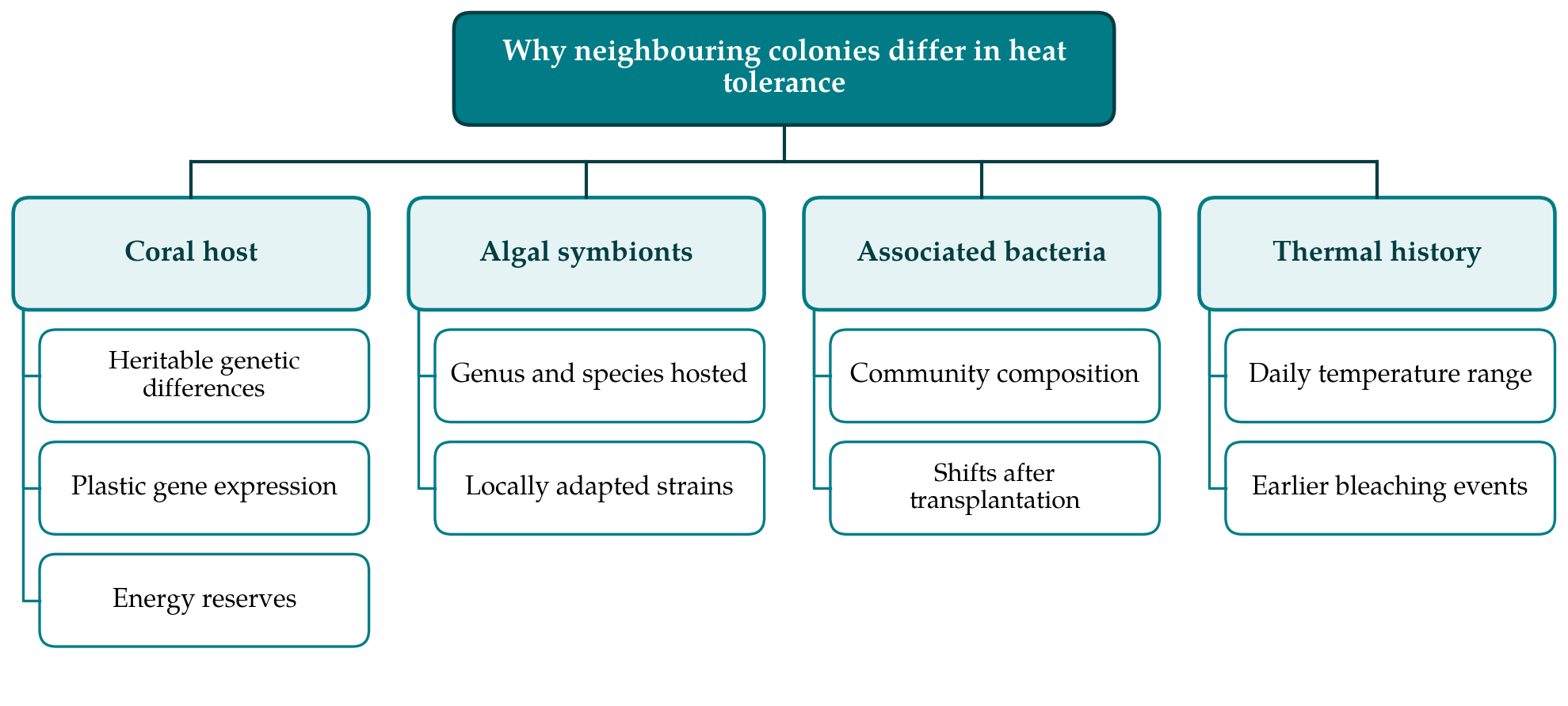
A colony that tolerates heat better than its neighbour may do so because of the genes it carries, because of what it has experienced, because of the algae it hosts, or because of its other microbial associates. Figure 1 sets out these possibilities, and Table 1 summarises how each has been tested and how strong the evidence is. The four are not exclusive, and the published studies suggest that several act together.
| Source | Principal test | State of the evidence | Representative sources |
|---|---|---|---|
| Host genetics | Genome scans; controlled crosses | Many loci of small effect; heritability shown across latitude | Bay and Palumbi, 2014; Dixon et al., 2015 |
| Host plasticity | Reciprocal transplants; gene expression | Partial gain of tolerance after transplanting | Palumbi et al., 2014; Barshis et al., 2013 |
| Symbiont genus | Genotyping before and after heat stress | Well supported; linked to slower growth | Berkelmans and van Oppen, 2006 |
| Symbiont strain | Inoculation of juveniles | Shown in one host species | Howells et al., 2012 |
| Bacteria | Community profiling after transplants | Associations only; causation untested | Ziegler et al., 2017 |
| Thermal regime | Temperature logging; cross-reef comparison | Variable sites bleach less; other factors confounded | Safaie et al., 2018 |
4.1. Heritable differences in the host
Evidence that the coral animal itself contributes comes from three directions. First, tolerance differences persist when symbiont type is the same, as in the Florida Porites comparison (Kenkel et al., 2013). Second, genome scans at Ofu identified many loci whose allele frequencies differ between the pools and track heat resistance, a pattern that points to selection acting on numerous genes of small effect and not on a single switch (Bay and Palumbi, 2014). Third, crosses between Acropora millepora colonies from warmer and cooler parts of the Great Barrier Reef showed that larval survival under heat depends strongly on parentage, which demonstrates heritability directly (Dixon et al., 2015).
The last result comes from a latitudinal comparison and cannot simply be transferred to adjacent pools, where larvae from both habitats mix in every generation. For genetic differentiation to persist at that scale, selection after settlement must be strong enough to sort recruits by habitat each generation. The Ofu genome scans are consistent with such sorting, but they do not exclude the alternative that some differentiated loci mark cryptic lineages that happen to prefer different pools. The host contribution at this scale is therefore well indicated but not yet fully resolved.
4.2. Acclimatisation and plasticity
Reciprocal transplantation is the standard test for separating fixed from acquired differences. When fragments of the same Ofu colonies were grown in both pools, those moved into the highly variable pool gained heat tolerance within one to two years, although not always to the level of the natives (Palumbi et al., 2014). The authors concluded that acclimatisation and fixed effects each account for a share of the difference. Transcriptome work pointed to a mechanism: corals from the variable pool maintain higher baseline expression of many genes that others induce only under heat, a pattern termed frontloading (Barshis et al., 2013).
Plasticity may itself be a trait under selection. In a reciprocal transplant between inshore and offshore reefs in Florida, Porites astreoides of inshore origin adjusted the expression of stress-related genes more than offshore corals did, and the degree of adjustment was associated with less bleaching (Kenkel and Matz, 2016). On this reading, a variable habitat favours genotypes that respond flexibly, so the line between adaptation and acclimatisation is less sharp than the transplant design implies.
4.3. Symbiont identity
The algal partner has long been recognised as a determinant of bleaching susceptibility (Baker, 2003). Colonies that host members of the genus now called Durusdinium, formerly clade D (LaJeunesse et al., 2018), generally tolerate more heat than conspecifics hosting Cladocopium. In Acropora millepora, a change in the dominant symbiont raised the bleaching threshold by roughly 1 to 1.5 °C (Berkelmans and van Oppen, 2006). At Ofu, corals in the more variable pool hosted heat-tolerant symbionts more often (Oliver and Palumbi, 2011).
Variation exists below the level of genus as well. Populations of a single Cladocopium type taken from a warmer and a cooler reef conferred different tolerance on juvenile corals raised with them, which indicates local adaptation of the symbionts themselves (Howells et al., 2012). A habitat comparison that records only symbiont genus may therefore miss part of the algal contribution and assign it to the host.
4.4. Bacterial associates
Corals also carry diverse bacterial communities. At Ofu, the bacterial assemblages of Acropora hyacinthus differed between pools, changed after transplantation towards those of the destination pool, and were associated with the heat tolerance of the fragments (Ziegler et al., 2017). Whether the bacteria contribute to tolerance or simply reflect the condition of the host cannot be decided from such associations, and this strand of evidence remains the least developed of the four.
5. Measuring Tolerance
Conclusions about variation depend on what is measured. Field surveys score visible paling during natural events. Tank experiments apply a heating ramp and track symbiont density, chlorophyll content, photochemical efficiency of the algae or mortality. These endpoints capture different stages of the cellular breakdown described by Weis (2008), and a colony ranked as tolerant by one may not be so by another. Fitt et al. (2001) warned that a single threshold temperature is a simplification, since the outcome depends on duration, light and season as well as on peak temperature.
Portable systems that expose fragments to a series of temperatures within a single day have made it practical to rank many colonies on site. Voolstra et al. (2020) showed that such acute assays resolved differences between neighbouring sites and agreed in direction with a longer experiment on the same corals. The gain in throughput is considerable. The open question is how well a ranking obtained over hours predicts performance over the weeks of accumulated heat stress that characterise a real bleaching event, and the comparison has so far been made for few species.
A related difficulty concerns the unit of replication. Because branching corals propagate by fragmentation, neighbouring colonies may belong to one genet. Unless colonies are genotyped, apparent replication among individuals may be repeated sampling of a single clone, and variation among genotypes will be confused with variation among habitats (Baums, 2008).
6. Costs and Limits
Heat tolerance is not free. Juvenile Acropora hosting the more heat-tolerant symbiont genus grew markedly more slowly than those hosting Cladocopium (Little et al., 2004), and constitutively high expression of stress genes implies a standing energetic cost. If tolerant genotypes grow or reproduce less in ordinary years, their frequency in a population will reflect a balance and not a steady rise, which may explain why sensitive genotypes persist beside tolerant ones.
The tolerance of corals from variable habitats is also bounded. The intertidal Kimberley corals, accustomed to some of the widest daily ranges recorded for reefs, still bleached and died when held a few degrees above their normal summer maximum (Schoepf et al., 2015). Reef-wide surveys after recent heatwaves found that the severity of bleaching followed the amount of heat exposure, with little sign of protection from earlier events (Hughes et al., 2017). Variable lagoons raise the threshold; they do not remove it.
7. Implications for Reef Management
The practical interest of this literature lies in restoration and in proposals for assisted evolution, which include selective propagation of tolerant stock (van Oppen et al., 2015). A test at Ofu gave some encouragement: fragments from colonies ranked as heat tolerant were grown in a common nursery, and they bleached less than fragments from sensitive colonies during a subsequent natural event (Morikawa and Palumbi, 2019). The tolerance was thus retained away from the home pool for at least the period observed.
Several cautions follow from the sections above. Tolerance that is partly acquired may fade once a coral is moved to a stable environment, on a timescale that has rarely been measured. Selection of a few tolerant genets narrows the genetic base of outplanted populations, a risk long recognised in restoration genetics (Baums, 2008). Trade-offs with growth may reduce the performance of selected stock in cooler years. Variable lagoon habitats are perhaps best regarded as places worth protecting in their own right, as reservoirs of tolerant genotypes and symbionts, whatever use is later made of them as sources of nursery material.
8. Gaps and Future Work
The evidence is narrow in three respects. Most of it concerns a handful of species, chiefly fast growing Acropora and one Porites, and a small number of well-instrumented sites. Massive and slow-growing corals, which dominate many lagoons, are poorly represented. Next, few studies have followed the same genotyped colonies through more than one natural bleaching event, so the repeatability of individual tolerance in the field is largely unknown. Finally, the relative contributions of host, symbiont and bacteria have seldom been estimated in a single design that manipulates each in turn.
Progress would come from long-term tagging of genotyped colonies in paired habitats with continuous temperature, light and flow records; from transplant experiments that run long enough to reveal whether acquired tolerance is lost as well as gained; and from calibration of acute assays against outcomes in natural heatwaves across a wider range of taxa. Common reporting of heating profiles and response variables would make studies comparable, which at present they often are not.
9. Conclusion
Conspecific corals from neighbouring lagoon habitats can differ consistently in the heat they withstand. The published work attributes the difference to a combination of heritable host variation spread across many genes, plasticity acquired under a variable thermal regime, the identity and local adaptation of the algal symbionts and, less securely, the bacterial community. These findings give grounds for valuing thermally variable habitats and for careful trials of selective propagation. They do not show that such corals are safe from continued warming, and the narrow taxonomic and geographic base of the evidence should temper any general claim.
Conflict of interest
To be declared by the author(s) before publication.
Funding
To be declared by the author(s) before publication.