1. Introduction
Care for people with schizophrenia is organised around appointments, and what happens between them is known mainly from what the patient and family later recall. Relapse seldom arrives without notice. Clinical research in the 1980s showed that changes in sleep, mood, social contact and thinking tend to appear in the weeks before a psychotic relapse and that patients and relatives can be taught to recognise them (Birchwood et al., 1989). The difficulty has always been that such monitoring depends on sustained effort and insight at the very time when both are failing.
Smartphones offer a different route. They carry sensors that record movement and location, they log calls, messages and screen use, and they can deliver short questionnaires. The term digital phenotype was introduced to describe the health-relevant traces that people leave through their use of technology (Jain et al., 2015), and digital phenotyping was then defined more narrowly as the moment-by-moment quantification of the individual-level human phenotype in situ using data from personal digital devices (Onnela and Rauch, 2016). The idea was taken up quickly in psychiatry, where objective measures of behaviour are scarce (Insel, 2017).
This review considers the approach as it applies to schizophrenia care. It describes the methods, summarises what has been shown, sets out the technical and clinical obstacles, and then turns to the ethical limits that should shape any move from research to practice.
2. Scope and Approach
The article is a narrative review of the published literature on smartphone-based and related sensing in schizophrenia-spectrum disorders, together with the ethical and methodological writing that surrounds it. It is selective, it relies on studies and commentaries that are widely cited, and it does not claim the coverage of a systematic review. Commercial products are not evaluated. The field changes quickly, and the reader should treat statements about the state of evidence as describing the published record known to the author and not the most recent unpublished work.
3. What Digital Phenotyping Involves
Two kinds of data are usually distinguished. Active data require the person to do something: answer a few questions about mood, sleep or voices, or complete a brief cognitive task. This is a descendant of the experience sampling method, which has a long record in psychosis research and showed that symptoms fluctuate with context across the day (Myin-Germeys et al., 2009). Passive data are collected without any action by the user and include location from the global positioning system, accelerometer readings, and metadata on calls, text messages and screen activity (Mohr et al., 2017).
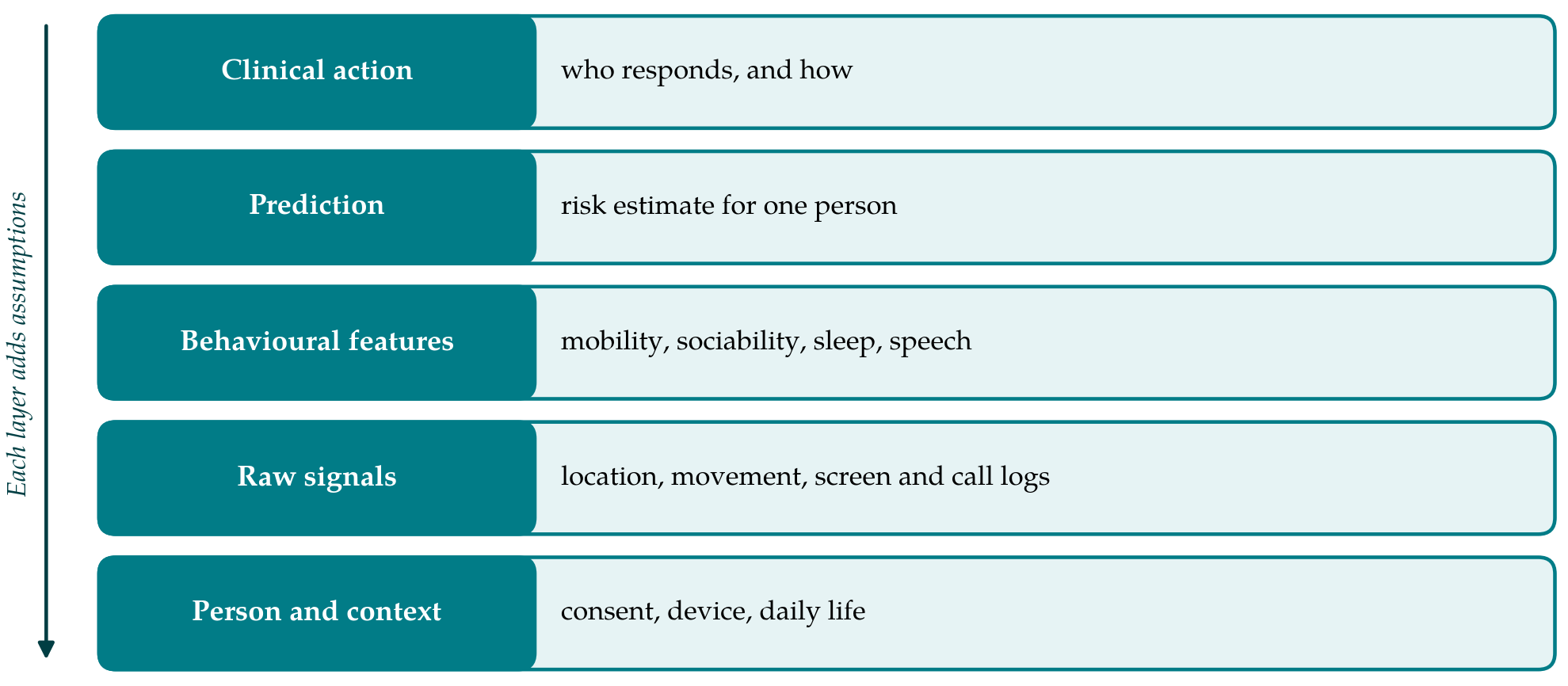
Raw sensor readings are not clinically meaningful. They are converted into behavioural features such as time spent at home, distance travelled, number of distinct places visited, regularity of daily routine, number of outgoing calls and estimated sleep period. Statistical or machine learning models then relate these features to a clinical outcome. Figure 1 sets out this chain from the person to the clinical response. Each step upward adds inference and assumption, and a failure at any level, from a phone left at home to a model trained on the wrong population, propagates to the top.
Open research platforms were built to make such studies reproducible. The Beiwe platform, for example, was designed to collect active and passive smartphone data with documented methods and configurable privacy settings (Torous et al., 2016). Other groups have analysed speech and written language, a separate strand of digital measurement that draws on the long-standing clinical observation of disorganised and impoverished speech in schizophrenia.
4. What the Evidence Shows
The published findings can be grouped by the clinical purpose they serve. Table 1 lists the main proposed uses, the data they draw on and a brief judgement of how far the evidence has advanced.
| Proposed use | Typical data | State of evidence | Representative source |
|---|---|---|---|
| Feasibility of monitoring | Smartphone ownership and app use | Well supported in research samples | Firth et al., 2016 |
| Relapse prediction | Mobility, sociability, self-report | Signals seen in small pilot cohorts | Barnett et al., 2018 |
| Symptom tracking | Brief repeated self-ratings | Established as a research method | Myin-Germeys et al., 2009 |
| Multimodal sensing | Sensors combined with self-report | Associations reported; validation pending | Ben-Zeev et al., 2017 |
| Onset prediction in high risk | Automated speech analysis | Promising; small samples | Corcoran et al., 2018 |
| Relapse signals in social media | Archived posts and messages | Exploratory | Birnbaum et al., 2019 |
4.1. Feasibility and acceptability
An early concern was that people with psychosis would not own smartphones, would not use monitoring applications, or would find them frightening. The evidence does not bear this out. A meta-analysis of survey studies found that mobile phone ownership among people with psychosis was common and rising and that a majority were favourable to the use of phones in their care (Firth et al., 2016). A smartphone intervention for illness self-management was used regularly by outpatients with schizophrenia and was rated acceptable (Ben-Zeev et al., 2014). These results come from volunteers, and people who decline research may differ, but the claim that the technology is beyond the reach of this population is no longer tenable.
4.2. Relapse prediction
Relapse is the outcome of greatest interest because it is frequent, costly and damaging. Discontinuing antipsychotic medication after a first episode is associated with a several-fold increase in the risk of relapse (Robinson et al., 1999), and relapse can be abrupt, with a rapid return of symptoms and little warning (Emsley et al., 2013). In a pilot study that followed a small group of patients with schizophrenia using the Beiwe platform, the rate of anomalies in passively measured mobility and sociability was higher in the two weeks before relapse than at other times (Barnett et al., 2018). The CrossCheck project combined sensing with self-report and described both a system for detecting behavioural change (Wang et al., 2016) and digital indicators that preceded relapse in individual participants (Ben-Zeev et al., 2017).
These studies demonstrate that a signal can exist. They were not designed to show how often an alert would be right or wrong in routine use. Few participants relapsed during follow-up, definitions of relapse varied, and models were generally evaluated on the people from whom they were built. A study of archived social media activity in young people with psychotic disorders likewise found linguistic and behavioural changes in the period before relapse hospitalisation and presented the work as a first step (Birnbaum et al., 2019).
4.3. Speech and language
Automated analysis of speech has produced some of the more striking results. In a small cohort of young people at clinical high risk, measures of semantic coherence and syntactic complexity derived from interview transcripts distinguished those who later developed psychosis from those who did not (Bedi et al., 2015). A later study applied a related classifier to a second cohort collected under a different protocol and again reported good discrimination (Corcoran et al., 2018). The work concerns onset more than ongoing care, the samples are small, and language differs across cultures, dialects and levels of education in ways that a model trained in one setting may misread.
5. Pitfalls
The gap between a research signal and a clinical tool is wide, and several obstacles recur across studies. Missing data is the first. Phones are switched off, left behind, shared or lost, operating systems restrict background sensing, and adherence to self-report falls over time. In schizophrenia missingness may itself be informative, since withdrawal and disorganisation reduce phone use, which makes it hard to treat gaps as noise.
A second obstacle is that behaviour measured by a phone is ambiguous. Staying at home may reflect negative symptoms, depression, physical illness, poverty, bad weather or a new job done remotely. A fall in outgoing calls may mean social withdrawal or a move to a messaging application that the study does not record. The features are proxies, and their relationship to the clinical construct has to be shown and not assumed (Huckvale et al., 2019).
Third, the standards that apply to any prediction model apply here. The TRIPOD statement asks for clear reporting of how a model was developed and insists on the difference between apparent performance and performance in new data (Collins et al., 2015). Most digital phenotyping models in psychosis have not been externally validated. Because relapse is uncommon in any given week, even a model with good discrimination would generate many false alerts for each true one, and repeated false alarms burden staff and may unsettle patients. Finally, almost nothing is known about the step that matters most: whether clinicians who receive such information act differently, and whether patients do better as a result. Calls for shared standards on safety, evidence and data handling in mental health applications reflect these gaps (Torous et al., 2019).
6. Ethical Boundaries
Ethical analysis of digital phenotyping has grown alongside the technical work, and commentators have set out the main areas of concern: consent, privacy, accountability and fairness (Martinez-Martin et al., 2018). Each takes a particular form in schizophrenia.
6.1. Consent and capacity
Valid consent requires that a person understands what is proposed, appreciates how it applies to them, can reason about it and can express a choice (Appelbaum and Grisso, 1988). Research on decisional capacity in schizophrenia found that many patients perform adequately, that impairment is related more to cognitive difficulty than to psychotic symptoms, and that an educational procedure can raise understanding to the level of comparison participants (Carpenter et al., 2000). Diagnosis alone is therefore no ground for presuming incapacity. Passive monitoring nonetheless strains the usual model of consent. Agreement is given once, while collection continues silently for months, across periods when capacity may fluctuate. Consent in this setting needs to be revisited at intervals, and the person needs a simple way to pause or stop collection without penalty.
6.2. Privacy and the risk of surveillance
Location traces and communication logs are among the most revealing kinds of personal data. They expose where a person sleeps, whom they contact and which services they attend, and location data are difficult to anonymise. They also describe third parties who never agreed to take part. In the European Union, data concerning health fall within the special categories that receive heightened protection under the General Data Protection Regulation (European Parliament and Council, 2016); elsewhere, data gathered by consumer applications may fall outside health privacy law altogether.
There is a further consideration particular to psychosis. Many patients have experienced coercion, and persecutory beliefs about being watched or tracked are common. A programme that follows a person's movements can be experienced as confirmation of those fears, and if monitoring is made a condition of discharge, housing or a community treatment order it ceases to be voluntary in any real sense. Risks of this kind are best assessed with the people affected, and before deployment instead of after a complaint.
6.3. Fairness and responsibility
Models learn from the data they are given. A widely discussed analysis of a commercial algorithm used to allocate health care in the United States showed that it systematically underestimated the needs of Black patients because it used cost as a proxy for illness (Obermeyer et al., 2019). Digital phenotyping is open to the same kind of error. Mobility, phone use and speech vary with income, employment, housing, language and culture, and a model built on urban research volunteers may misclassify people whose lives are organised differently. Responsibility for alerts is also unsettled. If a system flags a likely relapse at night or at a weekend, someone must be designated to respond, and a service that collects signals it cannot act upon has taken on a duty it may be unable to meet.
7. Conditions for Responsible Use and Future Work
The literature supports continued research and does not yet support routine clinical deployment. Several conditions would need to be met before that changed. Prediction models should be validated in samples other than those used to build them, with performance reported in terms that clinicians can use, including the expected number of false alerts. Trials should test whether acting on digital signals reduces relapse or improves functioning compared with good standard care, and should record harms such as anxiety, disengagement and loss of trust. People with lived experience of psychosis should take part in deciding what is measured, who sees it and what happens when a threshold is crossed.
Design choices can reduce risk. Collecting only the data needed for a stated purpose, processing data on the device where possible, giving patients access to their own records and keeping monitoring separate from any compulsory measure are all practicable. The more modest uses may prove the most valuable: a shared record of sleep and activity that patient and clinician review together asks less of prediction and more of conversation, and it leaves interpretation with the people best placed to provide it.
8. Conclusion
Digital phenotyping has shown that continuous behavioural measurement in schizophrenia is feasible and acceptable to many patients, and pilot studies suggest that changes in behaviour can precede relapse. The evidence stops short of showing that such changes can be detected reliably across settings or that responding to them helps. The ethical questions are substantial and are not side issues to be resolved after the technology matures; they determine whether the technology deserves the trust of the people it is meant to serve. Progress will depend as much on validation, governance and partnership with patients as on better sensors or algorithms.
Conflict of interest
To be declared by the author(s) before publication.
Funding
To be declared by the author(s) before publication.