1. Introduction
In the highlands of Peru, Bolivia and Ecuador, plants are the first resort for most ailments. An infusion of muña (Minthostachys mollis) for a stomach upset, coca leaf for altitude and fatigue, matico on a wound: these are household matters, learned without formal teaching. Ethnobotanical inventories from the region record hundreds of species in use and a healing tradition with deep historical roots (Bussmann and Sharon, 2006; De-la-Cruz et al., 2007).
Alongside the inventories runs a persistent worry. Elders, researchers and development agencies report that the young no longer learn the plants, and the phrase "knowledge erosion" has become a standard justification for documentation projects. The concern belongs to a wider argument that linguistic, cultural and biological diversity are declining together (Maffi, 2005). Yet the claim is easier to make than to demonstrate, and some authors have asked whether loss is being assumed where change is what is observed (Gómez-Baggethun and Reyes-García, 2013).
This article reviews the evidence for the erosion of medicinal plant knowledge among younger generations in Andean farming communities. It does not report a field study. It asks what has been measured, what the measurements can support, and which explanations hold up.
2. Scope and Approach
The review is narrative. It draws on ethnobotanical and anthropological studies from the central Andes and, where Andean data are thin, on well-known studies from other rural societies of Latin America that address the same question with stronger designs. It was not conducted as a systematic search, and the selection of sources reflects the author's reading of the field. "Knowledge" is used in the sense common to this literature: the ability to name plants, state their uses and, in some studies, prepare remedies.
3. The Andean Setting
Three layers of care are found in most highland communities. The household, usually the mother or grandmother, treats common complaints with plants from the garden, the field margins and the pastures. Specialists of several kinds handle serious or culturally defined illness; the Kallawaya herbalists of Bolivia, who travelled widely with their pharmacopoeia, are the best documented (Bastien, 1987). Government health posts and pharmacies form the third layer. Studies in Peru and Bolivia describe these as used together, with the choice depending on the illness, cost and distance (Vandebroek et al., 2004; Mathez-Stiefel et al., 2012).
The plant repertoire is itself layered. It includes native highland species, plants brought up from the valleys and the Amazonian slopes through long-standing exchange, and Old World introductions such as chamomile, rue and eucalyptus that have been fully absorbed into local practice. Urban markets carry large numbers of medicinal species from several ecological zones (Macía et al., 2005). Knowledge has therefore never been static, and any assessment of loss has to say which part of the repertoire is meant.
4. How Plant Knowledge Is Transmitted
Most studies rest on the framework of Cavalli-Sforza and Feldman (1981), which distinguishes vertical transmission from parents, oblique transmission from other members of the older generation, and horizontal transmission among peers. The pathways have different dynamics: vertical transmission is conservative, while horizontal transmission spreads novelty quickly. The classic field application, among Aka foragers, found that parents were the main source for most skills (Hewlett and Cavalli-Sforza, 1986). Figure 1 sets out the pathways as they apply to medicinal plants in a farming community.
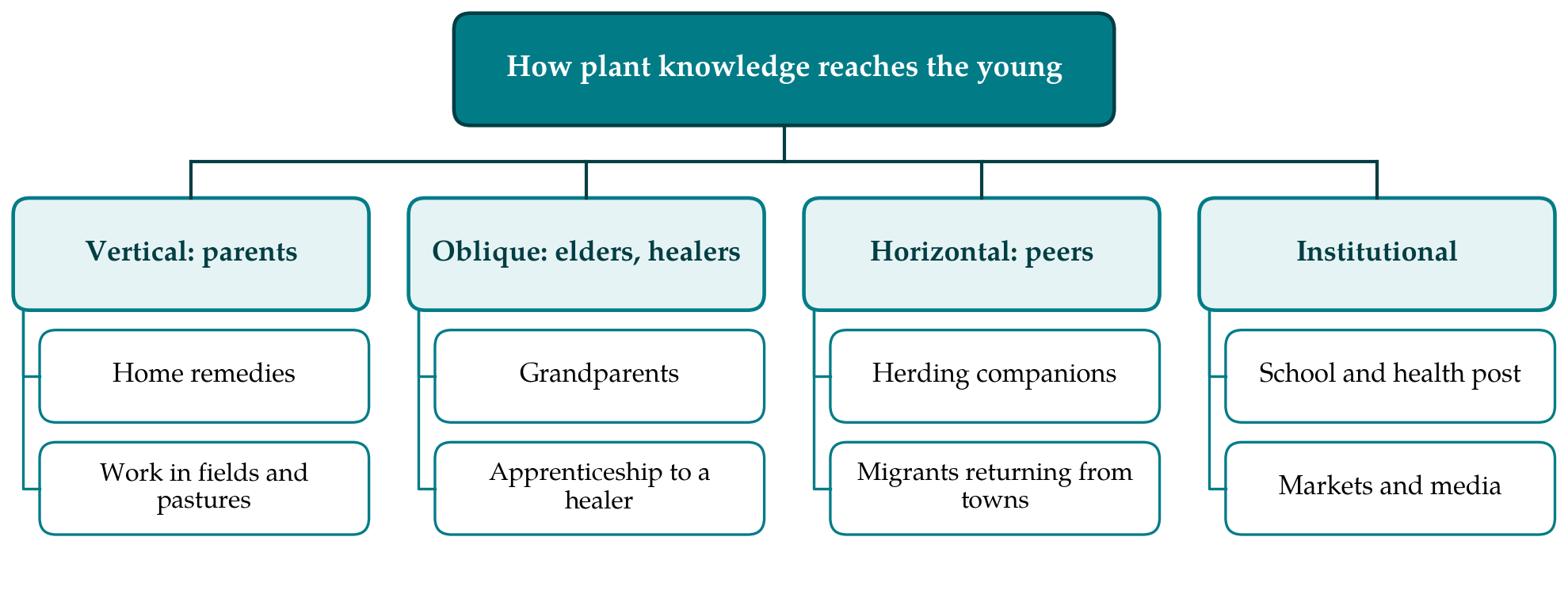
For the Andes, Mathez-Stiefel and Vandebroek (2012) examined transmission in highland communities of Peru and Bolivia and reported that the family, and parents above all, was the principal source, and that learning was not confined to childhood but continued through adult life. A study in rural Patagonia likewise found that plant knowledge passed mainly within the family and through shared practical activity (Lozada et al., 2006). Work among the Tsimane' of lowland Bolivia showed that the weight of each pathway shifts with age and with the kind of knowledge, parents mattering less and other members of the older generation more than the standard account assumes (Reyes-García et al., 2009). Learning happens while doing something else: herding, weeding, tending a sick sibling. When those activities change, the occasions for learning change with them.
5. Evidence on Generational Differences
The typical study interviews people of different ages at one point in time and compares the number of plants or uses each can report. Older respondents usually report more. In eastern Brazil, for example, Voeks and Leony (2004) found that knowledge of medicinal plants rose with age and fell with schooling, and read this as erosion. Comparable age gradients are reported from highland communities. The difficulty is that an age gradient at one moment has two possible explanations. The young may know less than their elders did at the same age, which is loss. Or they may simply not yet have had the children, the illnesses and the responsibilities through which adults learn, which is the normal life course. A single survey cannot tell these apart.
Studies that can separate the two are rare. Among the Tsimane', repeated measurement of the same population over several years showed a net decline in reported plant-use knowledge (Reyes-García et al., 2013). Among Tzeltal Maya children, by contrast, a restudy three decades after the original found that botanical knowledge had persisted (Zarger and Stepp, 2004). Neither population is Andean, and comparable repeated studies from highland farming communities are lacking. The Andean transmission study cited above found less evidence of generational decline than the erosion account predicts (Mathez-Stiefel and Vandebroek, 2012). The fair summary is that erosion is documented in some places, absent in others and unmeasured in most.
6. Drivers Proposed for Erosion
Table 1 lists the drivers most often named, the mechanism suggested for each and the state of the evidence. Four deserve comment.
| Driver | Suggested mechanism | What studies report | Sources |
|---|---|---|---|
| Schooling | Less time in fields; lower status of local knowledge | Negative in some settings, no clear effect in others | Voeks and Leony, 2004; Wyndham, 2010 |
| Market integration | Wage work replaces farming and gathering | Effects differ with the kind of market activity | Godoy et al., 2005 |
| Biomedical services | Pharmaceuticals displace plant remedies | Plants and pharmaceuticals commonly used together | Vandebroek et al., 2004; Monigatti et al., 2013 |
| Migration | Young people leave; contact with habitats is lost | Knowledge may be retained or reshaped in cities | Vandebroek and Balick, 2012 |
| Modernization in general | Combined change in livelihood and values | Components pull in different directions | Quinlan and Quinlan, 2007 |
| Environmental change | Plants become scarce or distant | Wild-plant knowledge tracks access to habitats | Ladio and Lozada, 2004 |
Schooling is blamed most often. Children in class are not in the pastures, instruction is in Spanish, and the curriculum seldom values what grandparents know. Yet a careful study of Rarámuri children in northern Mexico found no simple negative relation between schooling and plant knowledge; family circumstances and time spent on the land mattered more (Wyndham, 2010). The effect of school seems to depend on whether it removes children from the settings where learning happens.
Market integration and modernization are composite notions. Reviewing work on indigenous societies, Godoy et al. (2005) concluded that effects on knowledge and resource use vary with the form that market participation takes. In a Caribbean village, Quinlan and Quinlan (2007) found that different components of modernization were associated with medicinal plant knowledge in opposite directions. Access to biomedicine does not straightforwardly displace plants either. In an Andean comparison of communities at different altitudes, medicinal plants remained in regular use alongside the health post (Monigatti et al., 2013), and the coexistence of Andean and biomedical care has been described in detail for Peru and Bolivia (Mathez-Stiefel et al., 2012).
Migration removes young adults from the countryside, often seasonally. Its effect on knowledge is not self-evident. Vandebroek and Balick (2012), working with Dominican migrants, showed that plant knowledge can be maintained and even enlarged in a city when a market supplies the plants, and they questioned the assumption that globalization always means loss. In Andean cities the herb stalls serve exactly this function (Macía et al., 2005). What migrants are less likely to retain is the ability to find and recognise wild plants in their habitats, which, as work in Patagonia suggests, depends on continued contact with the environments where they grow (Ladio and Lozada, 2004).
7. Problems of Measurement
Beyond the confounding of age and generation, three problems recur. The first is what counts as knowledge. A free list of plant names rewards verbal recall and elders' fluency in the indigenous language; it says little about whether a person can identify the plant, prepare it or judge when to use it. Studies that separate theoretical knowledge from practical skill find that the two behave differently (Reyes-García et al., 2009). The second is who is asked. Women are frequently the main holders of household remedy knowledge (Voeks, 2007), so samples that underrepresent young mothers will understate what the younger generation knows.
Language complicates both points. Plant names and illness categories in Quechua and Aymara do not map neatly onto Spanish, and many young people are more at ease in Spanish than their grandparents are. An interview held in the indigenous language may favour elders, and one held in Spanish may fail to elicit names that a respondent knows only in Quechua. Culturally defined illnesses such as susto, fright sickness, have their own plant remedies, and whether a young respondent mentions them may depend on how the interviewer is perceived as much as on what the respondent knows.
The third problem is the baseline. When informants are asked whether knowledge is declining, each compares the present with what was normal in their own youth. Hanazaki et al. (2013) argue that this produces a shifting baseline in ethnobotany, as it does in fisheries: every generation perceives decline from its own starting point, or fails to perceive a decline that began earlier. Statements by elders that the young know nothing are evidence of how elders see the young. They are not a measurement.
8. Gaps and Future Work
What is needed above all is repeated measurement. Restudies of Andean communities for which earlier inventories exist, using the original methods, would show change directly. Where no baseline exists, cohort designs that compare people of the same age at different dates, or that follow children into adulthood, would separate life-course learning from generational loss. Knowledge should be assessed with identification and preparation tasks as well as lists, and reported by domain: common household remedies, wild highland species and specialist ritual knowledge are unlikely to share one trajectory.
Research should also treat knowledge as adaptive. Traditional ecological knowledge has always incorporated new elements and discarded others (Berkes et al., 2000), and the Andean pharmacopoeia with its many introduced species shows this plainly. The useful question for a community is less whether the total has fallen than whether people can still meet their health needs and whether particular bodies of knowledge that they value are failing to pass on. That is a question communities can help to frame, and school gardens, healer apprenticeships and local registers can be evaluated against it.
9. Conclusion
The belief that young Andean farmers are losing their elders' knowledge of medicinal plants is plausible and only partly supported. Age differences are well attested, but most of the evidence cannot distinguish erosion from the ordinary course of learning, and the stronger studies from comparable societies point in both directions. The drivers usually named act unevenly and sometimes sustain knowledge in new forms. Household remedy knowledge appears resilient, while knowledge that depends on time spent in wild habitats or on apprenticeship to a specialist is more exposed. Better longitudinal data from the Andes itself would turn a common assumption into something that can be tested.
Conflict of interest
To be declared by the author(s) before publication.
Funding
To be declared by the author(s) before publication.