1. Introduction
A vehicle returning from orbit must shed an enormous kinetic energy, and it does so by heating the gas around it. Only a small fraction of that energy reaches the surface, yet the fraction is enough to raise unprotected aluminium or composite structure far above its working temperature within seconds. The thermal protection system, or TPS, is the set of materials and attachments that keeps the heat out. Capsules and probes have generally relied on ablators, which consume themselves in a controlled way, and the modern lightweight ablators descended from phenolic impregnated carbon are very effective (Tran et al., 1997; Natali et al., 2016). An ablator that recedes on every flight, however, sits uneasily with the idea of a vehicle that is turned around like an aircraft.
Reusable systems therefore depend chiefly on materials that reject heat by re-radiation and do not change shape: insulators that run hot at the surface and cool at the bond line, and hot structures that carry load at temperature. The Space Shuttle Orbiter showed that such a system could fly repeatedly, and also how much labour it could demand between flights (Curry, 1993). Interest has revived with partially and fully reusable launchers and with spaceplanes and lifting re-entry demonstrators, and reviews of the wider field are available (Uyanna and Najafi, 2020). This article concentrates on the reusable case, and on the link between materials and the tests used to qualify them.
2. Approach of the Review
The article is a narrative review of the open literature: journal papers, agency technical reports and standard texts on high-temperature materials and hypersonic heating. It makes no claim to exhaustive coverage. Much of the detailed design data for operational vehicles is proprietary or export controlled, and the published record is correspondingly weighted towards government programmes and laboratory studies. Property values are discussed qualitatively unless they are firmly established, because reported figures depend strongly on processing route, fibre architecture and test condition.
3. The Entry Environment and What It Demands
Convective heating at the stagnation point of a blunt body scales inversely with the square root of the nose radius, a result that follows from the classical analysis of Fay and Riddell (1958) and that explains why the Orbiter was blunt and why sharp leading edges are so much harder to protect. Behind the bow shock the air is dissociated, and atoms that recombine on the surface release their heat of formation there. A surface that is a poor catalyst for recombination therefore receives noticeably less heat than a fully catalytic one (Goulard, 1958), which makes catalytic efficiency a material property of the first importance alongside emissivity. The gas chemistry and its coupling to the wall are treated at length by Anderson (2006).
Heating is only part of the load. The TPS must tolerate launch acoustics and vibration, the strain of a cryogenic tank shrinking beneath it, rain and ground handling, impact by debris and ice, and the oxidising, low-pressure atmosphere of entry, all of it repeatedly. For a reusable vehicle the governing figure of merit is less the peak temperature capability than the cost of returning each square metre to flight condition. Design issues of this kind for hypersonic vehicles generally are surveyed by Sziroczak and Smith (2016).
4. Material Families
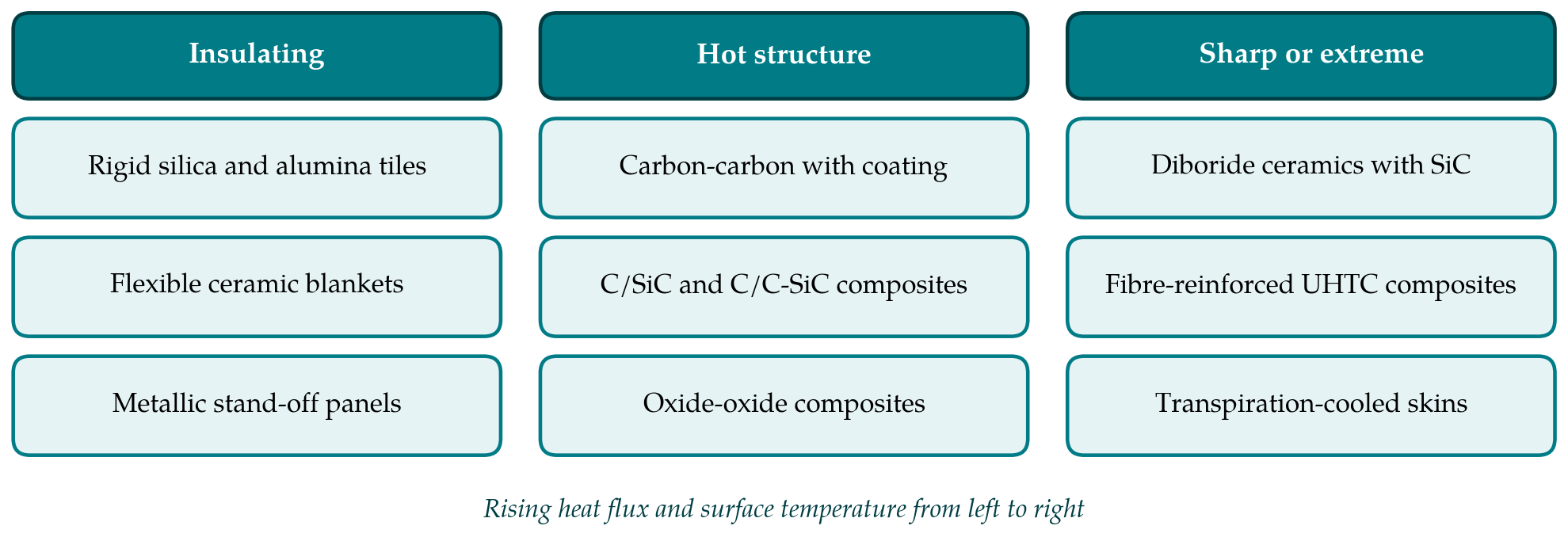
Reusable TPS concepts can be grouped by how they handle the heat and by the severity of the environment they suit. Figure 1 arranges the main families in that way, and Table 1 summarises their principal strengths and life-limiting weaknesses.
| Family | Typical location | Strengths | Life-limiting issues |
|---|---|---|---|
| Fibrous ceramic tiles | Windward acreage | Very low density and conductivity | Brittleness, water uptake, gaps, coating damage |
| Ceramic blankets | Leeward acreage | Easy installation, conformable | Limited temperature, fabric erosion |
| Metallic panels | Moderate-heating acreage | Durable, weatherproof, removable | Alloy oxidation and creep, edge sealing, mass |
| Coated carbon-carbon | Nose and leading edges | Strength retained at very high temperature | Coating cracks, subsurface oxidation, impact |
| C/SiC composites | Flaps, nose caps, panels | Load-bearing, tougher than monoliths | Active oxidation, fibre attack through matrix cracks |
| Diboride ceramics | Sharp edges and tips | Highest temperature capability, conductive | Thermal shock, scale loss, part size |
4.1. Rigid tiles and flexible blankets
The Orbiter's lower surface was covered with tiles of very low density sintered silica fibre, coated with a borosilicate reaction-cured glass that provided high emissivity and low catalycity. Later tile compositions added alumina-borosilicate and alumina fibres to raise strength and temperature capability (Leiser et al., 1981), and toughened surface treatments were developed to improve resistance to impact. On cooler upper surfaces, quilted ceramic fibre blankets replaced many tiles and proved quicker to install and maintain (Curry, 1993).
These materials are superb insulators and extremely light. Their drawbacks are mechanical. The tiles are brittle and weak, so each was bonded through a felt strain-isolation pad and separated from its neighbours by gaps that then needed fillers. The porous body absorbs water and had to be re-waterproofed between flights. Thousands of individually shaped parts made inspection slow (Curry, 1993). Current development aims at larger, tougher tiles with mechanical attachment, and at standardised shapes that can be replaced without custom machining.
4.2. Metallic panels
Metallic TPS replaces the brittle outer surface with a thin superalloy or titanium skin, usually a honeycomb sandwich, standing off from the structure with fibrous insulation beneath. The appeal is robustness: a metal panel resists rain and handling, does not need waterproofing and can be unbolted. Panels of this type were developed for the windward surface of the X-33 demonstrator and refined in later studies (Blosser et al., 2004). Their limits are the oxidation and creep of the alloy, which confine them to the moderate-temperature acreage, the thermal expansion that must be accommodated at panel edges, and a mass per unit area that is generally higher than that of tiles. The design of the internal high-temperature insulation is itself a coupled radiation and conduction problem (Daryabeigi, 2002).
4.3. Carbon and ceramic matrix composite hot structures
Where temperatures exceed the capability of silica, the Orbiter used reinforced carbon-carbon on the nose cap and wing leading edges. Carbon keeps its strength to very high temperature but oxidises readily, so the laminate was converted at the surface to silicon carbide and sealed with a glass former. The loss of Columbia in 2003, traced to a breach in a leading edge panel struck by insulating foam during ascent, showed how little impact tolerance such a component had (CAIB, 2003).
Carbon fibre reinforced silicon carbide, made by chemical vapour infiltration, polymer pyrolysis or liquid silicon infiltration, offers better oxidation resistance than coated carbon-carbon and enough toughness to serve as a load-bearing control surface or nose cap (Naslain, 2004; Krenkel and Berndt, 2005). Body flaps, leading edges and windward panels in these materials have been built for several European and American demonstrators, and the field is reviewed by Glass (2008). Protection still depends on a silica scale. Under the low oxygen pressures of high-altitude entry, silicon carbide can pass from passive oxidation, in which a protective film grows, to active oxidation, in which volatile silicon monoxide forms and the surface recedes (Jacobson, 1993). Predicting where on a trajectory that transition lies is central to life assessment.
4.4. Ultra-high temperature ceramics
Slender vehicles with sharp leading edges see heat fluxes beyond the reach of silicon carbide. The borides and carbides of zirconium and hafnium melt above 3000 °C and, when combined with a silicon carbide addition, form a layered oxide scale that gives useful oxidation resistance (Fahrenholtz et al., 2007; Opeka et al., 2004). Their high thermal conductivity helps a sharp edge by carrying heat away from the tip to regions where it can be radiated (Squire and Marschall, 2010). Plasma wind tunnel exposures of zirconium diboride with silicon carbide have confirmed stable behaviour up to a point, followed by rapid degradation once the silica-rich outer layer is lost (Monteverde and Savino, 2007).
The monolithic ceramics are dense, brittle and vulnerable to thermal shock, and they are difficult to make in large pieces. Much current work therefore reinforces an ultra-high temperature ceramic matrix with carbon fibre, seeking the damage tolerance of a composite with the temperature capability of the boride (Tang and Hu, 2017; Binner et al., 2020). Whether such materials can survive many cycles, as opposed to one severe exposure, is not yet established in the open literature.
5. Test Methods and Their Fidelity
No ground facility reproduces entry in full. Each matches some parameters and distorts others, and a qualification programme is an exercise in combining partial views (Laub and Venkatapathy, 2004).
Arc-jet facilities heat air with an electric arc and expand it over a sample, giving a long-duration, high-enthalpy, chemically reacting flow. They are the standard for demonstrating a TPS at flight-like heat flux and surface pressure. Their limitations are well known: the stream may be contaminated by electrode material, its composition and enthalpy are hard to measure, and model sizes are small. Inductively coupled plasma torches produce a cleaner subsonic stream and are favoured for catalycity and oxidation studies. In both, interpreting the result requires a model of the facility flow, and in situ diagnostics have become part of good practice (Marschall and Fletcher, 2010). Because arc-jet time is costly, a material rarely accumulates many cycles there.
Simpler tests fill the gap. The oxyacetylene torch test standardised as ASTM E285 is cheap and severe and is widely used for screening, although its combustion products are not air and its results rank materials more reliably than they predict flight performance. Radiant lamp arrays and furnaces apply realistic temperature histories to full-size panels and can run hundreds of cycles, but without flow there is no shear, no atomic oxygen and no catalytic heating. Laser and solar furnace heating reach very high flux on small coupons. Mechanical, acoustic, vibration, impact and rain-erosion tests are run separately, usually at room temperature. The weakness of the whole approach is that mechanisms interact in flight: a coating crazed by acoustic loading oxidises differently from a pristine one, and few rigs combine the loads.
6. Open Questions
The first open question is life prediction. Oxidation kinetics, coating crack growth and creep can each be characterised, but a validated method that turns a handful of short plasma exposures into a certified number of flights does not yet exist in the public domain. Accelerated testing is hard to justify when the damage mechanism changes with temperature and oxygen pressure, as the passive-to-active transition does.
The second is inspection. Rapid reuse needs a way to clear a large surface quickly, which points towards automated optical and thermographic scanning and embedded sensing, and towards acceptance criteria that say which defects may fly. The Orbiter experience was that inspection and repair, not the materials themselves, set the turnaround time (Curry, 1993).
Joints, seals and attachments form the third. A vehicle combines families, and the interfaces between a hot composite and a cool tank wall, or between adjacent tiles, are where hot gas ingress and thermal mismatch cause trouble. They receive less published attention than the materials on either side. The fourth concerns the balance of modelling and test. Coupled simulation of flow, surface chemistry and material response has advanced, yet the surface reaction data that such models need are sparse and facility dependent (Marschall and Fletcher, 2010). Finally there is the choice between passive and actively cooled concepts. Transpiration or film cooling could relax the demands on materials at the hottest points, at the price of plumbing, coolant mass and new failure modes.
7. Conclusion
Reusable thermal protection has moved from a single flown architecture, the tile and carbon-carbon system of the Orbiter, to a broader palette in which ceramic matrix composites carry load at temperature, metallic panels and tougher tiles compete for the acreage, and ultra-high temperature ceramics are candidates for the sharpest features. The materials science of each family is reasonably mature. What lags is the evidence on durability across many flights, because the facilities that best represent entry are the least suited to repeated cycling. Progress on reuse will depend as much on test strategy, inspection and joining as on new compositions.
Conflict of interest
To be declared by the author(s) before publication.
Funding
To be declared by the author(s) before publication.