1. Introduction
(Curcuma
longa Curcumin,
the
yellow
diarylheptanoid
of
turmeric
L.),
is 1,7-bis(4-hydroxy-3-methoxyphenyl)-1,6-heptadiene-3,5-dione. Its structure can be read in three parts: two guaiacol rings, two trans alkene bridges, and a central β-diketone that exists in solution almost entirely as the hydrogen-bonded keto-enol tautomer (Payton et al., 2007). Each part contributes to the long list of activities reported for the compound in cell culture, and each is also a point of weakness (Priyadarsini, 2014).
The gap between that list of activities and clinical usefulness has been recognised for a long time. Early clinical pharmacology found very low concentrations of the parent compound in plasma after oral doses measured in grams (Sharma et al., 2005), and an influential review attributed the problem to poor absorption, rapid metabolism and rapid elimination acting together (Anand et al., 2007). Two responses followed. One was formulation: phospholipid complexes, nanoparticles, micelles and co-administration with inhibitors of conjugation. The other, the subject of this review, was to change the molecule.
The literature on synthetic curcumin analogues is now very large, and several surveys have catalogued it by biological activity (Anand et al., 2008). This article takes a narrower view. It asks which structural changes have made the scaffold more stable, by what mechanism, and what happened to activity when they were made.
2. Scope and Approach
This is a narrative review of the medicinal chemistry literature published from roughly the mid-2000s onward, with earlier papers on degradation and metabolism included where they explain the design logic. It is organised by the site of modification, not by disease area. Stability is taken in two senses that the literature often runs together: chemical stability in aqueous media at physiological pH, and metabolic stability towards reduction and conjugation. Formulation approaches are outside the scope. No claim of exhaustive coverage is made, and potency values from individual papers are not tabulated, because they were obtained in different cell lines and assay formats and cannot be compared across laboratories.
3. How Curcumin Is Lost
Design for stability presupposes an account of instability. Three processes are well documented, and they act on different parts of the molecule.
3.1. Degradation in aqueous solution
Curcumin is reasonably stable in acid and decomposes quickly as the pH rises above neutrality, as kinetic studies established in the 1980s (Tønnesen and Karlsen, 1985). The observation most often quoted comes from Wang et al. (1997), who found that most of the compound disappeared within half an hour in serum-free phosphate buffer at physiological pH and temperature, and who identified vanillin, ferulic acid and feruloylmethane among the products. For some years these cleavage products were taken to be the main fate of the molecule.
Later mechanistic work changed that picture. The dominant reaction at physiological pH is an autoxidation: hydrogen abstraction from a phenolic hydroxyl gives a radical that is delocalised through the conjugated chain, oxygen is incorporated, and the heptadienedione chain cyclises to a bicyclopentadione (Griesser et al., 2011). The cleavage products are minor. The same studies showed that the reaction depends on the phenol and on the unsaturated diketone together, and that the methoxy groups accelerate it, which is why bisdemethoxycurcumin is far more resistant to autoxidation than curcumin itself (Schneider et al., 2015). Curcumin is also degraded by light.
3.2. Metabolic conversion
In animals and in human tissue preparations curcumin is metabolised along two routes. The alkene bridges are reduced stepwise to dihydro-, tetrahydro- and hexahydrocurcumin, and the phenolic hydroxyls of the parent and of its reduced forms are conjugated with glucuronic acid and sulfate (Pan et al., 1999; Ireson et al., 2001). The conjugates are the principal circulating species after oral dosing. A comprehensive pharmacological review concluded that the pharmacokinetics of the parent compound are difficult to reconcile with many of the systemic effects attributed to it (Heger et al., 2014).
These findings define the design problem. The active methylene and enol of the diketone, the free phenol and the conjugated dienone are each implicated in loss of the compound, and the same groups have each been proposed as essential for one activity or another. The structural liabilities, the strategies used against them and the price paid for each are summarised in Table 1.
| Liability | Structural origin | Analogue strategy | Usual trade-off |
|---|---|---|---|
| Autoxidation at neutral pH | Phenol plus conjugated enolised diketone | Monocarbonyl linker; removal of methoxy groups | Dienone remains a reactive Michael acceptor |
| Alkaline cleavage | Active methylene and β-diketone | Pyrazole or isoxazole in place of the diketone | Metal chelation and enol chemistry are lost |
| Glucuronidation and sulfation | Free phenolic hydroxyl groups | O-Methylation or replacement of the phenol | Lower aqueous solubility; radical scavenging reduced |
| Reduction of alkenes | Conjugated double bonds | Ring constraint or hindered enones | Gain is modest and seldom measured directly |
| Keto-enol reactivity | Acidic C-4 hydrogens | Mono- or disubstitution at C-4 | Planarity and conjugation are altered |
| Photodegradation | Extended chromophore | Shortened or saturated chromophore | Loss of colour and of photodynamic activity |
4. Analogue Strategies by Site of Modification
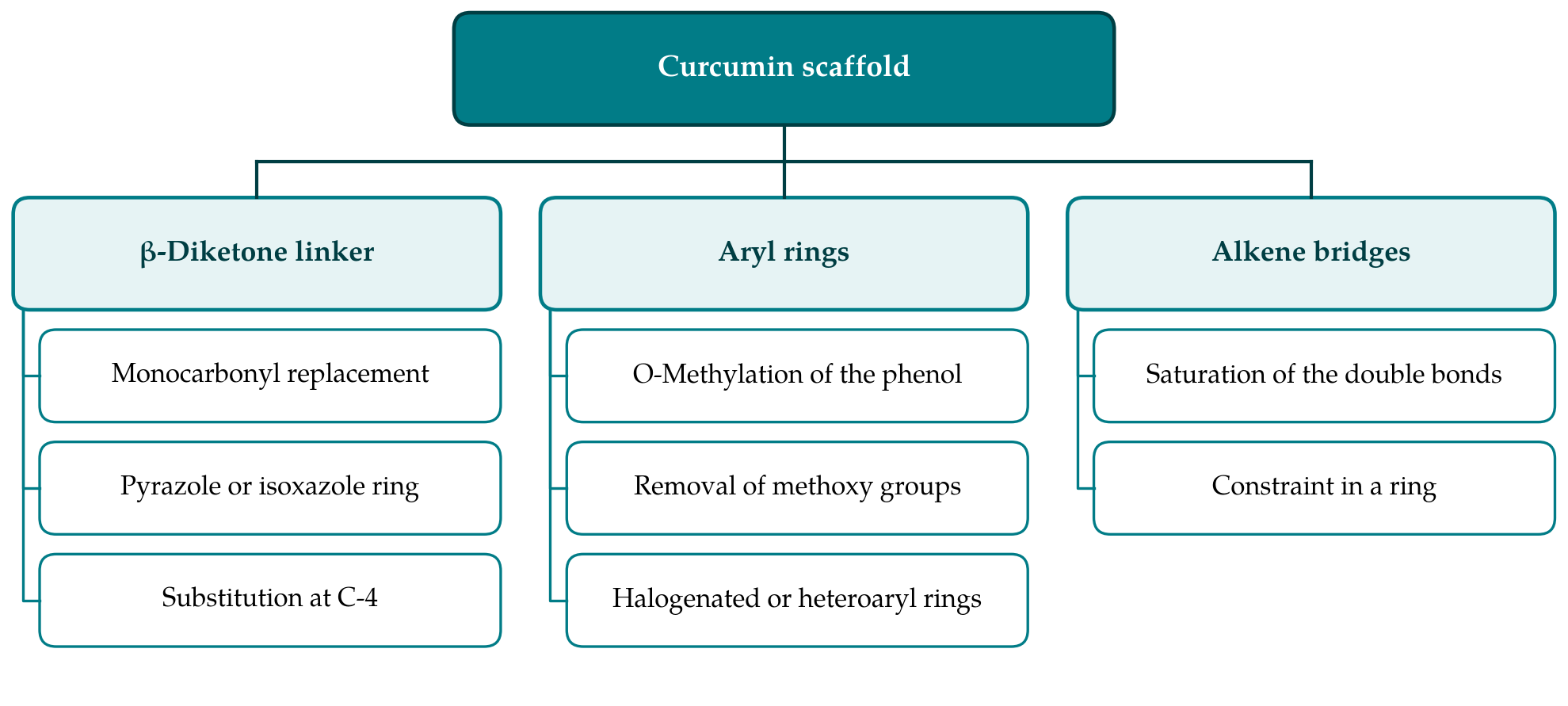
The modifications that have been tried fall naturally into three groups according to the part of the scaffold they change, as Figure 1 shows. The groups are not exclusive, and the most studied compounds combine changes at two sites.
4.1. Removing the β-diketone: monocarbonyl analogues
The most productive single idea has been to delete one carbonyl and the methylene between them, leaving a 1,5-diaryl-1,4-pentadien-3-one. The dienone may be acyclic or built on a cyclopentanone, cyclohexanone or 4-piperidone ring. A series from Emory University introduced the fluorinated piperidone later known as EF24 and showed that compounds of this type could exceed curcumin in potency in tumour cell and angiogenesis screens (Adams et al., 2004). Working independently, Ohori et al. (2006) prepared a set of symmetrical diarylpentadienones, among them the compound designated GO-Y030, with markedly greater growth-suppressive activity than the parent.
The stability argument for this class was made explicitly by Liang et al. (2009), who reasoned that the active methylene was the source of instability, synthesised monocarbonyl analogues lacking it, and reported both improved persistence in buffer and a better pharmacokinetic profile in rodents. Their result is consistent with the autoxidation mechanism: without the enolisable diketone the radical chain cannot proceed as it does in curcumin. Subsequent reviews of the class describe several hundred members and a broadly consistent pattern in which the central ring and the aryl substituents tune potency while stability in buffer is a property of the class as a whole (Mosley et al., 2007; Shetty et al., 2015).
4.2. Masking the diketone as a heterocycle
Condensation of curcumin with hydrazines or hydroxylamine converts the diketone into a pyrazole or an isoxazole. The heterocycle locks the two carbons that carried the carbonyls into an aromatic ring, removes the acidic methylene, and abolishes both the enol and the ability to chelate metal ions, while keeping the two styryl arms in conjugation. Selvam et al. (2005) prepared such compounds and found antioxidant and cyclooxygenase-inhibitory activity retained or increased. In work directed at neurodegeneration, Narlawar et al. (2008) showed that curcumin-derived pyrazoles and isoxazoles inhibited tau aggregation and amyloid-related processes, sometimes more effectively than curcumin, which demonstrated that the diketone is not required for those effects.
4.3. Changing the aryl rings
The phenolic hydroxyl is both the handle for conjugation and the starting point of autoxidation, so its protection addresses two liabilities at once. Dimethoxycurcumin, in which both phenols are methylated, proved considerably more stable than curcumin in cells and in mice and was at least as active against tumour cells (Tamvakopoulos et al., 2007). A systematic programme on anti-prostate cancer agents varied the ring substituents and the linker together and identified methylated and otherwise protected analogues with improved activity (Lin et al., 2006).
The
natural
congeners
offer
a
complementary
lesson.
Demethoxycurcumin
and bisdemethoxycurcumin differ from curcumin only in lacking one or both methoxy groups, and comparison of symmetric and asymmetric curcuminoids found clear differences between them in hydrolytic stability (Tomren et al., 2007). The methoxy group ortho to the phenol stabilises the phenoxyl radical and so promotes the first step of autoxidation; its removal slows degradation while leaving the phenol open to conjugation. Halogenated rings, as in EF24, and pyridyl or other heteroaryl rings have been used in the monocarbonyl series to adjust electron density at the enone and to improve solubility (Shetty et al., 2015).
4.4. Altering the linker carbons
Substitution at the central carbon, C-4, removes one or both acidic hydrogens. A single substituent shifts the tautomeric balance, and two substituents prevent enolisation altogether and force the molecule out of planarity. Analogues of this kind appear in several of the series already cited (Lin et al., 2006; Anand et al., 2008). Saturation of the alkenes is the opposite extreme. Tetrahydrocurcumin, itself a metabolite, lacks the conjugated dienone, is colourless, and is considerably more stable in neutral buffer than curcumin (Pan et al., 1999). It retains antioxidant activity attributable to the phenols and the diketone but loses the activities that depend on the electrophilic enone.
5. Structure Activity Trends That Recur
Four trends appear repeatedly across independent series. First, the β-diketone is dispensable for cytotoxic and anti-inflammatory activity in cell assays: both the monocarbonyl dienones and the heterocyclic analogues retain or exceed the potency of curcumin. Second, at least one α,β-unsaturated carbonyl is required for most of the cell-based activities; analogues in which the alkenes are saturated are consistently weaker in those assays. Third, a free phenol is not necessary for cytotoxic potency, though it is necessary for direct radical-scavenging activity. Fourth, electron-withdrawing substituents on the aryl rings of monocarbonyl analogues tend to raise potency, in line with a mechanism involving conjugate addition of cellular thiols to the enone (Adams et al., 2004; Mosley et al., 2007).
Taken at face value these trends describe a pharmacophore that is essentially a bis-aryl enone. That conclusion is chemically coherent and has been reached by several groups, but it also raises the central difficulty of the field.
6. Stability Is Not the Same as Developability
The feature that most analogue series preserve, a doubly activated Michael acceptor, is the feature that makes the compounds react with glutathione and with cysteine residues across many proteins. Potency that rises with electrophilicity is as likely to reflect indiscriminate covalent reactivity as selective target engagement. Curcumin itself matches several of the substructure patterns that Baell and Holloway (2010) identified as characteristic of pan-assay interference compounds, and a detailed critical review described it as unstable, reactive and not a viable lead, noting in addition that it aggregates, fluoresces and chelates metals in ways that distort assay readouts (Nelson et al., 2017).
Stabilised analogues answer the first of those charges and not necessarily the others. A monocarbonyl dienone that persists for hours in phosphate buffer may still be consumed in minutes by thiols in a cell or in plasma, and persistence in buffer has too often been reported as though it settled the question of metabolic fate. Few papers measure reactivity towards glutathione, stability in liver microsomes or hepatocytes, and plasma protein binding alongside potency. Fewer still identify the metabolites of the analogue, as was done for dimethoxycurcumin (Tamvakopoulos et al., 2007). A further complication is that the degradation products of curcumin are themselves biologically active, and some of the effects attributed to the parent in long cell incubations may belong to its oxidation products (Gordon et al., 2015). An analogue that cannot autoxidise may therefore lack an activity for reasons that have nothing to do with target affinity.
7. Gaps and Future Work
Three gaps stand out. The first is measurement. Stability should be reported under stated and comparable conditions, covering buffer, plasma and a metabolically competent system, with curcumin run alongside as a reference and with thiol reactivity determined explicitly. The second is selectivity. Claims of target engagement for enone-containing analogues need support from orthogonal assays, from counter-screens for aggregation and interference, and where possible from analogues in which the electrophile is removed while the shape is kept. The third is translation: very few analogues have progressed to rigorous pharmacokinetic and toxicological evaluation in animals, and none has become an approved medicine, so the clinical value of the whole approach is unproven.
There is also a case for asking a different question. If the reproducible activities of the scaffold reduce to those of a tunable electrophile, then the more promising route may be to design that reactivity deliberately, with a defined target and a reversible or weakly reactive warhead, and to treat the natural product as a starting point of historical interest.
8. Conclusion
Two decades of analogue work have shown convincingly how to make the curcumin scaffold last longer. Removing the active methylene and the enol, by deleting a carbonyl or by building the diketone into a heterocycle, suppresses the autoxidation and cleavage that destroy the parent at physiological pH, and masking the phenol slows conjugation. The associated structure activity trends are consistent between laboratories. What the work has not yet shown is that a stabilised analogue is a selective and well-behaved drug candidate. The field's next advances are more likely to come from stricter characterisation of the compounds already in hand than from further additions to an already long list.
Conflict of interest
To be declared by the author(s) before publication.
Funding
To be declared by the author(s) before publication.