1. Introduction
The word overtourism entered common use in the second half of the 2010s, when residents of Barcelona, Venice, Dubrovnik and Palma de Mallorca began to protest against a visitor economy that many of them also worked in. The phenomenon it names is older. Van der Borg et al. (1996) had already described European heritage cities in which visitors outnumbered residents on most days of the season, and Russo (2002) had traced a vicious circle in Venice in which day visitors displaced overnight guests, spending per head fell and the quality of the offer declined. What changed was the scale, the arrival of low-cost flights, large cruise ships and short-term rental platforms, and the willingness of residents to organise (Colomb and Novy, 2016).
City governments have responded with a growing list of controls. Venice has trialled an access charge for day visitors on peak days, Barcelona adopted a special plan that zones and caps tourist accommodation, Dubrovnik has limited cruise calls, and several cities have restricted group sizes, guided tours or behaviour in monumental areas. Such measures are usually justified in the name of residents. They also impose costs on some of them: owners of rental flats, shopkeepers, guides, and anyone whose movements are checked at a turnstile. A control that residents experience as unfair or ineffective is unlikely to survive a change of administration.
This article reviews what the published literature says about resident attitudes to overtourism controls in the heritage cities of southern Europe. It asks which theories explain those attitudes, which features of heritage cities make the question distinctive, how the main families of control measures are regarded, and where the evidence is thin.
2. Scope and Approach
The article is a narrative review. It draws on the established literature on resident attitudes to tourism, on the more recent body of work on overtourism and urban tourism conflict, and on policy reports prepared for the World Tourism Organization and the European Parliament. No claim is made to an exhaustive or systematic search, and no new data are reported. Heritage city is used here for a city whose historic core is the main attraction and is also a place of residence, which covers large cities such as Barcelona and Lisbon as well as small walled towns such as Dubrovnik. Southern Europe is understood broadly as the Mediterranean and Adriatic countries of the European Union. Studies from elsewhere are cited where they supply a theory or a method that the regional literature relies on.
3. How Tourism Research Explains Resident Attitudes
Research on resident attitudes is one of the oldest strands of tourism scholarship, and a review of 140 articles published over a quarter of a century found it dominated by quantitative surveys and by a small number of theories (Nunkoo et al., 2013). Three groups of ideas matter for the present question.
3.1. Stage models
The earliest accounts tied attitudes to the stage of development of the destination. Doxey (1975) proposed that host communities pass from euphoria through apathy and annoyance to antagonism as visitor numbers grow, and Butler (1980) described a life cycle in which a destination moves from exploration to consolidation and then stagnation, with resident opposition appearing in the later stages. Both models are intuitive and both treat the community as a single body with a single mood. Later work found that attitudes within one city at one time are highly varied, which a stage model cannot represent (Sharpley, 2014).
3.2. Social exchange
Social exchange theory, introduced to the field by Ap (1992), holds that residents support tourism when they judge that what they receive from it outweighs what it costs them. Perdue et al. (1990) had earlier shown that support for development and for restrictive policies could be modelled from perceived benefits and costs, and Gursoy et al. (2002) built a structural model in which community concern, attachment and the state of the local economy shape those perceptions. The consistent finding of this tradition is that personal economic benefit raises support, while its relation to perceived costs is weaker than the theory predicts (Andereck et al., 2005).
3.3. Trust, power and feeling
A third group of studies argues that exchange is only part of the story. Nunkoo and Ramkissoon (2012) added trust in government actors and the perceived power of residents to influence decisions, and found that both shaped support. Boley et al. (2014) distinguished psychological, social and political empowerment and showed that these non-economic factors sat alongside economic benefit. These additions are directly relevant to controls, because a control is an act of government, and attitudes to it are likely to follow attitudes to the government that imposes it.
4. What Is Distinctive About Heritage Cities
Overtourism is not simply a matter of too many visitors. Goodwin (2017) defined it from the point of view of those affected, as a situation in which hosts or guests feel that the quality of life or of the experience has deteriorated unacceptably. Koens et al. (2018), drawing on interviews in thirteen European cities, argued that the problems grouped under the term are bound up with wider urban change, that they are concentrated in particular places and times, and that they cannot be solved by tourism policy or by technology alone. Mihalic (2020) placed the concept within the sustainability literature and stressed the gap between policies written on paper and their implementation.
Heritage cities sharpen each of these points. The attraction is a compact, protected core whose streets cannot be widened and whose buildings cannot be replaced, so the idea of a physical carrying capacity has more purchase than in most destinations; Canestrelli and Costa (1991) attempted to calculate one for the historic centre of Venice more than three decades ago. Day visitors and cruise passengers use the core intensively and contribute little to the cost of maintaining it (Russo, 2002). The core is also a residential neighbourhood, often with an ageing population and a rental market that tourism can outbid.
Housing has become the central grievance. Cócola-Gant (2016) described the conversion of flats to holiday rentals in the Gothic Quarter of Barcelona as a form of displacement, and Gutiérrez et al. (2017) showed that platform listings in that city cluster in central residential areas more tightly than hotels do. A survey-based study of Barcelona residents identified the rising cost of rented housing among the main factors behind rejection of tourism, even in a city whose economy depends on it (Martín Martín et al., 2018). In the smaller capital of Ljubljana, Kuščer and Mihalič (2019) found resident attitudes linked both to perceived impacts and to the quality of cooperation among stakeholders.
5. The Control Measures and How Residents Regard Them
Policy reports list many possible responses. The World Tourism Organization set out a catalogue of strategies for managing urban visitor growth (UNWTO, 2018), and a study for the European Parliament reviewed measures in use across the continent (Peeters et al., 2018). For the purpose of this review they can be grouped into six families, summarised in Table 1 together with the pattern of resident response that the literature suggests.
| Family of measure | Typical instruments | Resident response suggested by the literature |
|---|---|---|
| Access limits | Entry charges, booking systems, caps on cruise calls and coaches | Supported in principle; doubts about enforcement and about living in a ticketed city |
| Accommodation rules | Zoning, licence caps and bans on new short-term rentals | Strong support from tenants; opposition from owners and hosts Cócola-Gant, 2016 |
| Taxes and charges | Overnight taxes, day-visitor levies, mooring fees | Accepted when revenue is visibly spent in affected districts |
| Dispersal | Promotion of other districts, seasons and nearby towns | Welcomed in the core; resisted where it brings visitors to quiet areas Koens et al., 2018 |
| Conduct rules | Fines for noise, dress and eating in monuments; limits on tour groups | Popular and low cost; seen as treating symptoms |
| Participation | Resident councils, neighbourhood plans, consultation on strategy | Raises trust where it changes decisions Nunkoo and Ramkissoon, 2012 |
Access limits are the most visible family and the one most closely tied to the heritage core. They follow directly from the logic of carrying capacity. The literature suggests that residents tend to approve of restricting cruise ships and coaches, which bring large groups for short stays, and are more divided over charges or gates at the entrance to the city itself. The objection is partly practical, since exemptions for residents, workers and relatives require a registration system, and partly symbolic: a turnstile confirms that the place has become an attraction instead of a town. Commentary on Venice has warned that managing the city only as a destination risks its decline as one (Seraphin et al., 2018).
Rules on accommodation are where interests divide most clearly. Residents who rent their homes gain from limits on holiday lets, and residents who own a second flat, or who host visitors in their own, lose income. Social exchange theory predicts exactly this split, and it is consistent with the finding that economic dependence on tourism moderates rejection (Martín Martín et al., 2018). Movements that formed around housing in Barcelona and other cities framed their demands in terms of the right to remain in the neighbourhood and directed them at city government as much as at visitors (Colomb and Novy, 2016). Milano et al. (2019) make the related point that what the press called tourismphobia was in most cases a critique of a growth model.
Taxes, dispersal and conduct rules attract less controversy and, the literature suggests, less confidence. Overnight taxes are familiar across the region and fall on visitors, yet they do not reach day visitors and are seldom set high enough to change behaviour. Dispersal moves pressure to districts whose residents did not ask for it. Conduct rules are easy to adopt and hard to enforce. Across the three, the recurring resident complaint is that the measure manages appearances while the number of beds, flights and berths continues to rise (Peeters et al., 2018).
6. Conditions That Shape Support
Reading the general attitude literature alongside the overtourism studies points to a set of conditions that shape whether a given resident supports a given control. They are drawn together in Figure 1. None is a tested model of support for controls; each is a factor that the cited studies identify as bearing on attitudes to tourism and that can reasonably be expected to carry over.
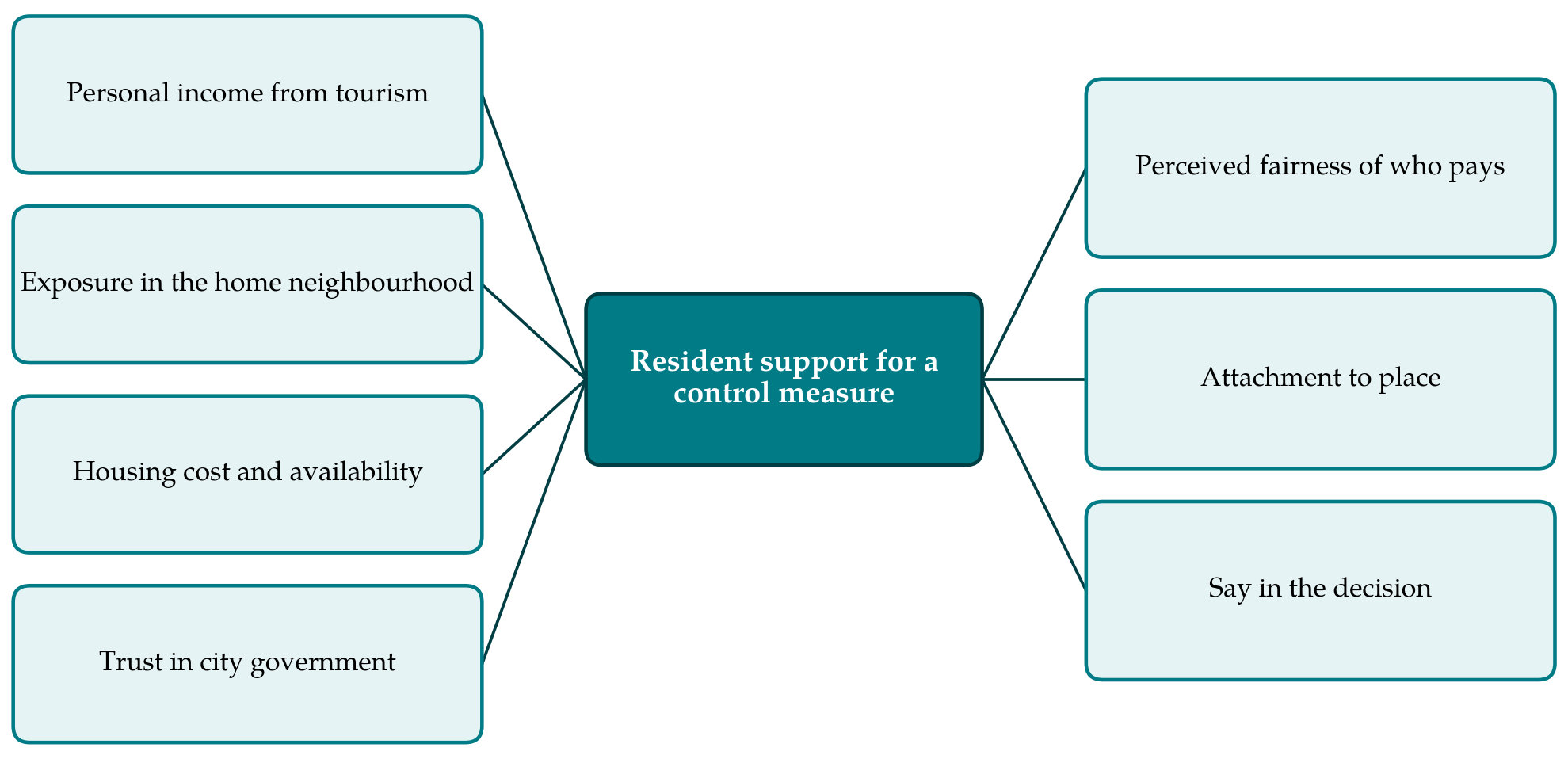
Two of the conditions are economic. Residents who earn their living from visitors are more favourable to tourism and can be expected to be more cautious about restricting it, while residents exposed to rising rents are the natural constituency for accommodation rules. Two are spatial and affective: people who live inside the visited core bear the crowding and noise directly, and attachment to place has been linked to closer attention to both benefits and costs (Gursoy et al., 2002). The remaining three concern governance. Trust in the city administration, a sense of having been consulted and a belief that the burden of the measure falls fairly are the factors on which the work on power and empowerment places most weight (Boley et al., 2014).
These conditions help to explain an apparent paradox in the commentary on southern European cities, where the same population is reported as hostile to tourism and hostile to restrictions on it. The two positions are often held by different people, or by the same people about different measures. A resident may favour a cap on holiday flats and oppose an entry charge, and stage models that assign the whole community to a single level of irritation conceal this (Sharpley, 2014).
7. Gaps and Directions for Research
Several limits of the evidence stand out. Most studies measure attitudes to tourism in general, or to its impacts, and infer attitudes to controls; few ask residents about a specific instrument with its costs and exemptions spelled out. Designs are overwhelmingly cross-sectional, so little is known about whether support rises or falls once a measure is in force and its effects can be seen. The long pause in travel during the pandemic years offered residents a direct comparison between a full city and an empty one, and its effect on attitudes to controls deserves closer study than it has received.
Sampling is a further weakness. Surveys tend to reach registered residents, which leaves out those who have already moved away because of housing costs and whose views would be the most critical. Workers who commute into the core, students and recent migrants employed in hospitality are also under-represented. Comparative work is scarce: studies of Barcelona and Venice dominate, and much less has been published on smaller heritage towns, where a single cruise call can change the character of a day. Finally, published discussion of overtourism has concentrated on definitions and causes more than on the evaluation of responses (Mihalic, 2020), so a body of before-and-after evaluations of individual measures remains to be built.
8. Implications for City Governments
Three practical points can be drawn from the review, with the caution that they rest on inference from studies of attitudes to tourism more than on evaluations of controls. The first is sequencing. Measures that respond to the grievance residents rank highest, which in most of these cities is housing, are likely to earn the credit that later and more intrusive measures will need. The second is visibility of proceeds. Where a charge or tax is levied, residents of the affected districts should be able to see what it has paid for, since the exchange logic that governs attitudes to tourism applies equally to attitudes to its regulation. The third is procedure. The studies of trust and empowerment imply that a measure negotiated with neighbourhood associations will be judged more leniently than the same measure announced from the town hall (Nunkoo and Ramkissoon, 2012), and that consultation which changes nothing is worse than none.
9. Conclusion
The literature gives a reasonably clear account of why residents of southern European heritage cities feel as they do about tourism and a much less complete account of how they regard the measures taken in their name. What it does suggest is that support for controls cannot be read off from visitor numbers. It follows from who gains and who pays, from where in the city a person lives, from the state of the housing market, and from whether the administration is trusted to apply the rule evenly. Measures that address housing draw the strongest and most divided reactions, and measures that manage visitor conduct draw agreement and scepticism in equal measure. For city governments the practical implication is to design controls with residents and to report openly on their effects. For researchers it is to study specific instruments over time instead of general sentiment at a single moment.
Conflict of interest
To be declared by the author(s) before publication.
Funding
To be declared by the author(s) before publication.