1. Introduction
A furnace is planned differently from a machine tool. A lathe processes one part after another, and its energy use rises roughly with the number of parts. A chamber furnace takes a whole charge through a thermal cycle whose length and energy depend only weakly on how full the chamber is. Running it half empty wastes much of the energy of the cycle; waiting to fill it delays the parts already there. This is a lot-sizing problem in the original sense: a fixed cost per run is weighed against the cost of holding and of lateness.
Time-of-use electricity tariffs add a second consideration. When the price per kilowatt-hour differs between day and night or between weekday and weekend, the cost of a furnace run depends on when it takes place, and a cycle of several hours may straddle price periods. Tariffs of this kind are a standard instrument of demand response (Albadi and El-Saadany, 2008), and energy-intensive industry is regarded as one of its most promising sources (Paulus and Borggrefe, 2011). Planning research has responded with a large body of work on energy-aware scheduling, surveyed by Gahm et al. (2016) and Biel and Glock (2016). The latter review notes that models at the lot-sizing level are far fewer than models that sequence or time given jobs.
This article reviews the literature relevant to that neglected combination, lot sizing for furnaces under time-of-use tariffs. Its aim is to show which building blocks exist, which features of furnaces they fail to capture, and where further work is needed.
2. Scope and Approach
The review is narrative. It draws on the principal surveys of lot sizing, of scheduling with batching, and of energy-aware production planning, on the papers most often taken as starting points in each stream, and on work from process systems engineering that addresses the same question under another name. It covers electrically heated furnaces operated in batches, such as resistance and induction furnaces for heat treatment and melting, and refers to electric steelmaking where the literature is richest. Fuel-fired furnaces are outside its scope except where the planning logic is the same. No systematic search was conducted and the selection reflects judgement about what is foundational.
3. Furnaces as Batch Processors and Energy Consumers
Three properties of furnaces drive the planning problem. The first is batching. Scheduling theory calls a resource that processes several jobs at once a batch-processing machine and distinguishes it from a machine that processes a family of jobs in series after one setup (Potts and Kovalyov, 2000). The model was developed for burn-in ovens in semiconductor testing by Lee et al. (1992), and much of the subsequent work, reviewed by Mathirajan and Sivakumar (2006), comes from that industry. Jobs have sizes, the chamber has a capacity, and jobs can share a charge only if their thermal recipes are compatible.
The second property is that energy per charge has a large component that does not depend on the load. The chamber, the fixtures and the atmosphere are heated with every cycle, and heat is lost through walls and openings for as long as the furnace is hot. Energy per kilogram of product therefore falls as the charge approaches capacity. The third property is the cost of state. A furnace held at temperature between charges consumes power without producing; a furnace allowed to cool must be reheated, which takes time and energy, and repeated thermal cycling shortens the life of linings and heating elements. The decision to hold, cool or switch off between runs belongs to the lot-sizing problem as much as the size of the runs. The general importance of such machine states for energy use in manufacturing is set out by Duflou et al. (2012).
4. Tariff Structures
Albadi and El-Saadany (2008) divide demand response programmes into incentive-based programmes, in which the consumer is paid to reduce load on request, and price-based programmes, in which the price varies with time. Time-of-use tariffs are the simplest of the second kind. The day is divided into periods, commonly labelled peak, shoulder and off-peak, with prices fixed in advance for a season or a year. Critical-peak pricing adds a small number of very expensive periods announced at short notice, and real-time pricing passes on a price that changes hourly or faster.
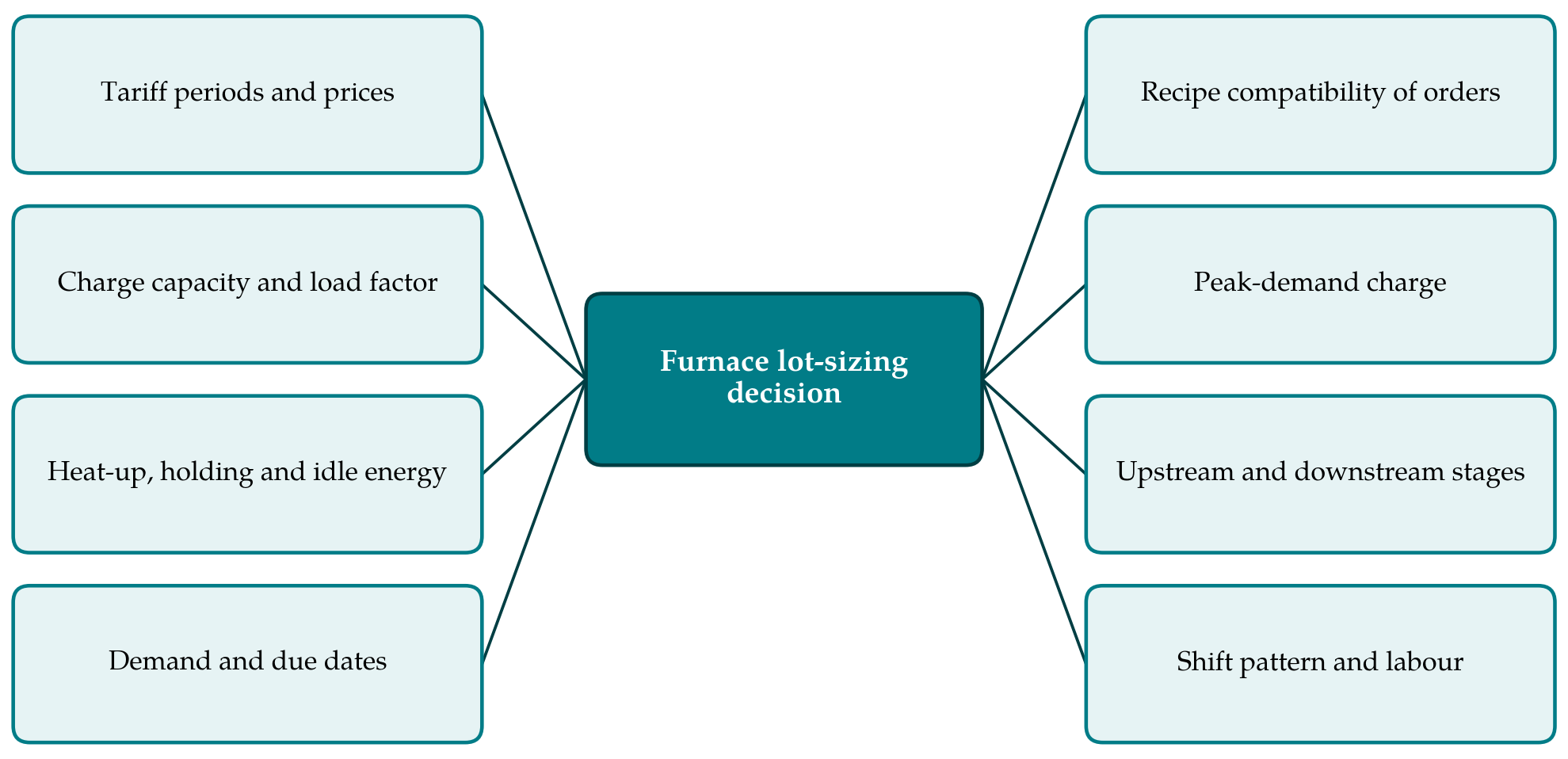
Industrial bills usually contain a second element: a demand charge based on the highest average power drawn in any metering interval of the billing period. A furnace that starts its heat-up while other large loads are running can set that peak for the whole month. A model that minimises energy cost alone may shift several furnaces into the same cheap hours and raise the demand charge, so the two elements have to be considered together. Figure 1 gathers the considerations, physical, commercial and organisational, that bear on the lot-sizing decision for a furnace; the sections that follow ask how many of them existing models cover.
5. Four Streams of Modelling Work
The relevant models come from four communities that cite one another only occasionally. Table 1 summarises what each contributes and what it leaves out.
| Stream | Decision modelled | Treatment of energy | Representative sources |
|---|---|---|---|
| Dynamic lot sizing | Quantity per period; setups; inventory | Usually absent; could enter as time-varying cost | Wagner and Whitin, 1958; Karimi et al., 2003 |
| Batch-processor scheduling | Which jobs share a charge; charge sequence | Absent; objective is time-based | Lee et al., 1992; Potts and Kovalyov, 2000 |
| Energy-aware machine scheduling | Start times and machine states for given jobs | Time-of-use price per period; idle and off states | Mouzon et al., 2007; Shrouf et al., 2014 |
| Power-intensive process planning | Operating mode per period; production level | Hourly prices; mode transitions; contracts | Mitra et al., 2012; Castro et al., 2009 |
| Lot sizing with energy terms | Quantity per period on a line | Energy cost and power limit per period | Masmoudi et al., 2017 |
| Demand response for manufacturing systems | Production rate and buffer use over the day | Time-of-use price and demand charge | Wang and Li, 2013 |
5.1. Classical lot sizing
The dynamic lot-size model of Wagner and Whitin (1958) chooses production quantities over a finite horizon with known demand, a fixed cost per production period and a holding cost, and its cost parameters may vary from period to period. A time-of-use tariff fits that structure naturally if a period of the model is a tariff period. The capacitated versions, surveyed by Karimi et al. (2003), and the family of models that combine lot sizing with sequencing, surveyed by Drexl and Kimms (1997), add the features of a real shop, and the mixed-integer programming techniques for them are treated at length by Pochet and Wolsey (2006). What these models lack is the furnace: production in a period is a continuous quantity bounded by capacity, not an integer number of charges each with its own fill level, duration and recipe.
5.2. Batch-processor scheduling
The batch-machine literature supplies exactly that missing structure. Jobs with sizes and release dates are grouped into charges subject to capacity and compatibility, and the charges are sequenced to minimise makespan, flow time or tardiness (Potts and Kovalyov, 2000). Heuristics of the form "start when full, or when the oldest job has waited long enough" come from this stream and are what most heat-treatment shops use in practice. Energy does not appear, but it could be attached with little change, since each charge has a definite start time and duration. In steel production the charge is the unit that links melting, casting and rolling, and planning systems for integrated steelworks are built around it (Tang et al., 2001).
5.3. Energy-aware machine scheduling
Mouzon et al. (2007) drew attention to the energy consumed by machines that are idle and proposed rules for switching them off between jobs. Fang et al. (2011) formulated a flow shop model with peak power load and energy consumption as objectives alongside makespan. Time-varying prices entered soon after. Shrouf et al. (2014) scheduled a single machine with processing, idle and shutdown states against prices that change through the day, Luo et al. (2013) treated a hybrid flow shop under time-of-use prices with a multi-objective ant colony method, and Che et al. (2016) gave an insertion heuristic for the single-machine case. The framework of Gahm et al. (2016) organises this work by energy supply, energy demand and the breadth of energy considered. These models represent machine states well, which is what furnaces need, but jobs and their sizes are inputs and each machine handles one job at a time.
5.4. Planning of power-intensive processes
Process systems engineering has dealt with electricity prices for longer, because air separation units, cement mills and electric arc furnaces buy power on a scale that makes hourly prices decisive. Castro et al. (2009) proposed a continuous-time formulation for continuous plants under variable electricity cost. Mitra et al. (2012) modelled plants as having discrete operating modes with constrained transitions between them and chose the mode for each hour of a week, a representation that maps directly onto the hold, cool and reheat states of a furnace. Hadera et al. (2015) scheduled a steel melt shop against several electricity contracts at once, and Merkert et al. (2015) review the industrial challenges. This stream handles tariffs and states in detail. Its plants, however, are few, large and dedicated, and the discrete, many-order, mixed-recipe character of a jobbing heat-treatment shop is absent.
6. What a Combined Model Requires
Taken together, the streams contain every element needed, but no one of them contains all the considerations gathered in Figure 1. A combined model has to decide, for each furnace and each interval of the horizon, whether a charge starts, which orders it contains, and what state the furnace is in when it is not processing. Its objective adds the electricity cost of each cycle, evaluated against the tariff periods the cycle spans, to the energy of holding and reheating, the inventory and lateness of orders, and the demand charge on the plant-wide peak.
The trade that such a model resolves can be stated without mathematics. Suppose a chamber is half full on a weekday afternoon, in the expensive period. Running it now wastes the unused part of the cycle's fixed energy at the highest price but ships the waiting orders. Holding it hot until evening buys a cheaper cycle and perhaps a fuller charge at the price of some hours of holding power and delay. Letting it cool and restarting at night saves the holding power but adds the reheat and postpones everything further. Which is best depends on the price ratio between periods, the share of cycle energy that is independent of load, the holding power, and the urgency of the orders, and none of the four streams evaluates all of these at once.
The few models that carry energy into lot sizing show both the possibility and the distance still to go. Masmoudi et al. (2017) formulated lot sizing for a multi-stage flow line with energy cost and a limit on available power, and Wang and Li (2013) optimised the daily production plan of a manufacturing system with buffers under a time-of-use tariff including the demand charge. Neither addresses batch furnaces, where the integer number of charges and the dependence of energy on fill level are central.
Solution methods follow the formulation. Time-indexed mixed-integer programmes are natural for time-of-use tariffs, because tariff periods are themselves intervals of time, and they can be strengthened by the valid inequalities developed for lot sizing (Pochet and Wolsey, 2006). Their size grows with the fineness of the time grid, and a furnace cycle that must be located to the quarter hour within a planning week yields a large model. Decomposition into a batching step and a timing step, metaheuristics of the kind used in the energy-aware scheduling stream, and rolling-horizon application are the obvious remedies, each at some cost in solution quality.
7. Open Problems
The first open problem is the energy model of the furnace itself. Planning models need energy per cycle as a function of load, recipe and starting temperature, and holding power as a function of state. Such functions can be estimated from metered data, but published planning papers commonly assume constant power per machine state. Work that connects simple thermal models to planning formulations, and tests how much planning quality is lost by cruder assumptions, would be valuable.
The second is the treatment of the demand charge, which couples all loads in the plant through a maximum and therefore resists decomposition by furnace. The third is uncertainty: orders arrive during the horizon, cycles overrun, and under critical-peak or real-time tariffs the prices themselves are not known in advance. The fourth is the interaction with neighbouring stages. A charge delayed to a cheap period may starve the next operation or exceed the time that parts may wait between processes. The last is evaluation. Savings reported in this literature are computed within the models that produce them. Comparisons against the rules that shops currently use, on data from real order streams and real tariffs, would show how much of the theoretical saving survives contact with practice.
8. Conclusion
Lot sizing for furnaces under time-of-use tariffs sits between four well-developed literatures. Classical lot sizing provides the trade between run cost and holding cost and the machinery of time-varying parameters. Batch-processor scheduling provides the charge. Energy-aware scheduling provides machine states and tariff periods, and process systems engineering provides operating modes and contracts. Models that unite the charge, its load-dependent energy, the state of the furnace between charges and the full structure of the electricity bill are still scarce. Building and testing them against the practice of real shops is a tractable programme of work with a direct return in cost and in the flexibility that power systems increasingly ask of industry.
Conflict of interest
To be declared by the author(s) before publication.
Funding
To be declared by the author(s) before publication.