1. Introduction
A homestay places a paying visitor in a family house, at the family table. In its community-owned form the houses of a village operate under one committee, guests are allocated among them by turn, and a share of each payment goes to a common fund. Villages such as Sirubari and Ghale Gaun in Nepal made the model known, and state programmes in Sikkim, Uttarakhand and Ladakh have since encouraged it. The appeal is plain. A homestay needs little capital, uses buildings and food that the household already has, and sells what mountain villages possess in abundance: scenery, quiet and a way of life that visitors find distinctive.
The record is less encouraging than the promotion. A review of community-based tourism initiatives found that many had been set up with donor money and few had become commercially viable (Goodwin and Santilli, 2009). Where schemes do survive, the questions of who hosts, who decides and who is paid are often settled informally in favour of households that were already better off. These are failures of design as much as of circumstance, and design can be improved.
This article sets out a planning framework for a village that is considering a community-owned homestay scheme and for the organisation that supports it. The framework is proposed on the basis of published theory and experience. It is not a report of a project, no village has been studied for it, and it has not been validated in use.
2. Background
The framework rests on three bodies of work, each of which supplies a test that a homestay scheme should be able to pass.
2.1. Livelihoods thinking
The sustainable livelihoods approach defines a livelihood as the capabilities, assets and activities required for a means of living, and calls it sustainable when it can cope with stress and shocks without undermining the natural resource base (Chambers and Conway, 1992). Scoones (1998) turned the idea into an analytical framework linking context, resources, institutions, strategies and outcomes, and the guidance sheets of the British development ministry gave it the familiar form of five capitals: human, social, natural, physical and financial (DFID, 1999). Rural households seldom depend on one activity, and diversification is their normal response to risk (Ellis, 2000). The implication for tourism was drawn by Tao and Wall (2009): it should be judged by how well it fits alongside existing activities, and it becomes a hazard when it displaces them.
2.2. Community-based tourism and its critics
The case for community involvement in tourism planning was made by Murphy (1985) and sharpened by Scheyvens (1999), who distinguished economic, psychological, social and political empowerment and argued that income alone is a poor measure of success. The limits were mapped almost at once. Tosun (2000) described operational, structural and cultural barriers to participation in developing countries. Blackstock (2005) criticised the literature for treating the community as a single body with a single interest and for ignoring outside constraints. Simpson (2008) observed that benefit can reach a community without ownership and that ownership does not guarantee benefit. Pro-poor tourism research added the practical point that market access decides whether poor producers gain (Ashley et al., 2001). Okazaki (2008) combined the ladder of participation of Arnstein (1969) with ideas of power redistribution and social capital into a model for judging how far a community actually controls its tourism.
2.3. Common-property institutions and the mountain setting
A community homestay scheme is a shared enterprise with a shared reputation, and the rules that keep such arrangements working have been studied at length. Ostrom (1990) identified design principles common to long-lived common-property institutions, among them clear membership, rules made by those who must follow them, monitoring by members, graduated sanctions and accessible means of resolving disputes. Himalayan villages have long experience of this kind of institution in the management of forests, pasture and irrigation. The mountain setting also brings constraints: a short and weather-dependent season, difficult access, fragile water and waste systems, and tourism flows concentrated on a few trails (Nepal, 2000). Homestay work falls largely on women, and a study of a women-managed scheme in rural Nepal shows that it can bring them income and standing where they also hold the management roles (Acharya and Halpenny, 2013).
3. The Proposed Framework
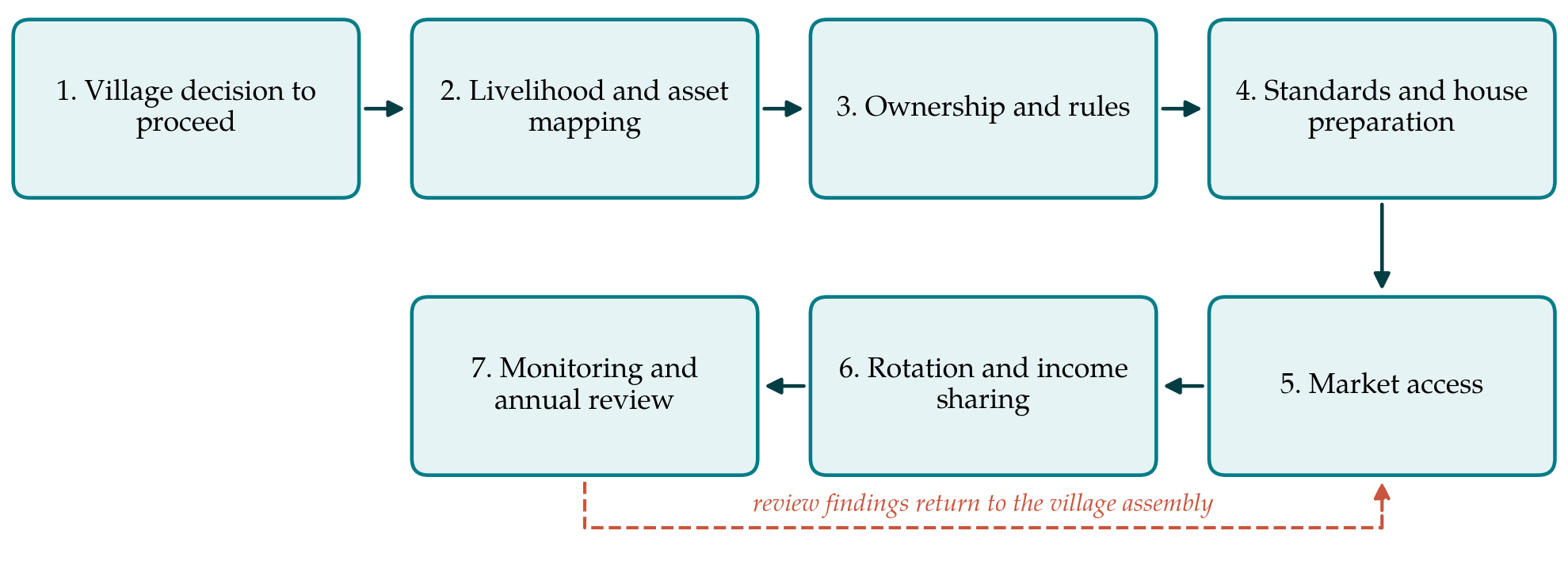
The framework has seven steps, listed in Table 1 with the decision each requires and the record it should leave. Figure 1 shows the sequence and the return from annual review to the village assembly. The steps are meant to be taken in order, at the pace of village decision-making and not of a project calendar.
| Step | Main decision | Record produced |
|---|---|---|
| 1. Decision to proceed | Whether the village wants visitors in its homes, and on what terms | Minuted assembly decision |
| 2. Livelihood and asset mapping | What households have, what they do through the year, what could go wrong | Seasonal calendar, asset map, risk list |
| 3. Ownership and rules | Who is a member, how the committee is chosen, how rules are changed | Written constitution |
| 4. Standards and preparation | Minimum standards for rooms, toilets, food hygiene and safety | Agreed checklist, house inspection notes |
| 5. Market access | Which visitors to seek and through which channels | Price list, booking procedure |
| 6. Rotation and income sharing | How guests are allocated and how each payment is divided | Rotation register, fund accounts |
| 7. Monitoring and review | What is tracked and who reports to the assembly | Annual review report |
3.1. Steps 1 and 2: deciding and mapping
The first step is a decision by the whole village, taken with enough information to refuse. Households should hear what hosting involves, including strangers in the house, extra work at harvest time and the possibility that visitors do not come. Participation at this point should reach the upper rungs of Arnstein's ladder: the village decides, and the supporting organisation advises (Arnstein, 1969). The second step applies the livelihoods framework. Using the methods of participatory rural appraisal (Chambers, 1994), households draw a seasonal calendar of farm work, migration and festivals, map the assets under each of the five capitals, and list the shocks that matter locally, from landslides and road closures to a failed season. The purpose is to see where tourism fits in the year and which households lack the room, labour or savings to take part.
The mapping should be done with separate groups of women, men, older residents and returned migrants before the results are brought together, since each group knows a different part of the village economy and a single open meeting tends to record the view of its most confident speakers. Its findings are kept as the baseline against which the annual review in step 7 is read.
3.2. Steps 3 and 4: rules and standards
The third step writes the institution down. Ostrom's principles serve as a checklist: who is a member, including households that cannot host but may supply food, guiding or portering; how the committee is elected and for how long; what happens when a house breaks the rules; and how a complaint is heard (Ostrom, 1990). Reserved places for women on the committee follow directly from the evidence on who does the work. The fourth step fixes minimum standards that every member house must meet before it receives guests. National homestay regulations, where they exist, set the legal floor. Beyond that the village should agree on a short list that guests care about and households can afford: a clean private sleeping space, a usable toilet, safe drinking water, hygienic food handling and a plan for solid waste.
3.3. Steps 5 and 6: market and money
The fifth step concerns the point at which most schemes fail. A village needs a realistic idea of which visitors it can attract, whether trekkers on a nearby route, domestic weekend travellers or groups sent by an operator, and of how they will book. A single price list, one contact for bookings and a working arrangement with at least one outside operator are the minimum. The sixth step sets the rotation and the division of income. Guests are allocated to houses in turn, and the register is open to all members. Each payment is divided in agreed proportions between the host household and a common fund, and the uses of the fund, such as trail repair, a loan facility or support for households that cannot host, are decided by the assembly. Published accounts are the safeguard against the elite capture that critics describe (Blackstock, 2005).
3.4. Step 7: monitoring and review
The last step is an annual review in the assembly. A small set of indicators is sufficient: guest nights per house, income to households and to the fund, the spread of income across households, complaints and how they were resolved, and observed effects on water, fuelwood and waste. Indicators should be reported against the four forms of empowerment that Scheyvens (1999) distinguishes, so that a year of good income and declining participation is recognised for what it is.
4. Fitting the Framework to a Particular Village
The framework is a sequence of decisions, and the answers will differ between places. A village on an established trekking route can rely on passing trade and may need the rotation rule more than a marketing plan. A village far from any route depends on an operator or a state programme and should weigh that dependence carefully. Where caste or ethnic divisions are strong, membership rules need explicit attention, since a scheme confined to one settlement cluster will deepen the division. Where out-migration has left few working adults, the mapping step may show that the labour for hosting does not exist in the peak farming months. The honest result of the first two steps may be a decision to begin with three or four houses, or to hold off for now.
The role of the supporting organisation also needs to be fitted to the place. Experience with community-based tourism suggests that outside bodies are most useful when they supply what a village cannot easily obtain for itself, such as training in food hygiene and first aid, introductions to operators, and help with registration under national rules, and least useful when they take the decisions that the constitution assigns to members. A written exit plan, agreed at the start and stating when and how outside support will be withdrawn, guards against the dependence on donors that Goodwin and Santilli (2009) identified. Regulations matter here as well. Where a national or state directive distinguishes community-run from privately run homestays, registration in the community category usually carries conditions on the number of participating houses and on record keeping, and these should be read before the rules in step 3 are drafted.
5. Limitations and What Remains to Be Shown
The framework has been derived from the literature and has not been tried. Whether villages that follow it do better than villages that do not is an empirical matter, and answering it would require following schemes for several years and comparing income, its distribution among households and the survival of the institution after external support ends. The steps also assume a supporting organisation with the patience to let the village set the pace, which funding cycles often rule out. The framework says little about demand, which lies largely outside village control, and nothing about exposure to events such as earthquakes, floods or a collapse in travel that no local design can remove. It should be read as a structured set of questions and not as a guarantee.
6. Conclusion
Community-owned homestays can add a useful strand to mountain livelihoods when they complement farming and migration, when the rules for sharing guests and income are explicit, and when the village can reach its market without permanent outside help. The seven steps proposed here arrange what livelihoods research, tourism studies and the theory of common-property institutions each say about those conditions into an order that a village can work through. Testing the framework in practice, and revising it in the light of what villages report, is the work that remains.
Conflict of interest
To be declared by the author(s) before publication.
Funding
To be declared by the author(s) before publication.