1. Introduction
Most operations on the heart need an empty, motionless field. The surgeon obtains it by clamping the ascending aorta, which separates the coronary circulation from the bypass circuit and leaves the myocardium without blood flow until the clamp is removed. For a single valve replacement or a routine coronary operation this period is short enough that almost any accepted method of protection will serve. The difficulty arises in multiple-valve procedures, aortic root and arch reconstruction, reoperations and combined operations, in which the clamp may stay on for well over two hours and the heart is often hypertrophied or already impaired.
Myocardial protection is the name given to everything done to limit the damage of that ischaemic interval and of the reperfusion that ends it. The subject has a long experimental history and a surprisingly thin base of large clinical trials. Practice varies between countries, between hospitals and between surgeons in the same hospital. This review sets out the principal strategies and what the published evidence says about each, with attention to the particular demands of long operations.
2. Scope and Approach
The article is a narrative review of the published literature, drawing on the laboratory studies that established the main concepts, the randomised trials and meta-analyses that have tested them in patients, and authoritative reviews. It was not conducted as a systematic search and makes no claim to completeness. No agreed definition of prolonged bypass exists. The term is used here for operations whose cross-clamp time clearly exceeds that of routine single procedures, so that repeated dosing, rewarming of the heart between doses and cumulative ischaemia become practical concerns. Paediatric practice and donor heart preservation are mentioned only where they explain the origin of a technique used in adults.
3. The Injury to Be Prevented
An ischaemic heart that continues to contract exhausts its high-energy phosphate within minutes. Arresting it removes most of the demand. Buckberg et al. (1977) measured oxygen consumption in beating, fibrillating and arrested hearts at several temperatures and showed that arrest accounts for the greater part of the saving, with cooling adding a smaller further reduction. That observation remains the foundation of the field: stop electromechanical work first, then lower the basal requirement.
Restoring flow brings a second injury. Reperfusion after ischaemia is accompanied by calcium overload, a burst of reactive oxygen species, opening of the mitochondrial permeability transition pore and microvascular dysfunction, and a share of the final damage is attributable to these events and not to ischaemia itself (Yellon and Hausenloy, 2007). At the mild end of the range lies stunning, the reversible depression of contraction that persists after flow has returned (Braunwald and Kloner, 1982). At the severe end lies necrosis. Some rise in cardiac troponin follows every cardiac operation, and the universal definition of myocardial infarction sets a high threshold, together with supporting evidence, before a procedure-related infarct is diagnosed (Thygesen et al., 2018). Trials of protection therefore often rely on enzyme release and low cardiac output as end points, which are sensitive but only loosely tied to survival.
4. Cardioplegic Solutions
Chemical arrest of the heart was described by Melrose et al. (1955), who used potassium citrate; the concentration proved injurious and the idea was set aside for nearly two decades, during which surgeons relied on cooling and on intermittent clamping. It returned when Gay and Ebert (1973) showed that a lower concentration of potassium gave safe, reversible arrest, and when Hearse et al. (1976) characterised the components of what became the St Thomas' Hospital solution. Since then the argument has been less about whether to use cardioplegia than about its vehicle, its composition and how often it must be given.
4.1. Depolarising crystalloid and blood cardioplegia
Raising extracellular potassium depolarises the cell membrane, inactivates the fast sodium channels and stops the heart in diastole. Extracellular-type crystalloid solutions of this kind are simple and give a clear field. Their weaknesses are that they carry almost no oxygen, dilute the patient and have limited buffering capacity. Follette et al. (1978) introduced blood as the vehicle, arguing that it supplies oxygen, buffers and oncotic pressure during each infusion. A meta-analysis of randomised trials found that blood cardioplegia was associated with less low-output syndrome and lower release of creatine kinase MB than crystalloid cardioplegia, with no detectable difference in myocardial infarction or death (Guru et al., 2006). The trials were small and mostly enrolled patients having routine coronary surgery, so their relevance to long complex operations is by extension.
4.2. Single-dose solutions
Conventional cardioplegia is repeated every 15 to 20 minutes or so, which interrupts the operation and is easily delayed at a difficult moment. Two solutions designed to last much longer are now widely used in adults. The first is the intracellular-type solution developed by Bretschneider et al. (1975), which arrests the heart by sodium depletion and relies on a high concentration of histidine as a buffer. A systematic review of its use found outcomes broadly comparable with those of conventional cardioplegia, on evidence the authors regarded as limited (Edelman et al., 2013). The large volume infused can lower the serum sodium, and this needs to be anticipated.
The second is the del Nido solution, developed for paediatric surgery and described in detail by Matte and del Nido (2012). It is a crystalloid base containing lidocaine and magnesium, mixed with a small proportion of the patient's blood; the lidocaine blocks sodium channels and is intended to limit calcium entry during arrest. A prospective randomised trial in adults undergoing coronary and valve surgery reported no disadvantage in comparison with whole-blood cardioplegia (Ad et al., 2018). Table 1 compares the main families of solution.
| Strategy | Rationale | Limitation in long operations | Key source |
|---|---|---|---|
| Cold crystalloid, extracellular type | Potassium arrest; simple; clear field | No oxygen carriage; haemodilution; frequent doses | Hearse et al., 1976 |
| Cold blood, multidose | Oxygen, buffering and oncotic pressure with each dose | Repeated interruptions; cumulative potassium load | Follette et al., 1978 |
| Warm blood, continuous or intermittent | Aerobic arrest; avoids hypothermic injury | Obscured field; short tolerance if flow stops | Lichtenstein et al., 1991 |
| Histidine-buffered, intracellular type | Sodium depletion; long single dose | Hyponatraemia; evidence limited | Edelman et al., 2013 |
| del Nido solution | Lidocaine and magnesium; long single dose | Few adult trials with long clamp times | Ad et al., 2018 |
| Polarised arrest | Arrest near resting membrane potential | Largely experimental | Dobson and Jones, 2004 |
4.3. Alternatives to depolarisation
Potassium arrest holds the membrane at a potential at which some sodium and calcium currents persist, and this has prompted a search for agents that arrest the heart nearer its resting potential. Dobson and Jones (2004) proposed the combination of adenosine and lidocaine for this purpose. Chambers and Fallouh (2010) reviewed the pharmacology of the candidate agents and concluded that polarised arrest is attractive in principle while still lacking the clinical trials that would justify replacing hyperkalaemic solutions.
5. Temperature and Route of Delivery
For many years cold was assumed to be indispensable. Lichtenstein et al. (1991) challenged that assumption with continuous warm blood cardioplegia, in which the heart is kept arrested and aerobic at body temperature. A large randomised trial in coronary surgery found no difference in mortality between warm and cold techniques and less low-output syndrome in the warm group (The Warm Heart Investigators, 1994). Continuous flow obscures the field, however, and warm arrest gives little margin if delivery is interrupted. Intermittent warm and tepid regimens were developed as compromises and occupy the ground between the two.
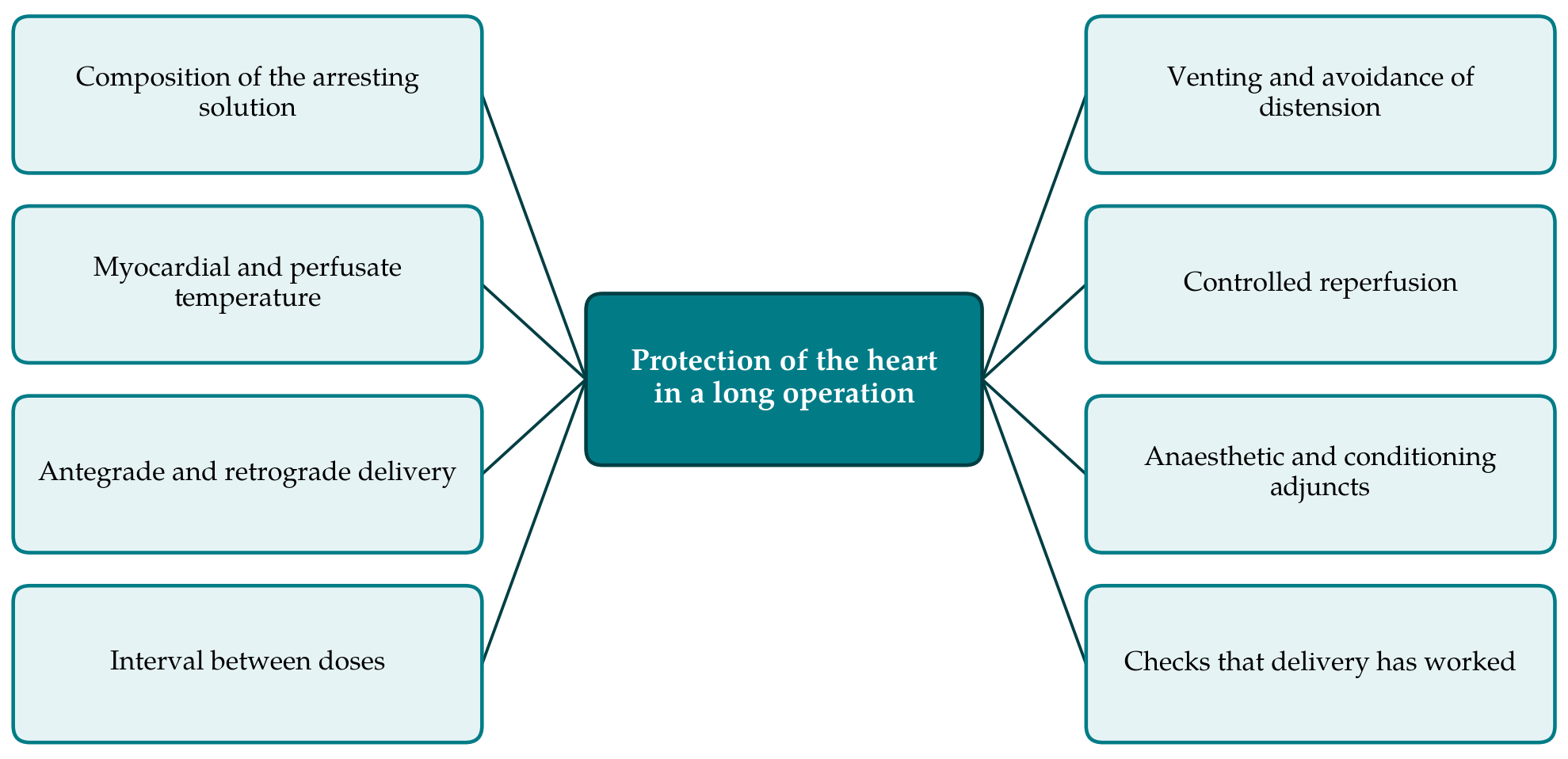
Cardioplegia given into the aortic root reaches the myocardium only as far as the coronary arteries allow. Severe proximal stenoses, aortic regurgitation and an open root all impair antegrade delivery. Infusion through the coronary sinus avoids those obstacles and was adapted to continuous warm perfusion by Salerno et al. (1991); its drawback is unreliable perfusion of the right ventricle and septum. Buckberg (1987) set out an integrated approach that combines both routes with a warm induction dose, cold maintenance and a warm substrate-enriched dose before the clamp is released. The scheme is logical and widely taught, though its separate elements have never been tested individually in adequately powered trials. Figure 1 gathers the elements that a protection plan for a long operation has to cover.
6. Conditioning and Anaesthetic Adjuncts
Murry et al. (1986) showed in dogs that brief episodes of ischaemia before a prolonged coronary occlusion reduced the size of the resulting infarct. Zhao et al. (2003) found a comparable effect when brief occlusions were applied at the onset of reperfusion. Because the protection could also be induced by ischaemia in a limb, remote preconditioning with a blood-pressure cuff became an appealing, almost cost-free adjunct to cardiac surgery, and early single-centre studies reported lower troponin release.
Two large multicentre trials then tested clinical outcomes. Neither found that remote ischaemic preconditioning reduced death, myocardial infarction, stroke or the other major events measured (Hausenloy et al., 2015; Meybohm et al., 2015). One explanation discussed since is that propofol, used in most of the participants, blunts the conditioning response; this is a hypothesis and has not been settled. Volatile anaesthetics have conditioning-like properties in the laboratory, and in a small trial the effect of sevoflurane on postoperative cardiac function depended on when during the operation it was given (De Hert et al., 2004). A large pragmatic trial in coronary surgery nonetheless found no difference in mortality at one year between volatile and total intravenous anaesthesia (Landoni et al., 2019).
7. What Changes When the Clamp Time Is Long
Three practical problems grow with time. The heart rewarms between doses from the surrounding tissues and from collateral flow, so that a hypothermic strategy drifts away from its intended temperature. Non-coronary collateral blood washes cardioplegia out of the myocardium, and electrical activity returns. And each missed or late dose adds unprotected ischaemia. Long-acting single-dose solutions reduce the number of occasions on which a dose can be missed, which is probably their chief merit, but the published adult comparisons seldom include many operations at the long end of the range and should not be read as proof of equivalence there.
Distribution is the other issue. In a hypertrophied ventricle or one with diffuse coronary disease, parts of the myocardium may receive little of an antegrade dose however well it is composed. Combining antegrade and retrograde routes, giving cardioplegia directly into the coronary ostia or down completed grafts, keeping the ventricle decompressed with a vent and watching for the return of electrical or mechanical activity are ordinary measures that address distribution directly. The evidence for them is physiological and observational. It is reasonable to regard a carefully delivered familiar regimen as safer than an unfamiliar one adopted for its theoretical advantages.
8. Gaps and Future Work
The clearest gap is a shortage of adequately powered trials in the patients for whom protection matters most. The existing randomised comparisons were largely conducted in low-risk coronary surgery, where event rates are low and any reasonable method succeeds. Trials restricted to long, complex operations and to ventricles with hypertrophy or reduced function would be more informative, and they would need clinical end points such as low-output syndrome requiring support, in addition to biomarker release.
Other questions follow from the material reviewed. The appropriate redosing interval for the single-dose solutions in adults has been set by custom more than by study. The interaction between anaesthetic agents and conditioning stimuli is unresolved. Polarised arrest awaits clinical testing. Finally, reporting is inconsistent: few papers state the temperatures actually achieved in the myocardium, the volumes delivered or the intervals between doses, and without these details a named solution describes only part of the strategy that was used.
9. Conclusion
Protection of the heart during long operations rests on principles established decades ago: arrest the heart promptly, keep its metabolic demand low, deliver the protective solution to all of the myocardium, and reperfuse in a controlled way. Blood-based and long-acting single-dose solutions both have support, none has been shown to improve survival over the others, and the adjuncts that looked most promising have not delivered clinical benefit in large trials. Until trials are done in the high-risk, long-duration operations where differences are most likely to appear, consistency and completeness of delivery remain the best-supported priorities.
Conflict of interest
To be declared by the author(s) before publication.
Funding
To be declared by the author(s) before publication.