1. Introduction
For most of the history of company law, a director who paid no attention to the climate could not sensibly have been accused of neglecting a duty. That position has changed, and the change has come less from the courts than from disclosure regulation. In 2015 the Governor of the Bank of England described climate change as a threat to financial stability operating through physical, liability and transition risks, and argued that the horizons of business and regulation were too short to register it (Carney, 2015). Two years later an industry task force convened by the Financial Stability Board published a framework for reporting those risks (TCFD, 2017). Legislators have since turned that framework into law.
Disclosure mandates are obligations of the reporting entity. Directors' duties are obligations of individuals, owed in most systems to the company. The two bodies of law have different sources, different enforcers and different remedies, and a mandate to report does not in terms tell a director how to act. The literature reviewed here argues that the separation is less complete than it looks. A rule that requires a company to describe its board's oversight of climate risk assumes that there is oversight to describe, and a board that has signed such a description has made a record of what it knew.
This article reviews what has been written on that relationship. It considers how the mandates are constructed, what fiduciary doctrine requires in the principal common-law jurisdictions, the routes by which the first affects the second, and the unresolved debate about the purpose of the company that lies behind both.
2. Scope and Approach
The review is narrative. It draws on primary legal materials, meaning statutes, regulations, standards and reported cases, and on the scholarly and professional literature in law, accounting and finance that interprets them. It concentrates on the United Kingdom, the European Union, the United States and Australia, because those jurisdictions have produced most of the instruments and commentary, and it does not attempt a systematic search or a complete catalogue. Sources were chosen for their influence on the debate. Legal positions are described as they are generally understood from the published materials; the article does not offer legal advice, and readers should check current law in their own jurisdiction.
3. From Voluntary Framework to Legal Mandate
The recommendations of the Task Force on Climate-related Financial Disclosures were organised under four headings: governance, strategy, risk management, and metrics and targets (TCFD, 2017). The first of these asks a company to describe the board's oversight of climate-related risks and opportunities and management's role in assessing them. That architecture has been carried into every major mandate that followed, as Table 1 shows, and Figure 1 places the main steps in order.
| Instrument | Legal character | Content bearing on the board |
|---|---|---|
| TCFD recommendations (TCFD, 2017) | Voluntary framework | Describe board oversight and the role of management |
| UK climate-related financial disclosure regulations (UK Government, 2022) | Statutory, within the strategic report | Governance arrangements for assessing and managing climate risks |
| EU CSRD (European Union, 2022) | Directive, with mandatory reporting standards | Role of administrative and supervisory bodies; double materiality |
| IFRS S2 (ISSB, 2023) | Global baseline standard, adopted by jurisdictions | Governance body responsible for oversight, its skills and its information |
| SEC climate rule (SEC, 2024) | Federal rule, stayed after adoption | Board oversight and material climate risks |
| Australian climate reporting law (Commonwealth of Australia, 2024) | Statute, phased in by size of entity | Climate statements within the annual report, with a directors' declaration |
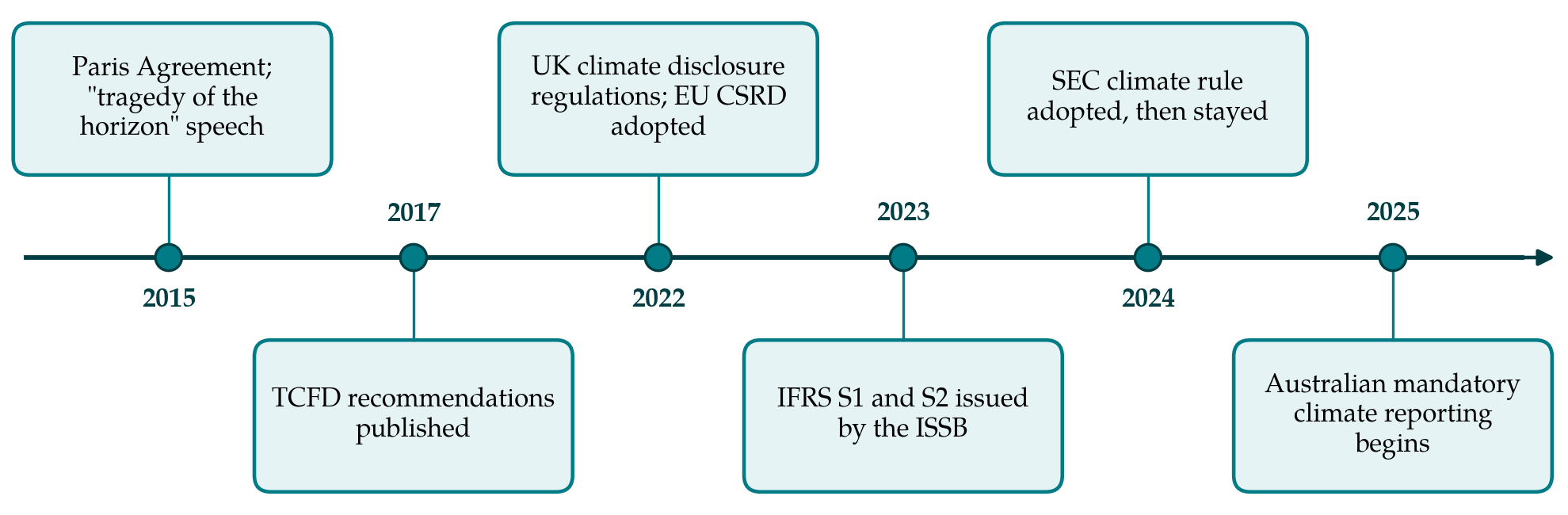
The United Kingdom was early to legislate. Regulations made in 2022 amended the Companies Act 2006 to require certain large companies to include climate-related financial disclosures in the strategic report (UK Government, 2022). The European Union went further in the Corporate Sustainability Reporting Directive, which requires reporting under detailed standards and on a double materiality basis, covering the effect of sustainability matters on the undertaking and the undertaking's effect on people and the environment (European Union, 2022). The scope and timing of that directive have since been reopened by simplification proposals, which is a reminder that the direction of travel is not fixed.
The International Sustainability Standards Board issued IFRS S2 in 2023 as a global baseline built on the task force structure and directed at information material to investors (ISSB, 2023). Australia legislated for mandatory climate statements phased in from 2025 (Commonwealth of Australia, 2024). The United States followed a different course. The Securities and Exchange Commission adopted a climate disclosure rule in March 2024 (SEC, 2024); it was challenged at once, the Commission stayed it, and the Commission later withdrew from defending it. The American literature therefore discusses a federal mandate that has not taken effect.
4. The Doctrinal Baseline
Common-law systems divide the obligations of directors into a duty of loyalty and a duty of care. In the United Kingdom the general duties are stated in the Companies Act 2006. Section 172 requires a director to act in the way he or she considers, in good faith, would be most likely to promote the success of the company for the benefit of its members as a whole, having regard to matters that include the likely long-term consequences of a decision and the impact of the company's operations on the community and the environment. Section 174 imposes a duty of reasonable care, skill and diligence (UK Parliament, 2006). Australian law contains a comparable statutory duty of care and diligence.
Two features of the doctrine limit liability. The first is the business judgement rule, by which courts decline to review the merits of a decision taken in good faith, on an informed basis and without conflict of interest. The second is the high threshold for oversight liability. In Delaware, the Caremark decision held that directors must make a good-faith effort to see that a reporting system exists, and that only a sustained or systematic failure of oversight will ground liability (Delaware Court of Chancery, 1996). The Delaware Supreme Court's later decision in Marchand v. Barnhill allowed such a claim to proceed where the board had no system for monitoring a risk central to the company's business (Delaware Supreme Court, 2019). Both features protect the director who considers an issue and decides, and give little shelter to one who never considers it.
5. How Disclosure Mandates Alter the Content of the Duty
The literature identifies four routes by which a reporting obligation changes what the duty requires in practice, without any amendment to the duty itself.
5.1. Foreseeability
The duty of care is measured against what a reasonable director would have known and done. An influential Australian opinion concluded in 2016 that climate risks were capable of being foreseeable risks to a company's interests, and that directors who failed to consider them could be found to have breached the duty of care and diligence (Hutley and Hartford Davis, 2016). Academic analysis reached similar conclusions for pension trustees (Barker et al., 2016). Once a statute requires a company to assess and report climate risk, the argument that such risk was unforeseeable is hard to sustain. The mandate supplies the knowledge that the standard of care presupposes.
5.2. Process and oversight
Every mandate in Table 1 asks for a description of governance. To give one truthfully, a board must have allocated responsibility, received information and considered it. The disclosure rule in this way specifies, indirectly, the minimum process that a diligent board should have. Scholarship on climate governance treats board-level structures for identifying and monitoring climate risk as part of what the duty of care now requires (Sarra, 2020). Where such risk is central to a company's business, the absence of any system for monitoring it begins to resemble the failure described in the Delaware oversight cases. The effect is to raise the floor of informed attention and to leave the substance of decisions to the board.
5.3. Exposure for what is said
A mandate brings climate statements within the regimes that govern misleading disclosure. Directors approve the reports in which the statements appear, and forward-looking claims about targets and transition plans carry particular risk because their basis can be tested later. The Australian statute recognises the point by granting a transitional period of modified liability for certain forward-looking climate statements (Commonwealth of Australia, 2024). The concession shows that legislators see disclosure and liability as connected.
5.4. Materiality
Mandates differ on the question of materiality, and the difference maps onto a difference in duty. The investor-focused standards ask what affects enterprise value. The European approach asks, in addition, what the company does to the world. A board subject to the second must inform itself about impacts that may never reach its own accounts. Whether that changes the interests the board must serve, or only the information it must gather, is disputed, and the answer depends on the theory of the company discussed below.
6. What the Cases Show
Litigation has tested these arguments, and the results so far counsel caution. In ClientEarth v Shell plc an environmental organisation holding shares sought permission to bring a derivative claim alleging that the directors had breached their duties under sections 172 and 174 in their management of climate risk. The High Court refused permission. It held that the evidence did not disclose a prima facie case and stressed that it is for directors to decide how to weigh competing considerations in promoting the success of the company (High Court of England and Wales, 2023). The decision confirms that an informed board retains wide discretion over strategy, even where claimants regard the strategy as inadequate.
The case does not show that climate is irrelevant to duty. The directors' defence rested on the fact that they had considered the matter and adopted a strategy. A board that had not done so would stand in a different position. The cases and the mandates therefore point the same way: the duty that has hardened is procedural.
7. Shareholder Value, Stakeholders and the Purpose Debate
Behind the doctrinal questions lies an older argument about corporate purpose. The classical statement is Friedman's (1970) claim that managers are agents of the owners and should pursue profit within the law. On that view climate matters to directors only as a financial risk, and investor-focused disclosure is the natural instrument. Critics have attacked the premise. Stout (2012) argued that shareholder primacy is neither required by law nor good for shareholders, and Mayer (2018) proposed that companies be defined by a purpose beyond profit. Hart and Zingales (2017) offered a reformulation from within economics: where shareholders care about externalities that the company can address more cheaply than they can, directors should maximise shareholder welfare, which is wider than market value.
Sceptics doubt that enlarging directors' discretion helps anyone but directors. Bebchuk and Tallarita (2020) argue that stakeholder governance is unlikely to deliver for stakeholders and would insulate managers from accountability. The European legislative record gives the debate a concrete form. The Commission's proposal for a corporate sustainability due diligence directive contained a provision on directors' duty of care that was removed before adoption (European Union, 2024). Legislators were willing to impose reporting and due diligence duties on companies and unwilling to rewrite the duties of individuals. For institutional investors an early and influential report had concluded that taking environmental, social and governance considerations into account is permissible and in some circumstances arguably required (Freshfields Bruckhaus Deringer, 2005).
8. Evidence on Investors and on Mandated Reporting
The case for treating climate as a financial matter rests on evidence that investors do so. Surveys of institutional investors report that many regard climate risks as having financial implications for portfolio firms and consider engagement a better response than divestment (Krueger et al., 2020), and that they value and demand climate risk disclosure (Ilhan et al., 2023). Bolton and Kacperczyk (2021) find that stocks of firms with higher carbon emissions earn higher returns, which they interpret as compensation for carbon risk. If markets price the risk, a director attending only to shareholder value has reason to manage and report it.
Evidence on what mandates achieve is less settled. A broad review of mandatory sustainability reporting concludes that its effects depend on the specificity of the standards, on enforcement and on the incentives of firms, and that reporting mandates can change real behaviour as well as information (Christensen et al., 2021). The review also warns of boilerplate. A governance disclosure can be complied with by description alone, and whether described processes correspond to real deliberation in the boardroom is something reports cannot show.
9. Gaps and Future Work
Three gaps stand out. The first is empirical: little is known about whether governance disclosures change what boards do, as opposed to what they say, and studies of board minutes, committee mandates and director time would help. The second is doctrinal. The interaction between oversight liability and mandated risk reporting has been argued by commentators more than it has been decided by courts, and the position outside Delaware, England and Australia is thinly covered. The third concerns double materiality. If a board must assess its company's effects on the climate, the literature has yet to say with confidence what follows when those effects are large and the financial consequences for the company are small. Comparative work on civil-law systems, where directors' duties are framed differently, is also scarce.
10. Conclusion
Climate disclosure mandates have changed directors' duties by changing their factual setting. They make climate risk foreseeable as a matter of law, describe the oversight a board is expected to exercise, and attach liability to statements that directors approve. They have not removed the deference courts show to considered business decisions, and legislators have so far declined to redefine whose interests directors serve. The boundary of fiduciary duty has moved in its procedural dimension: directors must inform themselves and must be able to show that they did. What they must then decide remains, for now, a matter of judgement, and the pressure on that judgement is coming from investors and regulators more than from the courts.
Conflict of interest
To be declared by the author(s) before publication.
Funding
To be declared by the author(s) before publication.