1. Introduction
The long-chain omega-3 fatty acids eicosapentaenoic acid (EPA) and docosahexaenoic acid (DHA), and their plant precursor α-linolenic acid (ALA), are under-consumed in many populations, and staple foods have long been considered as carriers for them. Bakery products are eaten often and in predictable amounts, which suits fortification. They are also baked at high temperature, are porous and so exposed to air, and are expected to keep for days or months. For a highly unsaturated oil those are hostile conditions.
The chemistry of the problem is well understood. Polyunsaturated lipids oxidise by a free-radical chain reaction whose hydroperoxide products break down into volatile aldehydes and ketones with very low odour thresholds (Frankel, 2005). Protective strategies include antioxidants, the exclusion of oxygen and physical barriers, and for foods enriched with omega-3 lipids no single one is sufficient (Jacobsen et al., 2008). Microencapsulation supplies the barrier: the oil is emulsified in a solution of wall material and dried, so that each droplet is enclosed in a glassy matrix (Gharsallaoui et al., 2007).
This article sets out a stepwise procedure for developing such a microcapsule with a pulse protein as the emulsifying wall component and carrying it through to a fortified bakery product. The procedure is proposed. It is built from published methods and has not been run and validated as a whole in the work reported here.
2. Background
Three bodies of literature inform the design: spray-dried oil encapsulation in general, the functional behaviour of pulse proteins, and the fate of encapsulated oil in baked goods.
2.1. Spray-dried oil microcapsules
Spray drying dominates industrial encapsulation of polyunsaturated oils because it is continuous, inexpensive and gives a free-flowing powder (Drusch and Mannino, 2009). The wall usually pairs a surface-active polymer, which forms the interface, with a low-cost carbohydrate such as maltodextrin, which forms the bulk of the dried matrix. Reviews agree on what governs quality: a fine and stable feed emulsion, a high solids content, wall materials that form a glass on drying, and drying conditions that set the particle crust quickly (Jafari et al., 2008). The key outputs are encapsulation efficiency, meaning the share of the oil that is not extractable from the particle surface, and oxidative stability in storage (Kaushik et al., 2015). Oxidation can begin during emulsification and drying, before storage starts, so the oil must be protected throughout (Serfert et al., 2009).
2.2. Pulse proteins as wall materials
Pulse proteins are mainly salt-soluble globulins of the legumin and vicilin types, with a smaller albumin fraction. Their solubility is lowest near the isoelectric region, around pH 4 to 5, and rises on either side of it. Extraction method matters: isolates made by alkaline extraction and isoelectric precipitation differ in solubility and surface properties from those made by salt extraction or membrane processing (Boye et al., 2010). Karaca et al. (2011) compared the emulsifying properties of chickpea, faba bean, lentil and pea isolates and found that both the pulse and the extraction route affected the result. The same group then encapsulated flaxseed oil with chickpea and lentil protein isolates combined with maltodextrin by spray drying (Karaca et al., 2013). Gumus et al. (2017) showed that lentil, pea and faba bean proteins can stabilise omega-3 oil emulsions, with sensitivity to pH, salt and heat that a formulator has to respect.
2.3. Encapsulated oil in baked products
During baking the crust of a loaf reaches temperatures well above 100 °C while the crumb stays close to the boiling point of water as long as it remains moist. Capsules in the crumb therefore face a hot, wet, mechanically worked environment and not dry roasting. Gökmen et al. (2011) added encapsulated omega-3 oil to bread and examined both lipid oxidation and the formation of thermal process contaminants, which is a reminder that fortification can affect more than the nutrient added. Dough mixing subjects capsules to shear and to water, which may dissolve a carbohydrate-rich wall before the oven is reached.
3. The Proposed Procedure
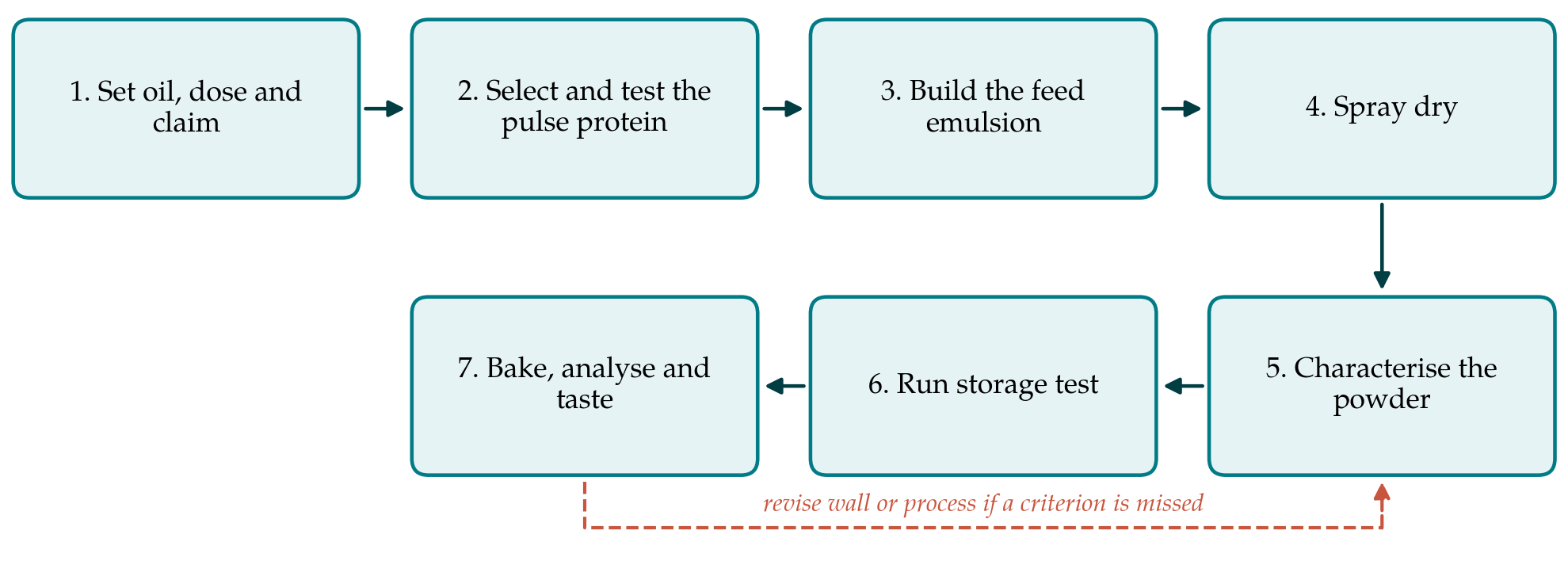
The procedure has seven steps. Figure 1 shows the sequence, and Table 1 lists for each step what is measured, by which method and what criterion allows the developer to proceed. The criteria are proposals that a laboratory should adapt to its own product and justify in its records.
| Step | Key measurements | Method or reference | Proposed criterion to proceed |
|---|---|---|---|
| 1. Oil, dose, claim | Fatty acid profile; peroxide and anisidine values of oil | Claim conditions (European Commission, 2010) | Required powder dose fits the recipe |
| 2. Protein | Solubility, test emulsion droplet size, flavour | Karaca et al., 2011 | Soluble at feed pH; flavour acceptable |
| 3. Emulsion | Droplet size, viscosity, creaming | Laser diffraction; factorial design | Fine, stable emulsion over holding time |
| 4. Drying | Inlet and outlet temperature, yield | Gharsallaoui et al., 2007 | Free-flowing powder; little wall deposit |
| 5. Powder | Moisture, water activity, surface and total oil | Kaushik et al., 2015 | High encapsulation efficiency; low moisture |
| 6. Storage | Peroxide, anisidine, Totox; volatiles | AOCS, 2017; Codex Alimentarius Commission, 2017 | Slower oxidation than bulk oil control |
| 7. Baked product | Retained fatty acids; volume; sensory difference | Lawless and Heymann, 2010 | Claim met; no detectable off-flavour |
3.1. Step 1: Fix the oil, the dose and the claim
The starting point is the label. In the European Union a food may be described as a source of omega-3 fatty acids if it contains at least 0.3 g of ALA per 100 g and per 100 kcal, or at least 40 mg of EPA and DHA combined per 100 g and per 100 kcal (European Commission, 2010). Other jurisdictions set their own conditions, and the applicable one should be written down first. The choice of oil follows: flaxseed oil for ALA, fish or microalgal oil for EPA and DHA. From the claim, the fatty acid content of the oil, the expected oil load of the powder and an allowance for losses, the developer calculates how much powder each 100 g of finished product must contain. If that amount is more than the recipe can absorb, the target has to change before any laboratory work begins. The oil itself is tested on receipt for peroxide and p-anisidine values, since encapsulation preserves the state of an oil and cannot improve it.
3.2. Step 2: Select and test the pulse protein
Candidate isolates or concentrates are obtained with their specifications and screened on three properties measured at the pH and solids content intended for the feed: nitrogen solubility, the droplet size of a standard test emulsion, and flavour. Solubility decides how much of the protein is available to adsorb at the oil surface. Flavour deserves equal weight, because the beany and earthy notes of some pulse ingredients can be as unwelcome in a sweet bakery product as the oxidised notes the capsule is meant to prevent. Suppliers' lots vary, so the screening is repeated on a second lot of any candidate taken forward.
3.3. Step 3: Build the feed emulsion
The protein is hydrated fully, the pH adjusted to a value at which it is soluble, and maltodextrin dissolved to bring total solids to the level the dryer can atomise. Oil is added, with any oil-soluble antioxidant such as mixed tocopherols already dissolved in it, and the coarse premix from a rotor-stator mixer is passed through a high-pressure homogeniser. A small factorial experiment is proposed, varying the ratio of protein to oil, the ratio of protein to maltodextrin and the homogenisation pressure (Montgomery, 2017). The responses are droplet size distribution by laser diffraction, viscosity and stability against creaming over the holding time before drying. Throughout, the emulsion is kept cool and held for as short a time as practicable, because oxidation at the enlarged oil-water interface is rapid (McClements and Decker, 2000).
3.4. Step 4: Spray dry
The emulsion is dried in a co-current spray dryer. Inlet air temperatures between about 160 and 200 °C are typical in the published work on oil encapsulation, with the feed rate adjusted to give an outlet temperature low enough to spare the oil and high enough to yield a dry powder (Gharsallaoui et al., 2007). The inlet and outlet temperatures, feed rate, atomiser setting and ambient humidity are recorded for every run. Powder is collected into oxygen-barrier pouches, flushed with nitrogen where possible, and cooled promptly.
3.5. Step 5: Characterise the powder
Each powder is analysed for moisture and water activity, total oil, and surface oil removed by a brief wash with a non-polar solvent. Encapsulation efficiency is calculated as total oil minus surface oil, divided by total oil. Particle size and, where a microscope is available, particle morphology are recorded. The droplet size of the emulsion obtained on redispersing the powder in water is compared with that of the feed, since a large increase indicates coalescence during drying. The fatty acid profile of the extracted oil is determined by gas chromatography of the methyl esters to confirm that the target fatty acids have survived.
3.6. Step 6: Test oxidative stability in storage
Powders are stored in the dark at a controlled temperature and humidity, alongside the unencapsulated oil and, ideally, a reference capsule made with a conventional wall such as sodium caseinate or whey protein. At intervals the oil is extracted and its peroxide value and p-anisidine value determined by the official methods (AOCS, 2017). The two are often combined as the Totox value, twice the peroxide value plus the anisidine value. The Codex standard for fish oils sets maxima of 5 milliequivalents of active oxygen per kilogram for peroxide value, 20 for anisidine value and 26 for Totox (Codex Alimentarius Commission, 2017), and these provide a convenient external benchmark for marine oils. Headspace analysis of volatile aldehydes such as propanal and hexanal, where available, relates more directly to what a consumer will smell.
3.7. Step 7: Bake, analyse and taste
The selected powder is added to a standard recipe at the level calculated in Step 1, with a control containing none and a second control containing the same amount of unencapsulated oil. Dough handling, loaf or piece volume, crumb structure and colour are recorded. After baking, lipids are extracted and the target fatty acids quantified to establish how much of the added amount is retained; that figure decides whether the claim is met. Sensory testing proceeds in two stages: a discrimination test to establish whether assessors can tell the fortified product from the control, followed, if they can, by descriptive or acceptance testing to find out whether the difference matters (Lawless and Heymann, 2010). Analyses and tasting are repeated at the end of the intended shelf life of the product.
4. Fitting the Procedure to Practice
The procedure can be shortened for a small company that buys a commercial pulse-protein capsule instead of making one: Steps 2 to 4 are replaced by a supplier specification, and Steps 5 to 7 are kept as incoming inspection and product validation. Where the full route is followed, the feedback loop in Figure 1 matters. A powder that fails in storage sends the developer back to the emulsion, usually to the protein-to-oil ratio or the antioxidant system, and a capsule that survives storage but fails in the dough sends the developer back to the wall composition.
Product type shapes the difficulty. Bread has a high water content and a short shelf life, so capsule integrity in the dough is the main concern. Biscuits and crackers are dry, are baked through to a low moisture content and are expected to keep for months, so they test long-term oxidative stability far more severely. The dose needed for a claim per 100 kcal is also harder to reach in energy-dense products. A developer should choose the first target product with these differences in mind.
5. Limitations and What Remains to Be Shown
This is a proposed procedure and it has not been validated in the present work. Its individual steps rest on published methods, yet the literature on pulse-protein capsules deals mostly with powders and model emulsions, and much less with their behaviour in real doughs. Three matters in particular are open. It has not been established how pulse-protein walls compare with dairy-protein walls under identical conditions through baking and product storage. The proceed criteria in Table 1 are qualitative, and numerical thresholds would have to be set from a laboratory's own data. And accelerated storage tests may not predict oxidation at ambient temperature, because the mechanisms shift as temperature rises and as the glassy wall softens (Frankel, 2005).
Two cautions lie outside the procedure. Chemical retention of a fatty acid in the loaf does not demonstrate that it is absorbed by the person who eats it, and bioavailability from encapsulated forms would need its own study. Pulse proteins can also provoke allergic reactions in some individuals, and replacing a dairy wall with a pulse wall changes the allergen declaration and does not remove the need for one to be considered.
6. Conclusion
Pulse proteins are credible wall materials for omega-3 oil microcapsules, and bakery products are sensible, if demanding, vehicles for them. The seven-step procedure proposed here ties the work to the intended claim from the outset, places a measurable check after every stage and carries the capsule through to the baked product, where success is finally judged. It is offered as a framework to be tested, refined and given numerical criteria by those who apply it.
Conflict of interest
To be declared by the author(s) before publication.
Funding
To be declared by the author(s) before publication.