1. Introduction
Heart failure is common, costly and, for most of its course, an outpatient condition. Its prevalence rises steeply with age, and it is a leading reason for hospital admission among older adults in countries that keep such figures (Savarese and Lund, 2017). Between admissions, people with heart failure live at home, take several medicines whose doses need adjusting over months, and are asked to watch their own weight, breathlessness and swelling. Most of that happens within reach of a general practice or community health centre and out of sight of a cardiology department.
Clinical guidelines on both sides of the Atlantic recommend that people with heart failure be enrolled in a multidisciplinary management programme, and they name specialist nurses as central to it (McDonagh et al., 2021; Heidenreich et al., 2022). The trials behind that recommendation were largely run from hospitals, and they enrolled patients at or soon after discharge. Health systems have since tried to deliver the same functions closer to home, through clinics led by nurses in primary care. The reasons are practical: access for frail patients, continuity with the clinician who manages their other conditions, and pressure on hospital outpatient capacity.
This review asks what such clinics look like, what is known about their results, and what stands in the way of setting them up. It is written for nurses, general practitioners and service planners who are considering a clinic and want an honest account of how far the evidence reaches.
2. Scope and Approach
The article is a narrative review of the published literature. It relies on landmark randomised trials, Cochrane and other systematic reviews, international guidelines and a small number of qualitative and observational studies, selected for their relevance to nurse-led follow-up of adults with chronic heart failure in community settings. It does not report a systematic search and does not pool results. "Primary care" is used broadly to mean first-contact, community-based services, including general practice and community health centres. "Nurse-led" means that a nurse runs the consultation and makes day-to-day management decisions within an agreed protocol, with medical support available.
3. Origins of the Nurse-Led Model
The modern case for nurse-coordinated heart failure care dates from a trial in St Louis in which older patients admitted with heart failure received education from a cardiovascular nurse, dietary and social work input, a review of medicines and intensive follow-up after discharge; readmissions over the following 90 days fell (Rich et al., 1995). Trials in other health systems followed. A home-based intervention in Adelaide reduced unplanned readmissions and deaths outside hospital (Stewart et al., 1999), and specialist nurses visiting patients at home in Glasgow reduced admissions for worsening heart failure (Blue et al., 2001).
The clinic form of the model was tested in Sweden, where patients followed up after hospitalisation at a nurse-led heart failure clinic had fewer deaths and admissions over twelve months and better self-care behaviour than those receiving usual care (Strömberg et al., 2003). These clinics were attached to hospital cardiology departments. Their nurses were specially trained, worked to protocols for changing medicine doses and had cardiologists close at hand. The question for primary care is how much of that arrangement can be reproduced in a health centre and how much of the benefit travels with it.
4. Models of Clinic in Primary Care
Descriptions of community services fall into three broad models, which are compared in Table 1 and sketched in Figure 1. In practice they overlap, and many services combine elements of each.
| Model | Who leads and where | Main strength | Main weakness |
|---|---|---|---|
| Clinic inside the practice | Trained practice or community nurse, in the health centre | Continuity and integration with care of other conditions | Limited specialist skill and small caseload per practice |
| Specialist outreach | Hospital heart failure nurse holding sessions in the community | Specialist expertise and direct line to cardiology | Depends on hospital staffing; weaker tie to the practice |
| Home-based follow-up | Community heart failure nurse visiting after discharge | Reaches frail and housebound patients; strongest trial evidence | Costly in nurse time and travel |
| Remote follow-up | Nurse using structured telephone calls or telemonitoring | Covers large or rural areas | No physical examination; relies on patient engagement |
| Hybrid service | Shared caseload moving between the above by need | Matches intensity to risk | Needs clear criteria and shared records |
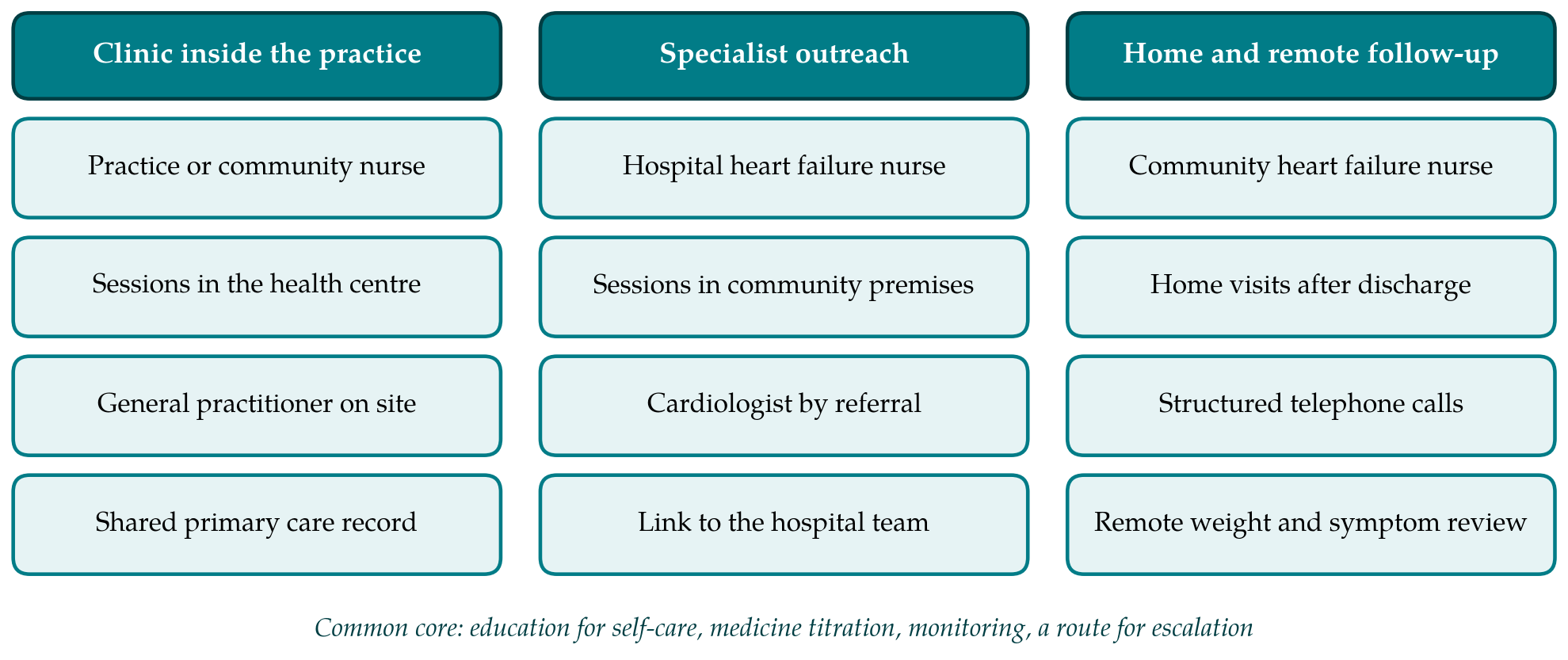
In the first model the clinic belongs to the practice. A practice nurse or community nurse with additional training in heart failure sees patients in scheduled sessions at the health centre, with the general practitioner available for decisions outside the protocol. This is the arrangement that the chronic care model would predict to work well, since it places planned, proactive visits and self-management support inside the team that already holds the patient's record (Wagner et al., 1996). A trial in Swedish primary care reported favourable results for a management programme delivered by heart failure nurses and physicians at health centres (Agvall et al., 2013).
In the second model the specialist comes out to the community. Heart failure nurses employed by a hospital or a community trust hold sessions in local premises and keep a direct line to the cardiology team. National guidance in England describes a specialist multidisciplinary team that works in collaboration with the primary care team in this way (NICE, 2018). The third model dispenses with the clinic room. Nurses visit patients at home in the weeks after discharge, or follow them by structured telephone calls and remote monitoring of weight and symptoms. A large Argentine trial of telephone follow-up by nurses reduced admissions for heart failure (GESICA Investigators, 2005), and a Cochrane review found that both structured telephone support and non-invasive telemonitoring lower mortality and heart failure admissions (Inglis et al., 2015).
5. What the Clinics Do
Whatever the model, the content of nurse-led heart failure care is fairly constant. Three functions account for most of it.
5.1. Education and support for self-care
Self-care in heart failure has been described as having two parts: maintenance, which covers taking medicines as prescribed, staying active and monitoring symptoms, and management, which is the person's response when symptoms change (Riegel and Dickson, 2008). Nurses teach both. They explain what the medicines are for, agree what the patient will do about a sudden gain in weight or worsening breathlessness, and involve family members who share the work. Self-care education is a consistent component of the programmes that succeeded in trials, although its separate contribution is hard to isolate from the rest of the package.
5.2. Titration of medicines
Several classes of medicine improve survival in heart failure with reduced ejection fraction, and the guidelines advise increasing each to a target or maximum tolerated dose (McDonagh et al., 2021). Registry data show that in ordinary outpatient practice many eligible patients are not prescribed these medicines or stay on low doses (Greene et al., 2018). Titration by nurses working to a protocol is one answer. A Cochrane review found that patients whose doses were titrated by nurses reached target doses more often and had fewer admissions and deaths than those titrated by primary care physicians, though the trials were few and small (Driscoll et al., 2015). A more recent trial of rapid up-titration with close follow-up after an acute admission reported fewer deaths and readmissions, which has renewed interest in who can provide such frequent visits (Mebazaa et al., 2022).
5.3. Monitoring and escalation
The third function is surveillance: checking weight, blood pressure, heart rate, fluid status, kidney function and potassium, and acting on change. In a primary care clinic the nurse needs prompt access to blood results and a defined route to a physician or cardiologist when a patient deteriorates or does not respond. The route for escalation is what separates a nurse-led clinic from a nurse working alone, and its absence is a recurrent theme in accounts of services that struggled.
6. Evidence on Outcomes
For follow-up organised around a hospital admission the evidence is substantial. A meta-analysis of randomised trials found that multidisciplinary strategies reduced admissions for heart failure and for any cause, and that follow-up by a specialised multidisciplinary team also reduced mortality (McAlister et al., 2004). The current Cochrane review of disease management reaches a compatible conclusion for case management and multidisciplinary interventions, while describing the evidence for clinic-based interventions as limited (Takeda et al., 2019). A network meta-analysis of transitional care services ranked nurse home visits and disease management clinics as the most effective at reducing mortality and readmission (Van Spall et al., 2017).
Three cautions apply before these results are carried over to primary care. First, the comparison in most early trials was with usual care that included little structured follow-up. Where usual care was already good, the added benefit shrank: in a large Dutch trial, neither moderate nor intensive additional support from a heart failure nurse reduced death or readmission compared with routine follow-up by a cardiologist (Jaarsma et al., 2008). Second, the trials enrolled people who had recently been in hospital and were at high risk. Whether a clinic for stable patients who have not been admitted prevents events is much less certain.
Third, the nurses in the trials were specialists. A Cochrane review of nurses substituting for doctors in primary care across many conditions found that care led by nurses probably produces similar or better health outcomes and higher patient satisfaction (Laurant et al., 2018), which is reassuring about the principle. It does not show that a generalist nurse with a short course can reproduce what a heart failure specialist achieved. The trial evidence that is specific to primary care is confined to a few studies in particular health systems (Agvall et al., 2013). The fair summary is that nurse-led follow-up works after admission, that it probably works when delivered in the community by trained nurses with medical backing, and that its value for stable patients in general practice remains to be shown.
7. Implementation Barriers
If outcomes are uncertain, the obstacles are not. They recur across countries and can be grouped using the domains of the Consolidated Framework for Implementation Research: the intervention, the outer setting, the inner setting, the individuals involved and the process (Damschroder et al., 2009).
The first barrier precedes the clinic. A register of patients requires a confirmed diagnosis, and diagnosis requires echocardiography. General practitioners interviewed in England described uncertainty about diagnosis, difficulty obtaining echocardiograms and unease about starting and increasing the recommended medicines in older patients (Fuat et al., 2003). Where the type of heart failure is not recorded, a nurse cannot know which patients the titration protocol applies to.
The second concerns authority. Titration is the function with the clearest evidence, and it depends on the nurse being permitted to change doses. Rules on nurse prescribing differ widely between countries and sometimes between employers. Where independent prescribing is not allowed, clinics rely on protocols signed by a physician or on a doctor countersigning each change, which slows the work and ties the clinic to that doctor's availability.
Workforce, money and information make up the rest. Heart failure nursing requires training in physical assessment and pharmacology, and a single practice may have too few patients for a nurse to build and keep that skill, which favours clinics shared across practices. Payment systems that reward consultations or admissions do not pay for telephone follow-up or patient education. Hospital and primary care records are often separate, so that discharge summaries arrive late and medicine changes made in one place are unknown in the other. Patients, for their part, may be frail, have several other conditions and find travel to any clinic difficult, which is one reason home-based and remote models persist alongside clinic rooms.
8. Gaps and Future Work
The research agenda follows from the limits described above. Trials are needed that are set in primary care, that enrol stable patients as well as those recently discharged, and that compare a nurse-led clinic with present-day usual care. Heart failure with preserved ejection fraction, which is common among the older patients seen in general practice and for which treatment options were long restricted, has been poorly represented in studies of nurse-led care. Economic evaluations should count nurse training, supervision and travel as well as admissions avoided.
Implementation research has its own questions. Little is known about the minimum training that allows a generalist nurse to titrate safely, about the caseload at which a clinic becomes sustainable, or about which elements can be dropped without loss when resources are short. Studies from low- and middle-income countries are scarce, although the burden of heart failure there is large and physicians are few. Reports that describe the context and the escalation arrangements in enough detail for others to judge their relevance would be more useful than further small trials of an undefined "nurse intervention".
9. Conclusion
Nurse-led heart failure clinics in primary care rest on a strong body of evidence from hospital-linked and home-based programmes and on a weaker one from primary care itself. The functions that matter are reasonably clear: teaching self-care, titrating medicines to guideline doses, monitoring, and having somewhere to turn when a patient worsens. Whether a given clinic delivers them depends on diagnosis, prescribing authority, training, funding and shared information, all of which are matters of organisation more than of clinical knowledge. Services planning such a clinic can proceed with reasonable confidence for patients recently discharged, and should treat routine follow-up of stable patients as a reasonable policy that still awaits proof.
Conflict of interest
To be declared by the author(s) before publication.
Funding
To be declared by the author(s) before publication.