1. Introduction
A sand holds water mainly in the narrow wedges where grains touch. Once the large pores between grains have emptied, which happens within a day or two of wetting, little remains for a crop to draw on. The consequence for irrigation is familiar to anyone who has farmed such land: water must be applied often and in small amounts, and whatever is applied beyond the modest storage of the root zone drains away with the nutrients dissolved in it (Hillel, 2004).
Deficit irrigation asks more of the soil, not less. The practice supplies less water than the crop would use if unrestricted, either throughout the season or during growth stages that tolerate stress, with the aim of raising the yield obtained per unit of water even if the yield per hectare falls slightly (Fereres and Soriano, 2007; Geerts and Raes, 2009). It works best where the root zone can buffer the crop between irrigations. On a coarse sand the buffer is small, the margin for error in scheduling is narrow, and a deficit intended to be mild can become severe within days.
Biochar, the carbon-rich solid left when biomass is heated with little or no oxygen, has been promoted as a way to enlarge that buffer. The idea has a long pedigree. Observations of charcoal-rich soils in the tropics, and early experiments with charcoal added to sandy soils, suggested that char could raise the moisture a coarse soil retains (Glaser et al., 2002). The modern literature on biochar is large (Lehmann and Joseph, 2015), and its findings on soil water are less uniform than the promotion implies. This review asks what that literature supports for the specific case of sandy soils irrigated below full crop demand.
2. Scope and Approach
The article is a narrative review of published work. It draws on the quantitative syntheses of biochar effects on soil hydraulic properties, on widely cited laboratory and field studies in coarse-textured soils, and on the standard literature of soil physics and irrigation scheduling. No formal search protocol was followed and no new data are reported. Studies were chosen because they are well known, because they address sand or loamy sand directly, or because they report a result that runs against the prevailing view. Numerical effect sizes from the syntheses are described in words, since they vary with the set of studies pooled and with how texture classes were drawn.
3. How Biochar Could Change the Water Retention of Sand
Soil water retention is described by the relation between water content and matric potential, often summarised with the closed-form function of van Genuchten (1980). Two points on that curve dominate agronomic discussion: field capacity, conventionally taken at a matric potential of −33 kPa and often at −10 kPa for sands, and the permanent wilting point at −1500 kPa. The water held between them, multiplied by rooting depth, is the total available water used in irrigation scheduling (Allen et al., 1998). An amendment helps only if it raises the upper point more than the lower one.
3.1. Pores within and between particles
Biochar inherits the cellular architecture of the plant tissue it was made from. Wood chars keep the lumens of vessels and tracheids as pores some micrometres to tens of micrometres across, a size range that holds water at potentials plants can overcome. Pyrolysis also creates much finer pores in the carbon matrix, which contribute greatly to measured surface area but hold water too tightly for roots. Liu et al. (2017) showed in a sand that both kinds of pore space matter: water is stored inside particles, and elongated or irregular particles disturb the packing of the grains and open new pores between them. Grinding the char finely removes much of the second effect.
3.2. Bulk density and packing
Biochar particles are far less dense than quartz grains. Mixing them into a sand lowers bulk density and raises total porosity almost as a matter of arithmetic, and reviews of soil physical responses report this consistently (Mukherjee and Lal, 2013; Blanco-Canqui, 2017). Whether the added porosity is useful depends on its size distribution. Large pores that drain at field capacity add nothing to storage. Laboratory work on sand has in fact found that biochar slows saturated flow, because particles lodge in the throats between grains and lengthen the path water must follow (Barnes et al., 2014). For a soil that drains too fast, a lower conductivity is itself a benefit, since it lengthens the time roots have to take up water before it passes below them.
3.3. Surface chemistry and wettability
Fresh biochar is not always wettable. Chars produced at low temperature can carry aliphatic residues on their surfaces that repel water, and Kinney et al. (2012) found that hydrophobicity and water-holding behaviour varied systematically with production temperature. A hydrophobic particle may have ample pore volume and still fail to fill when the soil is wetted. Repellency tends to decline as surfaces oxidise in soil, which is one reason results from freshly amended pots need not match those from fields several seasons after application (Atkinson et al., 2010).
4. What the Published Evidence Shows
Four quantitative or critical syntheses now cover the question. Omondi et al. (2016) pooled published experiments and reported that, on average, biochar lowered bulk density and raised porosity, available water-holding capacity and saturated hydraulic conductivity. Razzaghi et al. (2020) separated the retention data by texture and found the gains in water content at field capacity and in plant-available water to be concentrated in coarse-textured soils, with little change in fine-textured ones. Edeh et al. (2020) reached a compatible conclusion and added that saturated conductivity tended to fall in coarse soils and rise in fine ones. The review by Blanco-Canqui (2017) agreed on the direction of the effects and stressed how few of the underlying studies were field experiments of more than a season or two.
The syntheses therefore point the same way for sand. They also share weaknesses that matter for practice. Most of the pooled observations come from repacked cores, pots and columns, in which the amendment is mixed uniformly through the whole sample. Application rates in such work are often higher than a farm could afford. And the retention measurements are usually made within months of mixing. Table 1 sets out the main factors that the literature identifies as shaping the response, with the direction each is thought to act and the sources that discuss it.
| Factor | Reported influence | Representative sources |
|---|---|---|
| Soil texture | Gains concentrated in sands and loamy sands; little change in fine soils | Razzaghi et al., 2020; Edeh et al., 2020 |
| Application rate | Larger effects at high rates, many of them above farm practice | Omondi et al., 2016; Basso et al., 2013 |
| Particle size and shape | Coarse, irregular particles add pores between grains | Liu et al., 2017 |
| Production temperature | Low-temperature chars may repel water when fresh | Kinney et al., 2012 |
| Feedstock | Woody and herbaceous chars differ in pore structure and wettability | Novak et al., 2012; Abel et al., 2013 |
| Setting and duration | Field responses smaller and less consistent than laboratory ones | Hardie et al., 2014; Jeffery et al., 2015 |
4.1. Laboratory studies in coarse soils
Individual experiments illustrate the pattern behind the averages. Abel et al. (2013) added biochar and hydrochar to sandy soil and measured lower bulk density and higher available water capacity, with only limited water repellency. Basso et al. (2013) incubated a sandy loam with hardwood biochar in columns and found that amended soil held more water after gravity drainage and at moderate suctions. Novak et al. (2012) compared several biochars in a loamy sand and two arid-zone soils and observed that moisture storage rose with some chars far more than with others, which makes the choice of material a design decision and not a detail.
4.2. Field studies and null results
The field record is shorter and less encouraging. Jeffery et al. (2015) applied biochar made from herbaceous feedstock to a sandy soil and detected no improvement in water retention or in other measures of hydrological function; they attributed the result partly to the water repellency of the material and to pores too fine or too poorly connected to contribute. Hardie et al. (2014) sampled an orchard soil well after biochar had been incorporated and found no change in the retention curve or in plant-available water, although macroporosity had increased. These studies do not overturn the syntheses. They show that the average laboratory effect is not a forecast for any given field, and that the properties of the char decide whether the potential is realised.
5. From Retention to Availability Under Deficit Irrigation
Even where retention rises, the agronomic question is narrower: whether the crop meets less stress between irrigations, or the irrigator can lengthen the interval or reduce the depth applied without loss of yield. Scheduling under the FAO approach turns on the readily available water, the fraction of total available water a crop can deplete before transpiration falls (Allen et al., 1998). In a sand that quantity is small in absolute terms, so a modest absolute gain can be a large relative one. Against this, biochar is normally incorporated in the tilled layer only, while the roots of most field crops go much deeper. The amended layer is a fraction of the root zone, and its contribution to the whole-profile water balance is diluted accordingly.
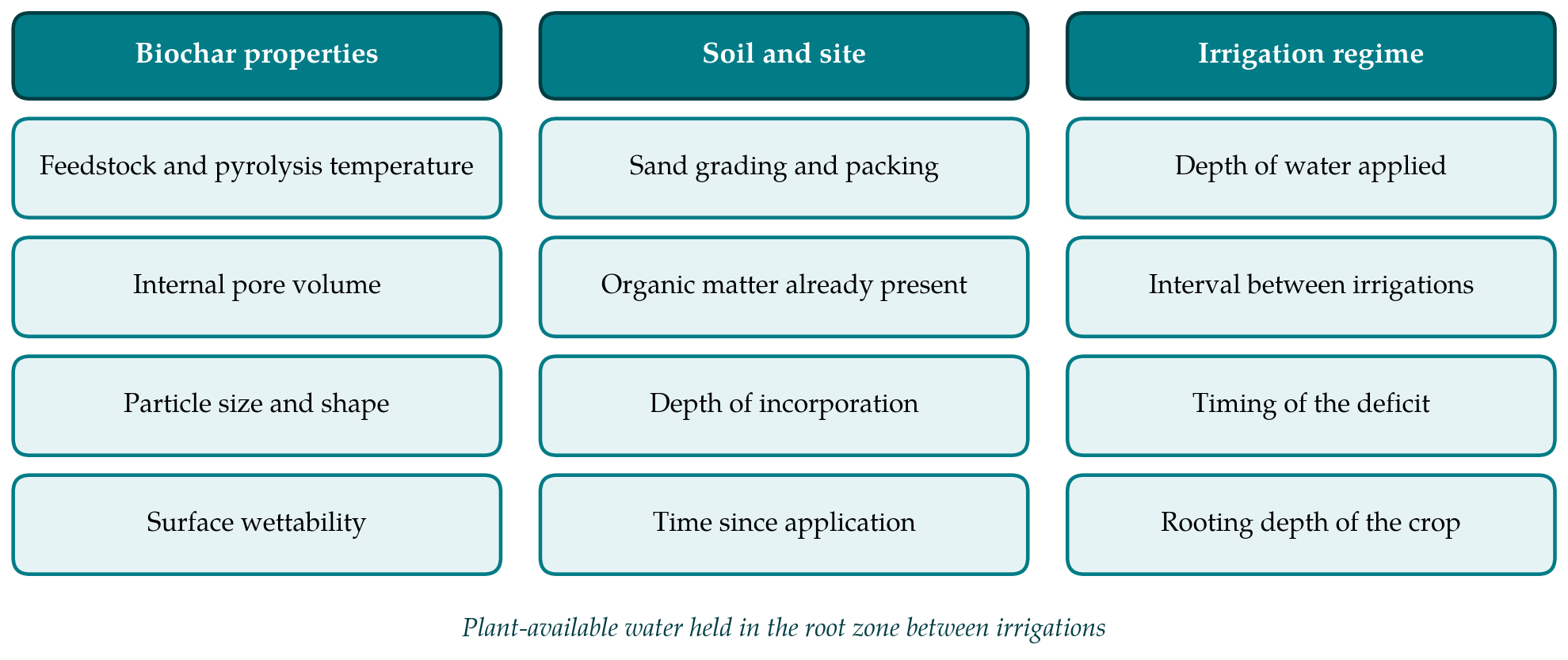
Figure 1 groups the conditions that the literature suggests jointly determine the outcome. The three groups interact. A coarse, wettable wood char placed in a uniform sand and irrigated frequently with small depths is the favourable case, because most of the applied water stays in the amended layer where the added storage lies. Infrequent, heavy irrigation pushes water past that layer whatever the amendment does. A deficit imposed late in the season, when roots are deep, draws on subsoil that the biochar never reached.
Direct tests of biochar under managed deficit are few. The best known is the greenhouse study of Akhtar et al. (2014), who grew tomato under full irrigation, deficit irrigation and partial root-zone drying and reported higher soil moisture, yield and fruit quality in the amended treatments under reduced water supply. The result is consistent with the mechanism but was obtained in containers, where roots cannot escape the amended volume. Yield syntheses give indirect support at most: the average yield response to biochar is modest, is attributed as much to liming and nutrient effects as to water, and is concentrated in acidic, nutrient-poor tropical soils (Jeffery et al., 2011; Jeffery et al., 2017). A yield gain on an amended sand cannot be credited to water retention without measurements that rule the other explanations out.
6. Gaps and Future Work
Several measurements are missing from most of the published studies and would resolve much of the disagreement. Retention curves should be determined on undisturbed samples taken from the field after at least one full season, alongside curves from the same soil unamended. Reports should give the pyrolysis temperature, feedstock, particle size distribution and a wettability test of the char as applied. Irrigation experiments need soil water monitored through the whole root zone, not only in the amended layer, so that a change in storage can be told apart from a change in drainage or in rooting. And the deficit should be defined against crop evapotranspiration, so that results can be compared across sites.
Two broader questions follow. One is persistence: whether any gain in storage survives tillage, particle breakdown and the filling of pores by fine material over years. The other is cost. The application rates at which laboratory effects are clearest are high, and whether the water saved would repay the outlay has rarely been assessed with field data. Deeper placement, banding beneath the crop row and combination with organic amendments have all been suggested as ways to get more from less material. Each remains to be tested under field deficit irrigation.
7. Conclusion
The published evidence supports the claim that biochar can raise the water retained by sandy soil, and it supports the physical reasoning behind the claim. It does not support treating the effect as assured. The response depends on the pore structure and wettability of the char, on the rate and depth of incorporation, and on whether irrigation keeps water within the amended layer. Laboratory gains have not been matched consistently in the field, and trials under managed deficit are too few to guide scheduling. Growers on sandy land should regard biochar as a promising amendment whose benefit for water must be verified locally, with the measurements described above, before irrigation is reduced on the strength of it.
Conflict of interest
To be declared by the author(s) before publication.
Funding
To be declared by the author(s) before publication.