1. Introduction
The first description of a pregnancy developing within a caesarean scar is credited to Larsen and Solomon (1978), who reported a scar sacculus as an unusual cause of haemorrhage after abortion. For two decades the condition was regarded as a rarity. Reports multiplied from the late 1990s, helped by the spread of transvaginal ultrasound in early pregnancy units and by the worldwide rise in caesarean section rates documented by Betrán et al. (2016). Reviews published in the following decade assembled the growing body of case reports and established the entity in the literature (Rotas et al., 2006; Ash et al., 2007).
The condition is dangerous in two directions. If the pregnancy continues, the placenta may invade the scar and beyond it, and a shared histology with early placenta accreta has been demonstrated (Timor-Tritsch et al., 2014). If it is interrupted without adequate planning, the thin and poorly contractile lower segment may bleed heavily. Many of the women affected want further children, and an emergency hysterectomy is the outcome that treatment aims above all to avoid.
This article reviews what the published literature says about conservative management of caesarean scar pregnancy, taking conservative to mean any approach that retains the uterus, and about fertility after such management. It reports no case of its own.
2. Approach to the Literature
The review is narrative. It is built on the professional guidance issued by the Royal College of Obstetricians and Gynaecologists and the Society for Maternal-Fetal Medicine, on the systematic reviews of treatment that have appeared since 2012, and on the primary case series most often cited in them. No formal search with screening counts was carried out. Because the underlying studies are mostly retrospective series with differing definitions of success, the review reports the direction of findings and the degree of agreement between sources instead of pooled success rates.
3. Definition, Mechanism and Diagnosis
Caesarean scar pregnancy is usually explained by implantation of the blastocyst into a microscopic or macroscopic defect in the scar, where the decidua is deficient. The defect visible on ultrasound in the non-pregnant uterus is termed a niche, and a consensus definition and measurement method have been agreed by a modified Delphi procedure (Jordans et al., 2019). Although the condition is commonly called an ectopic pregnancy, the sac lies within the uterine outline, and some authors prefer to regard it as a pathological form of intrauterine implantation that sits on a continuum with placenta accreta spectrum (Timor-Tritsch and Monteagudo, 2012; Jauniaux et al., 2018).
Diagnosis rests on transvaginal ultrasound in the first trimester. The criteria in common use derive from early series: an empty uterine cavity and cervical canal, a gestational sac or placental tissue embedded at the site of the scar in the anterior lower segment, thin or absent myometrium between the sac and the bladder, and prominent peritrophoblastic flow on colour Doppler (Vial et al., 2000; Jurkovic et al., 2003). The main differential diagnoses are a miscarriage in transit through the cervix and a cervical pregnancy. Misdiagnosis in either direction has consequences, and an international expert group has proposed a standard definition and reporting system for early gestation to reduce it (Jordans et al., 2022).
Two descriptive classifications bear on prognosis. Vial et al. (2000) distinguished pregnancies that grow towards the uterine cavity from those that grow deep into the scar towards the bladder and serosa. Kaelin Agten et al. (2017) separated implantation on a well-healed scar from implantation in a niche and found that the latter, with thinner residual myometrium, had the worse outcomes when pregnancy continued. Both observations suggest that the depth of implantation and the thickness of myometrium remaining should inform the choice of treatment.
4. Management Options That Preserve the Uterus
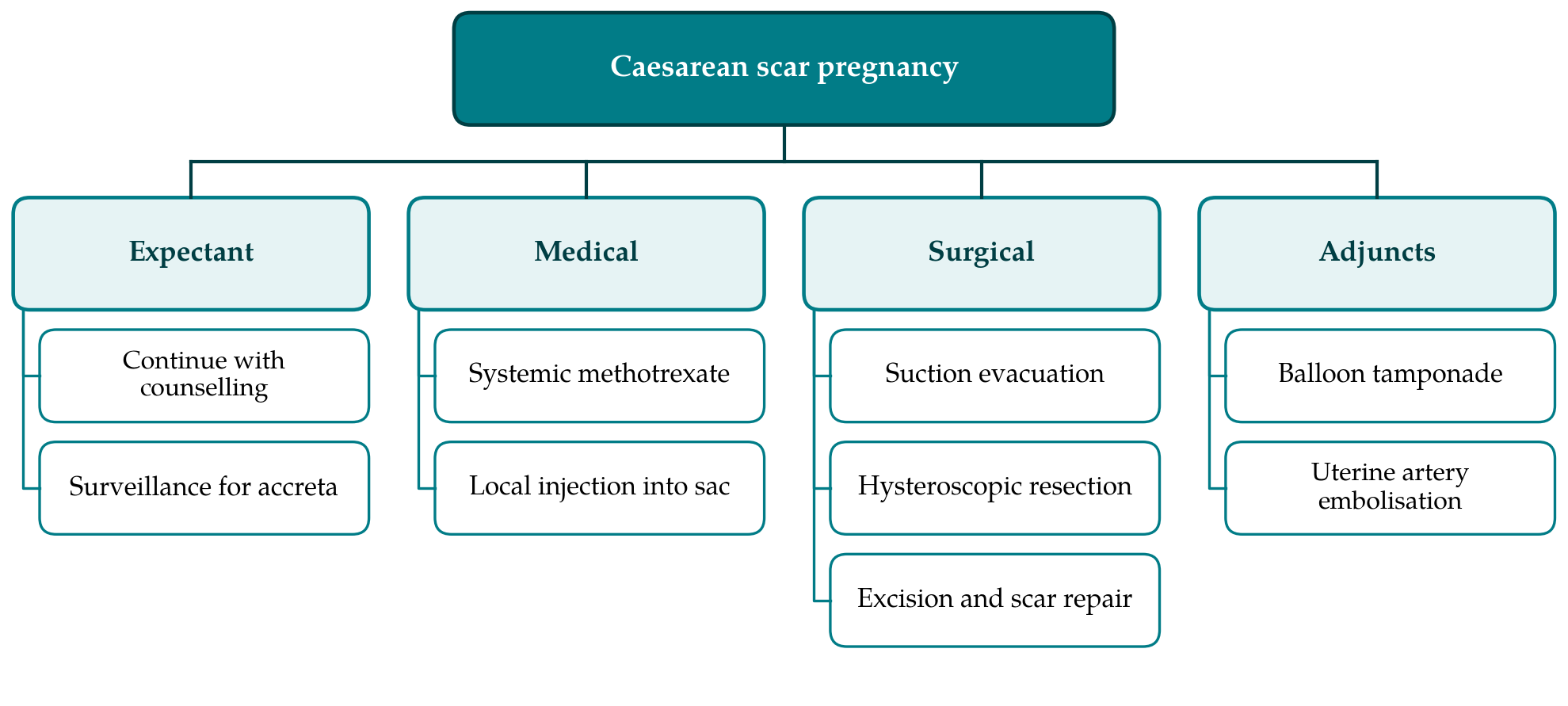
More than thirty treatment regimens, alone and in combination, have been counted in the literature (Timor-Tritsch and Monteagudo, 2012). They fall into the groups shown in Figure 1. No randomised trial of adequate size compares them, and professional bodies state that the evidence does not allow one method to be recommended over all others (Elson et al., 2016; SMFM, 2020).
4.1. Expectant management
Some women, fully informed, choose to continue the pregnancy. A systematic review and meta-analysis of expectantly managed cases found that, where fetal cardiac activity was present, a substantial proportion went on to severe morbidity including placenta accreta spectrum and hysterectomy, although live births were also achieved; outcomes were more favourable where no cardiac activity was detected (Calì et al., 2018). The Society for Maternal-Fetal Medicine recommends against expectant management of a viable scar pregnancy on this basis, while acknowledging the woman's right to decide (SMFM, 2020). Expectant management preserves the uterus only in the short term if it ends in caesarean hysterectomy, and counselling needs to make that plain.
4.2. Medical treatment
Methotrexate has been given systemically, by injection into the gestational sac under ultrasound guidance, or by both routes. Systemic methotrexate as sole treatment has performed poorly in the collected series. In a widely cited review of several hundred published cases, it was among the options with the highest complication rates, alongside curettage alone and uterine artery embolisation alone (Timor-Tritsch and Monteagudo, 2012). Slow resolution is a further drawback, since the trophoblast may take months to resorb and bleeding can occur in the interval. Local injection delivers the drug directly, can be combined with an embryocidal agent where cardiac activity is present, and was associated with fewer complications in the same authors' own series (Timor-Tritsch et al., 2012). Guidance from professional bodies describes medical treatment as an option in selected cases and does not endorse systemic methotrexate alone (SMFM, 2020).
4.3. Surgical treatment
Blind sharp curettage is discouraged because the sac lies outside the cavity proper and the curette may perforate the thinned scar or open large vessels (Rotas et al., 2006). Suction evacuation under continuous ultrasound guidance is a different procedure. A large single-centre series reported it to be effective, with haemorrhage controlled in most cases by a cervical suture or balloon (Jurkovic et al., 2016). Hysteroscopic resection allows the pregnancy to be removed under direct vision and bleeding points to be coagulated, and suits pregnancies that bulge towards the cavity. Excision of the pregnancy with repair of the scar, by a laparoscopic, transvaginal or open route, removes the niche as well as the pregnancy and is generally reserved for deeply implanted pregnancies with very thin overlying myometrium (Seow et al., 2004; Ash et al., 2007).
Three systematic reviews have compared these approaches across the published series. Birch Petersen et al. (2016) graded the evidence and concluded that interventional approaches, including hysteroscopy, transvaginal resection, laparoscopy and curettage combined with embolisation, were preferable to methotrexate alone. Maheux-Lacroix et al. (2017) found the highest success with surgical excision and with combined treatments. Gonzalez and Tulandi (2017) reached broadly similar conclusions. Table 1 summarises the options and the reviewers' assessments. All three reviews caution that selection bias is unavoidable in such data, because clinicians choose the method to suit the case.
| Approach | Principle | Assessment in reviews | Main concern |
|---|---|---|---|
| Expectant | Pregnancy continues under surveillance | High morbidity when cardiac activity present Calì et al., 2018 | Accreta spectrum, hysterectomy |
| Systemic methotrexate alone | Drug arrests trophoblast growth | Frequent failure and complications Timor-Tritsch and Monteagudo, 2012 | Slow resolution, delayed bleeding |
| Local injection | Agent delivered into the sac under ultrasound | Fewer complications in series Timor-Tritsch et al., 2012 | Needs operator skill; slow resorption |
| Guided suction evacuation | Sac aspirated under ultrasound view | Effective in a large series Jurkovic et al., 2016 | Haemorrhage needing tamponade |
| Hysteroscopic resection | Removal under direct vision | Favoured for cavity-directed sacs Birch Petersen et al., 2016 | Unsuitable with very thin myometrium |
| Excision with scar repair | Pregnancy and niche removed, defect closed | High success Maheux-Lacroix et al., 2017 | More invasive; surgical expertise |
| Embolisation as adjunct | Uterine blood flow reduced before evacuation | Useful in combination, poor alone | Possible effect on later fertility |
4.4. Adjuncts for haemorrhage control
Several measures are used alongside the primary treatment to prevent or control bleeding. Balloon catheters placed in the lower segment after evacuation tamponade the implantation site, and a cervical suture has been used for the same purpose (Jurkovic et al., 2016). Uterine artery embolisation reduces flow before surgical evacuation or rescues a bleeding patient. The reviews regard it as helpful in combination and unsatisfactory as sole therapy, and they note uncertainty about its effect on later ovarian and uterine function in women who wish to conceive (Birch Petersen et al., 2016; SMFM, 2020).
5. Fertility and Later Pregnancy
The evidence on reproductive outcome after uterus-preserving treatment is thinner than the evidence on immediate success. The most informative early study followed women treated for scar pregnancy in one London unit and found that the majority of those who tried to conceive again did so, most with a normally sited intrauterine pregnancy, while a minority had a recurrent scar implantation (Ben Nagi et al., 2007). Later series give a similar general picture: subsequent intrauterine pregnancy is the usual outcome, recurrence is uncommon but well documented, and placenta accreta spectrum and uterine rupture have been reported in subsequent pregnancies (Timor-Tritsch et al., 2012; Maheux-Lacroix et al., 2017).
Whether the method of treatment influences later fertility is not established. It has been suggested that excising and repairing the niche might lower the chance of recurrence by restoring myometrial thickness, and that embolisation might impair fertility, but the published follow-up is too short and too incomplete to confirm or refute either idea. Guidance is accordingly cautious. Women are advised of the risk of recurrence, offered an early transvaginal scan in any future pregnancy to locate the sac, and told that delivery in a later pregnancy will be by caesarean section (Elson et al., 2016; SMFM, 2020). Advice on how long to wait before conceiving again rests on expert opinion.
6. Gaps in the Evidence
Four gaps stand out. The first is the absence of comparative trials, which the rarity of the condition makes difficult but which multicentre collaboration and registries could address. The second is inconsistent terminology. Series differ in how they define the condition, how they describe depth of implantation, and what they count as treatment success, so that pooled figures conceal as much as they show; the reporting system proposed by Jordans et al. (2022) offers a common language if it is adopted. The third is follow-up. Few series trace women long enough, or completely enough, to describe subsequent conceptions, and those lost to follow-up may differ from those retained.
The fourth gap concerns the published record itself. Single case reports of successful conservative treatment are numerous, and they are selected for publication in a way that unsuccessful attempts are not. A further report of that kind adds little unless it documents the features that would let it be pooled with others: gestational age, sac position, residual myometrial thickness, cardiac activity, the sequence of treatments and the reproductive outcome. Prospective registries that record consecutive cases with standard definitions would serve patients better than the accumulation of favourable anecdotes (Gonzalez and Tulandi, 2017).
7. Conclusion
Caesarean scar pregnancy can usually be treated with preservation of the uterus when it is recognised early. The published reviews agree on which approaches to avoid as sole treatment, namely systemic methotrexate, blind curettage and embolisation, and they favour removal of the pregnancy under imaging or direct vision, with the technique fitted to the depth of implantation and to local expertise. Most women who retain the uterus and wish to conceive appear able to do so, with a real but modest risk of recurrence and of abnormal placentation. These conclusions rest on observational series, and they should be held with the caution that such evidence deserves.
Conflict of interest
To be declared by the author(s) before publication.
Funding
To be declared by the author(s) before publication.