1. Introduction
Small intestinal bacterial overgrowth is suspected far more often than it can be proved. The symptoms attributed to it, bloating, abdominal discomfort, diarrhoea and flatulence, are shared with irritable bowel syndrome and many other conditions. Culture of a small bowel aspirate, the traditional reference test, is invasive, prone to contamination and rarely performed outside research. Breath testing has filled the gap. It relies on the fact that hydrogen and methane in exhaled air come from microbial fermentation in the gut, so that an early rise after a carbohydrate load is taken to indicate fermentation in the small intestine (Rezaie et al., 2017).
The test is cheap and safe, and its results influence the prescription of antibiotics. Yet the criteria by which it is read vary from one guideline, and one laboratory, to the next. This commentary does not attempt to settle which threshold is correct. Its argument is that the immediate problem is one of reporting, and that a standard format for the report would remove much of the confusion that different thresholds now cause.
2. Why Thresholds Disagree
Table 1 compares the two consensus statements most often cited. The North American Consensus recommends 75 g of glucose or 10 g of lactulose and defines a positive test for overgrowth as a rise in hydrogen of at least 20 parts per million above baseline within 90 minutes; a methane level of at least 10 parts per million at any time is reported as positive for methane (Rezaie et al., 2017). The earlier Rome Consensus Conference favoured 50 g of glucose, read with a lower hydrogen threshold of about 12 parts per million, and advised against lactulose for this indication (Gasbarrini et al., 2009). The American College of Gastroenterology guideline adopted the North American criteria and introduced the term intestinal methanogen overgrowth for the methane-positive state (Pimentel et al., 2020). The European guideline on breath testing lays its emphasis on standardised conduct of the test and on recording symptoms during it (Hammer et al., 2022).
| Element | North American Consensus (2017) | Rome Consensus (2009) | Consequence for the report |
|---|---|---|---|
| Glucose dose | 75 g | 50 g | Dose must be stated |
| Lactulose | 10 g accepted | Not recommended for overgrowth | Substrate must be stated |
| Hydrogen criterion | Rise of 20 ppm or more by 90 minutes | Rise of about 12 ppm over baseline | Same curve may be read either way |
| Methane criterion | 10 ppm or more at any time | No separate threshold set | Methane values should always be shown |
| Culture reference | 1,000 or more organisms per mL | 100,000 or more organisms per mL | Accuracy figures are not comparable |
These differences are not arbitrary. They reflect a reference standard that is itself contested. The classical culture threshold was derived from patients with altered surgical anatomy, and the North American group proposed a lower count for aspirates from the proximal small bowel. A systematic review found that no breath test had been validated against a satisfactory gold standard (Khoshini et al., 2008), and a later meta-analysis reported only moderate sensitivity for both glucose and lactulose tests (Losurdo et al., 2020). Direct comparison of duodenal aspiration with the glucose breath test showed imperfect agreement (Erdogan et al., 2015). With no fixed point to calibrate against, a single agreed threshold is not in prospect.
3. What a Threshold Cannot Capture
Even an agreed number would leave a second problem. A rise in breath hydrogen shows that the substrate has met fermenting organisms, not where. Lactulose is not absorbed and always reaches the colon; when transit is fast, colonic fermentation can begin within the 90-minute window. Yu et al. (2011) combined scintigraphy with lactulose breath testing in patients with irritable bowel syndrome and found that the hydrogen rise usually coincided with arrival of the test meal in the caecum. Glucose is absorbed proximally and is less affected, but it may miss distal overgrowth and can give a false positive result after gastric surgery or with rapid transit (Massey and Wald, 2021). Methane adds a further complication, since it is produced by archaea, is associated with slower transit and constipation (Pimentel et al., 2006), and is often raised at baseline. A report reduced to one word hides all of this. The time at which the rise occurred, the shape of the curve and the baseline values are exactly what a clinician needs in order to judge how much weight the result will bear.
Conduct of the test matters as much as the cut-off. The North American Consensus asks that antibiotics be avoided for four weeks and promotility drugs and laxatives for at least one week before testing, that fermentable foods be avoided on the preceding day, and that the person tested fast for eight to twelve hours and refrain from smoking and vigorous exercise around the test (Rezaie et al., 2017). A high baseline hydrogen often signals that preparation was incomplete. Departures from these instructions shift the curve, and a reader who is not told about them cannot allow for them. The sampling interval has a similar effect: a rise that would be caught with samples every fifteen minutes may fall between samples taken every thirty.
4. A Minimum Reporting Format
The proposal is modest. Every breath test report should contain three groups of information, set out in Figure 1. The first is the conditions of the test: the substrate and its dose, the preparation instructions issued, including the period free of antibiotics and the diet and fast beforehand, and the sampling schedule. The second is the raw data: baseline hydrogen and methane, every timed value in parts per million, the device used, and whether values were corrected for sample quality, for instance by reference to carbon dioxide.
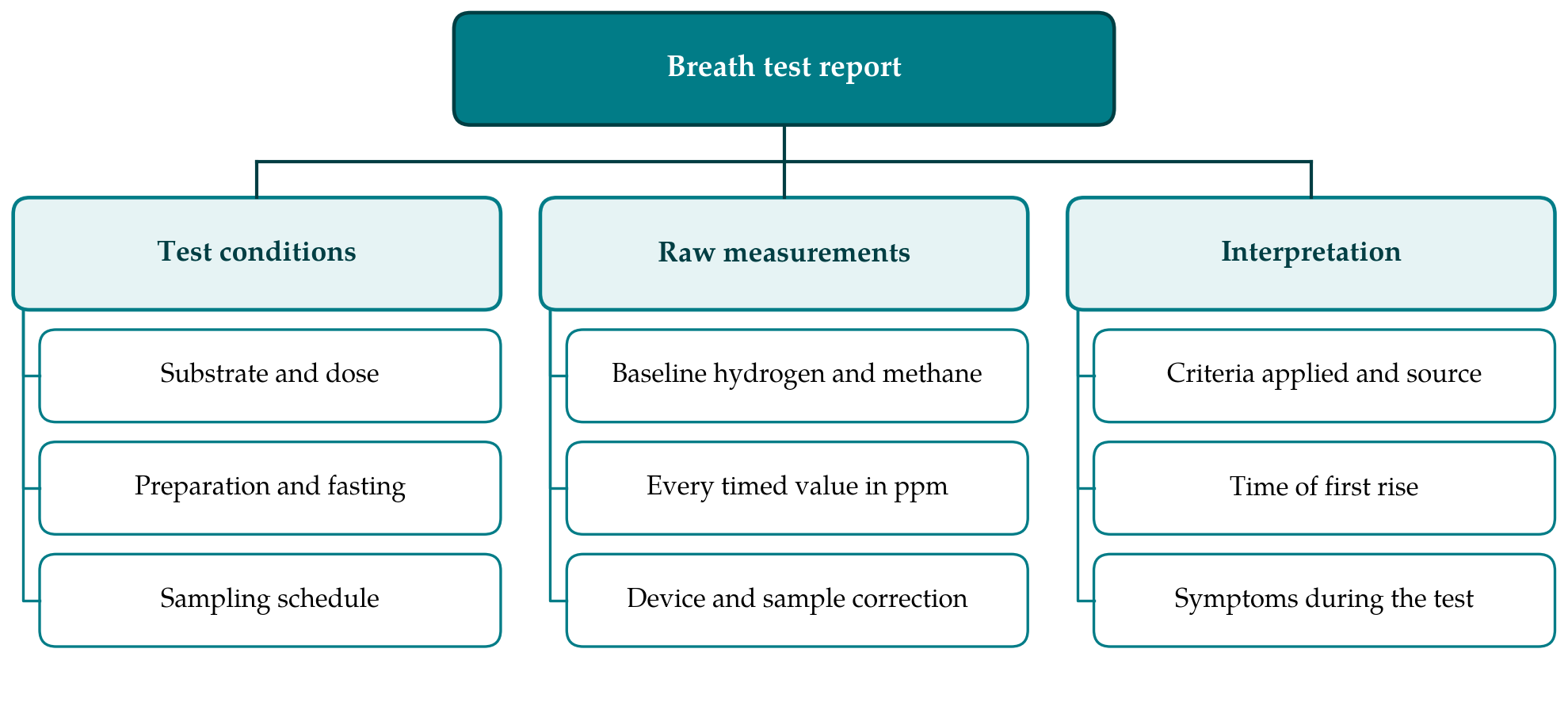
The third group is the interpretation. It should name the criteria applied and the document they come from, give the time of the first qualifying rise, state hydrogen and methane conclusions separately, and record symptoms during the test, as the European guideline recommends (Hammer et al., 2022). A positive or negative label may still head the report, but it would be accompanied by the means to check it.
The model is the reporting guideline for diagnostic accuracy studies, STARD, which improved the literature by asking authors to state what was done without telling them what to do (Bossuyt et al., 2015). A reporting format for breath tests has the same character. It does not require laboratories to change their protocol or professional societies to resolve their differences first.
5. Implications
A standard report would have three practical effects. A clinician could reinterpret a result under a different set of criteria, or after a guideline is revised, without repeating the test. Results from different centres could be compared when a patient moves between them. And researchers could pool raw curves, which is the only realistic route to testing alternative thresholds against clinical outcomes such as response to treatment. The expert review of the American Gastroenterological Association notes how weak the present evidence base is on precisely this point (Quigley et al., 2020).
Adoption would cost little. Modern analysers already store timed values, and most laboratory information systems can print a table and a curve. The main work lies in agreeing on the list of items and in persuading laboratories that a report of several lines is worth more than one word. Referrers have a part to play as well, since a request that states the clinical question, any previous abdominal surgery and current medication allows the interpretation to be written with those facts in view.
There are limits to what reporting can achieve. It does not make an inaccurate test accurate, and it does not solve the transit problem. The content proposed here is an outline that has not been tested with laboratories or referrers, and the exact items would need to be agreed through a formal consensus process involving both. Newer analysers that also measure hydrogen sulfide will add items to the list.
6. Conclusion
Disagreement over breath test thresholds for small intestinal bacterial overgrowth stems from an uncertain reference standard and will not be resolved quickly. Its practical harm can be reduced now if every report states the test conditions, shows the raw timed values and names the criteria used. Professional societies that have not been able to agree on a number may find it easier to agree on a format.
Conflict of interest
To be declared by the author(s) before publication.
Funding
To be declared by the author(s) before publication.