1. Introduction
Fruit flies of the family Tephritidae are the most damaging insect pests of mango. Females lay eggs beneath the skin of ripening fruit, the larvae feed in the pulp, and the fruit is lost to the grower or rejected by the buyer (White and Elson-Harris, 1992). Among them the oriental fruit fly, Bactrocera dorsalis (Hendel), has proved a formidable invader. It belongs to a complex of species that spread readily with traded fruit and attack a very broad range of hosts (Clarke et al., 2005).
The African experience shows how fast such an invasion can unfold. A Bactrocera new to the continent was detected in Kenya in 2003 (Lux et al., 2003), was described as B. invadens (Drew et al., 2005) and was later recognised as conspecific with B. dorsalis (Schutze et al., 2015). Within a few years it was established across much of sub-Saharan Africa. On mango it displaced native Ceratitis species as the dominant pest in many localities, helped by a high reproductive rate (Ekesi et al., 2006), and exporting countries faced new quarantine restrictions.
Districts that have not yet met the pest, or have just detected it, can prepare. This article sets out a framework for the response of a coastal mango district to a first outbreak. It is a proposed procedure built from published standards and research. It reports no outbreak and no field trial, and its purpose is to give plant health officers and grower organisations a structure to adapt.
2. Background
The framework rests on three established ideas: that a mobile pest must be managed over the whole area it occupies, that a small set of proven control tools exists for Bactrocera, and that international standards already define much of what an official response must contain.
2.1. The area-wide principle
An orchard treated in isolation is recolonised from its surroundings. Knipling (1979) formalised the argument that suppression applied uniformly to an entire population achieves more than the same effort applied intensively to parts of it, and the approach has since been developed for many pests, fruit flies prominent among them (Dyck et al., 2005). For fruit flies the area that matters includes commercial orchards, village and garden trees, roadside and wild hosts, markets and packhouses. A coastal district adds year-round host availability, since mango is followed by guava, citrus and other fruits, and tropical almond, Terminalia catappa, a favoured wild host, is common along shorelines.
2.2. Tools available
Males of B. dorsalis are strongly attracted to methyl eugenol, a plant compound they feed on and use in courtship (Tan and Nishida, 2012). The attraction serves both for detection, in baited traps, and for control by male annihilation, in which the lure is combined with an insecticide and distributed densely enough to remove most males before they mate. The method eradicated the species from the island of Rota in the 1960s (Steiner et al., 1965). Females are targeted with protein bait sprays applied as spots to foliage. Orchard sanitation removes the larvae in fallen and unharvested fruit. Parasitoids, notably the egg-attacking braconid Fopius arisanus, and the release of sterile males can be added where programmes have the means (Vargas et al., 2015). Experience with these tools in African mango systems is collected in Ekesi et al. (2016).
2.3. Standards
The International Plant Protection Convention sets the terms on which official action is recognised by trading partners. ISPM 9 describes how an eradication programme is to be evaluated, organised and verified (IPPC, 1998). ISPM 26 covers the establishment and maintenance of areas free of fruit flies, including surveillance, corrective action after a detection and the suspension and reinstatement of status (IPPC, 2006). Detailed guidance on trap types, lures, densities and servicing is published jointly by the Food and Agriculture Organization and the International Atomic Energy Agency (FAO/IAEA, 2018). The framework below does not restate these documents. It arranges their requirements, together with the control tools, into a sequence that a district can follow.
3. The Proposed Framework
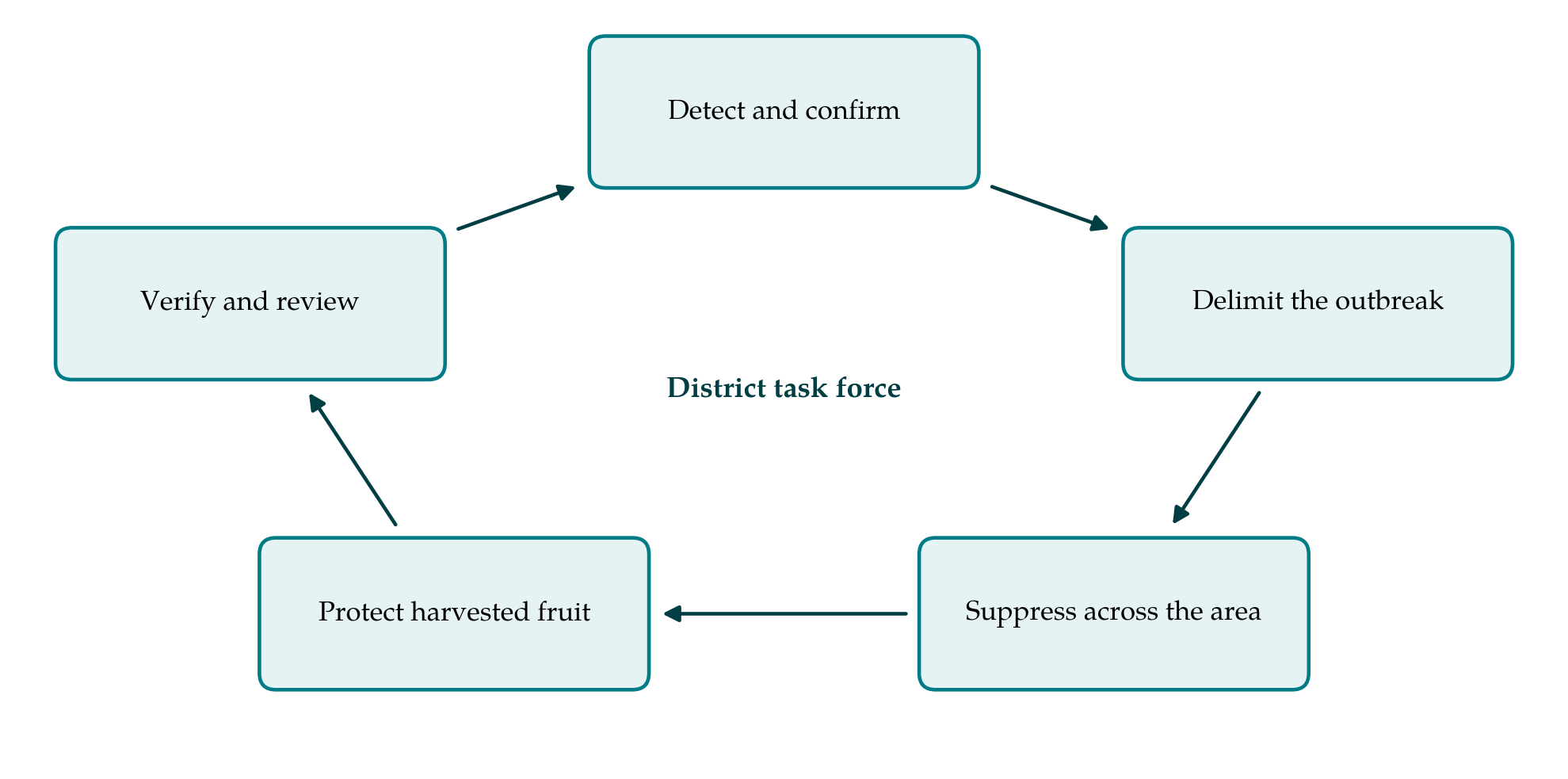
The response is organised in five phases under a single district task force, as shown in Figure 1. The phases overlap in time, and the last feeds back into the first, because surveillance continues after an outbreak is declared over. Table 1 gives the purpose of each phase and the indicator that should be recorded to show whether it is working.
| Phase | Purpose | Main actions | Indicator |
|---|---|---|---|
| 1. Detect and confirm | Find the pest early; establish identity | Sentinel traps at entry points; expert identification | Days from capture to confirmation |
| 2. Delimit | Establish the extent and whether breeding occurs | Dense trapping in zones; fruit sampling | Map of positive traps and fruit |
| 3. Suppress | Reduce the population over the whole area | Male annihilation, bait sprays, sanitation | Flies per trap per day |
| 4. Protect fruit | Keep markets open during the campaign | Bagging, early harvest, post-harvest treatment | Infested fruit at packhouse inspection |
| 5. Verify and review | Confirm the result; keep it | Continued trapping; programme review | Generations without a detection |
3.1. Phase 1: Detect and confirm
A district at risk should run a standing network of methyl eugenol traps before any fly is found, concentrated where entry is most likely: the port, fruit markets, bus and lorry terminals, and orchards near them. Trap placement and servicing follow the published guidance (FAO/IAEA, 2018). A suspect specimen is sent at once to a competent taxonomist, since species of the B. dorsalis complex are hard to separate and molecular confirmation may be needed. The plant protection authority is notified as soon as identity is confirmed, because official recognition of all later steps depends on it.
3.2. Phase 2: Delimit
Confirmation triggers a delimiting survey. Trap density is raised sharply around each detection and decreases outward in zones, and ripe fruit of mango and other hosts is collected and held to rear out larvae, which shows whether the fly is breeding or only arriving. Movement of host fruit out of the infested zone is restricted while the survey proceeds. Within a few weeks the task force should have a map of positive traps and infested fruit samples from which to judge the extent of the population.
3.3. Deciding between eradication and suppression
The delimiting survey supplies the evidence for the most consequential decision of the response. Eradication is realistic when the infestation is small, recently established and bounded, and when reinvasion can be prevented. A review of tephritid eradication programmes worldwide found that many have succeeded, most often against incipient populations detected early (Suckling et al., 2016). A coastal district with continuous hosts, a neighbouring infested region and unregulated fruit movement may meet none of these conditions, and the honest objective is then sustained suppression to a level that allows production and trade. The task force should record which objective it has adopted and why, in the terms set out in ISPM 9 (IPPC, 1998), and should revisit the decision at fixed intervals.
3.4. Phase 3: Suppress across the area
Suppression combines three measures applied to every host tree in the area, including those in homesteads. Male annihilation stations are distributed on a grid and renewed as the lure weathers. Protein bait is applied as spot sprays at regular intervals through the fruiting season, which uses far less insecticide than cover spraying and spares natural enemies. Fallen and over-ripe fruit is collected at least weekly and destroyed by deep burial, bagging in the sun, or placement in tent-like structures that retain emerging flies while letting parasitoids escape. Sanitation is the measure most dependent on household cooperation, and it is where community organisers and schools are of most use.
3.5. Phase 4: Protect harvested fruit
Growers need to sell fruit while the campaign runs. Mango cultivars differ in the damage they suffer, and late-maturing ones are typically worst affected because fly numbers build through the season (Vayssières et al., 2009). Harvesting at the mature green stage and bagging fruit on the tree reduce infestation. For consignments leaving the district, post-harvest disinfestation by hot water immersion or vapour heat, to schedules accepted by the importing authority, provides the assurance that inspection alone cannot (Heather and Hallman, 2008).
3.6. Phase 5: Verify and review
Trap catches, expressed as flies per trap per day, and the proportion of sampled fruit infested are compiled weekly and mapped. Under an eradication objective, freedom is declared only after trapping at delimiting intensity has yielded no detection for a period covering several generations of the fly, as provided for in ISPM 26 (IPPC, 2006). Under a suppression objective, the review compares catches and fruit losses with the targets set at the outset. In either case the sentinel network of Phase 1 remains in place.
4. Organisation and Fit to a Coastal District
The framework assumes a task force with authority over the whole district, in which the plant protection service, the horticulture department, grower associations, local government and port and market managers are represented. It needs a budget agreed in advance for traps, lures and bait, because procurement after detection costs the weeks that matter most. Three features of coastal districts deserve particular provision. Heavy rain and humidity shorten the life of lures and wash off bait, so servicing intervals must be set for local conditions. Fishing and trading craft move fruit between landing sites that lie outside road checkpoints. And tourist and urban areas hold many unmanaged host trees whose owners have no commercial stake in control.
5. Limitations and What Remains to Be Shown
The framework is a synthesis and has not been tested as a whole. Its components are individually well supported, but their combined cost and effect in a district of smallholders are not established here, and they will vary with the density of hosts and the pressure of reinvasion. No trap densities, lure loadings or treatment schedules are prescribed, because these must be taken from current official guidance and from the product labels in force in the country concerned. The framework is written for a methyl eugenol-responsive species. An outbreak of a fly that responds to cue-lure or to no male lure would need different detection and suppression tools. Finally, the indicators proposed in Table 1 measure the fly and the fruit. Whether growers judge the programme worth its effort is a separate question that an evaluation should also ask.
6. Conclusion
An invasive fruit fly in a coastal mango district cannot be dealt with orchard by orchard. The framework proposed here arranges established tools and international standards into five phases under one coordinating body, with an indicator for each phase and an explicit decision between eradication and suppression. Its value lies in preparation: a district that has its traps out, its task force named and its supplies budgeted before the first fly is caught has options that a district reacting afterwards does not.
Conflict of interest
To be declared by the author(s) before publication.
Funding
To be declared by the author(s) before publication.