1. Introduction
Bearing rings and rollers are made from high-carbon chromium steel of the AISI 52100 type, hardened to around 60 on the Rockwell C scale. For most of the last century such parts could only be finished by grinding. Turning with polycrystalline cubic boron nitride or ceramic tools has since become an established alternative, offering flexible geometry in one clamping and a process that needs no grinding fluid (Tonshoff et al., 2000). Hard turning is normally run dry. The cutting zone is deliberately hot, since heat softens the work material in the shear zone, and flood coolant can crack a brittle tool edge by thermal shock.
Dry cutting has costs of its own. Flank wear proceeds unlubricated, and a worn flank rubbing on the new surface raises its temperature, which favours the hard, brittle white layer and the tensile residual stresses that reduce rolling contact fatigue life (Chou and Evans, 1999; Bartarya and Choudhury, 2012). Minimum quantity lubrication, abbreviated MQL, is an attempt to keep the advantages of a dry process while putting a lubricant film where the rubbing occurs. This note considers what is known about using vegetable-based fluids for that purpose.
2. What Minimum Quantity Lubrication Does
In MQL a very small flow of oil, of the order of tens of millilitres per hour, is atomised in compressed air and directed at the cutting edge. The quantity is too small to carry away much heat. The review by Weinert et al. (2004) is explicit that the main action is lubrication of the contact zones, with the air stream contributing some cooling and chip transport, and that the oil is consumed in the process, so nothing is recirculated, filtered or disposed of as spent coolant. The earlier survey of dry cutting by Klocke and Eisenblatter (1997) placed MQL as the step taken when fully dry machining is not feasible. For hard turning the fit is good in principle: the process does not want bulk cooling, and it does want less friction at the flank.
Two delivery arrangements are in use. In external systems the aerosol is formed in a mixing unit or at the nozzle and sprayed at the tool from outside. In internal systems oil and air travel through the spindle or turret and emerge from channels in the tool holder. Turning with indexable inserts generally uses external nozzles, or holders with outlets close to the insert, which makes the aim of the jet a setting that the operator can change, for better or for worse.
Whether oil reaches the flank contact is the central doubt. Contact pressures in hard turning are high and the contact is short. Access is more plausible at the trailing part of the flank land and on the rake face behind the sticking zone than at the edge itself, which is why nozzle position recurs in the literature as a variable that matters.
3. Why Vegetable-Based Fluids
Because the lubricant in MQL leaves the machine as mist, as a film on the chips and as a residue on the part, its toxicity and biodegradability matter more than in a recirculating system. Vegetable oils are triglycerides, esters of glycerol with long-chain fatty acids. The polar ester groups adsorb on metal surfaces and the long chains form a dense boundary film, which gives these oils good lubricity without additives. They also have a high viscosity index and a high flash point, and they degrade readily in the environment (Shashidhara and Jayaram, 2010; Lawal et al., 2012).
Their weakness is oxidation. Unsaturated fatty acid chains, especially those with more than one double bond, react with oxygen at elevated temperature, and the products polymerise into a sticky varnish (Fox and Stachowiak, 2007). In a machine tool this shows as gummed slides, chucks and nozzles. Oils with a high oleic content, synthetic esters made from vegetable feedstocks and fatty alcohols are the usual answers, each trading some lubricity or cost for stability. Table 1 sets the fluid classes side by side as they bear on hard turning.
| Fluid class | Strengths | Limits |
|---|---|---|
| Refined vegetable oil (rapeseed, soybean, sunflower) | Strong boundary film; biodegradable; low cost | Oxidises and gums on hot surfaces |
| High-oleic vegetable oil | Better oxidation stability with similar lubricity | Higher price; supply varies by region |
| Synthetic ester from vegetable feedstock | Stable, clean-burning, tailored viscosity | Cost; hydrolysis if water is present |
| Fatty alcohol | Evaporates cleanly; some cooling by evaporation | Weaker lubricating film |
| Mineral oil | Stable and familiar | Poor biodegradability; mist is a health concern |
4. What the Published Studies Establish
Direct evidence on hardened bearing steel exists but is not extensive. Diniz et al. (2003) turned hardened 52100 steel dry, with a minimum volume of oil and with flood coolant at several cutting speeds, and found that the dry and minimum-oil conditions compared favourably with flood cooling in terms of tool wear. Varadarajan et al. (2002) applied a very small quantity of fluid as a pulsed jet in hard turning of an alloy steel and reported better overall performance than either dry or wet turning. Both studies support the view that a little lubricant helps and a lot of coolant does not. Neither used a vegetable oil as its subject, and neither isolates the effect of fluid chemistry.
Evidence for vegetable-based MQL comes mostly from softer material. Khan et al. (2009), for example, turned a low-alloy steel with vegetable oil MQL and reported lower cutting temperature, less tool wear and better finish than dry or flood conditions, and the reviews of vegetable-based metalworking fluids collect many similar results on ferrous metals (Lawal et al., 2012). Carrying these findings over to hard turning requires care. Carbide tools on soft steel benefit from lower temperature; cubic boron nitride on hardened steel works in a different thermal regime, with different wear mechanisms, and surface integrity is the criterion that matters most for a bearing.
Surface integrity is where the evidence is thinnest. The white layer on a hard-turned surface is understood to form mainly through rapid heating and quenching of the outermost material, and it grows thicker as flank wear increases (Chou and Evans, 1999). A lubricant that slows flank wear or lowers friction at the land should therefore delay its appearance, and this is the most persuasive argument for MQL in bearing work. It is an inference from mechanism, however. Studies of vegetable-based MQL seldom report metallographic sections or residual stress measurements, so the argument remains to be confirmed.
5. Variables to Fix Before Judging the Process
Reports on MQL differ partly because the delivery differs. Figure 1 gathers the variables that a shop or a laboratory should record and hold constant when comparing fluids. Flow rate and air pressure determine droplet size and how much oil arrives. Nozzle position decides whether it arrives at the flank, the rake face or neither. Viscosity affects atomisation as well as film strength. Tool grade and edge preparation, typically a chamfer with a hone on cubic boron nitride inserts, set the contact geometry. Workpiece hardness and carbide distribution vary between heats.
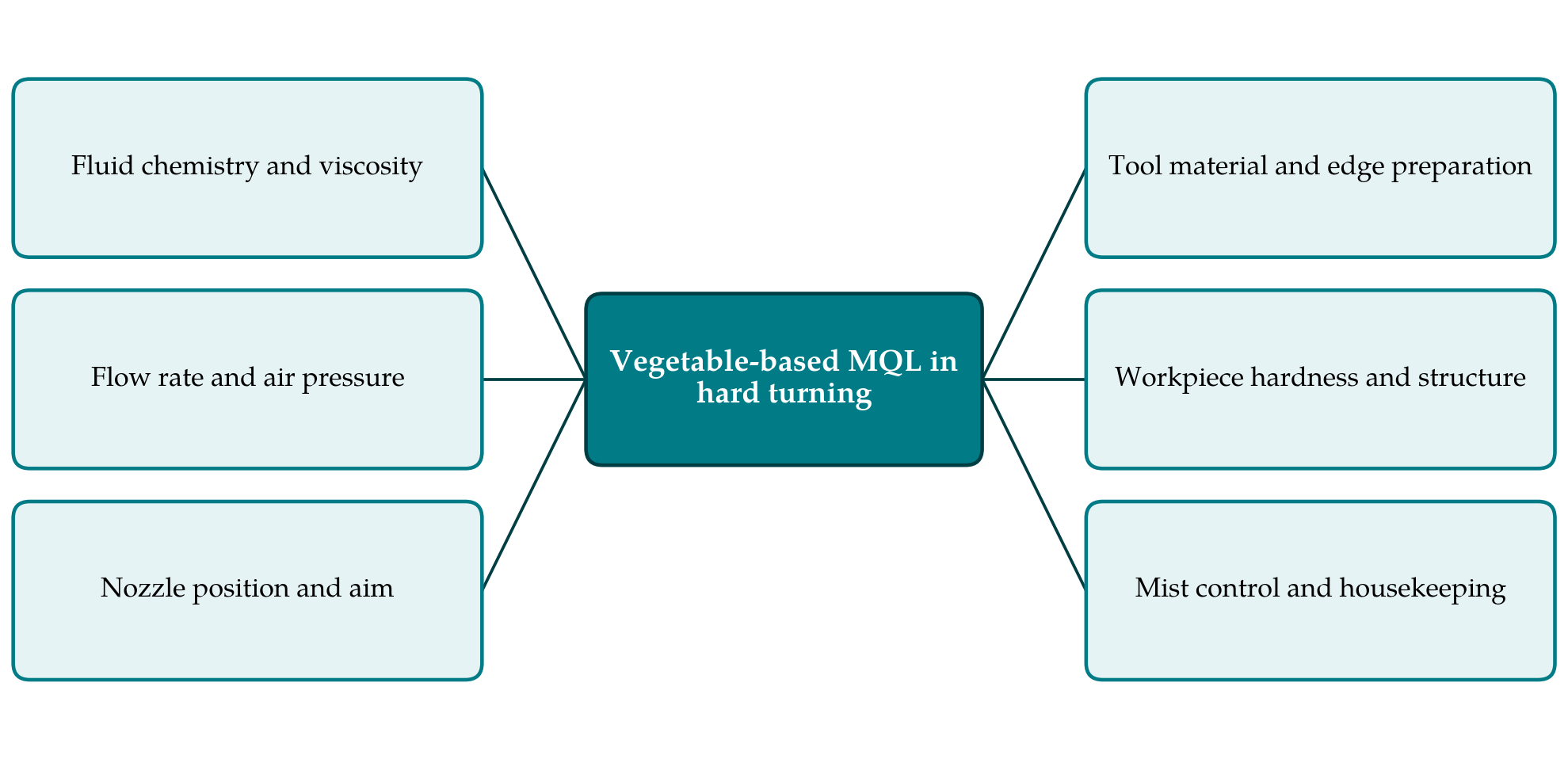
Mist is the last item and not a minor one. An MQL system that lubricates the tool also loads the air with fine droplets. A vegetable base reduces the hazard of what is inhaled but does not remove the need for enclosure and extraction, and occupational guidance on metalworking fluid aerosols applies regardless of the origin of the oil (NIOSH, 1998). Residue on parts and machine surfaces should be inspected over weeks, not hours, since oxidation of a thin film is slow to show.
6. What Would Settle the Question
Three comparisons are missing from the literature in a form that a bearing manufacturer could act on. The first holds the delivery fixed and varies only the fluid, across the classes of Table 1, on hardened 52100 steel with one tool grade. The second judges the outcome by surface integrity, meaning white layer thickness and residual stress profile at a stated flank wear, and not by tool life and roughness alone. The third runs long enough to show oxidation residue and its effect on the machine. Until such results are available, vegetable-based MQL in hard turning is best regarded as a promising option whose benefit over dry cutting has to be demonstrated for each application.
7. Conclusion
Minimum quantity lubrication matches what hard turning needs, friction reduction without bulk cooling, and vegetable-based fluids match what MQL needs, a lubricant that forms a strong boundary film and is acceptable when lost to the surroundings. The supporting evidence is suggestive, but much of it was obtained on softer steels with carbide tools. Oxidation stability of the fluid, access of the mist to the flank and the response of the machined surface layer are the points on which practice should focus, and on which carefully controlled comparisons are still needed.
Conflict of interest
To be declared by the author(s) before publication.
Funding
To be declared by the author(s) before publication.