1. Introduction
The report of the Institute of Medicine on patient safety argued that most harm in health care arises from faulty systems and that systems cannot be repaired unless errors come to light (Kohn et al., 2000). The same reasoning has long been applied in aviation, nuclear power and other hazardous industries, where Reason (1997) made a reporting culture one of the components of a safety culture. An error that is concealed can be neither corrected nor learned from. Whether it is disclosed depends less on the reporting system than on what the person who knows about it expects to happen next, and that expectation is shaped above all by the immediate superior.
Among the leader behaviours studied in this connection, humility has attracted growing attention. The intuition is simple. A leader who openly admits to having been wrong shows that such an admission is survivable. Since Owens and Hekman (2012) described what humble leaders do and Owens et al. (2013) supplied a measure, a considerable literature has linked expressed humility to team outcomes. Rather less of it addresses error reporting directly. This review assembles what is known, connects it to the older research on psychological safety and voice, and assesses how far the evidence supports the claim that humble leaders make teams more willing to report errors.
2. Approach to the Literature
The article is a narrative synthesis of published work and does not present a systematic search or a pooled estimate. It concentrates on peer-reviewed studies and reviews in organisational behaviour and applied psychology, together with foundational texts in safety science. Studies were included for their relevance to one of three questions: what leader humility is, why reporting an error is difficult, and through what mechanisms and under what conditions the first affects the second. Where a claim rests on a single study or on a design that limits inference, this is stated.
3. Leader Humility as a Construct
Psychological treatments of humility predate the leadership literature. Tangney (2000) characterised it as an accurate assessment of one's abilities, an ability to acknowledge mistakes and limitations, openness to new ideas and a low focus on the self, and distinguished it from low self-esteem. Morris et al. (2005) carried the idea into leadership, proposing self-awareness, openness and transcendence as its components. The decisive step was taken by Owens and Hekman (2012), who derived from interviews with leaders in varied settings three behaviours that followers recognise as humble: admitting mistakes and limitations, drawing attention to the strengths and contributions of followers, and modelling teachability. The scale of expressed humility developed by Owens et al. (2013) measures these behaviours as rated by others.
Two features of this definition matter for the present question. First, humility is treated as expressed behaviour and not as a private virtue, so that what counts is what the team sees. Second, the first of the three behaviours is itself an act of error disclosure by the leader. The construct therefore contains, in miniature, the outcome it is supposed to predict in followers, which gives the hypothesis its plausibility and also complicates its testing. Subsequent work has applied the construct at every level of the hierarchy, from first-line supervisors to chief executives.
4. Why Reporting an Error Is Risky
To report one's own error is to volunteer evidence of one's fallibility to a person with power over one's standing. To report a colleague's is to risk the relationship as well. Zhao and Olivera (2006) modelled the decision as a sequence of detection, appraisal of the situation and choice of response, in which the individual weighs material and reputational costs against benefits and in which fear and shame play a part. Morrison and Milliken (2000) described how such private calculations, repeated across an organisation, harden into a collective silence that nobody intends. Detert and Edmondson (2011) showed that employees carry implicit theories about when speaking up is dangerous, for example that one should not embarrass the boss in front of others, and that these theories suppress voice even where no threat has been made.
The classic demonstration that reported error rates reflect willingness to report is that of Edmondson (1996). Studying hospital nursing units, she found that units with better leadership and relationships had higher, not lower, recorded rates of medication error, and concluded that the difference lay in the readiness of staff to disclose. That study led to the concept of team psychological safety, a shared belief that the team is safe for interpersonal risk taking, which Edmondson (1999) showed to be associated with learning behaviour in work teams. Reviews and a meta-analysis have since confirmed psychological safety as a robust correlate of learning, information sharing and voice (Edmondson and Lei, 2014; Newman et al., 2017; Frazier et al., 2017).
5. Pathways From Humility to Reporting
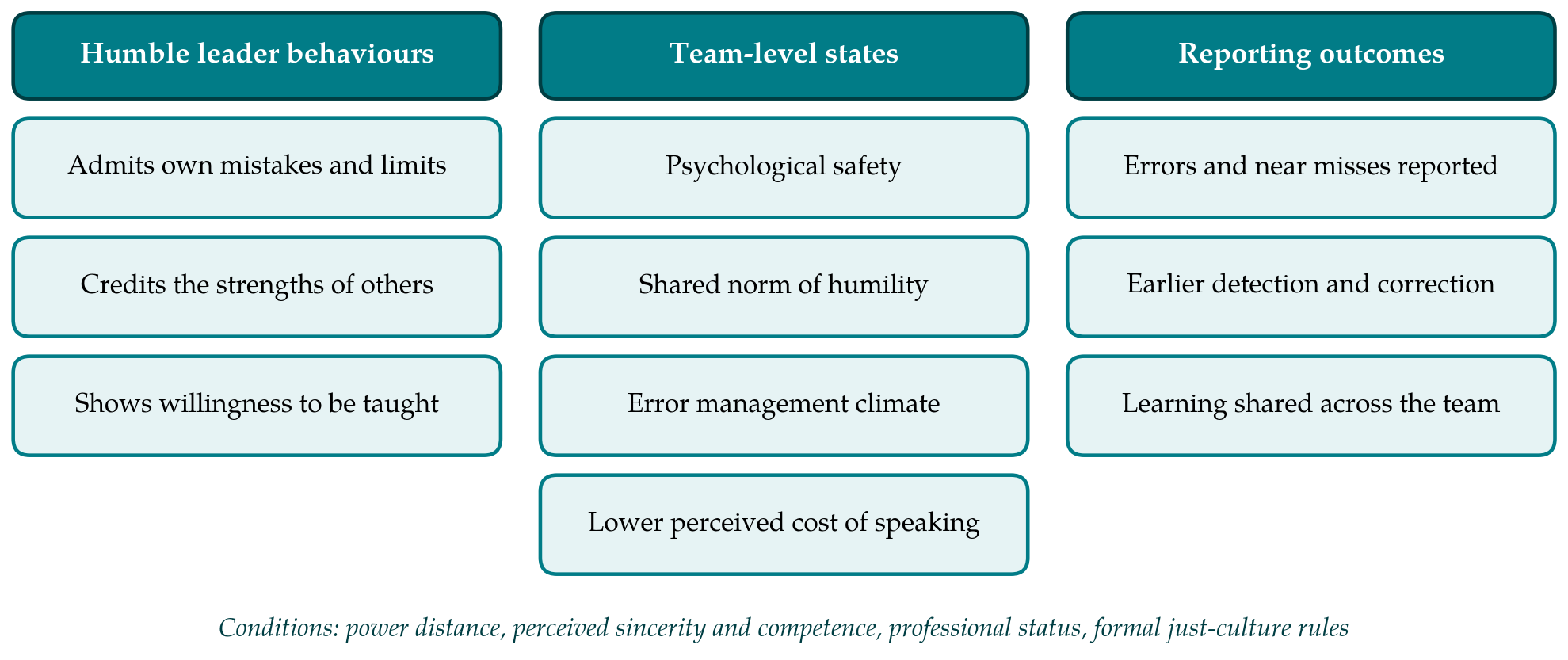
Three pathways are proposed in the literature. They are not rivals, and Figure 1 shows them together as team-level states standing between the leader's behaviour and the reporting that follows.
5.1. Psychological safety
The best supported pathway runs through psychological safety. Leader behaviour is among its strongest antecedents in the meta-analytic evidence (Frazier et al., 2017). Nembhard and Edmondson (2006) found in health care teams that leader inclusiveness, meaning words and deeds that invite and appreciate the contributions of others, was associated with higher psychological safety and reduced the gap in safety between high-status and low-status professions. Detert and Burris (2007) found that managerial openness was related to subordinates' voice and that psychological safety carried the relationship. Humble behaviour as defined above overlaps substantially with inclusiveness and openness, and studies using the expressed humility scale have reported associations with psychological safety and information sharing in teams (Hu et al., 2018).
5.2. Modelling and the spread of humble norms
A second pathway is imitation. Owens and Hekman (2016) proposed that a leader's humility spreads through the team by social contagion, producing a collective humility in which members acknowledge their own limits and one another's strengths, and they linked this to a shared focus on growth and to team performance. Rego et al. (2017) reported a similar sequence from leader humility through team humility to team effectiveness. For error reporting the implication is that the leader's admission does more than reassure. It supplies a script. Team members learn how a mistake is talked about in this group: in what tone, at what moment and with what consequences.
5.3. Error management climate
The third pathway concerns what the team believes errors are for. Research on error management distinguishes organisations that try only to prevent errors from those that also expect them and attend to their rapid detection, open communication and analysis (Frese and Keith, 2015). van Dyck et al. (2005) found error management culture to be related to firm performance in two national samples. A leader who treats personal mistakes as occasions for learning enacts that orientation daily. The connection to the safety literature is direct: the just culture described by Reason (1997) depends on staff trusting that honest error will be met with inquiry and not with blame, and that trust is formed in dealings with one's own superior before it is formed by policy.
6. Boundary Conditions
The association is not unconditional. The most frequently examined moderator is power distance, the extent to which unequal power is expected and accepted (Hofstede, 2001). Hu et al. (2018) found that the benefits of leader humility for information sharing and psychological safety depended on the power distance values of the team and were absent or reversed where those values were high. A plausible reading is that followers who expect a leader to be certain are unsettled by one who is not. A related finding comes from Zapata and Hayes-Jones (2019), who showed that humility is seen as untypical of leaders and can lower judgements of a leader's agency even as it raises judgements of warmth.
Sincerity matters as well. Owens and Hekman (2012) noted from their interviews that humble behaviour was effective only when followers regarded the leader as competent and the behaviour as genuine; a display of modesty read as tactical did harm. Status differences inside the team form a further condition. The work of Nembhard and Edmondson (2006) implies that those lowest in a professional hierarchy have most to fear from reporting and most to gain from a leader who invites it, so that the average effect in a team may conceal large differences between members.
7. The Quality of the Evidence
Table 1 summarises the main streams of work and the limitation that most constrains each. Three weaknesses run across them.
| Stream | Central claim | Representative sources | Principal limitation |
|---|---|---|---|
| Expressed humility | Humble leaders admit limits, credit others and remain teachable | Owens and Hekman, 2012; Owens et al., 2013 | Ratings by followers; overlap with related leader styles |
| Psychological safety | Shared belief that interpersonal risk is safe supports learning and voice | Edmondson, 1999; Frazier et al., 2017 | Mostly cross-sectional survey designs |
| Voice and silence | Speaking up is withheld when judged futile or dangerous | Morrison, 2014; Detert and Burris, 2007 | Voice in general, seldom error disclosure itself |
| Error management | Treating errors as information improves detection and learning | van Dyck et al., 2005; Frese and Keith, 2015 | Organisation-level measures, distant from the leader |
| Contagion of humility | Leader humility becomes a team norm | Owens and Hekman, 2016; Rego et al., 2017 | Outcomes are performance, not reporting |
| Cultural contingency | Effects depend on power distance and expectations of leaders | Hu et al., 2018; Zapata and Hayes-Jones, 2019 | Few settings compared directly |
The first weakness is the outcome measured. Most studies of leader humility record psychological safety, voice, information sharing or performance. Few record whether errors were in fact reported, and those that approach it usually rely on stated willingness. Morrison (2014) observed in reviewing the voice literature that intentions and behaviour are not interchangeable. The inference from humility to reporting therefore passes through an intermediate variable at which most studies stop.
The second is design. Much of the evidence comes from questionnaires in which the same respondents rate their leader and describe their team at one point in time. Podsakoff et al. (2003) set out how such designs inflate associations through common method variance. Followers who feel safe may also describe their leader generously, and a team that reports errors freely may make it easier for its leader to be humble. Studies with separate sources, time lags or experimental manipulation exist but are a minority. The third weakness is distinctiveness: humble leadership shares ground with inclusive, servant and participative styles, and it is seldom shown that humility explains reporting beyond what those neighbouring constructs already explain.
8. What Remains Unsettled
Several questions follow. The most pressing is behavioural measurement. Organisations with incident and near-miss reporting systems hold records that could be linked, with appropriate safeguards, to measures of leader behaviour at unit level, and such data would show whether the association survives when reporting is observed and not merely professed. The lesson of Edmondson (1996) should be kept in view: a rise in reports under a humble leader is a sign of disclosure and must not be mistaken for a rise in error.
Research is also needed on timing and on type. A leader's admission may matter most early in the life of a team, when norms are being set, and little is known about how quickly its effect decays or how it is undone by a single punitive reaction. Errors differ, too. Reporting a slip with no consequences is a different act from reporting one that harmed a client, and reporting one's own error differs from reporting a senior colleague's. Whether humility lowers the threshold equally for all of these has not been tested. Finally, formal protections and leader behaviour have mostly been studied apart, and it is unclear whether a humble leader compensates for a weak reporting policy or whether each needs the other.
9. Implications for Practice
Some cautious guidance can be drawn despite these gaps. The behaviours in question are specific and can be practised: saying plainly what one got wrong in a recent decision, naming the colleague whose objection turned out to be right, and asking a junior member to explain something one does not know. The literature suggests that such acts carry weight in proportion to their cost to the leader, so that an admission made in front of the team counts for more than one made in private, and one concerning a matter of substance for more than a ritual apology. It suggests equally that they are undone by an inconsistent response. A leader who admits personal fallibility on Monday and reacts sharply to a subordinate's mistake on Thursday teaches the team to believe the second signal.
Organisations should also resist treating humility as a substitute for structure. Confidential reporting channels, a clear distinction between honest error and reckless conduct, and visible action on what is reported remain necessary, and where the surrounding culture expects leaders to project certainty, the same behaviour may need to be introduced gradually and explained. Selection and development practices that reward only decisiveness will, on this evidence, work against the candour that error reporting requires.
10. Conclusion
The literature supports with some consistency the proposition that leaders who visibly admit their own limits, credit others and remain open to correction have teams that feel safer and speak more freely. It supports less firmly the further proposition that such teams report more of their errors, because that outcome has rarely been observed directly, and it shows that the benefit depends on culture, on status and on whether the humility is believed. For practitioners the reasonable inference is modest. A leader's candour about personal mistakes is a low-cost signal that costs most when it is absent, but it does not replace fair procedures for handling what is reported. For researchers the task is to follow the chain to its end.
Conflict of interest
To be declared by the author(s) before publication.
Funding
To be declared by the author(s) before publication.