1. Introduction
The medicine round at two or six in the morning is carried out by people whose bodies are set for sleep. Night work places the main sleep period at the wrong circadian phase, shortens it, and leaves the worker sleepiest in the second half of the shift (Åkerstedt, 2003). Hospitals have not agreed on whether a nurse may sleep for twenty or thirty minutes during a night break. In some organisations the practice is written into policy and a room is set aside for it. In many it is tolerated and unspoken. In others, being found asleep on duty is grounds for dismissal whatever the circumstances.
The question of napping is usually argued in terms of alertness and safety. This review adds a second question that the debate tends to overlook. Medication errors become known to an organisation largely because the nurse involved chooses to report them, and that choice is sensitive to fear, to the expected reaction of managers and to the nurse's own reading of whether an event counts as an error (Wakefield et al., 1999). A rule about sleeping on shift is also a statement about how an employer regards fatigue: as a physiological fact to be managed or as a personal failing to be punished. It is reasonable to ask whether that statement changes what nurses are prepared to disclose.
The title of this review joins two things, napping policies and error reporting, that the literature has mostly studied apart. The aim is to set out what is established about each, to examine the few points at which they meet, and to say plainly where evidence is missing. The focus is on registered nurses working nights on general hospital wards; studies from critical care, emergency departments and other industries are used where ward studies do not exist.
2. Scope and Approach
This is a narrative review of the published literature. It draws on well-known primary studies, systematic reviews, and reports and position statements from professional and scientific bodies in three areas: fatigue and error in nursing work, the effects of naps taken during night work, and the reporting of medication administration errors. No claim is made to an exhaustive search, and no pooled estimate is offered. Statements that a type of study does not appear to exist reflect the sources consulted and should be read with that limit in mind. The review reports no new data.
3. Fatigue, Night Work and Medication Error
The link between tiredness and impaired performance is among the better established findings in occupational science. In a widely cited experiment, Dawson and Reid (1997) compared the effect of sustained wakefulness on a tracking task with the effect of alcohol and found that performance after about 17 hours awake resembled that at a blood alcohol concentration of 0.05 per cent.
Studies of nurses at work point the same way. Using logbooks kept by hospital staff nurses, Rogers et al. (2004) found that the likelihood of an error rose markedly when a shift lasted twelve and a half hours or more, when nurses worked overtime and when they worked more than forty hours in a week; medication administration accounted for the largest share of the errors and near errors recorded. A companion study of critical care nurses linked longer hours to reduced vigilance (Scott et al., 2006). On the strength of this and related work the Institute of Medicine recommended limits on the hours nurses provide patient care (Institute of Medicine, 2004), and a later review of shift characteristics concluded that long shifts and limited rest are associated with poorer performance, while noting how variable the studies are in design and quality (Dall'Ora et al., 2016).
Fatigue is seldom the only cause of a medication error. In their systematic review of the causes of administration errors, Keers et al. (2013) found slips and lapses to be the most commonly described unsafe acts, arising in conditions that included heavy workload, interruptions, inadequate written communication and tiredness. A nap addresses one of several error-producing conditions, and a policy that improves alertness while leaving a ward short of staff during the break may exchange one hazard for another.
4. What a Planned Nap Does
Experimental work on napping long predates the nursing literature. Dinges et al. (1987) showed that a nap taken before sleep loss has accumulated protects later performance better than one taken after, which gave rise to the idea of the prophylactic nap. A study of long-haul flight crews for the United States space agency found that a planned rest opportunity of 40 minutes in the cockpit seat improved subsequent alertness and performance (Rosekind et al., 1994).
In health care the most direct evidence comes from a randomised trial in an emergency department, in which physicians and nurses working twelve-hour night shifts were assigned to a 40-minute nap opportunity at 3 a.m. or to no nap. Those who napped had fewer lapses on a vigilance test at the end of the shift and were quicker at a simulated intravenous insertion, although a memory test taken immediately after the nap was temporarily worse (Smith-Coggins et al., 2006). A systematic review of experimental studies in night-shift workers reached a similar overall judgement: naps taken during the night reduce sleepiness and improve sleep-related performance deficits (Ruggiero and Redeker, 2014).
The transient worsening after waking is sleep inertia, a period of grogginess and slowed thinking that is more pronounced after waking from deep sleep and after prior sleep loss (Tassi and Muzet, 2000). For a nurse who may be called from the rest room to an emergency or to check a controlled drug, it is the principal safety argument against napping. The studies reviewed by Ruggiero and Redeker (2014) suggest that inertia after short naps is brief, but they were not designed around drug administration, and none measured medication errors as an outcome. What is established is an effect on alertness and on laboratory or simulated tasks. An effect on real medication error rates is a plausible inference and has not been shown directly.
5. Napping Policies in Hospitals
Descriptive studies portray a practice that is common and largely unofficial. Most of the critical care and emergency nurses interviewed in one Canadian study said they napped during night breaks and believed it helped them, while describing poor facilities and uncertainty about whether napping was permitted (Fallis et al., 2011). Managers interviewed in a linked study recognised the benefits and were uneasy about the absence of any policy to guide them (Edwards et al., 2013). An implementation project in two hospitals in the United States found that uptake varied greatly between units and that the reservations of managers, more than those of staff, decided whether napping went ahead (Geiger-Brown et al., 2016).
Professional bodies have moved towards treating fatigue as a shared responsibility. The position statement of the American Nurses Association assigns duties to employers as well as to nurses, including the design of schedules and the provision of real rest breaks (American Nurses Association, 2014). The positions a hospital can take are summarised in Table 1. What matters most here is whether the organisation has put anything in writing, and whether what it has written frames sleep as care or as misconduct.
| Policy position | Typical features | Likely bearing on error disclosure |
|---|---|---|
| Sanctioned and supported | Written policy, protected break, rest room, agreed cover and wake-up | Fatigue can be named in a report without admitting a breach |
| Permitted in writing only | Policy allows naps on unpaid breaks; no room or cover arrangements | Disclosure possible, but naps are often not taken in practice |
| Silent | No written position; practice depends on the nurse in charge | Uncertain; nurses may omit tiredness from accounts of events |
| Prohibited | Sleeping on duty listed as misconduct, sometimes including breaks | Mention of drowsiness invites discipline; under-reporting is likely |
| Prohibited but tolerated | Formal ban with informal acceptance on some wards | Disclosure depends on trust in the individual manager |
6. Why Medication Errors Are and Are Not Reported
Voluntary incident reporting captures a fraction of the errors that occur, and the fraction is not constant. Wakefield et al. (1999) identified four groups of reasons why nurses do not report medication administration errors: fear, disagreement over whether an error took place, the response of administrators, and the effort that reporting requires. Later studies in different countries have found much the same. Nurses surveyed by Mayo and Duncan (2004) differed among themselves about what constituted a reportable error and cited the reactions of managers and colleagues as deterrents. In Taiwan, fear was the strongest of the barriers measured (Chiang and Pepper, 2006), and a systematic review confirmed that organisational barriers, especially a culture of blame, are the most frequently reported obstacle (Vrbnjak et al., 2016).
The consequence for anyone who counts reported errors is awkward. In a study of hospital nursing units, Edmondson (1996) expected better led teams to make fewer drug errors and found that they recorded more, because their members were more willing to speak about mistakes. The concept of psychological safety, a shared belief that the team is safe for interpersonal risk-taking, grew out of that finding (Edmondson, 1999). A rise in reported errors can therefore signal a healthier ward, and a fall can signal silence.
The system approach to error holds that people err for reasons rooted in the conditions of their work and that punishing the individual at the sharp end does little to prevent recurrence (Reason, 2000). The just culture model refines this by distinguishing human error and at-risk behaviour, which call for consolation and coaching, from reckless conduct, which may warrant sanction (Marx, 2001). Where sleeping on shift is classed as misconduct, a nurse who nodded off before an error occurred has good reason to leave that detail out, and perhaps to leave the event unreported altogether.
7. Where the Two Literatures Meet
Bringing these strands together yields three routes by which a napping policy could alter the number of medication errors that appear in a ward's incident system. They are set out in Figure 1. The first is the one usually discussed: a rested nurse makes fewer slips, offset to an unknown degree by sleep inertia and by thinner cover while colleagues are resting. The second concerns detection. Many administration errors are caught by the nurse who made them or by a colleague at a second check, and vigilance at checking is exactly the kind of sustained attention that suffers with sleepiness (Scott et al., 2006). A more alert night staff may notice errors that would otherwise have passed unseen.
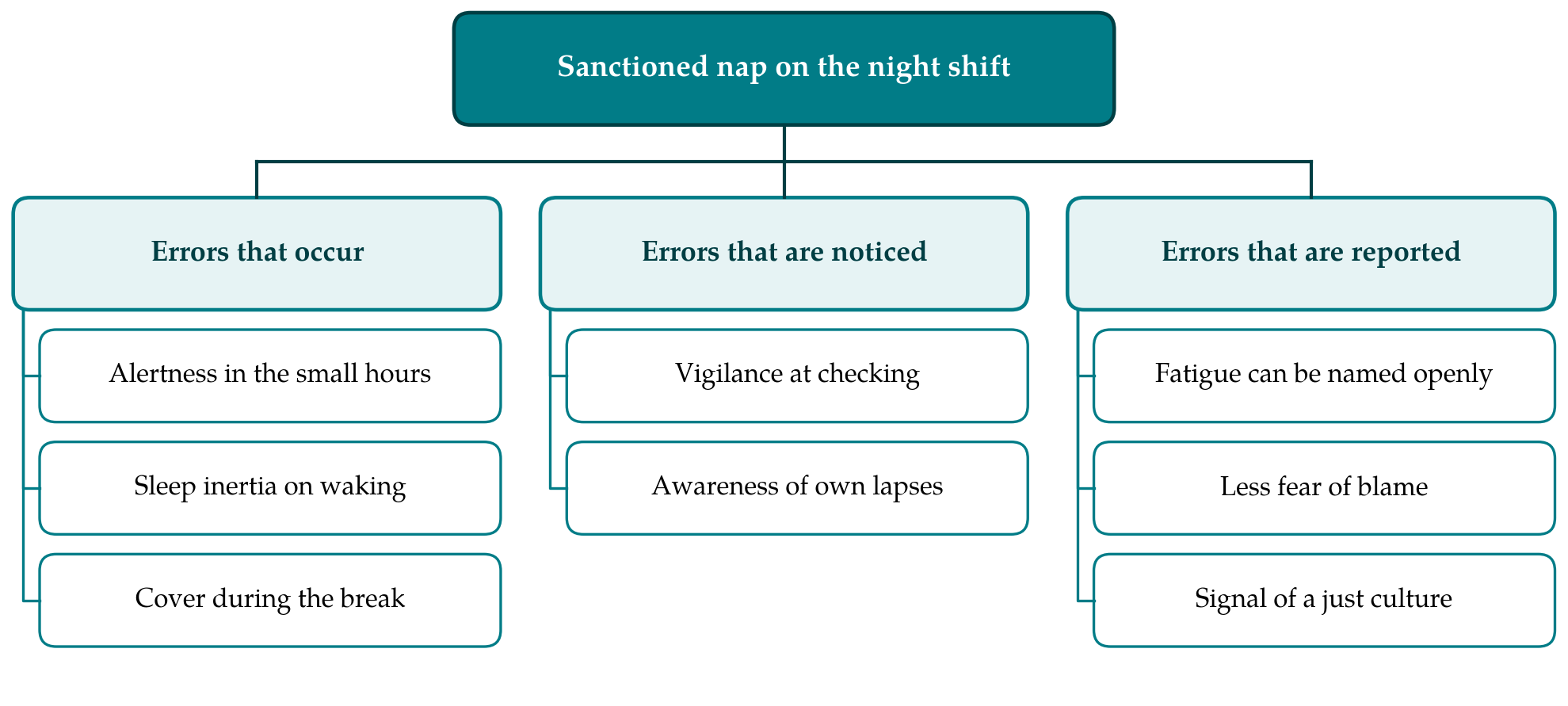
The third route runs through disclosure. A written policy that provides for rest tells staff that the organisation accepts tiredness as a normal feature of night work. Under such a policy a nurse can write that she was drowsy when she misread a chart without confessing to a disciplinary offence, and the report becomes more informative as well as more likely. This is an inference from the reporting literature and has not been tested in a study of napping.
The three routes push in different directions. Fewer errors occurring would lower the reported count; better detection and freer disclosure would raise it. A simple comparison of incident reports before and after a policy change could show a rise, a fall or no change, and each result would be compatible with the policy having worked. No published study was identified that attempts such a comparison for ward nurses, and the systematic review by Ruggiero and Redeker (2014) lists no trial with reported medication errors as its outcome. The question in the title therefore has no direct empirical answer.
8. Gaps and Directions for Research
Three gaps stand out. The first is the setting. The clinical trials of napping were conducted in emergency and critical care, where staffing ratios and break arrangements differ from those of a general ward at night with two or three registered nurses. Whether a protected nap is feasible there, and what happens to patients during it, has been described in implementation accounts (Geiger-Brown et al., 2016) but not evaluated with safety outcomes. The second gap is the outcome measure. Studies that rely on voluntary reports cannot separate a change in errors from a change in reporting. Designs that pair incident reports with an independent measure, such as direct observation of medicine rounds or review of electronic administration records, would allow the two to be distinguished.
The third gap is the policy itself. Research has treated napping as an intervention delivered to individuals and has paid little attention to the wording, status and enforcement of the rule that permits or forbids it. Comparative work across hospitals with different positions of the kind shown in Table 1, combined with validated measures of safety climate and of willingness to report, would show whether the association proposed here exists.
9. Conclusion
Night-shift fatigue impairs the kind of performance that safe medicine administration demands, and a short planned nap partly restores it. Reporting of medication errors depends on whether nurses expect to be blamed. Whether a napping policy changes the errors a ward reports has not been studied, and the direction of any change cannot be predicted from first principles, because a policy may lower the number of errors made and raise the proportion disclosed. Hospitals deciding on a policy should therefore not judge it by incident counts alone. A written position that treats rest as part of safe practice is consistent with what is known about both fatigue and reporting, and its effects deserve careful measurement.
Conflict of interest
To be declared by the author(s) before publication.
Funding
To be declared by the author(s) before publication.