1. Introduction
The case for bringing traditional medicine into primary care was made formally in 1978. The Declaration of Alma-Ata listed traditional practitioners, suitably trained, among the workers on whom primary health care could rely (WHO, 1978). Since then the World Health Organization has issued successive strategies urging member states to regulate traditional and complementary medicine and to integrate it into national health systems (WHO, 2013), and its global survey records a steady rise in the number of countries with national policies, laws and offices devoted to it (WHO, 2019). India has gone further than most, with a dedicated ministry and a national health policy that commits to mainstreaming the AYUSH systems and to a pluralistic model of care (Government of India, 2017).
These are real achievements. They have given traditional systems legal standing, training institutions and a place in public facilities. The argument of this article is that they are not sufficient, and that treating policy recognition as the goal has allowed a harder task to be postponed. Integration is worth having only if it improves care, and whether it does depends on evidence that policy cannot supply by declaration.
2. What Policy Support Has and Has Not Delivered
Integration in practice has mostly meant co-location. A Unani or Ayurvedic physician is given a room in a primary health centre, a supply of medicines from an approved list and a place in the staffing table. Patients choose which door to enter. This arrangement increases access and respects preference, which were the public health arguments for it (Bodeker and Kronenberg, 2002). It does not, by itself, create any working relationship between the two kinds of practitioner. There are seldom shared records, agreed referral criteria or common protocols for conditions that both treat.
The reason is not hostility alone. A conventional clinician asked to refer a patient with osteoarthritis, irritable bowel or early hypertension to a traditional colleague will reasonably ask what the patient can expect. A traditional practitioner asked when to refer in the other direction needs to know at what point the limits of the system have been reached. Neither question has an agreed answer for most conditions, because the studies that would answer them have not been done or have been done badly. Policy has built the house and left the rooms without connecting doors.
3. The Evidence That Integration Depends On
Evidence-based medicine was defined by its founders as the conscientious, explicit and judicious use of current best evidence in decisions about the care of individual patients, combined with clinical expertise and the patient's values (Sackett et al., 1996). That definition is not hostile to traditional practice. It asks only that claims of benefit be open to test. For a traditional intervention to be used with confidence in primary care, several kinds of evidence are needed, and they build on one another, as Figure 1 shows.
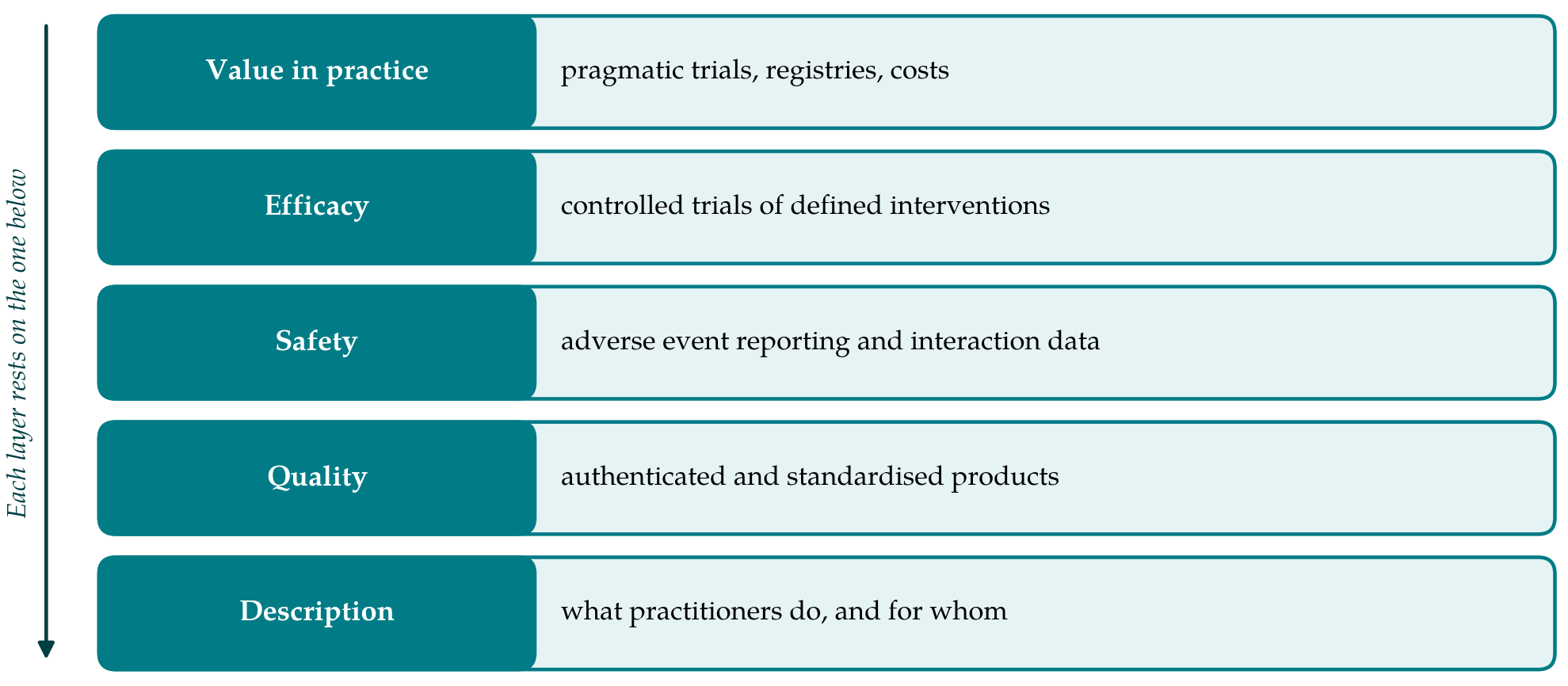
The base is description. Much of what traditional practitioners do in clinics has never been recorded systematically: which patients come, with what complaints, what is prescribed and what happens next. Above that comes the quality of the product. A trial of a herbal formulation means little if the next batch differs, and the CONSORT extension for herbal interventions asks authors to report the plant species, the part used, the extraction and the chemical characterisation for that reason (Gagnier et al., 2006). Safety follows. Analyses of traditional preparations sold to the public have found lead, mercury and arsenic in a proportion of them (Saper et al., 2004), and clinically significant interactions between herbal medicines and prescribed drugs are well documented (Izzo and Ernst, 2009). In a primary care population, where many patients take several medicines, that is a daily concern.
Only on that footing do questions of efficacy and of value in ordinary practice become answerable. Table 1 summarises the five kinds of evidence, the question each answers for a primary care service and the general state of each for traditional systems. The pattern is uneven. Pharmacopoeial standards and pharmacovigilance schemes exist on paper in several countries, but the upper layers are thin for all but a handful of interventions.
| Kind of evidence | Question for primary care | General state |
|---|---|---|
| Description of practice | Who is treated, for what, and how? | Sparse; few clinic-based records or registries |
| Product quality | Is each batch what the formula says? | Pharmacopoeial standards exist; enforcement varies |
| Safety | What harms and interactions occur? | Known hazards documented; routine reporting weak |
| Efficacy | Does it work better than a comparator? | Many small trials; few rigorous ones |
| Value in practice | Does adding it improve outcomes or costs? | Almost unstudied |
| Synthesis and grading | How sure can a guideline be? | Reviews often conclude evidence is of low certainty |
The last row matters because primary care runs on guidelines. The GRADE approach, now used by most guideline bodies, rates the certainty of evidence and separates it from the strength of a recommendation (Guyatt et al., 2008). A traditional intervention will enter a mainstream guideline when its evidence can be graded, and it will stay out, whatever the policy climate, when it cannot.
4. Objections Considered
The position taken here invites three objections, each with some force.
4.1. Trials cannot capture whole systems
The first is that the randomised trial was designed for single drugs and distorts systems in which treatment is individualised, combines diet, regimen and medicine, and aims at the person and not the disease. The criticism is fair when applied to trials that strip a formulation from its context and give the same dose to everyone. It does not follow that evaluation is impossible. Researchers in complementary medicine have argued for studying whole systems as delivered, starting from practice and working back towards mechanism (Fønnebø et al., 2007), and for combining several study designs in place of a single hierarchy (Walach et al., 2006). The Medical Research Council's guidance on complex interventions provides a general framework (Craig et al., 2008), and pragmatic trials, which randomise patients to a whole package of individualised care and measure outcomes that matter to them, have their own reporting standard (Zwarenstein et al., 2008). The methods exist. What has been lacking is their use.
4.2. Long use is evidence enough
The second objection holds that centuries of continuous use are themselves a demonstration of safety and benefit. Long use is evidence of something: it makes gross acute toxicity unlikely and it is a good guide to which remedies deserve study. The discovery of artemisinin began with a search of classical Chinese texts, and it became a treatment for malaria because the lead was then put through extraction, laboratory testing and clinical trials (Tu, 2011). Proposals to move from documented traditional use towards controlled study have been made for Ayurveda in the same spirit (Patwardhan et al., 2005). But tradition cannot detect harms that are delayed or uncommon, interactions with drugs that did not exist when the texts were written, or contamination introduced by modern manufacture. Nor can it separate the effect of a remedy from the natural course of illness.
4.3. The demand for evidence is unequal
The third objection is political. Conventional medicine, it is said, contains a great deal that has never been properly tested, and demanding trials of traditional systems alone is a way of keeping them subordinate. The premise is correct. Cochrane made the same complaint about the health services of his own country half a century ago (Cochrane, 1972), and it remains partly true. The conclusion should be the opposite of the one usually drawn. Untested conventional practice is a reason to test more, on both sides, and public funds spent on any intervention carry the same obligation. A traditional system that meets the standard gains an authority that no gazette notification can confer.
5. Implications for Policy, Institutions and Practitioners
If the argument is accepted, the content of policy support should change. Funding that now goes to expanding posts and dispensaries would do more good if a share of it built research capacity within traditional medicine: training in clinical research methods in Unani and naturopathy colleges, clinical trial units attached to teaching hospitals, and biostatistical support. Regulators could require adverse event reporting from integrated clinics and make the results public. Health services could treat co-located clinics as places of study as well as service, with simple shared records that capture diagnoses, treatments and outcomes for patients on both sides.
Priorities are needed, since not everything can be studied at once. The sensible candidates are conditions that are common in primary care, for which conventional treatment is unsatisfactory or burdensome, and for which traditional systems make specific and testable claims: chronic musculoskeletal pain, functional bowel disorders, and the early stages of metabolic disease are examples. For each, the work should run in order, from a clear description of what is done to a defined and quality-controlled intervention, and then to pragmatic comparison with usual care. Practitioners have their own part, which is to record outcomes honestly, to report harms, and to accept that some cherished treatments will not survive testing.
6. Conclusion
Policy has opened the door of primary care to traditional systems of medicine. Whether they are used well once inside depends on knowledge that is still mostly missing: what works, for whom, how safely and in combination with what. Supplying that knowledge is slower and less visible than issuing a strategy, and it is the form of support that would serve patients and the traditional systems best.
Conflict of interest
To be declared by the author(s) before publication.
Funding
To be declared by the author(s) before publication.