1. Introduction
The word microplastics entered the scientific vocabulary through marine science, when Thompson et al. (2004) drew attention to microscopic plastic fragments and fibres in sediments and plankton samples. For some years the subject stayed at sea. Rillig (2012) was among the first to ask whether soils, which receive plastic from many of the same sources, might be affected as well, and later estimates suggested that the quantity added to farmland each year through sewage sludge alone could rival or exceed the stock floating on the surface of the oceans (Nizzetto et al., 2016).
Microplastics are most often defined as plastic particles smaller than 5 mm, with nanoplastics forming the fraction below one micrometre, although the boundaries and the vocabulary of shapes and polymer types are still being harmonised (Hartmann et al., 2019). Research on their behaviour in terrestrial systems has expanded quickly, and several reviews now treat soil as a major reservoir (de Souza Machado et al., 2018; Hurley and Nizzetto, 2018). Most of that work concerns the topsoil and the organisms that live in it.
The question taken up here is what happens below. Shallow groundwater beneath farmland supplies wells, feeds streams and is already known to be vulnerable to nitrate and pesticides that originate at the surface. Whether plastic particles follow the same route depends on processes that soil physics and colloid science have studied for decades in other contexts. This review connects that older knowledge with the newer literature on microplastics in soil and groundwater.
2. Approach of the Review
The article is a narrative review of the published literature. It was not designed as a systematic search, and it makes no claim to cover every study. Sources were selected to represent four bodies of work: studies of plastic inputs to agricultural soil, experiments on the movement of plastic particles in soil, the established theory of colloid transport in porous media, and surveys of plastic particles in groundwater. Where the microplastic literature is thin, the review relies on well-tested principles from the study of other particles and says so.
3. Sources of Plastic in Cultivated Soil
Sewage sludge is the best documented input. Treatment works retain most of the particles in wastewater, which concentrates them in the solids that are then spread on land. Zubris and Richards (2005) showed that synthetic fibres could be used as a marker of sludge application because they remained detectable in soil long after spreading had ceased, and Corradini et al. (2019) found that the microplastic content of field soils rose with the number of sludge applications they had received. Composts and digestates made from municipal organic waste carry fragments of packaging that survive sorting.
Plastic mulch film is the second large source. Thin polyethylene films are difficult to recover completely after harvest, and the residues are broken up by tillage and weathering into progressively smaller pieces (Steinmetz et al., 2016). Irrigation with untreated or partly treated wastewater, littering, wear of tyres on farm tracks and deposition from the air add smaller amounts. The result is a surface layer loaded with particles of many sizes, shapes and densities, from fibres millimetres long to fragments too small to see.
4. Movement Within the Soil Profile
Three kinds of process carry particles downward: mechanical mixing, biological transport and movement with water. They operate over different depths and select for different particle sizes.
4.1. Tillage and bioturbation
Ploughing distributes surface-applied material through the tilled layer within a season or two, and it places some particles at the plough sole, where the soil below is denser and less disturbed. Soil animals then extend the reach. Huerta Lwanga et al. (2016) exposed the deep-burrowing earthworm Lumbricus terrestris to polyethylene particles mixed with surface litter, and a companion study found the particles incorporated into burrow walls (Huerta Lwanga et al., 2017). Rillig et al. (2017) demonstrated the same species carrying polyethylene beads down the profile, with the smallest size class travelling furthest. Fauna matter doubly, because the burrows they leave are also the channels through which water later moves fastest.
4.2. Transport in percolating water
Particles suspended in water moving through a granular medium are removed by two mechanisms. Straining occurs when a particle is too large to pass a pore throat, and its importance grows with the ratio of particle to grain diameter (Bradford et al., 2002). Attachment occurs when a particle collides with a grain surface and adheres. Colloid filtration theory, developed for water treatment by Yao et al. (1971) and refined by Tufenkji and Elimelech (2004), predicts the collision rate from diffusion, interception and sedimentation, and shows a minimum in removal for particles of roughly a micrometre, which are too large to diffuse quickly and too small to settle or be intercepted efficiently.
Whether a collision leads to attachment depends on surface chemistry. Most plastics and most soil minerals carry negative charge at ordinary soil pH, so attachment is unfavourable in dilute water and becomes easier as ionic strength rises or divalent cations such as calcium are present. Weathering, biofilm growth and coatings of organic matter change the surface properties of plastic particles and make their behaviour difficult to predict from the polymer alone (Alimi et al., 2018). Shape and density add further complications. Fibres align with the flow and can thread through pores much narrower than their length, whereas films and irregular fragments lodge more readily. Polyethylene and polypropylene are less dense than water and polyester and polyvinyl chloride are denser, so that settling assists the removal of some polymers and not others.
Most of this theory was developed for saturated media, and the root zone is seldom saturated. In unsaturated soil the interface between air and water offers a further site of retention, and it moves as the soil wets and dries. Thin water films also confine particles to the smaller pores, where straining is more likely. Drying can therefore hold particles in place for long periods, and an advancing wetting front can release many of them at once. Column experiments in sand have indeed found that repeated wet and dry cycles carry microplastics deeper, and that small particles travel further than large ones (O'Connor et al., 2019). Table 1 summarises the main processes, the particles they act on and their likely consequence for transport to depth.
| Process | Particles most affected | Effect on downward transport | Key sources |
|---|---|---|---|
| Tillage | All sizes | Mixes particles through the plough layer only | Steinmetz et al., 2016 |
| Bioturbation | Particles small enough to be ingested or carried | Moves particles into burrows below tilled depth | Rillig et al., 2017 |
| Straining | Large relative to pore throats | Stops particles near the point of entry | Bradford et al., 2002 |
| Attachment | Colloidal sizes | Retards transport; depends on water chemistry | Tufenkji and Elimelech, 2004 |
| Wet-dry cycling | Small particles | Remobilises retained particles | O'Connor et al., 2019 |
| Preferential flow | All sizes that fit the channel | Bypasses the filtering matrix | Jarvis, 2007 |
4.3. Preferential flow
Filtration theory describes a uniform bed of grains. Field soils are structured. Earthworm burrows, old root channels, shrinkage cracks in clay and the gaps between aggregates form continuous large pores that conduct water rapidly when rain or irrigation exceeds the infiltration capacity of the matrix (Beven and Germann, 1982). Water in these channels has little contact with the surrounding soil, and solutes and particles that would otherwise be retained can be carried to drains or to the water table within hours (Jarvis, 2007). The mobilisation of natural colloids by such flow, and their capacity to carry strongly sorbed contaminants with them, has been recognised for a long time (McCarthy and Zachara, 1989). Nothing in the physics distinguishes a plastic fragment from a clay particle of the same size and density, so preferential flow should be expected to be the dominant route by which microplastics reach depth in structured soils.
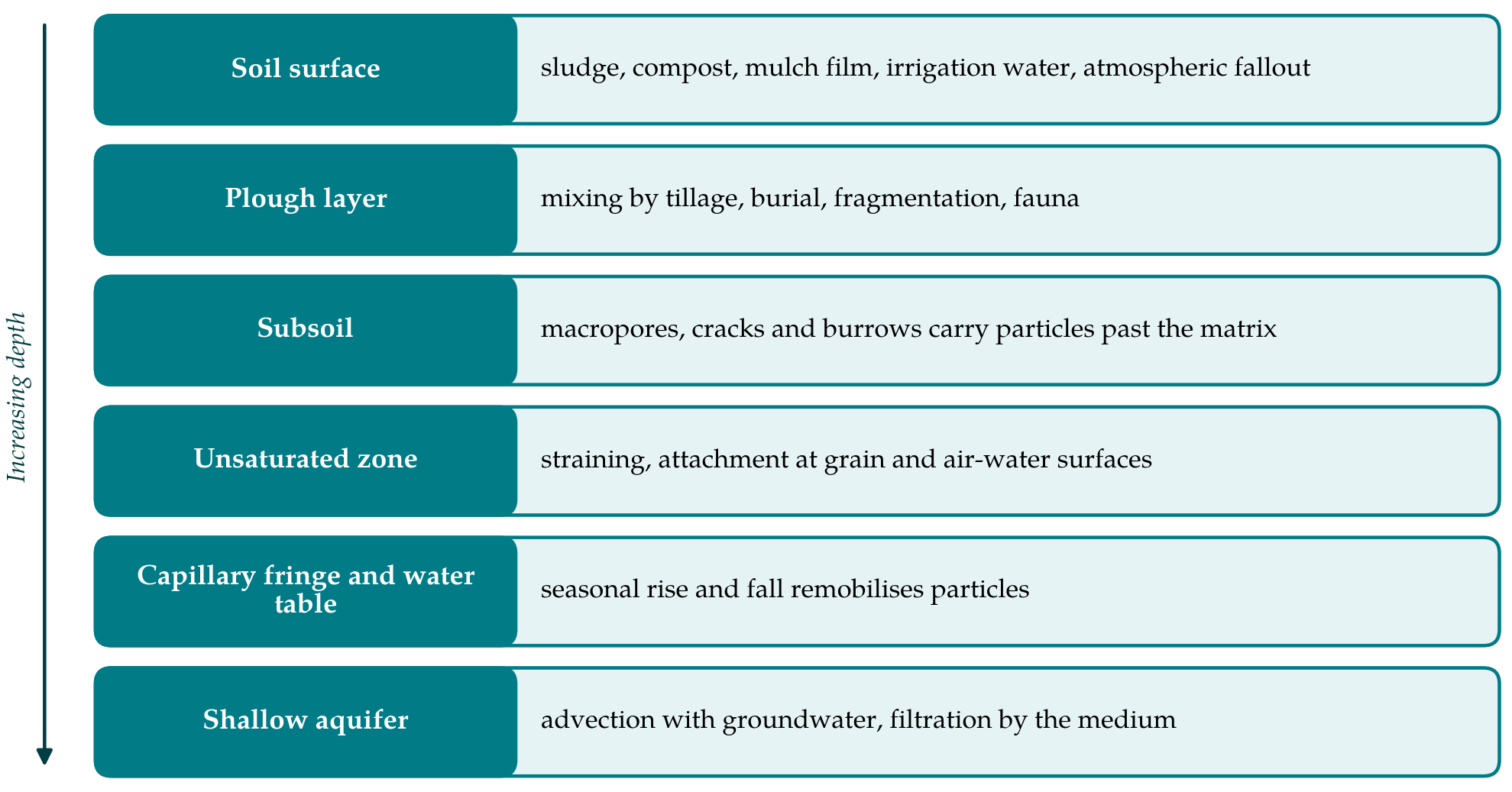
Figure 1 sets the processes in the order a particle meets them on its way down. The upper layers are dominated by mechanical and biological mixing, the middle layers by the contest between bypass flow and retention in the matrix, and the lowest by the fluctuation of the water table, which periodically floods soil that has accumulated particles and may release them.
5. Evidence From Groundwater
Direct measurements in aquifers are scarce. Panno et al. (2019) reported microplastic fibres in springs and wells of karst aquifers together with pharmaceuticals and other markers of wastewater, a setting in which conduits connect the surface to groundwater with almost no filtration. Mintenig et al. (2019) examined raw groundwater and the drinking water produced from it and found very low numbers of small fragments, whose polymer types suggested that abrasion of plastic components in the wells and treatment plant was at least as likely a source as the aquifer. Re (2019) reviewed the hydrogeological reasoning and argued that fibres deserve particular attention because their small diameter allows passage through pores that would retain a fragment of the same length.
These findings fit the theory. Rapidly recharged systems, such as karst, fractured rock and coarse gravels, are those in which particles have been found, and granular aquifers appear to be well protected against all but the finest fraction. The inference must be held loosely, because the number of studies is small and the data are of uneven quality. A critical assessment of studies on microplastics in fresh and drinking water concluded that few met basic criteria for sampling, blank correction and polymer identification (Koelmans et al., 2019).
6. Limits of Current Methods
Measuring microplastics in soil is harder than in water. Particles must be separated from a matrix of mineral grains and organic matter, usually by flotation in a dense salt solution followed by chemical digestion of organic residues, and then identified by infrared or Raman microscopy or by thermal methods such as pyrolysis coupled to gas chromatography and mass spectrometry (Bläsing and Amelung, 2018). Each step loses some particles, and the losses are greatest for the smallest sizes, which are also the most mobile. Spectroscopic identification becomes impractical well above the nanometre range, so the fraction most likely to reach groundwater is the fraction about which least is known.
Contamination is the second difficulty. Groundwater is sampled through plastic well casings, pumps and tubing, and laboratory air carries textile fibres. Without field and procedural blanks a low count cannot be distinguished from background. Studies also report results in different units, counts per volume or mass per mass, over different size ranges, which prevents comparison between sites and makes mass balances between soil and aquifer impossible to close.
7. Gaps and Future Work
The largest gap is the absence of studies that follow particles from surface to water table at a single site. What is needed is a field with a known history of sludge or mulch use, sampled by depth through the unsaturated zone, with the soil structure characterised and the underlying groundwater monitored through wet and dry seasons using plastic-free equipment. Tile-drained fields offer a convenient intermediate step, since drain outflow integrates preferential flow over a known area and can be sampled during storms.
Laboratory work should move from repacked sand to undisturbed soil monoliths, and from pristine spheres to weathered fragments and fibres of the polymers found in fields. Transport models developed for colloids and pathogens can be adapted, but they require attachment and straining parameters for realistic particles. Finally, the role of plastic particles as carriers of sorbed pesticides or metals, by analogy with natural colloids, has been proposed more often than it has been tested in soil.
8. Conclusion
Agricultural soils receive plastic particles in quantity, and several mechanisms move them below the surface. Tillage and soil animals redistribute them within the upper profile. Percolating water can carry them further, but the soil matrix is an effective filter for all except the smallest particles unless structure allows water to bypass it. Shallow groundwater beneath structured or fractured materials is therefore the most exposed, and the limited survey evidence agrees. Present methods cannot quantify the fine fraction that theory identifies as most mobile. Until measurements at field sites connect loading, soil structure and groundwater quality, statements about the scale of the pathway should be made with caution in either direction.
Conflict of interest
To be declared by the author(s) before publication.
Funding
To be declared by the author(s) before publication.