1. Introduction
The ratio of weight to the square of height was described in the nineteenth century by Adolphe Quetelet as a regularity of human build and was given its present name by Keys et al. (1972), who judged it the most convenient of the simple indices of relative weight for population studies while acknowledging that it was not fully satisfactory. The World Health Organization later attached categories to it, with overweight beginning at 25 and obesity at 30 kg/m2 (World Health Organization, 2000). Those categories were chosen from the relation between the index and mortality in large cohorts, a relation that later pooled analyses have refined without overturning (Global BMI Mortality Collaboration, 2016).
A descriptive statistic thus became a diagnosis, and the diagnosis became a gate. Licensed indications for anti-obesity medicines are framed as a body mass index (BMI) of 30 or more, or 27 or more with a weight-related complication. Criteria for metabolic surgery have for decades been written in the same form, and even their recent revision moves the numbers and keeps the structure (Eisenberg et al., 2022). Payers and health systems translate these indications into rules, so that a single measurement taken with a scale and a stadiometer often decides whether care is offered at all.
The argument of this article is that BMI should keep its place as a screening measure and should lose its place as the sole definition of who receives obesity care. The case rests on what the index misses, on who is disadvantaged by it, and on the availability of better ways to decide.
2. What the Index Does Not Measure
Obesity is a condition of excess adiposity that impairs health. BMI measures neither adiposity nor health. It is a measure of mass for height, and mass includes muscle, bone and water. When BMI is compared with body fat measured directly, a value of 30 or more identifies people with high body fat with good specificity but poor sensitivity: a large share of those with excess fat by composition fall below the threshold, the more so among men and older people (Romero-Corral et al., 2008). Loss of muscle with ageing lowers BMI while fat is unchanged or rising, and a muscular young adult may cross the threshold with little fat.
The index is also silent on distribution. Fat stored in the abdomen and within the liver, muscle and pancreas carries more metabolic and cardiovascular risk than fat stored under the skin of the hips and thighs. Waist circumference adds prognostic information at every level of BMI, and an international consensus has called for it to be measured routinely for that reason (Ross et al., 2020). The simple ratio of waist to height performs better than BMI as a screen for cardiometabolic risk factors in pooled analyses, with a boundary value near one half (Ashwell et al., 2012).
Most important for decisions about care, BMI does not say whether a person is unwell. At any given value some people have diabetes, sleep apnoea, osteoarthritis or heart failure and others have none of these. The existence of people with a high BMI and a favourable metabolic profile is well documented, even if the state is often temporary (Stefan et al., 2013). The much-discussed observation that mortality in the overweight category is no higher than in the normal category in some analyses (Flegal et al., 2013) is partly a reflection of this heterogeneity: the category mixes people whose weight is harmless with people whose weight is harmful.
3. Who Is Disadvantaged
Errors in a gatekeeping measure are not evenly distributed. People of South Asian, East Asian and some other ancestries develop type 2 diabetes and cardiovascular disease at lower BMI than people of European ancestry, a fact recognised in the lower action points proposed by a WHO Expert Consultation (2004). A large cohort analysis in England estimated that the risk of diabetes carried by a BMI of 30 in White adults is reached at markedly lower values in South Asian, Black, Chinese and Arab adults (Caleyachetty et al., 2021). Where eligibility rules use a single threshold, people from these groups reach the same level of risk and are told they do not qualify.
Older adults are disadvantaged in a different way, since loss of height and muscle makes the index an unreliable guide to fat. So are people who have already lost weight: a person whose BMI has fallen below a threshold through effort or earlier treatment may lose eligibility for the support that maintains the loss. In the other direction, a rule that offers pharmacotherapy to everyone above a threshold directs scarce and costly treatment to some people with no present illness, while people with complications at a lower BMI wait. A measure that both over-includes and under-includes is a poor basis for allocating care.
4. Alternatives Already Available
The claim that nothing better exists is no longer tenable. Three developments, summarised in Table 1, show how assessment can move beyond a single number.
| Approach | Core idea | Role of BMI | Source |
|---|---|---|---|
| Edmonton Obesity Staging System | Five stages by medical, mental and functional impairment | Entry screen only | Sharma and Kushner, 2009 |
| Complications-centric care | Intensity of treatment follows complications present | Screen, then stage | Garvey et al., 2016 |
| Canadian clinical practice guideline | Obesity as chronic disease defined by health impairment | Not sufficient for diagnosis | Wharton et al., 2020 |
| European framework | Adiposity confirmed by waist-to-height ratio, then staged | Lowered entry point with other criteria | Busetto et al., 2024 |
| Lancet Commission criteria | Clinical versus preclinical obesity by organ dysfunction or limitation | Screen; adiposity to be confirmed | Rubino et al., 2025 |
Clinical staging came first. The Edmonton Obesity Staging System grades people with obesity from stage 0, with no apparent risk factors, symptoms or limitation, to stage 4, with severe disability from end-stage complications (Sharma and Kushner, 2009). Applied to a population-representative cohort, the stage predicted mortality independently of BMI and of metabolic syndrome, whereas BMI within the obese range added little once stage was known (Padwal et al., 2011). The complications-centric model of the American endocrine societies made the same move for treatment planning, tying the intensity of intervention to the complications present (Garvey et al., 2016), and the Canadian guideline defines obesity as a chronic disease in which excess adiposity impairs health and treats BMI as insufficient for diagnosis (Wharton et al., 2020).
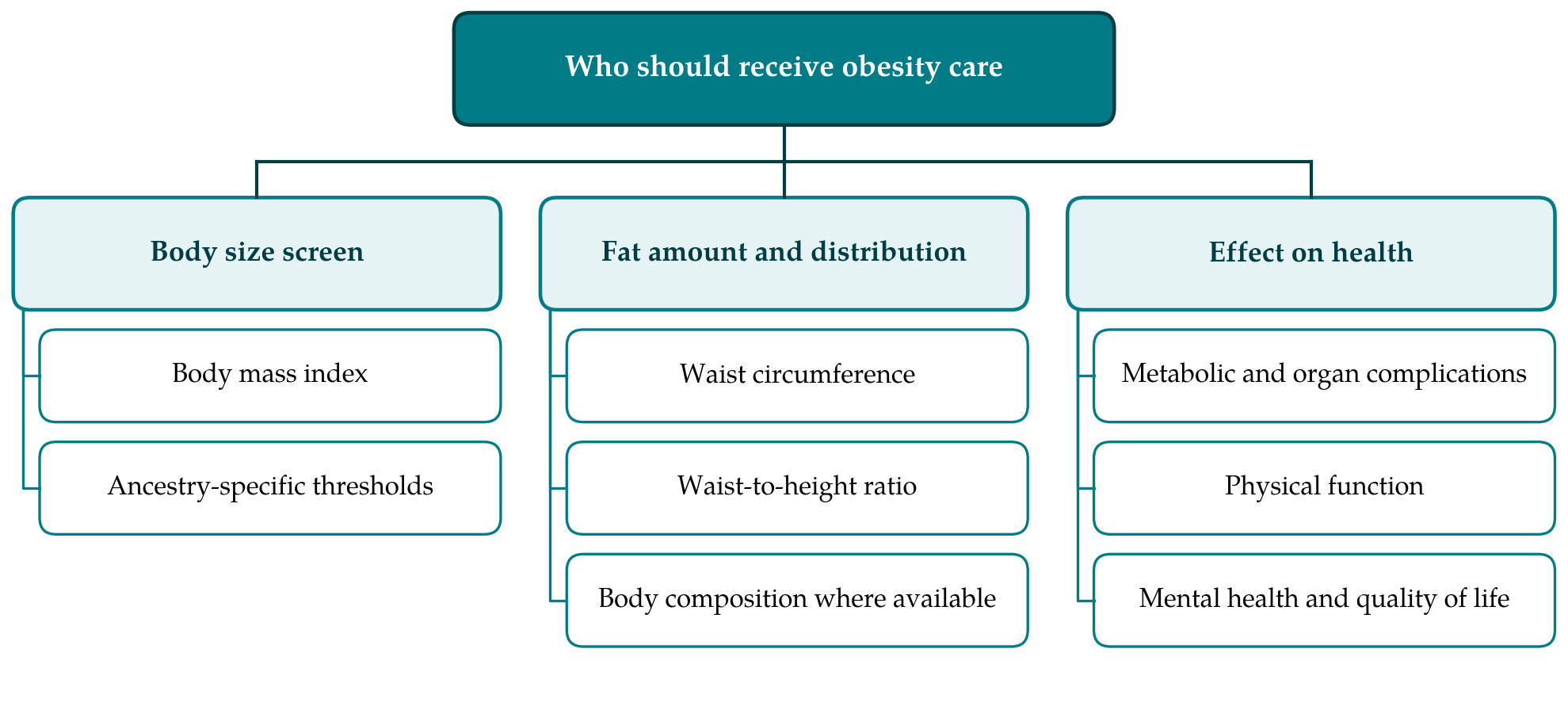
Two recent proposals formalise the diagnosis itself. The framework of the European Association for the Study of Obesity asks for excess adiposity to be supported by a raised waist-to-height ratio and for medical, functional and psychological impairment to be assessed, which brings in people with a BMI between 25 and 30 who have abdominal fat and complications (Busetto et al., 2024). The Lancet Diabetes and Endocrinology Commission goes further. It recommends that BMI be used as a surrogate for screening and population work, that excess adiposity be confirmed by at least one other anthropometric measure or by direct measurement, and that clinical obesity be diagnosed when there are objective signs of organ dysfunction or substantial limitation of daily activities attributable to it; excess adiposity without these is termed preclinical obesity (Rubino et al., 2025). Figure 1 shows how these elements combine into an assessment that begins with BMI and does not end with it.
5. Objections Considered
The first objection is practical. BMI needs a scale and a height rod, and anything more is said to be beyond busy primary care. Yet a tape measure costs less than either, and the remaining elements of staging, blood pressure, glucose and lipid measurement, enquiry about sleep, joints, mood and daily function, are the ordinary content of a consultation about weight. Staging organises information that a careful clinician already gathers. Waist measurement does have poorer reproducibility than weight, and it loses discrimination at very high BMI, which is why the Commission accepts that excess adiposity can be assumed at the upper extreme without confirmation (Rubino et al., 2025).
A second objection is that a numerical threshold is transparent and resists gaming, whereas clinical criteria invite inconsistency and allow payers to narrow access by demanding proof of complications. The concern about payers is serious. If the preclinical category were used to deny preventive care to people at high risk, the reform would do harm. The answer is to specify, as the newer frameworks attempt to, that people without current complications but with high risk remain eligible for risk-reducing care, and to keep a BMI route open at the upper extreme where the index is reliable.
The third objection is evidential: the trials that established the benefits of modern treatments enrolled by BMI, so the evidence applies to BMI-defined groups. This is true and it argues for new trials, since those same trials cannot show that a person with abdominal obesity, diabetes and a BMI of 28 benefits less than a person at 31 with no complications. Regulatory precedent already accepts a lower threshold when complications are present, which concedes the principle.
A final objection deserves respect. Some fear that moving from a neutral number to an assessment of illness will increase stigma, or will medicalise large bodies that are healthy. The opposite seems at least as likely. Weight stigma is widespread in health care and is itself harmful (Puhl and Heuer, 2010), and it is sustained by the habit of reading health from size. A definition that separates body size from disease gives formal standing to the person with a high BMI who is well, and to the person with a lower BMI who is not.
6. Implications
For clinicians, the change is modest: measure the waist, look for complications and functional limitation, record a stage, and let that record guide the offer of treatment. For guideline writers and regulators, eligibility statements should name confirmed excess adiposity with defined health consequences or high risk as the indication, with BMI thresholds, adjusted for ancestry, retained as one route and not the only one. For payers, criteria built on staging allow resources to be directed first to those with most to gain, which a flat threshold cannot do. For researchers, trials should enrol and report by stage and by measures of fat distribution as well as BMI, so that future evidence matches the way care ought to be allocated. Health records will need fields for waist circumference and stage, a small change with large effects on what can be audited.
7. Conclusion
BMI earned its position through simplicity, and simplicity is why it should stay as the first step. It was never designed to decide who is ill, and used alone it decides badly: it overlooks fat that the scale does not register, treats unlike bodies alike, sets the bar higher for some ancestries than their risk warrants, and ignores whether health is affected. Staging systems and the newer diagnostic frameworks offer practical ways to do better, and their weaknesses are reasons to refine them. Access to obesity care should follow from an assessment of adiposity and its consequences, with body mass index as one piece of evidence among several.
Conflict of interest
To be declared by the author(s) before publication.
Funding
To be declared by the author(s) before publication.