1. Introduction
Complications of preterm birth are the leading cause of death in the neonatal period, and the burden falls most heavily on South Asia and sub-Saharan Africa (Blencowe et al., 2012; Lawn et al., 2014). Many of the interventions that protect small infants in wealthy countries, such as surfactant, mechanical ventilation and intensive care nursing, are expensive and depend on equipment and staff that district hospitals do not have. Kangaroo mother care is unusual in being a treatment of proven benefit whose principal component is the mother herself.
The method was introduced in Bogotá in the late 1970s as a response to overcrowded nurseries and a shortage of incubators, and early accounts from visiting clinicians brought it to wider attention (Whitelaw and Sleath, 1985). As later codified, it consists of early, continuous and prolonged skin-to-skin contact between the infant and the mother or another caregiver, exclusive breastfeeding where possible, and early discharge with close follow-up (WHO, 2003). For most of its history it was offered only to infants who had already been stabilised in an incubator or under a radiant warmer. This review concerns the more recent proposal that it should begin at birth.
2. Approach of This Review
The article is a narrative review of the published literature. It relies on the randomised trials of kangaroo mother care and of its early or immediate initiation, on published systematic reviews of effectiveness and of barriers to uptake, and on guidance from the World Health Organization. It does not report a new search or pooled analysis, and effect sizes are left to the sources cited. The first part summarises what is known about effectiveness, the second considers mechanisms, and the third examines barriers to scale using the health system as the frame of reference.
3. Evidence After Stabilisation
The first large randomised trial, conducted in Bogotá, compared kangaroo care with traditional incubator care in infants of 2000 g or less once they had adapted to extrauterine life, and found it to be at least as safe, with benefits for breastfeeding and hospital stay (Charpak et al., 1997). Follow-up of the same cohort two decades later reported lasting social and behavioural advantages in the kangaroo group (Charpak et al., 2017). Pooled analyses have since established the effect on survival. Lawn et al. (2010) estimated a substantial reduction in neonatal deaths among infants below 2000 g when kangaroo care was started in the first week. The Cochrane review by Conde-Agudelo and Díaz-Rossello (2016) found lower mortality, less severe infection and hypothermia, and better weight gain and breastfeeding, and a broader meta-analysis that included observational studies reached consistent conclusions (Boundy et al., 2016).
A large community trial in Haryana, India, extended the evidence beyond hospital walls. Infants of low birth weight who were stable at home were randomised to community-initiated kangaroo care supported by trained workers or to usual care, and survival through infancy was better in the intervention group (Mazumder et al., 2019). By the end of the last decade the question was no longer whether kangaroo care works in stable infants but why so few eligible infants receive it, and whether the unstable infant, who has most to gain, should be included.
4. Evidence for Early and Immediate Initiation
Small trials had hinted that waiting for stability was unnecessary. In Cape Town, Bergman et al. (2004) randomised infants of 1200 to 2199 g to skin-to-skin contact from birth or to a conventional incubator and found that cardiorespiratory stabilisation in the first hours was better on the mother's chest. In Addis Ababa, Worku and Kassie (2005) started kangaroo care within hours of birth, before stabilisation, and reported better survival than with conventional care, although the trial was small. In term and late preterm infants the benefits of early skin-to-skin contact for breastfeeding and physiological stability were already well documented (Moore et al., 2016).
The decisive study was the immediate kangaroo mother care trial coordinated by the World Health Organization in tertiary hospitals in Ghana, India, Malawi, Nigeria and Tanzania (WHO Immediate KMC Study Group, 2021). Infants with a birth weight of 1.0 to 1.799 kg were randomised either to continuous skin-to-skin contact begun immediately after birth and continued in a specially adapted mother-newborn intensive care unit, or to conventional care in an incubator or warmer with kangaroo care started once the infant was stable. Infants in the intervention group received many more hours of skin-to-skin contact per day during their stay in intensive care. Mortality in the first 28 days was lower in the intervention group, and the trial was stopped early on the advice of its monitoring board because of this finding. Suspected sepsis and hypothermia were also less frequent. Because the comparison group also received kangaroo care, only later, the trial isolates the effect of timing and of keeping mother and infant together during the first days, when the risk of death is highest.
Two African trials of initiation before stabilisation give a more cautious picture. In The Gambia, a single-site trial of early kangaroo care in mildly to moderately unstable infants below 2000 g did not show a difference in mortality at 28 days; the authors noted that survival in the control arm improved markedly during the study period and that the trial was consequently underpowered (Brotherton et al., 2021). In Uganda, the OMWaNA trial across five hospitals likewise did not demonstrate a significant reduction in early mortality with kangaroo care started before stabilisation (Tumukunde et al., 2024). Neither trial contradicts the WHO result, but together they suggest that the benefit depends on how early contact begins, how many hours are achieved and what else the unit can offer. A recent meta-analysis that combined trials of early and late initiation supports starting within the first day (Sivanandan and Sankar, 2023).
On this evidence the World Health Organization revised its guidance in 2022. Kangaroo mother care is now recommended as routine care for all preterm or low-birth-weight infants, to be started as soon as possible after birth, with an aim of at least eight hours a day and for as many hours as possible, and initiation before stabilisation is recommended unless the infant cannot breathe spontaneously after resuscitation or is in shock or needs mechanical ventilation (WHO, 2022).
5. Possible Mechanisms
Several pathways may account for the survival benefit, and none has been isolated in a trial. Thermal protection is the most direct: the newborn of low birth weight loses heat rapidly, and the mother's chest is an effective and self-regulating heat source. Skin-to-skin contact is associated with more stable heart rate, respiration and oxygenation in the hours after birth (Bergman et al., 2004). Early and frequent access to the breast promotes the intake of colostrum and the establishment of exclusive breastfeeding (Moore et al., 2016). Colonisation of the infant with maternal flora, in place of organisms resident in the nursery, and reduced handling by multiple staff may explain the lower rate of sepsis observed in the WHO trial. Finally, a mother who is present around the clock functions as a continuous observer of her infant, and may notice apnoea, colour change or poor feeding sooner than an overstretched nurse responsible for many cots. These explanations are not mutually exclusive, and their relative weight is likely to differ between a unit with reliable warmers and monitors and one without.
6. Barriers to Scale
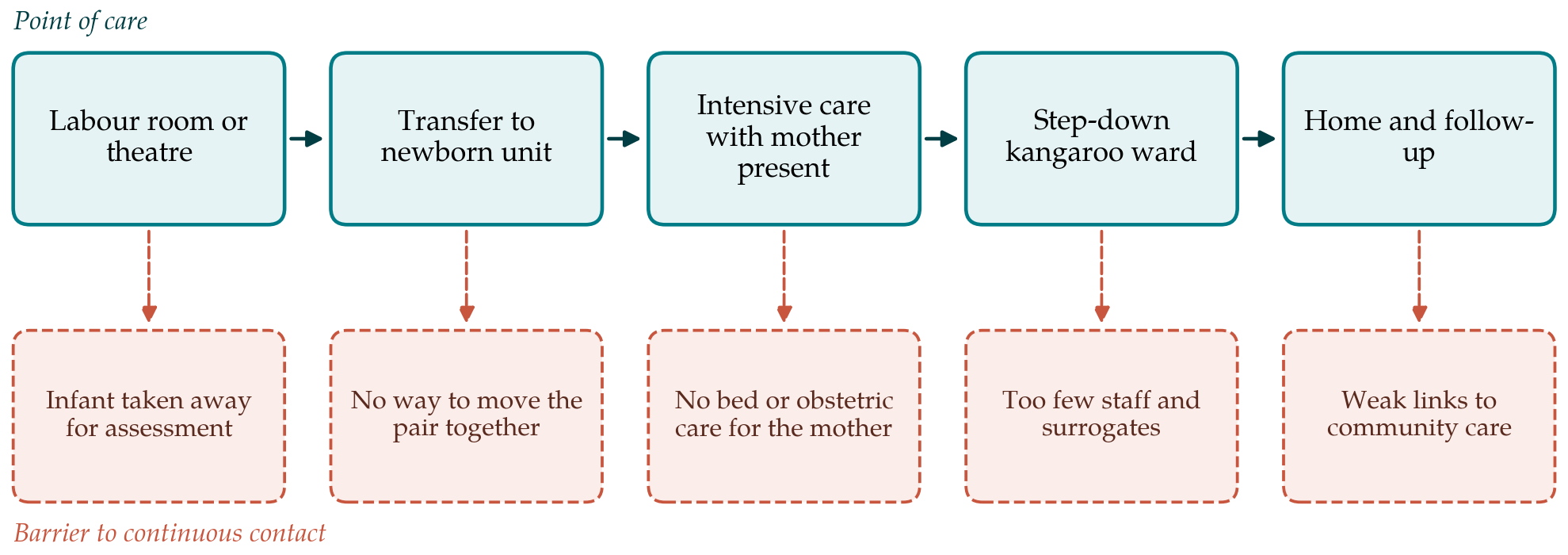
Coverage of conventional kangaroo care has remained low in most countries despite two decades of endorsement, a gap that prompted an international call for acceleration (Engmann et al., 2013). Systematic reviews have catalogued the obstacles from the viewpoint of mothers, families and health workers (Seidman et al., 2015; Chan et al., 2016), and a multi-country analysis of health system bottlenecks identified financing, leadership, workforce and community ownership as the weakest building blocks (Vesel et al., 2015). Immediate initiation inherits all of these difficulties and adds its own. Table 1 groups them by level, and Figure 1 sets them against the path that a mother and infant follow from birth to home.
| Level | Barrier | Response described | Sources |
|---|---|---|---|
| Facility design | Newborn units separate from maternity; no space for mothers | Mother-newborn intensive care units with adult beds beside cots | WHO Immediate KMC Study Group, 2021 |
| Maternal care | Mother recovering from caesarean section or complications | Obstetric review within the newborn unit; surrogate caregivers | WHO, 2022 |
| Workforce | Staff shortages, rotation and limited training | Dedicated staff, mentoring and supportive supervision | Vesel et al., 2015 |
| Health workers | Belief that unstable infants are safer in an incubator | Local champions, shared audit data, joint obstetric and neonatal protocols | Chan et al., 2016 |
| Family and community | Fatigue, pain, household duties, norms against exposure | Family participation, privacy, food and facilities for mothers | Seidman et al., 2015 |
| Policy and data | No indicator for hours of contact; unclear financing | Kangaroo care indicators in routine information systems | WHO and UNICEF, 2019 |
6.1. Keeping mother and infant together
The intervention tested in the WHO trial was not simply earlier skin-to-skin contact. It was a reorganisation of intensive care so that the mother, or a surrogate, could stay beside her infant continuously, with adult beds, reclining chairs, toilets, meals and obstetric review provided inside the newborn unit (WHO Immediate KMC Study Group, 2021). Most hospitals separate maternity and neonatal services by building, by management and by budget. The infant is carried to the newborn unit while the mother remains on the labour ward or in theatre recovery, and she may not see her child for hours or days. Achieving zero separation therefore requires capital works, or at least a determined rearrangement of existing space, and agreement between departments that seldom share protocols. The transfer itself is a weak point. Where the newborn unit is on another floor or in another building, the pair must be moved together, with the infant on the chest of the mother or a surrogate, and few hospitals have a trolley, a route or a member of staff assigned to that task.
6.2. The mother as patient
Women who deliver small infants are themselves more likely to have had a caesarean section, pre-eclampsia, haemorrhage or infection. Immediate kangaroo care asks a woman in the first hours after birth to hold her infant against her chest for most of the day and night. The guideline acknowledges that another family member may substitute when the mother is unable (WHO, 2022), and surrogates were used in the trial, but this depends on relatives being present, being permitted to enter the unit and being willing. Obstetric and midwifery staff must be prepared to deliver postnatal care in the newborn unit, which changes their place and pattern of work.
6.3. Staff, beliefs and measurement
Health workers commonly regard an incubator as the safer place for an infant who is on oxygen or continuous positive airway pressure, and worry about dislodged cannulae, missed deterioration and infection carried by visitors (Chan et al., 2016). These concerns are reasonable and are answered by training, by securing devices for the kangaroo position and by monitoring that continues during contact. Nursing ratios are a harder constraint. Supporting a mother to position, feed and observe her infant takes time in the first days, even if it saves time later. Measurement is a further gap: routine information systems seldom record whether kangaroo care was started, when, or for how many hours, so managers cannot see coverage or quality. Global guidance on care for small and sick newborns has called for such indicators and for family-centred design of newborn units (WHO and UNICEF, 2019).
7. Gaps and Future Work
The immediate kangaroo care trial excluded infants below 1.0 kg and those unable to breathe spontaneously in the first hour, so the recommendation does not rest on direct evidence for the smallest and sickest. Whether skin-to-skin contact is safe and beneficial during invasive ventilation, and how to provide it, are open questions being addressed mainly in high-income units. The trial was conducted in tertiary hospitals with research staff; effectiveness in district hospitals with fewer nurses and no capacity for respiratory support beyond oxygen is not known. The contrasting results from The Gambia and Uganda indicate that context matters and that the dose of contact achieved should be reported in every evaluation.
Economic evidence is also incomplete. Adapting a unit costs money at the outset, while savings from shorter stays, fewer infections and less use of incubators accrue later and to different budgets. Implementation research is needed on models that district hospitals can afford, on the experience of mothers asked to provide near-continuous care while recovering from birth, and on the role of fathers and other relatives. Long-term developmental follow-up of infants who received immediate kangaroo care has yet to be published in full. Finally, most evaluations report whether kangaroo care was offered and not how it was experienced. Studies that record interruptions, their causes and the hours of contact actually achieved in routine services would show managers where the pathway breaks.
8. Conclusion
Kangaroo mother care started immediately after birth saves lives among infants of 1.0 to 1.8 kg, and global guidance has changed accordingly. The evidence is strongest where the intervention was delivered as designed, with the mother resident in an adapted intensive care unit and many hours of contact each day. That design is the source of both the benefit and the difficulty. Scaling it up is less a matter of persuading mothers than of rebuilding the places and routines that separate them from their infants, and of counting the hours of contact that hospitals actually provide.
Conflict of interest
To be declared by the author(s) before publication.
Funding
To be declared by the author(s) before publication.