1. Introduction
Cheddar is a dry-salted cheese. Salt is mixed into the milled curd before pressing, and the concentration that matters for ripening is the ratio of salt to the water in which it is dissolved, usually written S/M. Good-quality Cheddar has traditionally been made with a salt-in-moisture level of roughly four to six per cent, and cheese graders learned long ago that cheese falling below that band ripens quickly, turns acid and often becomes bitter (Guinee and Fox, 2004; Fox et al., 2017).
The reason for wanting less salt is nutritional. The World Health Organization recommends that adults consume less than two grams of sodium a day, equivalent to five grams of salt (WHO, 2012), and cheese is one of the foods that reformulation programmes target. Reviews of sodium reduction in cheese agree that the technical obstacles are greater than in most foods because salt is a process control as well as a flavouring (Johnson et al., 2009; Cruz et al., 2011).
One proposed remedy is microbiological. Mesophilic lactobacilli dominate the secondary flora of Cheddar whether or not the cheesemaker wants them, and selected strains can be added deliberately as adjunct cultures to shape flavour. If a reduced-sodium cheese suffers from an excess of bitter peptides, an adjunct with strong peptidase activity might remove them. This review asks how far the published evidence supports that idea, taking proteolysis as the thread that connects salt, enzymes, bacteria and flavour.
2. Scope and Approach
This is a narrative review of the published literature. It draws on the standard texts of cheese science, on reviews of proteolysis and of non-starter lactic acid bacteria, and on primary studies of Cheddar made with reduced or partly replaced sodium chloride. No formal search protocol was applied and no pooled estimates are offered. The aim is to set out the mechanisms that are well established, to show where the experimental record is consistent and to mark where it is thin. Cheddar is the reference variety throughout; other cheeses are mentioned only where they clarify a mechanism.
A note on names is needed. The genus Lactobacillus was divided in 2020, and the species most often used as Cheddar adjuncts are now placed in Lacticaseibacillus (L. casei, L. paracasei, L. rhamnosus), Lactiplantibacillus (L. plantarum) and Latilactobacillus (L. curvatus) (Zheng et al., 2020). The older literature uses the former names, and the collective term "lactobacilli" is kept here for convenience.
3. Proteolysis in Cheddar and Its Dependence on Salt
Proteolysis is the most complex of the biochemical events of ripening and the one most closely tied to texture and flavour in Cheddar (McSweeney, 2004). It is convenient to separate primary proteolysis, in which intact caseins are cut into large and intermediate peptides, from secondary proteolysis, in which those peptides are reduced to small peptides and free amino acids, and from the catabolism of amino acids to volatile compounds (Upadhyay et al., 2004). Each stage has its own agents, and salt affects each differently. Table 1 summarises the agents and the direction in which lower salt-in-moisture is expected to move them.
| Agent | Main action during ripening | Expected effect of lower S/M | Key sources |
|---|---|---|---|
| Residual chymosin | Cleaves α -casein early; s1 cleaves β-casein slowly | β-casein hydrolysis increases; more bitter C-terminal peptide | Kelly et al., 1996 |
| Plasmin | Converts β-casein to γ-caseins and proteose peptones | Small change within the Cheddar range | Fox et al., 2017 |
| Starter proteinase | Degrades chymosin-derived peptides to smaller ones | More starter cells and more activity | Upadhyay et al., 2004 |
| Starter peptidases | Release amino acids after cell lysis | Depends on strain and extent of lysis | Christensen et al., 1999 |
| Non-starter and adjunct lactobacilli | Peptidase action and amino acid catabolism | Faster growth to high numbers | Beresford et al., 2001 |
| Lactose fermentation (indirect) | Sets final pH and hence enzyme activity | Lower pH; more residual acid | Thomas and Pearce, 1981 |
3.1. Coagulant and plasmin
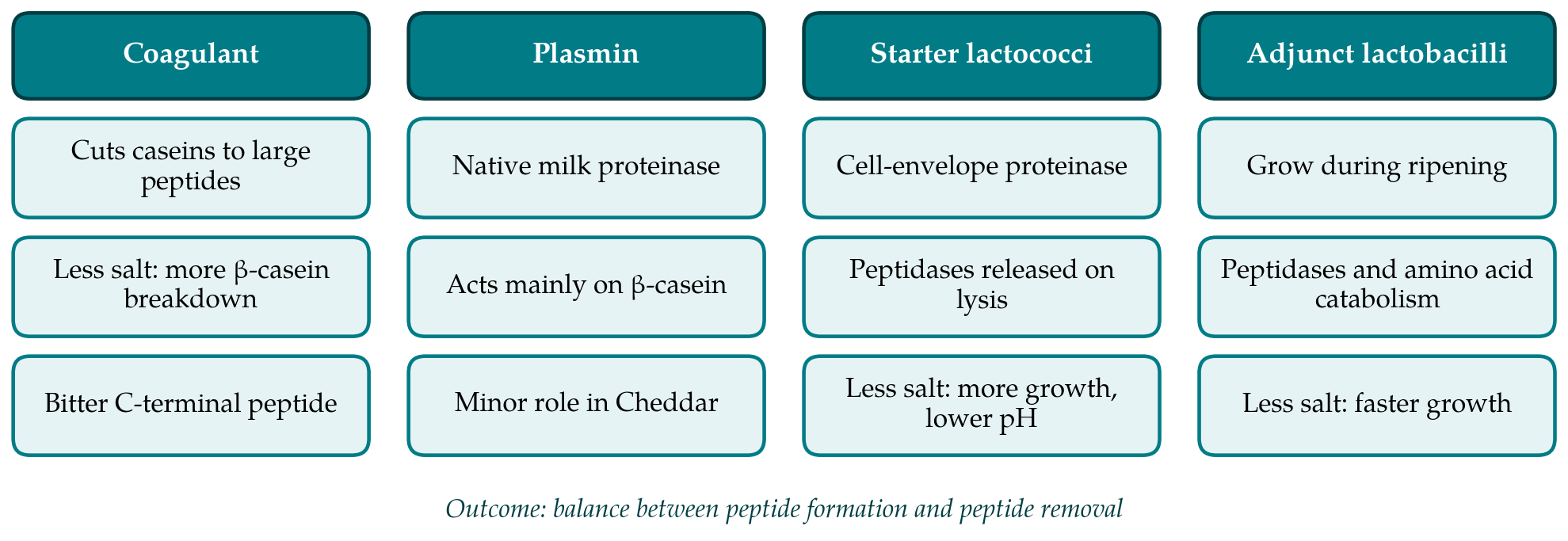
A small part of the chymosin added to the vat stays in the curd and is the main agent of primary proteolysis in Cheddar. Its first target is the Phe23-Phe24 bond of αs1-casein, whose cleavage softens the young cheese. β-Casein is attacked far more slowly because salt promotes hydrophobic association of its C-terminal region and hides the susceptible bonds. When salt-in-moisture falls, that protection is lost. Kelly et al. (1996) showed in Cheddar-type cheese that hydrolysis of β-casein rose as salt-in-moisture declined, and the fragment released from the C-terminus, β-casein f193-209, is a well-known bitter peptide (Sousa et al., 2001). Plasmin, the native alkaline proteinase of milk, also acts on β-casein, but its contribution in a low-cook, acid cheese such as Cheddar is modest and is not thought to change much across the range of salt levels used in reformulation (Fox et al., 2017).
3.2. Starter enzymes and the indirect effect through pH
The cell-envelope proteinase of Lactococcus lactis cuts the peptides released by chymosin into shorter ones, and intracellular peptidases released when starter cells lyse carry the process on to amino acids (Christensen et al., 1999). Salt bears on this in two ways. Directly, it slows starter growth, so a curd salted lightly carries more starter cells and more enzyme. Indirectly, it determines how much lactose is fermented after salting. Thomas and Pearce (1981) established that Cheddar with low salt-in-moisture ferments its residual lactose rapidly and reaches a lower pH, and a lower pH favours retention and activity of chymosin. Whether the intermediate peptides so formed accumulate as bitterness depends on the proteinase specificity of the starter strain as well as on salt (Broadbent et al., 1998).
4. What Reduced-Sodium Cheddar Shows in Practice
Experimental cheeses confirm the textbook account. An early study by Schroeder et al. (1988) made Cheddar across a range of salt contents and reported that the low-salt cheeses showed more proteolysis, softer body and less acceptable flavour. More recent trials with full-fat cheese, covering salt levels from well below to above the commercial norm, again found that reducing sodium chloride raised indices of proteolysis and lowered pH, with bitterness and a loss of firmness as the sensory consequences (Rulikowska et al., 2013).
A difficulty in reading these studies is that salt and moisture move together. Salt draws whey out of the curd, so a cheese made with less salt is normally wetter, and extra moisture alone accelerates ripening. Møller et al. (2013) addressed the confound by adjusting manufacture so that cheeses of different salt content had equal moisture. Salt-dependent differences in casein breakdown and in sensory character remained, which indicates that the effect of salt on proteolysis is not simply an effect of water content.
Replacement is the usual alternative to plain reduction. Potassium chloride is the commonest substitute because it restores ionic strength and water activity. Cheddar-style cheeses in which part of the sodium chloride was replaced by potassium chloride have been reported to stay closer to the control in composition and ripening than cheeses that were simply salted less, with bitter and metallic notes becoming the limit as the proportion of replacer rises (Grummer et al., 2012). A comparison of sodium, potassium, magnesium and calcium salts in full-fat Cheddar found that the cation matters for pH, proteolysis and microbial populations during storage, and that the divalent cations were the least satisfactory substitutes (McMahon et al., 2014).
Bitterness deserves separate comment because it is the defect that adjunct cultures are most often proposed to cure. It arises when hydrophobic peptides of low molecular mass are formed faster than peptidases can remove them (Lemieux and Simard, 1991). Low salt tilts the balance towards formation in the ways already described. The remedy must therefore either slow formation, which is what salt replacers attempt, or speed removal, which is what a peptidolytic adjunct might do.
5. Adjunct Lactobacilli and Secondary Proteolysis
Non-starter lactic acid bacteria are present in Cheddar curd at low numbers after pressing and grow during the first weeks and months of ripening to become the dominant living population, while the starter declines (Beresford et al., 2001). The flora is mostly facultatively heterofermentative lactobacilli. Because it is adventitious it varies from plant to plant and vat to vat, and the case for adding a chosen strain as an adjunct is partly a case for replacing an uncontrolled population with a known one (Gobbetti et al., 2015).
What these bacteria do to proteolysis was clarified by experiments in which Cheddar was made under controlled microbiological conditions, so that cheeses with and without adjunct lactobacilli could be compared against an almost non-starter-free control. Lynch et al. (1996) found little difference in primary proteolysis but higher concentrations of free amino acids in the cheeses containing adjuncts. Lane and Fox (1996) likewise attributed to lactobacilli a contribution at the level of small peptides and amino acids and not at the level of casein hydrolysis, and a later comparison of Lactobacillus paracasei and Lactobacillus plantarum adjuncts showed that the outcome for flavour differs between species (Lynch et al., 1999). The pattern is consistent with the enzymology: lactobacilli are weakly proteolytic but well supplied with peptidases, including general aminopeptidases and proline-specific enzymes able to act on the proline-rich fragments of β-casein (Christensen et al., 1999).
Beyond peptide hydrolysis, lactobacilli convert amino acids into aroma compounds. Transamination is the first step for the branched-chain, aromatic and sulphur amino acids, and it depends on a supply of an α-keto acid acceptor (Yvon and Rijnen, 2001). Strains differ widely in these activities, which is one reason why reviews of adjunct use describe benefits and drawbacks side by side: fuller and faster flavour development in some trials, and gas, slits, crystals or atypical flavours in others (Gobbetti et al., 2015).
6. Combining Reduced Sodium With Adjunct Lactobacilli
Putting the two bodies of evidence together gives a clear expectation and an equally clear uncertainty. Figure 1 sets the four groups of agents side by side with the response of each to lower salt. The expectation is that a reduced-sodium Cheddar offers an adjunct both more substrate, because primary proteolysis is faster, and a more permissive environment, because lactobacilli are among the more salt-tolerant members of the cheese flora and still grow faster when salt-in-moisture is lower. A peptidolytic strain should then shift nitrogen from the bitter peptide fraction into free amino acids.
The uncertainty is whether that shift is large enough, and whether it comes at an acceptable cost. The controlled studies of adjuncts cited above were made at normal salt levels, where the supply of bitter peptides is limited. The salt-reduction studies in turn rarely controlled or characterised the non-starter flora, although some followed starter and non-starter counts and noted differences between salt treatments (Rulikowska et al., 2013; McMahon et al., 2014). Few published trials cross salt level with a defined adjunct in a factorial design, and fewer still do so under conditions that exclude adventitious lactobacilli. The claim that adjuncts correct the proteolytic faults of reduced-sodium Cheddar is therefore a reasonable inference from mechanism and not yet a demonstrated result.
There are also reasons for caution that follow from the same mechanisms. A lower-salt cheese has a lower pH and less protection against unwanted growth, so the faults associated with lactobacilli are more likely, not less. Faster amino acid catabolism can produce unclean or over-ripe notes in a cheese that is already ripening too quickly. And an adjunct does nothing about the soft, pasty body that follows from extensive hydrolysis of αs1-casein and higher moisture, which sensory panels penalise alongside bitterness (Johnson et al., 2009).
7. Measuring Proteolysis: What Studies Need to Report
Comparison across studies is hampered by differences in what is measured. Nitrogen soluble in water or at pH 4.6 is the usual index of primary proteolysis, and the extraction procedure affects the value obtained (Sousa et al., 2001). Nitrogen soluble in trichloroacetic or phosphotungstic acid, and total free amino acids, index secondary proteolysis. None of these bulk fractions distinguishes a bitter peptide from a bland one. Urea-polyacrylamide gel electrophoresis of the caseins and reversed-phase chromatography of the soluble peptides are needed to show which bonds have been cut and whether hydrophobic peptides are accumulating (Upadhyay et al., 2004).
A study able to answer the question posed in this review would report all three levels, would hold moisture constant or measure it and analyse accordingly, would state salt-in-moisture and pH at several ripening times, and would enumerate starter and non-starter populations separately. It would also name the adjunct strain and say what is known of its peptidase and transaminase activities. Sensory analysis by a trained panel using defined descriptors for bitterness, acid and body is the necessary endpoint, since chemical indices of proteolysis predict flavour only loosely.
8. Gaps and Future Work
Three gaps stand out. The first is the factorial evidence just described: salt level, salt replacer and adjunct strain varied together under microbiologically controlled manufacture. The second is strain selection. Screening adjuncts for activity against specific bitter peptides, such as the C-terminal fragment of β-casein, under the pH and ionic conditions of a low-salt cheese would give a more rational basis for choice than general measures of peptidase activity in buffer. The third is the interaction with the starter. Since starter proteinase specificity influences which peptides accumulate (Broadbent et al., 1998), an adjunct that works with one starter may be unnecessary or insufficient with another.
Safety and shelf life also belong on the agenda. Salt is one of the hurdles that restrain pathogens and spoilage organisms in cheese, and a reformulation that changes water activity and pH needs to be assessed for its microbiological consequences as well as for flavour (Guinee and Fox, 2004).
9. Conclusion
The effect of salt on proteolysis in Cheddar is well understood. Lower salt-in-moisture releases β-casein to attack by chymosin, allows more starter growth and more acid, and favours the build-up of hydrophobic peptides; the experimental cheeses of several groups show the predicted faster ripening, softer body and bitterness. Adjunct lactobacilli act later in the sequence, converting peptides to amino acids and amino acids to flavour compounds, and on mechanistic grounds a suitable strain could relieve bitterness in a reduced-sodium cheese. The literature does not yet show that it reliably does, nor at what risk of other defects. Partial replacement of sodium by potassium remains the better documented route, and adjunct cultures are best regarded as a complement to it that still needs direct, well-controlled testing.
Conflict of interest
To be declared by the author(s) before publication.
Funding
To be declared by the author(s) before publication.