1. Introduction
When the Governor of the Bank of England spoke in 2015 of a tragedy of the horizon, he was describing a mismatch of time. The costs of climate change fall beyond the planning periods of firms, the mandates of regulators and the tenor of most financial contracts, so that those able to act have little reason to do so until it is late (Carney, 2015). The speech distinguished physical, transition and liability risks, and that classification was soon adopted in the disclosure recommendations of the Task Force on Climate-related Financial Disclosures (TCFD, 2017) and in the first report of the central banks and supervisors that formed the Network for Greening the Financial System (NGFS, 2019).
Supervisors responded with the tool they knew best. Stress testing had been the centrepiece of bank supervision since the financial crisis, and it seemed natural to extend it to a new source of loss. The Dutch central bank published a transition stress test in 2018, and the authorities in France, the United Kingdom, the euro area and other jurisdictions followed with exercises of their own. For a commercial bank, the practical consequence is that the loan book must now be examined against paths for carbon prices, energy demand and extreme weather that extend for decades.
This article reviews what has been learned. Its subject is credit risk in lending, as distinct from the market risk of traded securities, because loans are held to maturity, are seldom marked to market and are extended to many borrowers about whom public information is poor. The review asks how climate-related drivers are supposed to reach loan losses, how supervisory exercises model that passage, whether there is evidence that the risks are real and priced, and what the limits of the present frameworks are.
2. Approach of the Review
The article is a narrative review of the published literature. It draws on academic research in climate finance, on the methodological papers and results published by central banks and supervisors, and on the documents of the Basel Committee on Banking Supervision. No formal search protocol was used, and the selection reflects a judgement about which sources have shaped practice. Supervisory exercises are discussed for their design and not for the particular loss figures they reported, since those figures depend on scenario and modelling choices that differ from one authority to the next and cannot be compared directly.
3. How Climate Drivers Reach the Loan Book
The Basel Committee treats climate change as a driver of the existing categories of financial risk and not as a category of its own (BCBS, 2021a). For lending, the relevant category is credit risk, and the drivers act through the borrower's ability to pay and through the value of what the bank can recover.
3.1. Physical risk
Physical risk is divided into acute hazards, such as floods, storms and wildfires, and chronic changes, such as rising sea levels and higher average temperatures. An acute event damages property that secures a loan and interrupts the income from which the loan is serviced. Chronic change erodes both more slowly. Coastal housing exposed to rising seas has been found to sell at a discount to comparable property that is not exposed (Bernstein et al., 2019), which matters to a mortgage lender because the term of the loan may exceed the period over which the collateral holds its value. At the level of the whole economy, output responds to temperature in a non-linear way (Burke et al., 2015). Insurance stands between the hazard and the lender, and its withdrawal or repricing in exposed areas is itself a channel of credit risk.
3.2. Transition risk
Transition risk arises from the policies, technologies and preferences that accompany a move away from fossil fuels. If warming is to be limited to 2 °C, a large part of known coal, oil and gas reserves cannot be burned (McGlade and Ekins, 2015), and the assets built to extract and use them lose value. A carbon price raises the costs of emitting firms and reduces their margins in proportion to their emissions and their inability to pass costs on. For a lender, the effects appear as a higher probability of default among borrowers in exposed sectors and as lower recovery where the security is a stranded plant or an inefficient building. Battiston et al. (2017) showed that exposure is larger than direct lending to fossil fuel producers suggests, because banks also hold claims on other financial institutions that carry the same exposures.
4. How Supervisory Exercises Are Built
Most exercises share a common chain, shown in Figure 1 together with the principal weakness at each link. The starting point is a set of scenarios. The reference scenarios of the NGFS are grouped into orderly transitions, disorderly transitions in which policy is late or abrupt, and a hot house world in which policy fails and physical damage grows (NGFS, 2020). They are produced by integrated assessment models, which give paths for emissions, energy use and carbon prices, and are then passed through macroeconomic models to obtain output, inflation and interest rates.
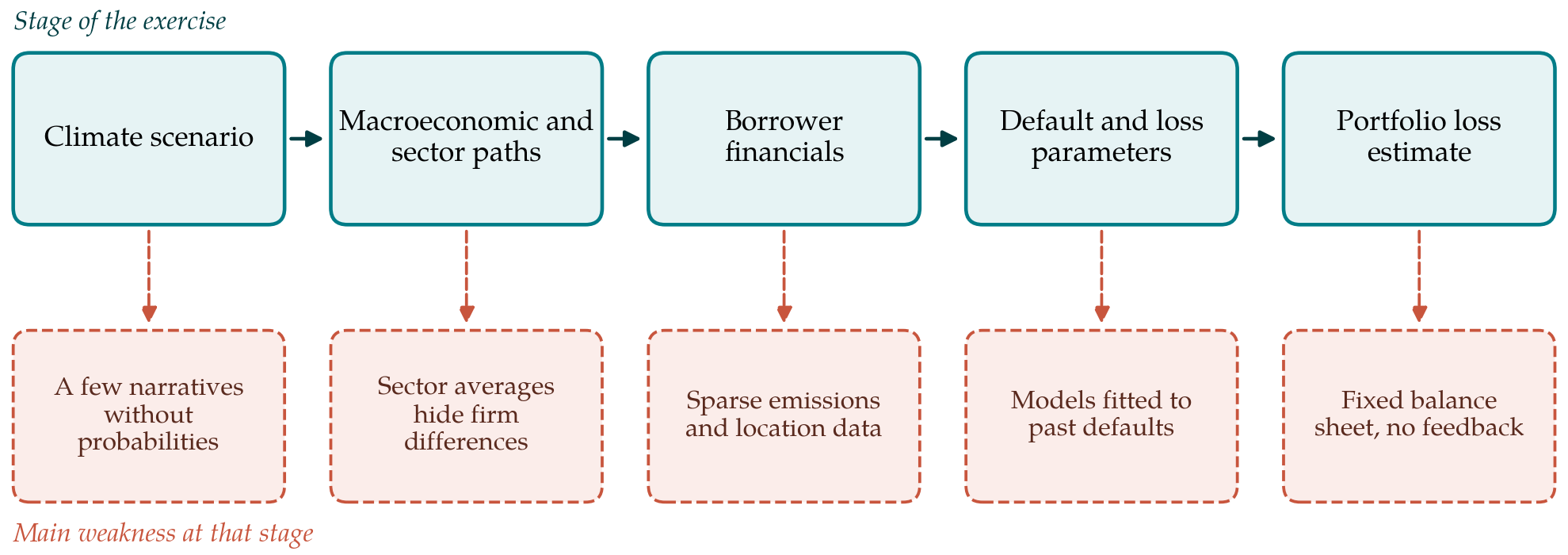
The aggregate paths have to be broken down by sector, since a transition that reduces national income only slightly may still remove most of the revenue of coal mining. The Dutch exercise did this with transition vulnerability factors based on the embodied emissions of each industry (Vermeulen et al., 2018). The euro area economy-wide test went further and matched banks' exposures to individual firms, assigning each firm a physical risk score from its location and a transition burden from its emissions (Alogoskoufis et al., 2021). The final step translates projected firm financials into probability of default and loss given default and applies them to exposures.
Exercises differ in who performs the last step. In a top-down design the authority applies its own models to data it already holds; in a bottom-up design the banks run the scenarios through their internal models. The Bank of England's exploratory scenario of 2021 and the European Central Bank's supervisory test of 2022 were of the second kind, and both were presented as learning exercises with no direct consequence for capital requirements (Bank of England, 2022; European Central Bank, 2022). The survey by Acharya et al. (2023) compares the approaches and notes how much rests on choices made at the scenario stage. The Basel Committee's review of measurement methods reached a similar view and described the state of practice as early (BCBS, 2021b).
5. Evidence That the Risks Are Priced
If lenders and investors already allowed fully for climate-related risk, stress tests would add little. The evidence is that pricing has begun and is incomplete. Institutional investors report that they regard climate risks as financially material, particularly those arising from regulation, and that they believe equity valuations do not yet reflect them in full (Krueger et al., 2020). Shares of firms with higher carbon emissions have earned higher returns, which is consistent with investors demanding compensation for transition risk (Bolton and Kacperczyk, 2021). The survey of the field by Giglio et al. (2021) concludes that the pricing of physical risk in particular is uneven across asset classes.
The evidence for bank loans is thinner than for traded securities, for a plain reason: loan terms are private and loans are not revalued. Much of what is known about lending therefore comes from syndicated loans to large firms, which are the borrowers with the best disclosure and the easiest access to other finance. The small and medium-sized firms and households that make up most of a typical loan book are those for which evidence is least available, and they are also the borrowers for which stress tests have the weakest data.
6. Limits of Current Frameworks
The exercises conducted so far have been candid about their shortcomings. Table 1 summarises the design features that recur across them and the limit each imposes. Six deserve discussion.
| Design feature | Common practice | Limit for credit risk assessment |
|---|---|---|
| Time horizon | Paths of up to thirty years | Far longer than loan maturities and planning periods |
| Balance sheet | Held fixed, or changed by stated rules | Ignores lender response; long-run losses hard to interpret |
| Scenarios | A small set of reference narratives | No probabilities; compound and abrupt events left out |
| Granularity | Sector-level shocks applied to borrowers | Hides differences between firms in the same sector |
| Borrower data | Estimated emissions; proxies for location | Weakest for small firms, which dominate many loan books |
| Credit models | Parameters estimated on past defaults | History contains no comparable climate episode |
| System effects | First-round losses only | Omits fire sales, insurance retreat and credit contraction |
6.1. Horizon and the fixed balance sheet
A scenario that runs to the middle of the century asks what would happen to a portfolio that will have been repaid and replaced several times before the scenario ends. Exercises resolve this either by holding the balance sheet fixed, so that the bank is assumed to go on lending to the same sectors in the same proportions, or by allowing banks to state how they would adjust. The first choice produces losses that no management would in fact accept. The second depends on assumptions that cannot be checked and that every bank makes in its own favour, since all cannot leave the same sectors at the same price. Neither yields a figure that can be set against today's capital. Short-horizon scenarios, in which a disorderly transition or a severe flood arrives within a few years, are closer to conventional stress testing and were added to several exercises for that reason.
6.2. Scenarios without probabilities
Conventional stress tests use scenarios that are severe but plausible by reference to history. Climate scenarios have no such anchor. They are narratives chosen to span a range, and nothing is said about their likelihood. The damage functions inside integrated assessment models have been criticised as close to arbitrary (Pindyck, 2013), and Weitzman (2009) argued that the uncertainty about catastrophic outcomes is deep enough to dominate any calculation of expected cost. The reference scenarios, by contrast, mostly describe smooth paths. Events that would do the most damage to a loan book, such as several hazards in one region in one year or a sudden reversal of policy, sit outside them. This is the sense in which Bolton et al. (2020) describe climate risks as green swans to which backward-looking risk models are poorly suited.
6.3. Data and granularity
Transition risk depends on a borrower's emissions and its ability to reduce them; physical risk depends on where its assets and suppliers are. Banks hold neither kind of information for most borrowers. Emissions are reported by large listed companies and estimated for the rest from sector averages, and the accounting standard developed for financed emissions grades such estimates by quality for exactly that reason (PCAF, 2020). An estimate built from a sector average cannot distinguish the efficient firm from the laggard, although that difference is what determines which of them defaults. Location data are often limited to a registered address. For commercial property and mortgages the energy rating and flood exposure of the building are needed, and coverage of both is incomplete in most jurisdictions.
6.4. Credit models and second-round effects
The models that turn financial ratios into probabilities of default were estimated on past recessions. Applying them to a structural change in relative prices assumes that the relation between a firm's margins and its survival will be the same when the cause is a carbon price as when it is a fall in demand. The assumption may hold, but it has not been tested, because the history contains no comparable episode. The same difficulty affects the forward-looking loan loss provisions that accounting standards now require, which are meant to reflect expected losses over the life of a loan.
Finally, the exercises are largely partial. They measure the first-round effect of a scenario on each bank and add the results. They leave out the feedback that made earlier crises severe: the sale of devalued assets by many holders at once, the withdrawal of insurers from exposed regions, and the contraction of credit by weakened banks, which deepens the downturn that caused the losses. Campiglio et al. (2018) set out these interactions as a central difficulty for financial regulators, and they remain largely outside current practice.
7. From Exploratory Exercises to Risk Management
Given these limits, the results of climate stress tests are best read as conditional illustrations and not as estimates of loss. Their value so far has been indirect. They have obliged banks to collect data on emissions, energy ratings and locations, to form a view on which sectors and regions concentrate their exposure, and to involve boards in the question. The Basel Committee's principles reflect this emphasis: they ask banks to build climate-related risks into governance, internal capital assessment and scenario analysis, without prescribing a capital charge (BCBS, 2022).
Whether capital requirements should follow is disputed. One position holds that capital must rest on measurable risk and that the present measurements do not qualify. The other, set out by Chenet et al. (2021), holds that under radical uncertainty the absence of reliable measurement is a reason for precaution and not for waiting. The dispute is about how policy should act when a risk is real and its distribution is unknown, and better models alone will not settle it.
8. Gaps and Future Work
Several lines of work would narrow the gap between what exercises report and what a lender needs. Short-horizon scenarios with explicit severity, including compound physical events and abrupt policy change, would connect climate analysis to ordinary capital planning. Borrower-level data on emissions, transition plans and asset locations, collected at origination and held in a common format, would allow differentiation within sectors. Studies of how defaults and recoveries have responded to past regional disasters and to sharp changes in energy prices would give credit models something to be tested against. And models of the financial system that include insurers, funds and banks together are needed to gauge second-round effects. Smaller banks with regional concentrations, which have mostly been outside the published exercises, deserve particular study.
9. Conclusion
Climate stress testing has moved quickly from proposal to routine, and it has changed how banks and supervisors look at loan books. The frameworks in use nonetheless inherit the structure of tests designed for cyclical shocks and apply it to a problem that is long-dated, structural and deeply uncertain. Long horizons combined with fixed balance sheets, scenarios without probabilities, sectoral averages in place of borrower data, credit models fitted to the past and the neglect of feedback all limit what the results can bear. Used as a discipline for gathering data and identifying concentrations, the exercises are valuable. Used as measures of loss, they are not yet reliable, and that distinction should govern how their results are reported and applied.
Conflict of interest
To be declared by the author(s) before publication.
Funding
To be declared by the author(s) before publication.